
India is known for its long list of challenging competitive exams. But if you pause for a moment and really think about it, which one truly earns the title of the most toughest exam in India? It’s a question that often leads to debate. Some say it’s the UPSC Civil Services, others point to JEE or CLAT. And honestly, each has its own level of intensity, requiring months, sometimes years, of preparation.
Still, regarding overall difficulty, the UPSC Civil Services Examination, often referred to as the IAS exam, is widely seen as the toughest exam in India. The reasons aren’t hard to see: it covers an incredibly broad range of subjects, takes place in three demanding stages, and selects only a tiny fraction of the lakhs who apply. This exam, conducted by the Union Public Service Commission, opens the door to roles like IAS, IPS, and IFS, which carry respect and responsibility.
In this article, we’ll also take a closer look at other top-tier exams like IIT JEE, CA, NEET, AIIMS, GATE, NDA, CLAT, UGC-NET, and IES, all of which challenge candidates in different ways, testing not just what they know, but how well they handle pressure and stay consistent over time.
India hosts some of the most challenging examinations globally, recognized for their extensive syllabi, fierce competition, and stringent assessment methods. These tests evaluate students’ knowledge, skills, and commitment in diverse areas such as civil services, engineering, medicine, law, and management. The level of competition is intense, demanding thorough preparation and unwavering determination to achieve success.
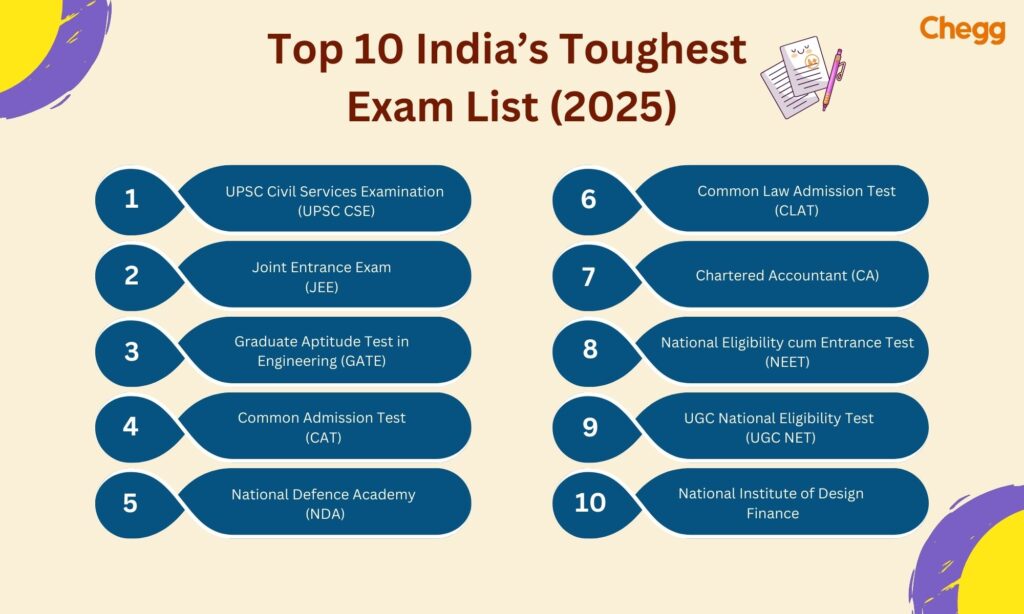
Let’s explore the details of India’s top 10 toughest exam in india and what makes them difficult.
The toughest exam in India is UPSC CSE, held annually by the Union Public Service Commission for recruiting candidates into civil services such as IAS, IPS, IFS, IRS, and associated roles. The eligibility to appear for UPSC is a recognized university graduation. It is known as the hardest exam in India.
The exam comprises three stages: preliminary, main written, and personality tests. Prelims contain two multiple-choice papers, while mains have nine descriptive papers. Merit is based on main and personality test scores, testing consistency and problem-solving skills, emphasizing current events and book knowledge. Despite many yearly applicants, the selection rate is under 1%.
| Candidates appeared | 10 lakh (approx.) |
| Selection rate | 0.1 to 0.3% |
| Level of exam | National |
| Frequency of exam | Annual |
| Mode of exam | Offline |
| Duration of exam | Prelims – 2 hours each for both papers Mains – 3 hours each for 9 papers |
| Purpose of exam | Recruitment for the posts of IAS, IPS, IFS, and central services as per the rules of the Department of Personnel & Training |
The National Testing Agency (NTA) administers the national JEE exam, attracting numerous students annually. It is known as the hardest exam in India after UPSC. It consists of two papers: Paper 1 for B.E/B. Tech and Paper 2 for B.Arch/B.Planning courses.
There are two levels: JEE Main for NITs, IITs, and other government institutes, and JEE Advanced for IITs, IISc, and RGIPT, with questions from physics, chemistry, and math.
The number of JEE Advanced questions varies yearly, making it one of India’s toughest exams, fostering intense competition among candidates for top rankings and IIT admissions.
| Candidates appeared | 6 lakh approx. |
| Selection rate | 25 – 30% |
| Level of exam | National |
| Frequency of exam | Twice in a year |
| Mode of exam | To get admission to engineering colleges |
| Duration of exam | 3 hours |
| Purpose of exam | To get admission in engineering colleges |

The Graduate Aptitude Test in Engineering (GATE) committee conducts the GATE exam, an all-India exam, in eight regions nationwide. The committee has diverse members from the National Coordinating Board and Department of Higher Education, the Ministry of Human Resource Development, and IISc.
Public Sector Undertakings (PSUs) will use the final GATE score. PSU recruits students for jobs like Indian oil, GAIL and Hindustan Petroleum.
The exam pattern will be based on multiple-choice questions, multiple-select questions, or numerical answer types. There will be 2 sections – General aptitude and candidate’s selected section.
| Candidates appeared | 7 lakh approx. |
| Selection rate | 17% |
| Level of exam | National |
| Frequency of exam | Once a year |
| Mode of exam | Online |
| Duration of exam | 3 hours |
| Purpose of exam | To test student knowledge in Engineering and Science and for recruitment in companies like GAIL |
Recommended read: 7 Proven GATE Preparation Tips for a Winning Score
The CAT is a national-level exam. IIM conducts it on a rotational basis. It is a computer-based test for admission to the Master in Business Administration (MBA). A student with a 50% aggregate score in a Bachelor’s degree can apply for the exam, and the aggregate score is 45% for reserved categories.
The paper has 3 sections: quantitative aptitude, logical reasoning and data interpretation, verbal ability, and reading comprehension. The questions will be in the form of multiple-choice and non-multiple-choice questions.
This year, 66 questions are expected to be asked. CAT scores will be determined based on the scaling and normalization process, as the exam is conducted in multiple shifts.
| Candidates appeared | 2.30 lakh approx. |
| Selection rate | 2% |
| Level of exam | National |
| Frequency of exam | Annual |
| Mode of exam | Online |
| Duration of exam | 2 hours |
| Purpose of exam | Pursuing MBA courses in business schools |
The Union Public Service Commission (UPSC) has the authority to conduct the NDA exam, India’s toughest exam for the defence line. The selected candidates will get a chance to enter the Army, Navy and Air Force wings of the NDA.
The exam is conducted twice a year. The Supreme Court recently gave a verdict in 2021 and allowed women to sit for the NDA exam. It lies in the list of top 5 toughest exam in India.
The exam pattern will be based on a written test and a Service Selection Board (SSB) interview. The written test will include questions from the mathematics and general ability sections. The general ability test syllabus contains topics from English and general awareness. The mathematics paper will be 300 marks, and the general ability test will have 600 questions. After being selected in this exam, the candidates will be able to serve the nation.
| Candidates appeared | 3 lakh approx. |
| Selection rate | 0.1% |
| Level of exam | National |
| Frequency of exam | Twice a year |
| Mode of exam | Offline |
| Duration of exam | 2.5 hours each for both papers |
| Purpose of exam | To serve in the Army, Navy and Air Force wings of the NDA |
Recommended read: NDA Previous Year Papers – PDF Download
The Consortium of National Law Universities administers the annual CLAT exam for undergraduate and postgraduate law program admission at 24 national law universities in India.
The exam features 150 questions across five sections, which include the following segments
1. Logical reasoning
2. Legal aptitude
3. English,
4. General Knowledge
5. Maths
Conducted through offline mode, where qualifying candidates can pursue careers in law, judiciary, higher education, and civil services. A minimum cut-off mark is necessary, with no maximum age limit for candidates.
| Candidates appeared | 60,000 approx. |
| Selection rate | 3% approx. |
| Level of exam | National |
| Frequency of exam | Twice in a year |
| Mode of exam | Offline |
| Duration of exam | 2 hours |
| Purpose of exam | For admission to undergraduate and postgraduate law colleges |
One of India’s toughest exam is the Chartered Accountant exam. The Institute of Chartered Accountants of India (ICAI) has been conducting the CA exam since the beginning. The degree is equivalent to a postgraduate degree at Delhi University (DU). The candidates need to clear 3 levels – foundation, intermediate and final. It is held twice a year.
The foundation course will be based on multiple-choice questions, but the other stages will include multiple-choice and descriptive questions.
The foundation exam has 4 papers, and the intermediate and final exam has two groups with 4 papers each. This exam is one of the toughest exam in India and demands more study time and hard work. The candidates must clear all the stages to fulfil their dream of becoming a chartered accountant.
| Candidates appeared | 93,729 approx. |
| Selection rate | 25% |
| Level of exam | National |
| Frequency of exam | Twice a year |
| Mode of exam | Online computer based |
| Duration of exam | 3 hours for the final exam |
| Purpose of exam | Candidates who will qualify will become certified chartered accountants |
The National Testing Agency conducts the NEET exam. It is the toughest exam in India for the medical field. Every year, it is conducted for admission to various undergraduate courses like Bachelor of Medicine, Bachelor of Surgery (MBBS), Bachelor of Dental Surgery (BDS), AYUSH, and veterinary courses. The questions revolve around Chemistry, Physics, Zoology, and Botany.
The total mark is 720 for this exam. The competition and cut-off are both increasing at a fast pace. It is a single-stage exam. There is no defined maximum age limit, but the minimum age should be above or equal to 17 years.
| Candidates appeared | 18 lakh approx. |
| Selection rate | 6.5 – 7% |
| Level of exam | National |
| Frequency of exam | Annual |
| Mode of exam | Offline |
| Duration of exam | 3 hours |
| Purpose of exam | For admission to undergraduate courses like Bachelor of Medicine, Bachelor of Surgery (MBBS), Bachelor of Dental Surgery (BDS), AYUSH, and veterinary courses. |
Recommended read: Toughest Competitive Exams after 10th in India
The National Testing Agency (NTA) is responsible for conducting the UGC NET exam for the University Grants Commission (UGC). The exam is conducted twice a year to become assistant professors or seek junior research fellowships.
The required eligibility is that aspiring candidates must have 55% marks in their Master’s degree. The exam has two papers, both of which are conducted online.
The common paper includes questions about teaching and research aptitude, general awareness, reasoning ability, and reading comprehension. Paper 2 is subject-specific. To qualify for the paper, candidates need to get 40% marks. The reserved candidates should get 35% as the minimum mark.
| Candidates appeared | 5 lakh approx. |
| Selection rate | 9% approx. |
| Level of exam | National |
| Frequency of exam | Twice a year |
| Mode of exam | Getting eligibility for the post of assistant professor and junior research fellowship award in Indian universities and colleges. |
| Duration of exam | 3 hours |
| Purpose of exam | Getting eligibility for the posts of assistant professor and junior research fellowship award in Indian universities and colleges. |
The NID Design Aptitude Test (DAT) is conducted at the national level by the National Institute of Design. The candidates take the NID DAT exam for admission into undergraduate and postgraduate courses.
There will be two stages – NID DAT prelims and NID DAT mains. Both of these stages must be qualifying in nature. The candidates should have attained 19 years before applying for the exam. The merit list will be prepared based on the scores obtained in the prelims and mains. The NID conducts counselling in 2 stages.
| Candidates appeared | 15000 |
| Selection rate | 14% |
| Level of exam | National |
| Frequency of exam | Annual |
| Mode of exam | Offline |
| Duration of exam | 3 hours |
| Purpose of exam | Admission for undergraduate and postgraduate design programs |
Recommend read: World’s Most Toughest Exams: Complete List
Understanding the challenges of the toughest exam in India, such as the UPSC Civil Services Exam, can significantly improve preparation. Here’s how recognizing its difficulty can help:
Knowing that the toughest exam in India requires extensive preparation helps students create focused study plans. For a challenging exam like UPSC, allocating more time to complex topics is essential, while easier subjects can be reviewed more quickly.
Understanding the toughness of the exam aids in effective time management. Students can allocate more study hours to difficult subjects, preventing last-minute cramming and reducing stress levels.
Familiarity with the expectations of the toughest exam in India can enhance confidence. A solid preparation plan and realistic goals help minimize anxiety, leading to improved performance.
Identifying which areas of the UPSC syllabus are more challenging allows students to concentrate on improving their weaknesses, ensuring a comprehensive preparation for the toughest exam in India.
Taking mock tests that reflect the difficulties of the toughest exam in India is crucial. These practice exams help students get accustomed to the format and build the endurance needed for the actual test.
Understanding the challenges of the toughest exam in India sets achievable goals. This approach keeps students motivated and helps avoid burnout, allowing them to celebrate small victories along the way.
By grasping the challenges posed by the toughest exams in India, students can tailor their preparation effectively and approach their studies with confidence. For more insights on the UPSC Civil Services Exam, visit: UPSC Civil Services Exam Information.
The Criteria for the Toughest Exams in India are as follows:
“The more students take the exam, the harder it gets.” For the toughest exams like NEET, millions of students fight for a limited number of medical seats. Just one or two extra marks can shift your rank by hundreds, making competition super intense.
“Is it hard to pass?” Some of the toughest exams in India, such as the CA Exam, have very low passing rates. That means even with good preparation, staying consistent and giving it your all in every attempt is essential.
“How long should I prepare?” The toughest exams, like JEE Advanced, can take 1-2 years of dedicated preparation, involving coaching classes, mock tests, and practice papers. Some other exams need less time, but planning your studies and staying consistent is the key to success.
| Exam Name | Applicants (Approx.) | Selection Rate | Mode | Frequency | Purpose / Career Path |
|---|---|---|---|---|---|
| UPSC Civil Services (IAS) | 11.35 lakh | 0.07% | Offline | Annual | Recruitment for IAS, IPS, IFS, IRS, other central services |
| JEE (Main & Advanced) | 6 lakh | 25–30% (Mains); <2% (Advanced) | Online | Twice a year | Recruitment for IAS, IPS, IFS, IRS, and other central services |
| GATE | 7 lakh | ~17% | Online | Annual | Higher studies & PSU recruitment (IOCL, GAIL, HPCL, etc.) |
| CAT | 2.3 lakh | ~2% | Online | Annual | Admission to IIMs & top B-schools (MBA/PGDM) |
| NDA | 3 lakh | 0.1% | Offline | Twice a year | Entry into Army, Navy & Air Force (Defence services) |
| CLAT | 60,000 | ~3% | Offline | Annual | Admission to NLUs, law programs (UG/PG) |
| CA (Chartered Accountant) | 93,729 | ~25% (final <5%) | Offline & Online | Twice a year | Professional qualification for Chartered Accountancy |
| NEET | 18 lakh | 6.5–7% | Offline | Annual | Admission to MBBS, BDS, AYUSH, veterinary courses |
| UGC NET | 5 lakh | ~9% | Online | Twice a year | Eligibility for Assistant Professor & JRF |
| NID Entrance (DAT) | 15,000 | ~14% | Offline | Annual | Admission to UG & PG Design programs |
In short, India’s toughest exams challenge students with huge syllabuses, deep conceptual questions, and intense competition, but staying focused, consistent, and managing stress is the key to success.
Setting out on a quest to pass India’s most difficult competitive exams calls for unwavering commitment, a successful study plan, a comprehensive curriculum comprehension, and frequent practice with mock exams. The ability to think critically, solve problems, and perform well under pressure is necessary for success on these tests, which require more than just academic knowledge.
India is home to many tough exams, and while JEE is often seen as the hardest, every exam on our list, from UPSC CSE to NID, requires serious preparation and dedication.
To succeed, students need hard work, smart planning, reliable study resources, regular practice, time management, consistent revision, expert guidance, staying informed, and mental and physical health care. Each exam tests different abilities, making them challenging but achievable with the right mindset and strategy.
Evaluate numerous career choices to choose the right career path for yourself. Dive into our guide on Career Advice.
Read more:
UGC NET Dec 2025: Dates, Apply Online, June Result & Cut Off
UPSC CSE 2025: Notification, Vacancy, Eligibility & Dates
The toughest exam board in India is considered to be the Indian Institutes of Technology (IIT) Joint Entrance Examination (JEE).
Cracking the IIT JEE demands years of focused preparation, making it the benchmark for academic toughness in India.
Tip: Build a strong foundation in Physics, Chemistry, and Mathematics early on, as conceptual clarity is key to succeeding in the IIT JEE.
The Gaokao exam in China is the toughest in the world. The candidates are tested for critical thinking ability through this exam. It is an entrance examination for all higher educational institutions in China. The future of many children depends on this exam. Sometimes, it becomes difficult for the appearing candidates to tackle these exams.
Tip: Prioritize consistent practice and mental well-being, as both academic strength and emotional resilience are crucial for handling the pressure of Gaokao.
The top five toughest exams in the world are the Gaokao exam in China, the Joint Entrance Examination (JEE) in India, the UPSC Civil Services examination (UPSC CSE), the Graduate Aptitude Test in Engineering (GATE) exam, and the Graduate Record Examination (GRE) of the USA. These exams test candidates’ knowledge and thinking abilities.
3 toughest exams in the world:
1. Gaokao (China): A 9-hour university entrance exam; tests memory, logic, and stress handling with millions competing.
2. UPSC Civil Services (India): Year-long, 3-stage exam covering vast subjects with a 0.1% selection rate.
3. CFA (Chartered Financial Analyst): Three levels, low pass rates, requires 900+ hours of study, tests advanced finance expertise.
Tip: Master core concepts, attempt timed mocks, and build mental endurance for success.
The RRB Group D Exam is often considered the easiest exam in India. It requires basic eligibility (10th pass) and tests candidates on general awareness, reasoning, and mathematics. With proper planning and consistent practice, clearing it is achievable.
India’s top competitive exam is the UPSC Civil Services Examination (CSE), recruiting for elite positions in the IAS, IPS, and IFS. It features three stages: Preliminary, Main, and Interview, making it one of the toughest exams in the country. Its extensive syllabus and intense competition make it highly sought after by aspirants aiming for public service careers.
The top exam in India is the Indian Administrative Service (IAS) exam, conducted by the Union Public Service Commission (UPSC).
UPSC is generally considered harder than IIT JEE due to its vast syllabus, long duration, and low success rate. While IIT JEE is technically challenging, UPSC demands greater mental endurance and broader knowledge.