
Need to move to a new branch, department, or city for your job? Writing a clear and professional transfer letter is the first step to making the transition smooth in today’s changing workplace. Whether you want a transfer for personal reasons, career growth, or company needs, a well-written transfer letter shows your professionalism, honesty, and respect for company rules. In 2025, with remote work and internal movement increasing, knowing the right format and tone for transfer letters is more important than ever.
This guide provides everything you need to know about writing an effective transfer letter, covering structure, key details, sample templates, and practical tips. Whether you’re an employee, HR professional, or manager, you’ll find useful insights to help you communicate your request clearly, maintain positive relationships, and advance your career with confidence.
What is a Transfer Letter?
A transfer letter is a formal document issued by an organization to inform an employee about their shift to a new location, department, or role. It clearly states the reason for the transfer, new responsibilities, and the effective date. This letter ensures proper communication between the employer and employee.
Types of Transfer Letters
1. Transfer Request Letter
A transfer request letter is written by an employee or student seeking a change in location, department, or institution. It usually includes valid reasons for the transfer—such as health issues, family relocation, or career growth—and is submitted to the HR department or school administration.
Example:
An employee requesting relocation to a different city branch due to a spouse’s job change.
2. Employee Transfer Letter
This is an official transfer letter issued by the company’s HR or management, informing an employee about their approved transfer. It includes details like the new department, location, effective date, and reporting manager. It is typically used in internal company transfers.
Example:
A company transferring a team leader from the marketing division in Delhi to the same role in Mumbai.
3. School/College Transfer Certificate Letter
A transfer certificate letter is issued by educational institutions when a student applies to move to another school or college. It certifies that the student has officially left the current institution and provides details like academic performance, attendance, and conduct.
Example:
A parent requesting a transfer certificate letter for their child who is moving to a different city.
4. Interdepartmental Transfer Letter
This letter is used when an employee is being moved to a different department within the same organization. It may be due to skillset realignment, promotions, or departmental restructuring.
Example:
A software engineer being transferred from the Development team to the Quality Assurance team.
5. Transfer of Ownership/Asset Letter
While not related to individuals, this type of transfer letter is used to record the movement of company-owned assets or ownership between departments or personnel.
Example:
Transferring ownership of a company vehicle or laptop from one employee to another.
Steps to Write a Transfer Letter
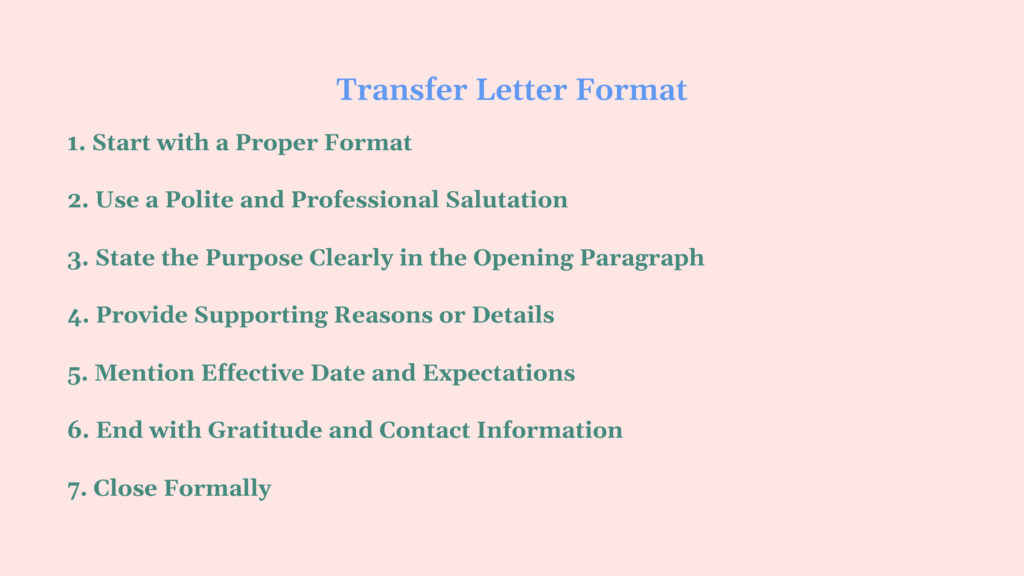
1. Start with a Proper Format
Use a formal business letter format with:
- Sender’s address (if it’s a request)
- Date
- Recipient’s name, designation, and address
- Subject line (clear and concise)
Example:
Subject: Request for Transfer to [Department/Branch Name]
2. Use a Polite and Professional Salutation
Address the letter to the concerned authority (e.g., Manager, HR, Principal).
Example:
Dear Sir/Madam,
Respected Principal,
3. State the Purpose Clearly in the Opening Paragraph
Mention your intention upfront—whether you are requesting a transfer or issuing one.
Examples:
- “I am writing this transfer request letter to formally seek a transfer from the Delhi branch to the Mumbai branch.”
- “This is to inform you that you have been transferred to the Accounts Department, effective from…”
4. Provide Supporting Reasons or Details
Clearly explain the reason for the transfer (personal, medical, family, organizational needs, academic progression, etc.), and attach any necessary documents.
Examples:
- “Due to my spouse’s relocation, I am seeking a transfer to be closer to family.”
- “As part of the inter-departmental restructuring, you are being transferred to the Sales Division.”
5. Mention Effective Date and Expectations
State the expected or assigned date of transfer and any follow-up actions (joining formalities, document submissions, etc.).
Example:
“The transfer will take effect from 1st August 2025. Please report to your new supervisor on that date.”
6. End with Gratitude and Contact Information
Be polite, express appreciation, and offer to provide any further information if required.
Examples:
- “I hope for your kind consideration of my transfer request letter and look forward to a positive response.”
- “Should you need any clarification, feel free to contact me at [email/phone number].”
7. Close Formally
Use a respectful closing like:
- Yours sincerely,
- Yours faithfully,
- Regards,
Followed by your full name, designation (if applicable), and signature.

Examples of Transfer Letter: Transfer Request Letter Sample
Here are 10 examples of transfer letters covering various purposes, including transfer request letters, official transfer letters, and transfer certificate letters. Each example is brief, clear, and can be adapted for use in schools, colleges, and workplaces.
1. Employee Transfer Request Letter (Location-Based)
Subject: Request for Transfer to Pune Office
Dear Sir/Madam,
I am writing to request a transfer from the Mumbai office to the Pune office due to my family’s recent relocation. I have been working as a Marketing Executive at XYZ Ltd. for the past two years and hope to continue contributing effectively from the Pune branch.
Sincerely,
[Your Name]
2. Employee Transfer Letter Issued by HR
Subject: Employee Transfer to HR Department – Effective July 1
Dear [Employee Name],
This is to inform you that you are being transferred from the Admin Department to the HR Department, effective July 1, 2025. Please report to your new team lead on the mentioned date.
Regards,
HR Manager
3. Student Transfer Request Letter (School Change)
Subject: Request for School Transfer Due to Relocation
Respected Principal,
I kindly request a transfer certificate for my son, [Student’s Name], studying in Class 7, as we are relocating to Delhi. We appreciate the support and learning provided during his time here.
Sincerely,
[Parent’s Name]
4. Transfer Certificate Letter Issued by School
Subject: Issuance of Transfer Certificate
This is to certify that [Student’s Name], studying in Class 9, has been granted a transfer certificate from ABC School as per the parent’s request. All dues are cleared and conduct has been satisfactory.
Principal
[School Name]
5. College Transfer Request Letter (Academic Purpose)
Subject: Request for College Transfer to Main Campus
Respected Sir,
I am currently enrolled in the BBA program at the satellite campus and wish to transfer to the main campus for better academic resources and mentorship. Kindly consider my request for internal transfer.
Thank you,
[Student Name]
6. Interdepartmental Transfer Request (Skill Utilization)
Subject: Request for Transfer to Product Development Team
Dear Manager,
I would like to request a transfer from the Quality Assurance team to the Product Development team, where my coding skills can be better utilized. I have been with the company for over two years and believe this move aligns with my long-term goals.
Best regards,
[Your Name]
7. Internal Transfer Letter Issued by Company
Subject: Departmental Transfer Notification
Dear [Employee Name],
You are hereby transferred from the Customer Support team to the Technical Operations Department effective August 1, 2025. Your reporting manager will be Mr. Rajiv Menon.
Warm regards,
[HR Department]
8. Transfer Request Due to Health Reasons
Subject: Request for Transfer to Less Demanding Role
Dear Sir,
Due to ongoing health issues, I request a transfer from the field operations role to an in-office profile. I have attached medical documents and hope for your kind support.
Sincerely,
[Employee Name]
9. Temporary Transfer Letter (Project Assignment)
Subject: Temporary Transfer for Project Deployment
Dear [Employee Name],
You are temporarily transferred to the Hyderabad branch for a special project, starting July 10 and ending August 31. Accommodation and travel support will be provided.
Regards,
Project Manager
10. School Transfer Request Due to Parental Job Change
Subject: Request for Transfer Certificate – Class 4
Respected Principal,
Due to my job transfer to Chennai, I kindly request a transfer certificate for my daughter, [Child’s Name], studying in Class 4 at your school. We are grateful for the nurturing environment provided.
Sincerely,
[Parent’s Name]
1. Transfer Letter Due to Relocation of Spouse
Subject: Request for Transfer to Hyderabad Branch Due to Spouse’s Relocation
Dear [Manager’s Name],
I am writing to formally request a transfer from my current position at the Bengaluru office to the Hyderabad branch. My spouse has recently been transferred to Hyderabad for work, and I would like to relocate to be with my family.
I have been serving as a Senior Analyst at [Company Name] for the past 3 years and have consistently met performance benchmarks. I am confident that I can continue contributing effectively from the Hyderabad office. I kindly request you to consider this transfer request favorably.
Thank you for your support and understanding.
Sincerely,
[Your Name]
[Employee ID]
2. Transfer Letter Due to Better Career Opportunity (Within Same Company)
Subject: Request for Transfer to Digital Marketing Department
Dear Sir/Madam,
I am writing this letter to request an internal transfer to the Digital Marketing team in the Mumbai office. I recently came across an opening that aligns well with my background in content strategy and digital outreach, and I believe this move would be a strong step forward for my career development.
Having worked in the Branding team for over two years, I have gained valuable experience in campaign planning and analytics. I am confident that these skills will be beneficial in the new role as well.
I would greatly appreciate your consideration and guidance in facilitating this transfer.
Warm regards,
[Your Name]
3. Transfer Letter Due to Marriage
Subject: Request for Transfer to Delhi Office Post-Marriage
Dear [HR Manager’s Name],
I would like to request a transfer from my current location in Jaipur to the Delhi office, following my upcoming marriage. My spouse is based in Delhi, and relocating will help me maintain both personal and professional stability.
I have been with [Company Name] for 2.5 years and am currently working as a Finance Executive. I am proud of my contributions and would like to continue delivering results from the Delhi branch.
Kindly consider my request and let me know the formalities required.
Sincerely,
[Your Name]
4. Transfer Letter Due to Personal Reasons
Subject: Request for Transfer Due to Personal Commitments
Dear [Supervisor’s Name],
I am writing to request a transfer from my current posting in Chennai to the Coimbatore branch due to personal reasons. These involve family responsibilities that require my presence in Coimbatore for the foreseeable future.
I have been with the company for nearly 4 years and am currently working as a Regional Coordinator. I remain committed to my role and assure you that this change will not impact my productivity or dedication.
I hope you will consider my request and support me in this transition.
Best regards,
[Your Name]
Some Key Tips
Here are 5 key tips to keep in mind while drafting a transfer letter:
1. Be Clear and Formal
Use professional language and clearly state the purpose of the letter. Avoid vague or overly casual phrasing to maintain clarity and respect.
2. Include Essential Details
Mention the employee’s current position, new designation or department, transfer location, effective date, and reporting authority to avoid confusion.
3. Explain the Reason (if appropriate)
Briefly state the reason for the transfer, such as organizational needs, employee request, or project requirements, while maintaining a positive tone.
4. Maintain a Positive and Supportive Tone
Show appreciation for the employee’s work so far and express confidence in their future contributions, making the transition smoother.
5. Follow Company Format and Policy
Ensure the letter adheres to your organization’s HR guidelines or format, and include necessary approvals or references if required.
6. Mention Any Support Provided
If the company is offering relocation assistance, accommodation, or onboarding help at the new location, clearly include those details to reassure the employee.
7. Keep It Concise and Organized
Structure the letter in clear paragraphs—introduction, body, and closing—so the information is easy to read and professionally presented.
8. Proofread for Accuracy
Double-check names, dates, designations, and locations to ensure there are no factual or grammatical errors that could cause misunderstandings.
Conclusion
Mastering the art of writing a professional transfer letter can greatly impact your career growth and workplace relationships. By clearly stating your reasons, providing important details, and following the correct format, you show respect for company processes and build trust with management and HR. In 2025’s flexible work environment, effective communication is essential for smooth transitions and ongoing development.
A well-written transfer letter supports your personal and professional goals while also helping to create a positive company culture. Regularly update your templates, seek feedback from mentors, and keep yourself informed about your organization’s transfer policies. With the right approach, you can navigate job changes with confidence and open doors to new opportunities within your organization.

Frequently Asked Questions (FAQ’s)
How do I write a transfer letter?
A transfer letter should be clear, professional, and polite. It typically includes your current role, the role or location you want to transfer to, the reason for the transfer, and the expected benefits to the company. Keep the tone formal and respectful.
For best results, start with a professional greeting. Explain your request in a concise paragraph. Close with a positive statement about your commitment to the company. Attach supporting documents if needed, such as performance reviews or recommendations.
How do I write a transfer mail to HR?
When writing a transfer email to HR, keep the subject line specific, such as “Request for Internal Transfer to [Department/Location].” Start with a polite greeting, then briefly explain the purpose of your request.
Include your achievements, current contributions, and how the transfer meets the company’s needs. Conclude by thanking HR for their consideration and offer to discuss it further. Short, clear, positive emails are the most effective.
What is a job transfer letter?
A job transfer letter is a formal document that employees submit when they want to move to another department, location, or role within the same company. It serves as an official record of your request.
Unlike informal communication, a transfer letter focuses on the professional reasons for the move. It often mentions career growth, skill fit, or personal circumstances. It also reassures management of your ongoing commitment.
How to request a job transfer?
To request a job transfer, review your company’s transfer policy. Next, write a request, either a letter or an email, that explains your reasons and how the transfer will help the organization.
It’s wise to discuss your interest with your manager first. This will promote transparency. Supporting your request with achievements and performance metrics can increase your chances of getting approved.
How do you write a letter?
A professional letter has a standard format: date, recipient details, subject line, greeting, body, and closing. Keep paragraphs short and use a polite, formal tone.
Always check grammar and clarity before submitting. Maintaining professionalism is key to making a good impression, whether it’s a transfer letter, resignation letter, or reference request.
How do I tell HR I want to transfer?
The best approach is to discuss your career goals and reasons for transferring with your manager. Then, send a formal email or letter to HR summarizing your request.
Be specific about the role or location you’re interested in and emphasize how your skills align. Presenting the request as beneficial for you and the company shows professionalism and foresight.