


Writing a notice is an important communication skill in academic, professional, or public situations. When professionally written, authors can communicate updates, essential matters, or instructions to a specially targeted audience clearly and quickly. Before you know it, your targeted audience will know immediately how to respond to that message. Whether you are a student, teacher, or office personnel, paying attention to the structure of your notice writing and getting it correct can significantly improve the effectiveness and credibility of your messages.
In this ultimately complete guide, we will cover notice writing components, considerations regarding structure, format recommendations, examples of notice writing, staying abreast of current 2025, and potential notice writing pitfalls to avoid. This research will guide the development of clear, concise, and impactful notices to communicate specific responsibilities and intentions or formally convey a message. Get the latest 2025 terminology and instructions on the latest conventions for notice writing. Furthermore, background knowledge and what you learn here will help build the shorthand language used in written documents.
Most noteworthy, we explore the common mistakes and why they can undermine communication intentions. You will read and learn how to write a professional notice that garners attention and requires follow-up every time.
Notice writing refers to creating short, formal announcements to inform a specific audience about an event, rule, or essential update. Notices are typically displayed in public places like school notice writing boards, office bulletin boards, or community centers. The primary purpose of notice writing is to communicate information clearly and concisely.
Notice writing is commonly used in educational institutions (like CBSE schools) and workplaces in India. For example, students may need to draft notices for annual day celebrations or sports competitions. Similarly, professionals might use notices to announce meetings, policy changes, or deadlines.
You can effectively ensure your message reaches the right people by mastering notice writing.
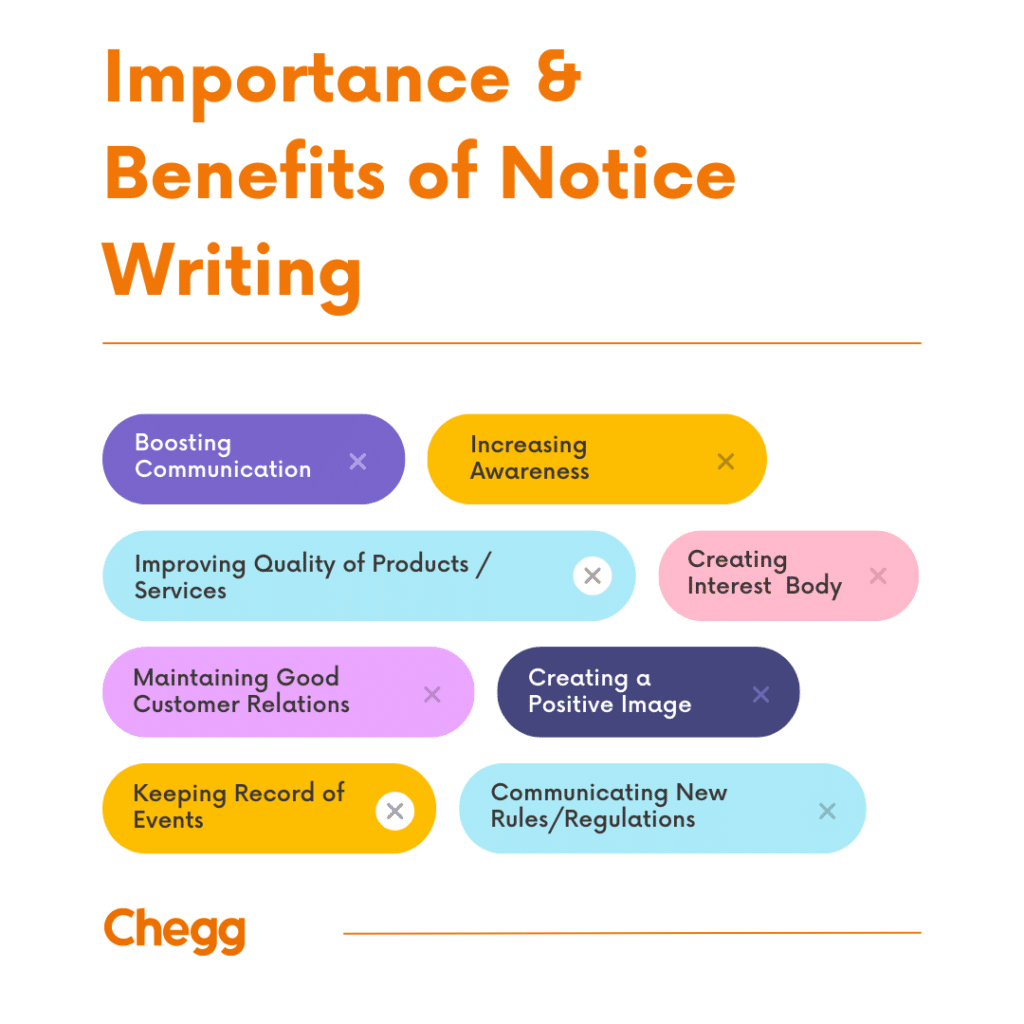
These notices provide important information or announcements to a specific audience. They can be used in schools, organizations, or communities to disseminate news, updates, or instructions.
These notices are designed to promote and provide details about upcoming events, such as conferences, seminars, workshops, or social gatherings. Event notices aim to attract participants and generate interest in the event.
Public notices are typically issued by government authorities, institutions, or organizations to inform the general public about legal matters, public hearings, policy changes, or community-related issues. They serve as a means of public communication and engagement.
Circular notices are used within organizations or institutions to circulate important information or directives to a specific group. They often address internal matters, such as policy updates, organizational changes, or meeting schedules.
Invitation notices are designed to invite individuals or groups to attend a specific event or occasion. They may include details such as date, time, venue, and RSVP instructions to encourage participation and create a sense of anticipation.
This type of notice is used in rental or lease agreements to inform tenants about the requirement to vacate the premises within a specified period. It outlines the terms and conditions related to the termination of the tenancy.
Lost and found notices are used to inform the public about lost items or to notify individuals who have found lost items. They provide contact information and details about the lost item to facilitate its recovery.
Recommended Read:- Get Paid for Perfection: Best Proofreading Jobs Online

Notice writing is considered one of the easiest forms of writing, particularly for students. Similar to letters and articles, it follows a specific notice writing format, and marks are often awarded for adhering to this structure during assessments. To achieve full marks, it is essential to understand the proper format and presentation of a notice, ensuring it effectively serves its intended purpose.
To write an adequate notice, follow these steps:
Mastering the art of Notice Writing involves understanding its structured format and purpose. A well-drafted notice format effectively communicates key information concisely and formally. Below is a standard template for writing a notice:
[Name of the Institution/Organization]
NOTICE
Date: [DD/MM/YYYY]
[Heading/Subject of the Notice]
Body:
• Begin with a clear statement of the purpose of the notice.
• Include essential details, such as the date, time, venue, and other relevant information.
• Provide instructions or any action required from the audience.
Signature [Name of the Issuer] [Designation]
This template ensures that your notice is formal, organized, and easy to comprehend. It’s the ideal structure to follow for effective communication! Using this structure ensures that all important details are included while maintaining brevity.
Now that you’re familiar with the format, reviewing a few notice writing format samples examples will help you apply what you’ve learned and craft effective notices with ease.
Suppose you have been assigned to write a notice about an upcoming parent-teacher meeting. Here is a sample to guide you in creating an effective notice.
Green Valley High School, Mumbai
NOTICE
Date: 22/02/2025
Subject: Parent-Teacher Meeting
This is to inform all parents of Class 10 students that a Parent-Teacher Conference has been scheduled for 28th February 2025. The conference will occur in the School Auditorium from 9:30 a.m. to 11:30 a.m..
Attendance is compulsory for all parents, as important academic progress and upcoming board exam preparations will be discussed. Please ensure you arrive by 9:15 a.m. for smooth coordination.
Signature
PRINCIPAL
Green Valley High School, Mumbai
If you need to draft a notice about the summer vacation along with important instructions, here is a sample to guide you in writing an adequate notice
Sunrise International School, New Delhi
NOTICE
Date: 21/02/2025
Subject: Summer Vacation Announcement
Dear Students and Parents,
This is to inform you that the school will remain closed for summer vacation from 1st May 2025 to 15th June 2025. The last working day before the break will be 30th April 2025.
Students are requested to complete any assigned holiday homework and adhere to the study schedule provided by their respective teachers. Parents are kindly asked to pick up their children promptly after the final day’s classes.
We wish all students a safe and enjoyable vacation.
Signature of the Principal
Principal
If you are the Head Boy or Head Girl of your school and need to issue a notice regarding a meeting for the Annual Day function, here is a sample notice to guide you in drafting one effectively.
Bright Future Senior Secondary School, Bengaluru
NOTICE
Date: 21/02/2025
Subject: Annual Day Function Meeting
All Class 12 students are informed that a meeting regarding the upcoming Annual Day Celebration will be held on February 26th, 2025, at 1:00 p.m. in the School Auditorium.
Students interested in participating in various events, such as cultural performances, speeches, or volunteering, are requested to attend the meeting without fail. Essential details about roles, responsibilities, and rehearsal schedules will be discussed.
Your presence is mandatory.
Signature
HEAD BOY/HEAD GIRL
Bright Future Senior Secondary School, Bengaluru
Here’s a sample notice for a holiday announcement in an office setting:
ABC Corporation Pvt. Ltd.
NOTICE
Date: 1st April 2024
Subject: Holiday Announcement for Good Friday
This is to inform all employees that the office will remain closed on 7th April 2024 because of Good Friday. Regular working hours will resume on 8th April 2024.
For any queries, contact the HR department.
Signature
Neha Gupta
HR Manager
Here’s an example of a notice for a blood donation camp:
ABC Institute of Technology NOTICE Date: 25/03/2025
Blood Donation Camp
This is to inform all students and staff that ABC Institute, in collaboration with XYZ Blood Bank, is organizing a Blood Donation Camp to promote health awareness and contribute to saving lives. The details of the event are as follows:
Date: 30th March 2025
Time: 10:00 AM to 4:00 PM
Venue: Main Auditorium, ABC Institute
We encourage everyone to participate in this noble cause. All donors must carry valid identification and ensure they meet the medical criteria for donation (age, weight, and general health requirements). Refreshments will be provided after the donation, and certificates of appreciation will also be awarded to participants.
For registration and further information, please contact:
Mr. Rahul Sharma (Event Coordinator) at +91-9876543210
Email: rahul.sharma@abc.in
Let’s come together and make a difference!
Signature Dr. Priya Mehta Principal
Writing an effective notice requires attention to detail. Here are some tips to improve your notice writing skills:
Remembering these tips, you can create impactful notices that serve their purpose.
Even experienced writers can make mistakes when drafting notices. Here are some common pitfalls to avoid:
Avoiding these mistakes will help you produce high-quality notices every time.
Being able to write a clear notice will enhance your professional communication in whatever context you find yourself working. Using an appropriate format and being clear and to the point will help your audience comprehend the message and comply with the action requested. It is always best practice to remember to include all of the essential components of the format, as these raise the credibility and clarity of your communication (date, heading, body of notice, signature). The more you practice and focus on clarity, the fewer mistakes you will make, and your writing will get better as you gain more experience.
Use this guide as a set of principles and examples to serve as guidelines to write notices in any context – from notifying parents within a school to communicating with colleagues within a workplace. With practice, you will improve with each draft of your notices. Still, you will also develop your reputation as a clear communicative educator, one who is prepared to fulfill their role in a 2025 academic environment.
Enhance your notice-writing and email-writing skills with Chegg Career Advice, helping you unlock your full communication potential.
A notice is a formal communication to inform people of significant information, such as events or announcements.
Example: “School trip to Jaipur on 10th Oct. Names to be submitted by 5th Oct.”
Tip: Be concise but clear, with date/time, place, and purpose.
How to write a notice:
Title: NOTICE
Date
Heading (purpose)
Details (what, when, where)
Signature (name & designation)
Tip: Keep it short and precise!
Your Address: Top right corner.
Date: Below your address.
Recipient’s Address: Left side, below the date.
Salutation: “Dear Sir/Madam,” or the person’s name.
Body: Write clearly in paragraphs, introduce, explain, and conclude.
Closing: Use “Yours faithfully” or “Yours sincerely.”
Signature: Your name below the closing.
Tip: Keep it polite and to the point.
Message writing is a short note to share information or instructions quickly.
Used for:
Informing someone
Leaving instructions
Giving reminders
Tip: Be brief and straightforward!
Yes, a 90-day notice period is legal if it’s clearly stated in your employment contract or company policy.
Tip: Always check your contract terms and local labor laws, as notice periods can vary by country and job type.
Meetings, events, lost items, holidays, exams, competitions.
Example: Notice about a school’s annual day.
Tip: Choose topics relevant to your audience.