

Strategic thinking is an essential skill in today’s rapidly evolving marketplace. Strategic thinking separates great leaders and organizations from the rest. Strategic thinking is a process that involves examining complex situations, anticipating future scenarios, and making decisions to move you towards the long-term purpose. Strategic thinkers can analyze the big picture, see brand new opportunities or threats, and agilely develop innovative solutions to drive successful business outcomes. Whether you are a business owner, a manager, or a high-potential executive, developing the strategic capacity to face change, allocate resources, and ultimately obtain competitive advantage is critical.
Today, when disruption and innovations abound, the most successful businesses are the ones whose employees can see forward and lead their organizations towards intentional action. So, are you ready to elevate your capability to enhance your professional relevance and career progression? Let’s explore the importance of strategic thinking and how to build this business skill.
Strategic thinking definition is the ability to plan for the future by making decisions that align with long-term goals. It involves looking at the big picture, identifying opportunities and challenges, and making thoughtful choices to stay ahead. In 2025, strategic thinking is critical due to rapid changes in technology, work environments, and global competition. Being able to anticipate trends and adapt quickly helps individuals and businesses succeed. It ensures that decisions are reactive and proactive, positioning people to navigate challenges and capitalize on new opportunities in a fast-changing world.
Any organization’s competitive landscape can shift rapidly, with emerging trends requiring swift action to capitalize on them or risk falling behind. Integrating strategic thinking into your daily work and personal routines will enhance your ability to anticipate, forecast, and seize new opportunities.
On an individual level, adopting a strategic mindset enables you to make more meaningful contributions, become a more valuable asset to your organization, and demonstrate your readiness to take on greater responsibilities and manage increased resources.
Various professions can benefit from strategic thinking, such as businesses in the business or sales industries. This is because professionals in these businesses or sales (meaning advertising marketing and promotion) often have to plan sales objectives o marketing campaigns for brand delivery to the intended audience to bring customers to and increase traffic to the company. Some finance professionals can apply strategic thinking, as it can help them to improve their recommendations to their clients related to financial decisions (that are likely to impact their financial portfolios) by directing them toward decisions likely to increase their revenue.
During an organization’s annual strategic planning process, leaders often assemble, analyze, synthesize, and evaluate external and internal data and ideas to find their strategic intent, transforming them into a strategic story. This document will lead the company to the future for a defined amount of time. After developing the strategic intent, leaders select and plan the specific actions to achieve these strategic initiatives.
Business also needs to allow for time to think strategically and to plan, as part of a previous year
Leadership teams should all strategically review their identity initiatives periodically throughout the year to assess whether they are being executed, plan, revisit, and sustain the effort throughout the organization.
Business leaders and stakeholders use strategic thinking and analysis to determine what product mix to offer, what competitive landscape to enter (or not enter), and how best to allocate limited resources, namely time, people, and capital. They also must weigh how to structure available resources and enroll others to meet important objectives while minimizing the risks of losing those resources unnecessarily.
Many components make up strategic thinking, but the main three components are planning, problem solving and adapting your approach based on new information. Here’s some more details on the three key components of strategic thinking:
Planning is a central component of strategic thinking because it allows you to take the time to set goals and genuinely think about how best to come up with ways to achieve them. As you plan, you can think about the most minor details, such as what you want to achieve, how realistic your goals are to achieve, and which steps you might take to get there, as well as the potential obstacles that may arise in every step. Planning could involve creating action plans that explore how successful each action is likely to be, and maybe even researching your competitors to see how they can influence your strategies.
Problem-solving is yet another significant factor within strategic thinking, as it can be realized at any point in the process. Regarding strategic thinking, problem-solving is mainly about responding to dilemmas that occur while taking the actions outlined in your planning. This may involve researching why the dilemma is occurring, developing potential solutions, and creating a strategic plan to rectify the problem. Problem-solving as part of strategic thinking also involves contemplating further dilemmas based on your experience so far and planning corrective measures for them as well.
The final key element of strategic thinking is the act of adjusting your actions as you work on the plans that you have developed. Given that a large part of strategic thinking is to evaluate the strategy and the actions you take in order to stay on the path to your goals, having the ability to adjust what actions you take in the process can allow you to succeed by affording you the flexibility of being able to spend time on the tasks that might be the most effective.
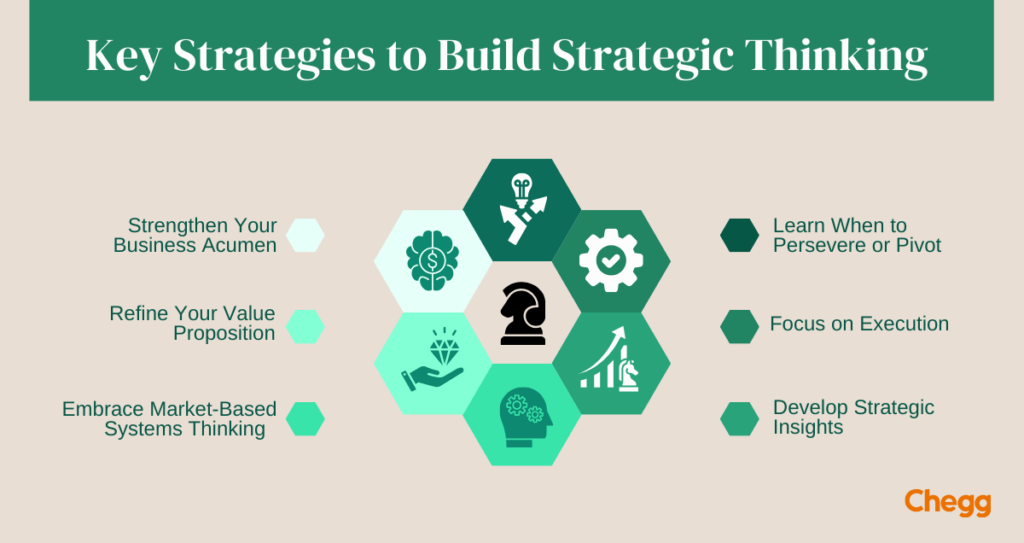
Business acumen is the foundation of strategic thinking. It’s about having a deep understanding of the business landscape, how industries work, what drives profitability, and where value is created. With industries rapidly evolving in 2025 due to technological advancements, having a strong knowledge in how business models are impacted by new trends is crucial.
To enhance your business acumen, stay informed about changes in your industry and monitor global business trends. Regularly assess how these shifts could affect your organization and your role within it. For example, understanding the rise of AI can help you see where efficiencies can be gained or where your business may be disrupted.
A clear value proposition is at the core of any strong strategic plan. Strategic thinking involves knowing exactly what value your product or service delivers to customers and how it differentiates you from competitors. In 2025, the ability to articulate and adapt your value proposition will be vital for success in increasingly competitive markets.
To refine your value proposition, continually ask yourself: What problem are we solving? How are we uniquely positioned to solve it? In what ways can we add more value to our customers? By answering these questions, you can align your business strategy with customer needs and market demands.
Market-based systems thinking is the ability to see how different forces in the market, such as competition, customer behavior, and regulatory environments, interact and influence one another. This approach helps you understand the ripple effects of decisions across an entire market ecosystem.
In 2025, market-based systems thinking is essential as industries become more interconnected. For example, a shift in consumer preferences towards sustainability can impact supply chains, product development, and marketing strategies. To cultivate this skill, study how different market components affect each other and use this knowledge to anticipate future trends and opportunities.
Strategic insights are crucial to identify opportunities and threats that others may overlook. These insights come from analyzing data, market trends, and internal performance metrics to make informed decisions. To develop strategic insights, immerse yourself in data-driven analysis. Look beyond surface-level information to understand the underlying causes of trends. For instance, if you notice a sudden spike in customer demand, ask more profound questions about the economic, social, or technological factors driving that change.
No strategic plan can succeed without effective execution. Execution means turning ideas and strategies into tangible actions that lead to results. It’s not enough to think strategically; you must follow through and ensure the vision becomes reality.
In 2025, with markets shifting rapidly, organizations need to be nimble and able to execute efficiently. Build a team that is aligned with your strategic goals and create clear plans with measurable milestones. Regularly review progress and adjust your actions to ensure the plan stays on track.
One of the hallmarks of strategic thinking is knowing when to stay the course and when to adapt. The ability to persevere or pivot can make or break your strategy. In 2025, the speed of change is so fast that even the best strategies can quickly become obsolete. Strategic thinkers must recognize when persistence is the right move or when a pivot is necessary to stay competitive.
To develop this skill, closely monitor your strategy’s outcomes. Don’t hesitate to pivot if a particular approach is not delivering the expected results. Conversely, if the market is still trending in a favorable direction, it may be worth persevering despite short-term challenges. The key is being flexible and willing to adjust when needed, without losing sight of your long-term objectives.
Here are some common challenges in strategic thinking:
Here are some ways to improve strategic thinking skills:
Integrating strategic thinking into business represents the best outcome for long-lasting growth and sustainability. Developing strategic thinking equips professionals to manage uncertainty properly, respond to changing market conditions, and lead organizations toward sustained business goals. In 2025, employers will prioritize individuals who can integrate analytical capabilities with creativity and vision when working on their organizations. Strategic thinking is about cultivating a mindset that enables continuous learning in the immediate, being open-minded, and working with different teams.
There are several methods to improve strategic abilities, including SWOT, scenario planning, regular feedback and reflections to enhance current status. Think of this, strategic thinkers are not just people who overcome problems; they are the same people who are creating opportunities. Investing time in developing strategic thinking skills will benefit you as a person and a future-ready leader in any career, field or industry. Begin today and explore the possibilities that thinking ahead will offer you and your career, as well as your organization.
Strategic thinking also means taking a high-level view, anticipating and planning for the future, and making informed decisions linked to a longer-term purpose.
For example, you plan a six-month initiative to enhance the product and customer experience rather than simply addressing a drop in sales.
Tip: Always ask yourself, “Is this in the long-term interest?”
The 5 P’s of Strategic Thinking: plans, ploys, patterns, positions, and perspectives.
For instance, a new food delivery app is developing its launch strategy and is using tactics like free delivery to outsmart its competition. It also practices such things as always being quicker, viewing the position of the cheapest delivery app, and acting with the purpose of solving people’s real challenges.
Tip: Strategy isn’t just planning, but the way you behave, compete, evolve, and think over time.
Strategic thinking means planning and focusing on long-term goals.
Example: Instead of just fixing a sales drop, you analyze trends to create a lasting growth plan.
Tip: Ask yourself, “How will this decision impact the future?”
The 5 C’s will assist you in thinking clearly, thinking creatively, questioning thinking, choosing wisely, and changing course.
For example, a manager observes a problem, suggests additional solutions, questions old solutions, chooses a solution, and modifies the plan as needed.
Hint: Keep these 5 C’s handy to stay flexible and improve your future decision-making.
Strategic thinking skills include analytical thinking, creativity, decision-making, problem-solving, systems thinking, and envisioning.
Examples include analyzing trend data, developing innovative ideas, making difficult decisions, solving complex problems, seeing systemic connections, and envisioning future success.
Tip: Facilitate with these skills to better plan and adapt to changes.
The fundamental aspects of strategic management consist of goal setting, environmental scanning, strategy formation, strategy implementation, and evaluation.
Example: A strategy begins with setting a goal, collecting data on market trends, developing a plan, implementing the plan, and evaluating progress.
Tip: Use all five steps for a disciplined and strategic approach.
Absolutely! It helps you make better decisions and plan, improving productivity and teamwork.
For example, you might learn to spot potential problems before they happen and create backup plans.
Tip: Try to apply one new strategy skill each week to see real improvements.