


Logical reasoning is the method of drawing conclusions by using principles, and systematic thinking. It requires analyzing, synthesizing, and making inferences to reach a conclusion; to make a prediction, solve a problem, or make sense of a situation. Logical reasoning can be verbal (words) or non-verbal (images, or figures). Logical reasoning is a critical skill used in competitive examinations, as well as for a job interview, in order to solve problems and think critically.
In today’s world, having strong logical reasoning skills is a must for anyone aiming to build a successful career. It helps us solve problems, make decisions, and think critically. It plays a huge role in almost every job, making it easier to deal with daily challenges at work. Studies suggest that over 85% of employers value problem-solving and decision-making skills as essential workplace competencies. Logical reasoning plays a huge role in almost every job, enabling professionals to handle daily challenges effectively.
In a nutshell, logical reasoning is simply the ability to use common sense and logic to solve problems. This is a major part of many competitive exams, and it reflects how you can think, analyze, and make decisions.
Logical reasoning is generally classified into a few types—verbal reasoning, non-verbal reasoning, and analytical reasoning. Each of these types of logical reasoning will challenge your mind differently.
Some common topics you would commonly study include:
Analogy, Classification, Coding-Decoding, Blood Relations, Venn Diagrams, Calendar, Clocks, Directions, Input-Output, and Puzzles.
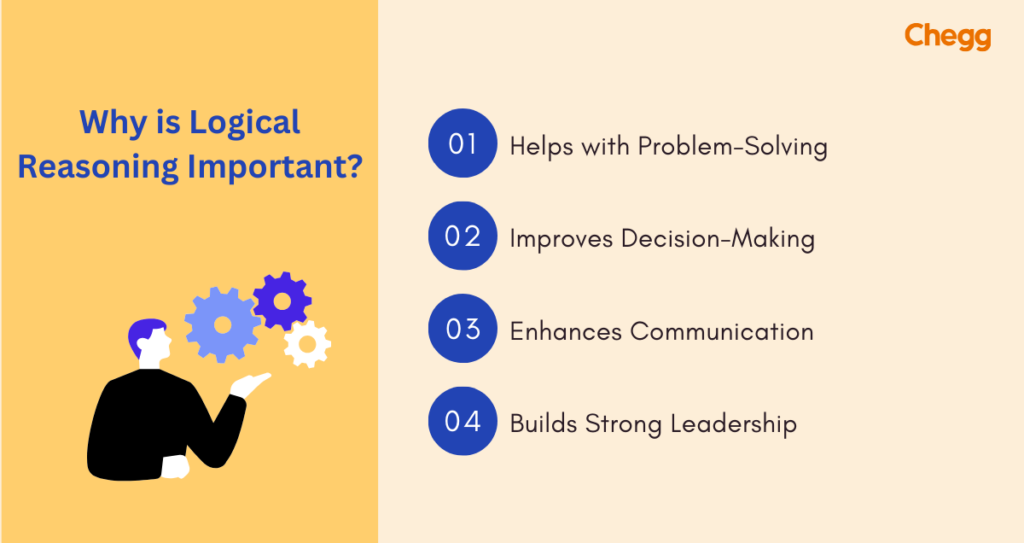
In most careers, you face challenges daily. Reasoning with logic allows you to think through these challenges step by step, helping you find the best solution. Whether you’re a teacher, engineer, or business leader, problem-solving is a skill you need. Reasoning is like the tool you use to break down a problem into smaller parts and then solve it piece by piece.
Making decisions at work can be tough, especially when many factors are involved. Reasoning helps you weigh the pros and cons of different options. It guides you in choosing the best path forward, avoiding mistakes that could happen if you made decisions too quickly or without enough thought.
It also helps you communicate better. When you present your ideas clearly and with strong reasons, people are more likely to understand and agree with you. In team meetings or when giving presentations, using your reasoning skills ensures that your arguments make sense and that you can back them up with evidence.
Leaders with good logical reasoning skills can make better decisions for their teams. They are also better at handling conflicts and guiding their team members toward solutions. If you’re aiming for a leadership position in your career, developing your reasoning skills is essential.
The following is a list of the steps for solving Logical Reasoning questions and answers:
There are a variety of topics that appear in the logical reasoning section, they will likely include the following types of questions:
Verbal reasoning is a cognitive process that involves understanding, analyzing, and drawing conclusions from written or spoken language. It tests an individual’s ability to comprehend and interpret information presented in words, as well as their capacity for critical thinking, problem-solving, and logical deduction using language.
In this type of logical reasoning section, candidates will be given various types of reasoning questions, which require a very good understanding of the verbal attributes of English. Some of the verbal reasoning topics are analogy, classification, coding-decoding, blood relation, Venn diagram, calendar, clocks, direction and distance, decision-making, input-output, puzzle and so on.
Non-verbal reasoning is a cognitive process that involves understanding, analyzing, and drawing conclusions from visual information, rather than written or spoken language. It tests an individual’s ability to recognize patterns, relationships, and sequences in images or abstract symbols, as well as their capacity for critical thinking, problem-solving, and logical deduction using non-linguistic information.
In this type of logical reasoning section, candidates will be given various types of reasoning questions, which don’t require very good grammar knowledge. Non-verbal reasoning is all about analyzing the given question very carefully and finding the correct answer. Various types of nonverbal reasoning are analogy, classification, cube and dice, image and figure counting and so on.
| Verbal Reasoning Topics | |
| Arrangement Pattern Reasoning | Input Output Reasoning |
| Blood Relation Reasoning | Linear Arrangement Reasoning |
| Calendar Reasoning | Order And Ranking Reasoning |
| Cause And Effect Reasoning | Order And Word Formation |
| Circular Arrangement Reasoning | Problem Solving And Reasoning |
| Classification Reasoning | Ranking Reasoning |
| Clock Reasoning | Seating Arrangement Reasoning |
| Coding Decoding | Statement And Argument Reasoning |
| Critical Reasoning | Statement And Assumption Reasoning |
| Cubes And Dice Reasoning | Statement And Conclusion Reasoning |
| Data Sufficiency Reasoning | Statement And Course Of Action Reasoning |
| Decision-Making Reasoning | Statements In Mathematical Reasoning |
| Deductive Reasoning | Syllogism Reasoning |
| Direction Distance Reasoning | Venn Diagram Reasoning |
When you face problems at work, logical reasoning is the key to finding solutions. For example, if you’re working on a project and hit a roadblock, logical reasoning helps you step back and analyze what went wrong. You can then figure out how to fix it without getting overwhelmed. This skill not only helps you succeed in your current job but also makes you stand out for future promotions.
In many workplaces, you need to work with others to achieve goals. Logical reasoning allows you to think about how to work best with your team members. It helps you see their perspectives, understand their ideas, and find common ground. Good teamwork leads to success in most jobs, and logical reasoning plays a big part in making teamwork smoother and more effective.
Employers value employees who can think logically and solve problems on their own. When you show that you have strong logical reasoning skills, you prove that you are capable of taking on more responsibility. This can lead to career advancement, as managers look for people who can handle complex tasks and make smart decisions.
If you want to improve your logical reasoning, there are many ways to practice. You can start by solving puzzles, playing strategy games, or reading books that challenge your mind. You can also practice thinking through problems in your daily life. Ask yourself questions like, “What is the best way to handle this situation?” or “What are the different outcomes of this decision?” These exercises train your brain to think logically.
Another great way to build logical reasoning is by working with others. When you’re part of a team, you often have to think through different ideas and opinions. This helps you practice seeing things from various angles and using logical reasoning to find the best solutions.
Candidates should find a variety of tips/tricks below for completing the Logical Reasoning questions. first of all, try to complete the logical reasoning syllabus.
Tip #1: Know the question type. It is not difficult to come across common question types in logical reasoning such as deduction, inference, assumption, strengthening / weakening arguments, and pattern recognition. Knowing the question type helps you take a strategy to approach the problem.
Tip #2: Breaking down the information. Then, be prepared to analyze the information that you have been provided with; you will want to break it down into smaller, manageable areas of focus. You will want to pick out the main points and assumptions you have, as well as what type of conclusion you can make. By breaking the task down, this will hopefully lead to a better understanding of the task and ability to think through solving it.
Tip #3: Draw some things out. For certain question types such as sequencing or spatial reasoning you may find it easiest to draw things out to visualize or to help find the solution. Drawing things out can help you visualize the non-verbal reasoning tasks and may help you to find the solution more quickly.
Tip # 4: Discard incorrect answer choices and systemically eliminate answers to clarify options. You should first identify any answer choices that you know are invalid or don’t fit with the information given. This will help you focus on the remaining answer choices and get to the correct answer faster in logic reasoning questions.
Tip # 5: Check and watch for fallacies, including ad hominem, hasty generalization, and false dilemma. Noting fallacies can keep you from spotting incorrect answer choices. You will avoid being trapped by the options given.
Tip # 6: Manage your time. Logical reasoning questions can take a long time to get through. Make sure to spend your time wisely, and try not to get bogged down on any one single question. If you’re not seeing any clear answer, try to move on to the next question and come back to the more difficult ones if you have time to spare at the end of your logical reasoning test.
Tip # 7: Practicing consistently is crucial for improving your logical reasoning abilities. Try different kinds of verbal and non verbal reasoning questions to help you get comfortable and confident. You can do this using online resources, books or mock tests.
Tip # 8: Try to remain calm and in a focused mindset while taking a test. When taking a test, overthinking or stressing about it can take away your ability to think logically and clearly. Trust your abilities and your preparation and maintain confidence.
Tip # 9: Check your answers If you have time left, go back and check your answers. Check your reasoning and ensure you didn’t make any calculation or assumption errors.
Tip # 10: Understand your mistakes after you complete a practice test or logical reasoning problem. Critically think about your mistakes and try to understand why you made it. This way you can ensure you don’t make the same mistakes in the future, and you will improve your overall logical reasoning skills.
Q: Pointing to a woman, Ramesh said, “She is the only daughter of my father’s only son.” Who is the woman to Ramesh?
A:
Ramesh’s father’s only son = Ramesh himself
So, the woman is Ramesh’s daughter.
Answer: Daughter
Q: If in a certain code, MANGO is written as NZOHQ, how is APPLE written?
A:
Each letter is shifted one step forward:
A → B, P → Q, P → Q, L → M, E → F
So, APPLE → BQQMF
Answer: BQQMF
Q: What comes next in the series: 2, 4, 8, 16, ___?
A:
Each number is multiplied by 2 → 2×2 = 4, 4×2 = 8, 8×2 = 16
Next: 16×2 = 32
Answer: 32
Q: Ravi walks 10 m north, then turns right and walks 5 m, then turns right again and walks 10 m. In which direction is he facing now?
A:
Starts facing north → turns right = east → turns right again = south
Answer: South
Q: Statements:
All apples are fruits.
All fruits are healthy.
Conclusion: All apples are healthy.
A:
This follows logically from the two given statements.
Answer: Conclusion follows
Q: A, B, C, D, and E are sitting in a row. B is to the right of A, but to the left of C. D is to the right of C, and E is to the left of A. Who is sitting in the middle?
A:
Order: E, A, B, C, D
Middle person = B
Answer: B
Q: Statement: “If you study hard, you will pass the exam.”
Assumption 1: Hard work leads to success.
Assumption 2: Passing the exam is important.
A:
Both assumptions are implicit in the statement.
Answer: Both assumptions are true
Is x > y?
Statements:
x = 8
y = 12
Solution:
Cannot be determined.
You are the team captain, and your team is trailing by one point with only a few seconds left in the basketball game. What will you decide to do?
A) Attempt a three-point shot
B) Go for a two-point shot
C) Pass the ball to a teammate
D) Call a timeout
Solution:
A) Attempt a three-point shot
Explanation:
Attempting a three-point shot is the best decision as it has the potential to earn three points and lead the team to victory.
All roses are flowers. This bouquet contains roses. What can you conclude?
A) The bouquet contains only roses.
B) The bouquet contains only flowers.
C) The bouquet contains roses and other flowers.
D) The bouquet does not contain any flowers.
Solution:
C) The bouquet contains roses and other flowers.
Explanation:
The given information tells us that all roses are flowers. The bouquet contains roses, but it does not exclude the possibility of other flowers being present as well.
In conclusion, logical reasoning is a crucial skill for anyone looking to build a successful career. It helps you solve problems, make smart decisions, and communicate effectively with others. Whether you’re just starting your career or aiming for a leadership position, strong logical reasoning skills will always set you apart. By practicing and developing these skills, you can ensure that you are ready to take on any challenge that comes your way in the workplace.
logical reasoning is all about solving problems by using common sense and logic. Logical reasoning is of various types such as verbal reasoning, non verbal reasoning, and analytical reasoning.
Topics of logical reasoning include everything from coding-decoding, blood relations, analogy, statement and conclusions, puzzles, direction sense etc. Logical reasoning can test candidates’ ability to think logically, analyze, and draw logical conclusions.
To successfully prepare for logical reasoning, focus on understanding the key components of logical reasoning, regularly exposing yourself to different question forms, and developing strong analytical skills. Regular practice, including work on past papers and mock papers will be key to developing speed and accuracy.
Logical reasoning is found in most competitive examinations, including:
UPSC, SSC, IBPS, CAT, CLAT, NDA, Railways
University entrances such as CUET, IPMAT, BBA, and MBA exams
Placement aptitude tests and government job tests
Logical reasoning is a broader concept that encompasses verbal and non-verbal reasoning patterns. Analytical reasoning is a subtype of logical reasoning, and it has a much stronger emphasis on verbal puzzles, sequences, seating arrangements, and data-related problem solving.
Study every day using mock tests and puzzles
Begin with easy sections and progress to harder sections
Try to learn the patterns and logic, not just memorize the answers
Use apps and websites that offer reasoning tests
Books like RS Aggarwal’s Verbal & Non-Verbal Reasoning are also a good reference.
Some questions, especially puzzles and arrangements, can be time-consuming. However, with regular practice and strategy, you can solve them efficiently and accurately within the time limit.
Key topics include:
Coding-Decoding
Blood Relations
Direction Sense
Number & Letter Series
Syllogisms
Statement & Assumption
Puzzles
Venn Diagrams
Calendars & Clocks
Input-Output
They help assess problem-solving skills, decision-making ability, and analytical thinking—essential for competitive exams, job assessments, and interviews.