Traditional businesses in India thrive due to personal service, cultural relevance, and local trust.
The guide compares traditional business vs e-business, outlining advantages, challenges, and startup steps.
Includes downloadable resources like traditional business pdf and traditional business vs e-business pdf for deeper understanding.
Table of Contents
In today’s digital-first economy, traditional business models continue to thrive across India, driven by deep-rooted trust, cultural values, and community connections. From kirana stores to family-run textile businesses, these enterprises offer personalized service and local engagement unmatched by online platforms. In this guide, we’ll explore what a traditional business is, highlight the advantages of traditional businesses, compare traditional business vs e-business, and provide tips to start your own venture in 2025. Whether you’re looking for a traditional business in India or need a traditional business pdf, this resource simplifies everything for beginners and aspiring entrepreneurs.
What is a Traditional Business?
A traditional business is any enterprise that operates using conventional methods rather than relying heavily on advanced technology or digital platforms. These businesses often focus on face-to-face customer interactions and maintain physical locations like shops, markets, or workshops. In India, businesses are deeply rooted in culture and community. They are typically small-scale operations run by families or individuals who pass down their trade from one generation to another.
For example:
A local tea stall owner serves chai every morning.
A handloom weaver creating beautiful sarees in a village.
A roadside dhaba offering authentic Indian meals.
These examples highlight how traditional businesses connect people through shared experiences and trust built over the years.
Key Characteristics of Traditional Businesses
To better understand what makes a traditional business unique, let’s look at its defining features:
1. Physical Presence
Most businesses operate out of physical stores or marketplaces. Customers visit these locations to purchase products or avail services.
2. Family Ownership
Many businesses in India are family-owned. This means the business is passed down from parents to children, preserving traditions and skills.
3. Personalized Service
Unlike large corporations, traditional businesses prioritize building relationships with their customers. Shopkeepers remember names, preferences, and even birthdays!
4. Limited Use of Technology
While some businesses may adopt basic tools like calculators or mobile phones, they generally avoid complex software or online platforms.
5. Local Focus
These businesses cater primarily to nearby communities. For instance, a vegetable vendor sells fresh produce to residents of his locality.
6. Face-to-Face Interactions:
In traditional businesses, most customer transactions, inquiries, and support are conducted in person, allowing direct communication and building trust through personal engagement.
By focusing on these aspects, traditional businesses create a sense of belonging and reliability among their customers.
Advantages and Disadvantages of Traditional Businesses
Every type of business has its pros and cons, and traditional businesses are no exception. Let’s examine both sides to help you decide if this model suits your needs.
Advantages of Traditional Businesses
Tangible Shopping Experience: One of the biggest advantages of traditional businesses is the ability for customers to have a hands-on experience. Shoppers can see, touch, and try products before making a purchase, which increases confidence in the quality and suitability of the items. This physical interaction often leads to higher customer satisfaction compared to online shopping.
Personalized Customer Service: Traditional businesses offer a more personalized approach to customer service. Staff can engage directly with customers, understand their specific needs, provide tailored recommendations, and resolve queries immediately. This personal touch enhances the overall shopping experience and builds customer loyalty.
Building Trust and Relationships: Face-to-face interactions in traditional businesses help in building stronger and long-lasting relationships with customers. Customers tend to trust brands and stores they can physically interact with, and this trust often translates into repeat purchases, referrals, and positive word-of-mouth marketing.
Established Supply Chains: Traditional businesses often benefit from well-established supply chains, ensuring a consistent availability of products and services. Strong supplier relationships, inventory management, and logistical networks allow these businesses to deliver products efficiently, maintain quality standards, and respond quickly to market demand.
Local Community Engagement: Traditional businesses play an important role in supporting local communities. They contribute to the local economy, create jobs, and often engage in community events, which further strengthens brand reputation and loyalty.
Immediate Problem Resolution: Unlike online shopping, traditional businesses allow customers to address issues immediately. Returns, exchanges, or product defects can be resolved on the spot, which reduces frustration and enhances customer trust.
Disadvantages of Traditional Businesses
Limited Geographic Reach: Traditional businesses are often confined to a specific geographic area, which limits their customer base. Unlike e-commerce stores that can sell nationally or globally, offline stores rely on foot traffic and local marketing, restricting growth potential.
Scalability Challenges: Expanding a traditional business can be complex and expensive. Opening new locations involves significant investment in real estate, staffing, inventory, and marketing. This makes scaling slower and more challenging compared to digital businesses.
Limited Product Variety: Physical space constraints often restrict the range of products that can be offered. Unlike online stores that can showcase thousands of items virtually, traditional businesses must carefully manage inventory to fit available store space, potentially limiting customer choice.
Less Operational Flexibility: Traditional businesses may be less adaptable to sudden market changes. Operational adjustments, such as changing store hours, adding new product lines, or adopting new sales strategies, can be slower and more costly than in online or hybrid models.
Potentially Higher Overhead Costs: Running a physical store involves significant overheads, including rent, utilities, insurance, and staffing costs. These fixed expenses can reduce profit margins, especially during slow sales periods or economic downturns.
Dependence on Local Market Conditions: Traditional businesses are more vulnerable to local economic fluctuations, seasonal trends, and foot traffic variations. This dependency can impact revenue stability and long-term growth.
Examples of Traditional Businesses in India for 2025
Traditional businesses are those that primarily operate through a physical presence, offering products or services directly to customers. Some common examples include:
1. Retail Stores: Local grocery stores, clothing boutiques, and electronics shops where customers can visit, browse, and purchase products in person.
2. Restaurants and Cafes: Eateries that rely on dine-in experiences, takeaways, or limited delivery services, emphasizing personal service and ambiance.
3. Salons and Spas: Hair salons, beauty parlours, and wellness centres that provide hands-on services to clients.
4. Bookstores and Libraries: Physical stores offering books, stationery, and reading experiences not replicable online.
5. Service-Based Businesses: Tailors, repair shops, laundries, and consultancy services that require face-to-face interactions with clients.
6. Local Manufacturers and Artisans:Small-scale businessesproducing handcrafted goods, furniture, or local products and selling them in physical markets or stores.
7. Fitness Centres and Gyms: Health clubs and fitness studios offering in-person training, equipment, and guidance.
8. Healthcare Providers: Clinics, hospitals, dental offices, and physiotherapy centres that provide direct care to patients.
These examples showcase how traditional businesses rely on physical presence, personal interactions, and local market engagement, making them integral to communities.
How to Start a Traditional Business in India in 2025?
Starting a traditional business in India can be a rewarding experience if planned properly. If you’re wondering how to start a business in India, ventures like local eateries, handicraft shops, textile stores, and small manufacturing units with their strong roots in Indian culture continue to thrive with the right approach. Follow these steps to set up a successful business:
Step 1: Identify Your Niche – Choose the Right Business for You
The first step in starting any business is choosing the right niche. Your niche should match your interests, skills, and market demand.
Think about what you enjoy doing and where your expertise lies.
Consider traditional businesses such as textile selling, spice trading, dairy farming, pottery, or a local eatery.
If you have family experience in a trade, use that knowledge to your advantage.
Selecting a business that aligns with your passion will keep you motivated and increase your chances of success.
Step 2: Conduct Market Research – Understand Your Customers and Competitors
Before investing time and money, studying the market and understanding what customers need is important.
Visit similar businesses in your area to see what works and what doesn’t.
Talk to potential customers to find out what products or services they want.
Identify gaps in the market where you can offer something better or different.
Proper research helps you make informed decisions and avoid unnecessary risks.
Step 3: Secure Funding – Arrange the Necessary Investment
Every business requires an initial investment, whether small or large. Understanding your financial needs in advance will help you plan better.
Calculate the rent, equipment, raw materials, salaries, and marketing costs.
If you have savings, consider using them to avoid debt.
Look for investors or business partners if you need additional funds.
Having a well-planned budget ensures that your business runs smoothly without financial stress.
Step 4: Find a Suitable Location – Choose a Spot with Good Customer Flow
The success of a business often depends on its location. A good location ensures that customers can easily find and visit your shop.
Choose a place with high foot traffic, such as markets, busy streets, or areas near schools, colleges, and offices.
If you’re starting a business that requires storage or manufacturing, ensure that transportation facilities are easily accessible.
If budget is a concern, consider starting from home or renting a small space in a shared marketplace.
A well-chosen location increases visibility and attracts more customers.
Step 5: Build Relationships – Connect with Customers and Suppliers
Building strong relationships with customers and suppliers is key to long-term success.
Provide excellent customer service to encourage repeat business.
Offer discounts, free samples, or loyalty programs to attract and retain customers.
Network with suppliers and wholesalers to get better deals on raw materials.
Create a friendly environment where customers feel valued and appreciated.
A business that prioritizes relationships will always have loyal customers.
Step 6: Adapt to Trends – Combine Tradition with Modern Techniques
While running a traditional business, staying updated with modern trends is important to remain competitive.
Accept digital payments like UPI, Paytm, Google Pay, and credit cards to attract younger customers.
Use social media platforms like Facebook, Instagram, and WhatsApp Business to promote your products.
Offer home delivery services if possible.
Keep an eye on changing customer preferences and modify your business accordingly.
Adapting to modern trends while maintaining traditional values will help your business grow in the long run.
Starting a traditional business in India requires patience, planning, and dedication. You can build a successful and profitable business by following these steps: choosing the right niche, researching the market, securing funds, selecting a good location, building strong relationships, and staying updated with trends.
Why Traditional Businesses Still Thrive in India Today?
Despite the rise of e-commerce, traditional family-run businesses in India continue to thrive due to their deep cultural roots, strong community trust, personal relationships, and immediate, accessible service—especially in semi-urban and rural areas with slower digital adoption.
Here are the key reasons why traditional businesses still thrive in India:
Strong Community Trust – Long-standing relationships with local customers build unmatched loyalty, a hallmark of many small-scale family businesses.
Immediate Service & Accessibility – Quick, face-to-face interactions offer faster resolution and convenience.
Cultural Relevance – Many traditional businesses (e.g., local sweet shops, textile stores) are tied to festivals, customs, and rituals.
Low Operating Costs – Most are home-based or rent small spaces, keeping overheads minimal.
Family Support & Succession – Generational continuity provides stability and business knowledge transfer.
Cash-Based Transactions –Many customers still prefer cash or UPI for day-to-day purchases, a major factor in the success of cash-based businesses in India.
Localized Market Understanding – Traditional shopkeepers understand regional preferences better than large corporates.
Challenges Faced by Traditional Businesses Today
Traditional businesses face several challenges in today’s rapidly evolving landscape. Here are some key challenges:
Higher Operational Costs Traditional businesses often have significant overhead costs, including physical store maintenance, employee salaries, and inventory management.
Limited Market Reach These businesses are typically restricted to serving local or regional markets, which limits their growth potential.
Dependence on Foot Traffic Success can depend highly on location and the ability to attract customers in person.
Unpredictability Traditional businesses rely heavily on past data to forecast future market conditions. However, this approach falls short in today’s unpredictable environment, where disruptions and innovations are common.
Rigidity in Organizational Structure Traditional businesses often have rigid structures that can stifle flexibility and creativity. This rigidity can hinder the ability to adapt to the ever-evolving business landscape.
Focus on Competitive Advantages Focusing solely on creating long-term competitive advantages can be problematic in a fast-changing environment where market niches are rarely permanent.
Employee Disengagement In traditional structures, employees often have limited input into business strategy or vision, leading to disengagement and a lack of connection to the organization’s purpose.
Slow Decision-Making Hierarchical structures can lead to slow decision-making processes, as multiple layers of management weigh in on issues.
Economic Uncertainty and Inflation Businesses must navigate economic uncertainty and inflation, which can impact financing costs, tighten credit markets, and affect supply chains.
Adaptability and Agility To succeed, businesses must embrace adaptability and agility, central to thriving in today’s competitive landscape.
These challenges highlight the need for traditional businesses to innovate and adapt to remain competitive in the modern market.
Tips for Running a Successful Traditional Business
Here are some practical tips to help your business thrive:
Focus on Quality
Ensure your products or services meet high standards consistently.
Adopt Technology Wisely
Use apps for inventory management or social media for promotions without losing your traditional charm.
Offer Unique Products
Stand out by selling items that aren’t easily available elsewhere.
Build a Loyal Customer Base
Treat customers like family members. Remember their preferences and greet them warmly.
Collaborate with Others
Partner with neighboring businesses to cross-promote each other’s offerings.
Implementing these strategies will give you a competitive edge.
Difference Between Traditional Business and E-Business
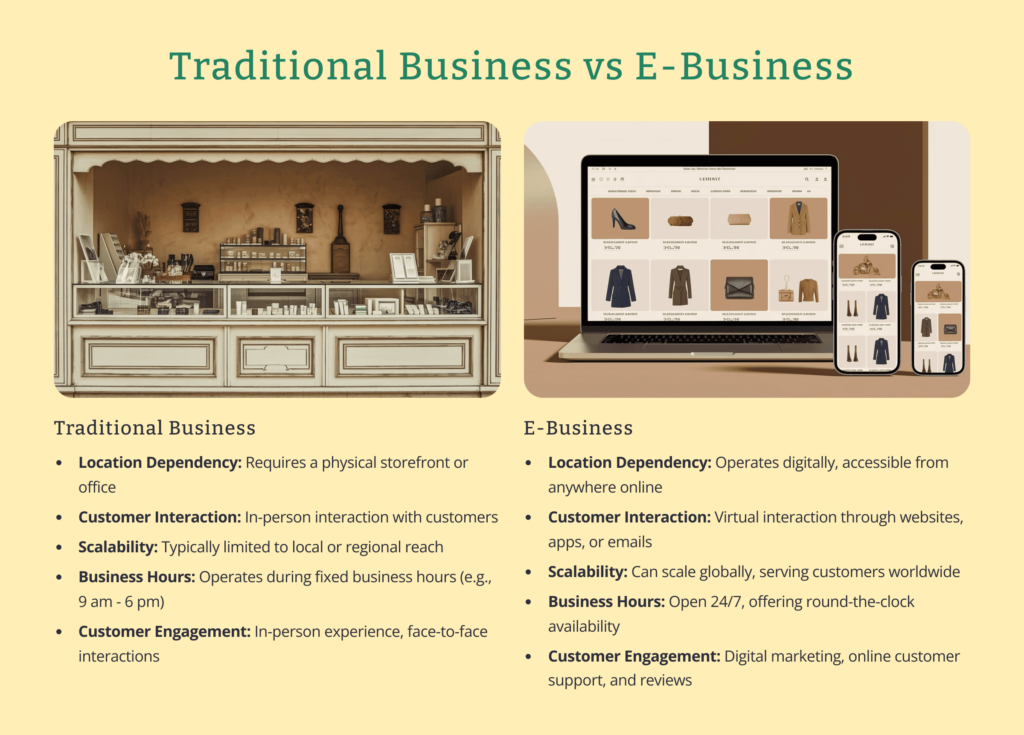
The rise of e-commerce has significantly changed the way businesses operate. The following table outlines key difference between e business and traditional business across various factors:
Traditional business and E-business Distinguish Between
In today’s digital age, traditional businesses still offer value through personal service, community trust, and cultural relevance. For those exploring this path, understanding traditional models is essential to long-term success. Whether you’re starting from scratch or transitioning from digital, resources like a detailed traditional business pdf can guide your planning. If you’re comparing models, the traditional business vs e-business pdf provides a clear breakdown of key differences to help you choose the right approach. Combining timeless business values with modern tools allows entrepreneurs to create sustainable ventures that thrive in both local and evolving markets.
We hope this guide has provided valuable insights into the world of traditional businesses. If you found this article helpful, please share it with others who might benefit from it.
Are you tired of finding ways to earn money online? Don’t worry—follow the Chegg India Earn Online Guides for proven ideas.
The best business depends on factors like location and market demand, but common successful ones include grocery stores, pharmacies, and local restaurants.
What is a traditional business model?
A traditional business model is a framework for how a company creates, delivers, and captures value. Examples include retail stores, manufacturing, and service-based businesses.
What is a traditional business process?
A business process involves a series of steps taken to achieve a specific goal, such as procuring, producing, and distributing products.
What is a traditional business, and how does it work?
A traditional business deals with physical transactions and works from a store. It includes interactions with customers in person. Examples include retail stores, cafes, and service firms. These businesses usually need a physical storefront, manpower for inventory management, and customer engagement.
What are the advantages of running a traditional business over an e-business?
Building trust is more effortless when traditional businesses provide a personal touch and direct customer relationships. In-person interactions also help customers see and feel the product before purchasing it. This face-to-face approach can be vital in building trust, offering personalized experiences, and ensuring customer satisfaction for specific sectors like hospitality and high-end retail.
How has e-business impacted traditional businesses?
With the advent of e-business, traditional businesses have faced considerable competition in reaching the world, having lower operational costs, and operating 24/7. Yet, they are now under pressure to adapt, set up an online presence, and adoptdigital marketing strategies.
Is it possible to run both a traditional business and an e-business simultaneously?
Yes, it’s possible, and most businesses today are in both physical and online spaces. This is a hybrid approach to multichannel presence, where businesses can reach customers across different channels by providing flexibility and expanding their market presence.
What are the biggest challenges traditional businesses face today?
Traditional businesses face many challenges, including higher overhead costs, limited geographical reach, and reliance on local foot traffic. Moreover, they must adjust to the increasing norm of digital commerce to compete in the rapidly changing market.
What are the main types of traditional business structures?
The three classic business forms are sole proprietorship, partnership, and family-owned businesses, each focusing on personal ownership, shared responsibilities, and often passing down through generations.
Why do online businesses often outperform conventional businesses?
Online businesses outperform conventional ones due to wider reach, lower costs, 24/7 availability, faster scalability, and easier access to global markets, making them more flexible and efficient in today’s digital world.
What are the three traditional forms of business?
The three traditional business forms are sole proprietorship, partnership, and corporation. Each structure differs in ownership, liability, and management, offering unique advantages depending on the size, goals, and legal needs of the business.
What is the difference between traditional business vs e-business?
Traditional business operates through physical stores and face-to-face interactions, while e-business runs online using digital platforms. E-business offers wider reach and flexibility, whereas traditional business focuses on personal service and local presence.
Authored by, Samiksha Samra Digital Content Writer
Samiksha is a writer with a passion for sharing ideas and a knack for detail. She loves turning concepts into meaningful, engaging content. With a strong background in research and content strategy, she crafts clear, easy-to-understand narratives that resonate with readers. Her curiosity drives her to explore new subjects, ensuring every piece she creates is both insightful and impactful.