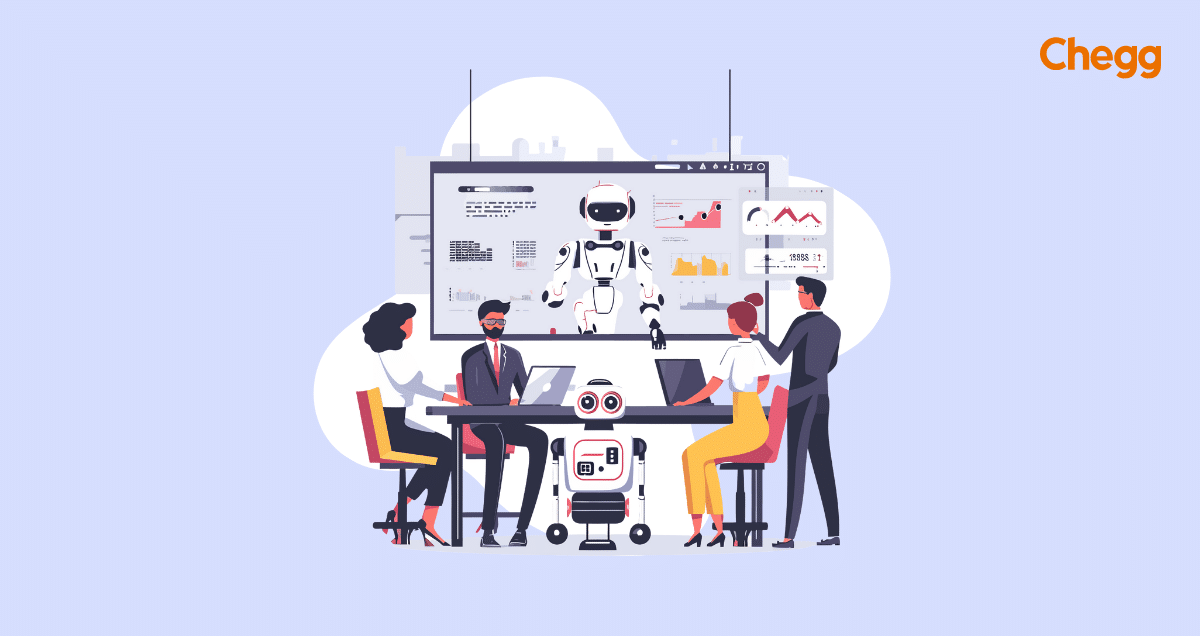
Artificial intelligence is revolutionizing business operations by automating marketing, finance, HR, and customer service, boosting efficiency and productivity.
Companies leverage AI tools like chatbots and predictive analytics to enhance decision-making, streamline workflows, and deliver personalized customer experiences.
The benefits of AI including cost savings, improved efficiency, and continuous innovation make it essential for maintaining a competitive edge in the modern digital economy.
Table of Contents
Artificial intelligence in business is no longer a futuristic concept it is a transformative force driving growth, efficiency, and innovation across industries. By leveraging tools like machine learning and natural language processing, businesses can automate tasks, analyze data, and enhance operations, resulting in improved customer experiences, smarter decision-making, and greater innovation. From AI-powered customer service and personalized marketing campaigns to predictive analytics, sales optimization, finance, HR, and cybersecurity, companies are integrating AI to gain a competitive edge in 2025.
According to recent reports, 9 out of 10 business leaders plan to invest in AI and machine learning, highlighting its essential role in modern enterprises. As Sundar Pichai, CEO of Google, said, “AI is one of the most important things humanity is working on. It is more profound than electricity or fire,” reflecting AI’s massive potential to reshape industries and redefine business operations.
By analyzing consumer behavior, automating repetitive tasks, and optimizing resource allocation, artificial intelligence empowers businesses to deliver targeted strategies, enhance customer engagement, reduce costs, and scale faster. In this guide, we’ll explore the top applications of AI in business, key benefits, and real-world examples that illustrate how AI is transforming entrepreneurship and enterprise success today.
What is Artificial Intelligence?
Artificial Intelligence (AI) is technology that enables machines and software to think, learn, and solve problems like humans. In business, AI is applied to operations, marketing, finance, and more to analyze data, make decisions, and improve over time.
Think of AI as a super-smart assistant that processes vast data, recognizes patterns, and delivers insights like predictive text on your phone or personalized recommendations on streaming platforms. AI can be narrow (specialized tasks) or general (broad intelligence, still in development).
Today, AI powers industries from healthcare to finance, enhancing decision-making, efficiency, and customer experiences but also raises concerns about privacy, fairness, and ethics. Understanding AI is essential for everyone navigating the modern digital world.
What is artificial intelligence in business?
Artificial intelligence in business is the use of AI tools such as machine learning, natural language processing, and computer vision to optimize business functions, boost employee productivity, and drive business value.
Tip: Leverage AI tools like chatbots, analytics platforms, and automation software to streamline business operations and boost productivity. Start small, test often, and scale what works.
Types of Artificial Intelligence in Business
All stages of an AI’s lifecycle need human involvement. This includes preparing data and algorithms, testing them, and verifying their results. We have also seen the use of several artificial intelligence examples in business. These include:
1. Machine Learning (ML)
Machine Learning (ML) Machine learning is a subfield of artificial intelligence. It copies intelligent human behavior to perform complex tasks like problem-solving. Data is the foundation of machine learning. It includes photos, numbers, and text. You can collect and store it to provide training data for the machine learning model. It is one of the most common types of artificial intelligence in business.
2. Natural Language Processing (NLP)
Computer Vision is another area of artificial intelligence in business. Natural Language Processing works with computers to understand text and spoken words like humans. NLPcombines linguistics and rule-based modeling of human language. This happens with the help of statistical, machine learning, and deep learning methods. It is one of the advanced types of artificial intelligence in business.
3. Computer Vision
Computer Vision is another area of artificial intelligence in business. It allows computers and systems to get meaningful information. This comes from digital images and other visual inputs. They can take action or make recommendations based on this information. You can also detect subtle defects or issues in products with computer vision.
4. Robotics
Robotics is a separate entity in artificial intelligence. It helps you study the creation of intelligent robots or machines. Robotics also combines electrical engineering, mechanical engineering, and computer science and engineering. These subjects include mechanical construction, electrical components, and work with programming languages.
Applications of Artificial Intelligence in Business
In today’s competitive market, businesses use AI to gain an edge through automation and data analytics. Multinational companies leverage AI to enhance operations, grow their customer base, and stay ahead of the curve
Let us look into the top applications of artificial intelligence in business below.
1. Marketing and Sales
The role of artificial intelligence and expert systems in business marketing is transformative. AI provides you with tools for personalized customer experience and predictive analytics. You can also automate customer service with artificial intelligence. This helps you boost your sales.
You can also focus on target marketing with the help of AI. It helps you do online advertising that shows ads to target audiences. Technical analysis of markets is also possible with AI. All you need to do is use the tools to collect data and present it on an artificial intelligence in business ppt. This helps you focus on areas of improvement and create new marketing strategies. These are real-world artificial intelligence in business examples driving growth.
2. Customer Service
Artificial intelligence in business enables you to perform surveys that provide customer feedback. These surveys work with historical data analysis and other important tools, providing you with accurate data. AI also helps create strategies for better customer engagement. This is how your business can improve sales with a better customer experience. AI helps make your business customer-centric, which benefits the company.
3. Operations
AI analyzes historical data and patterns to predict equipment failures in the future. This happens through predictive maintenance and helps reduce unexpected disruptions.
The application of artificial intelligence in business benefits quality control in operations. It ensures that your products meet standards with real-time monitoring and analysis. AI analytics also enhance supply management by tracking inventory and improving demand forecasting.
4. Finance
Artificial intelligence in business helps the finance and banking sectors. It provides advanced capabilities in data analysis and risk management. Machine learning algorithms enable correct credit scoring by analyzing variables, which improves lending decisions. Customers can also get instant business loan approval instead of waiting for days.
Using artificial intelligence in business can be a boon when there is less cash flow. So, you can use the capital to take advantage of time-sensitive market opportunities.
5. Human Resources (HR)
There is competition in employment because several candidates apply for the same position. It becomes tough for the human resources team to shortlist the correct candidate. You can use artificial intelligence to make things easier. AI and ML can help you filter the resumes and shortlist candidates that fit the roles.
They use attributes like location, skills, and education to complete the task. This is how artificial intelligence in business helps reduce the labor of the HR department.
Applications of Artificial Intelligence in Business with Real-World Examples & Benefits
Application Area
Real-World Examples
Key Benefits
Marketing & Sales
Targeted ads, AI-powered CRMs
Personalized campaigns, higher conversions
Customer Service
Chatbots, Virtual Assistants
24/7 support, faster query resolution
Operations
Predictive maintenance, supply chain AI
Reduced downtime, better efficiency
Finance
Fraud detection, credit scoring
Improved accuracy, lower risks
HR
Resume screening, employee analytics
Faster hiring, better retention
What Are the Key Benefits of AI in Business?
Artificial intelligence’s role in business is to help you save time and money. It helps automate and optimize several tasks and processes. Several important aspects and benefits of artificial intelligence in business are:
1. Increased Efficiency and Productivity
Artificial intelligence in business improves workplace efficiency in two ways. It includes saving time and reducing errors. It means you can work through all the to-do lists of simple, routine tasks. The best part is that you can complete these tasks with fewer mistakes. It gives you more time to dedicate to the high-level and engaging work that AI cannot do. Examples include relationship-building, collaborations, and innovations.
2. Improved Decision Making
AI technologies can help decision-making processes by analyzing vast amounts of data. This also involves using cognitive computing and machine learning. It enables you to recognize patterns and recommend solutions. This can help decision-makers in complex scenarios. This involves using AI to help in medical diagnosis or strategic planning.
AI also helps with risk assessment, which relies on the proper analysis of data. Situations can become problematic if the data is incomplete or inaccurate. Artificial intelligence can analyze such risk factors and eliminate anomalies. These are just a few benefits of artificial intelligence in business.
3. Enhanced Customer Experience
AI algorithms can analyze huge amounts of customer data. This helps them find patterns and insights humans may miss. The analysis can help identify the wants of customers and check their future needs. It also highlights areas where you can improve the customer experience for your business.
Chatbots can handle many conversations for a business at the same time. This makes it easier for you to manage customer inquiries. They can also handle repetitive tasks and free up your human agents to focus on complex queries.
4. Cost Reduction
AI-based management systems optimize energy consumption through historical data analysis, such as weather patterns and building occupancy. This helps your business cut costs and enhance its operational efficiency, and it also enables you to boost your sustainability.
Automation can reduce the need for human intervention in several tasks. This reduces labor costs and minimizes errors in business operations. It further increases the production speed and leads to improved revenue.
5. Innovation and Competitive Advantage
AI can improve innovation by generating new ideas. Its role involves analyzing these new ideas and improving the decision-making process. With the help of AI tools and solutions, you can access faster prototyping and assess all risks. Artificial intelligence uses data for various insights, automation, and customer services to promote innovation.
The best part about the use of artificial intelligence in business is competition. This is because you can predict market trends and consumer behavior with AI. It helps your business analyze future needs and adjust your strategies.
AI has transformed various business functions. This includes marketing strategies, product development, and customer support. Marketers and business professionals use artificial intelligence to create stronger campaigns. This helps you make smarter decisions and streamline workflows. The importance of artificial intelligence in business is evident in how it reshapes these operations.
Take a look at the role of artificial intelligence in business operations below.
1. Augmenting Human Capabilities
AI does not diminish your human intelligence. Rather, it complements it. The relationship between human cognitive abilities and AI can lead to a partnership. Here, each party brings unique strengths to the table. Humans excel in areas that need creativity and complex decision-making. Artificial intelligence enhances these tasks by processing data and offering insights.
2. Creating New Job Roles
The demand for artificial intelligence in business has increased in the past decade, creating new job roles. Examples include the positions of AI specialists and data scientists. An AI specialist designs, develops, and tests AI systems and applications, while a data scientist uses data to build organizational solutions. These are among the most practical artificial intelligence in business.
3. Changing the Nature of Work
Artificial intelligence introduces automation and optimization into various business processes. You can now perform tasks with AI systems that were manual earlier. This shift enables your employees to focus on other important activities. Most of these tasks need critical thinking, creativity, and emotional intelligence.
AI in Business: Key Challenges and Ethical Concerns
Key Challenges of AI in Business
1. Data Quality and Availability
Issue: AI systems require vast amounts of high-quality, structured data.
Challenge: Many businesses struggle with data silos, missing data, or unstructured data that hinder effective AI deployment.
2. Integration with Existing Systems
Issue: AI must be integrated with legacy IT systems.
Challenge: Compatibility, scalability, and technical debt can slow adoption.
3. Talent Shortage
Issue: AI projects require skilled data scientists, engineers, and domain experts.
Challenge: The demand for AI talent exceeds the current supply, especially for specialized roles.
4. High Implementation Costs
Issue: Developing, training, and maintaining AI systems can be expensive.
Challenge: Small and medium-sized enterprises (SMEs) may find it hard to justify the investment without a clear ROI.
5. Regulatory Uncertainty
Issue: AI regulations are still evolving.
Challenge: Uncertainty around compliance (e.g., GDPR, AI Act) can deter innovation and cause legal risks.
6. Bias and Accuracy
Issue: AI can unintentionally learn and perpetuate biases in data.
Challenge: Biased outputs can affect decision-making in hiring, lending, or customer service.
Ethical Concerns in Business AI
1. Privacy and Surveillance
Concern: AI often relies on personal data.
Ethical Issue: Balancing data collection with individuals’ right to privacy is critical, especially in marketing, HR, and customer service.
2. Bias and Discrimination
Concern: AI models can reflect or amplify societal biases.
Ethical Issue: Discriminatory outcomes in areas like hiring, insurance, or credit scoring can lead to reputational and legal consequences.
3. Transparency and Explainability
Concern: Many AI models, especially deep learning, operate as “black boxes.”
Ethical Issue: Lack of explainability undermines accountability and trust, especially in high-stakes decisions.
4. Job Displacement
Concern: Automation of tasks through AI can lead to workforce reductions.
Ethical Issue: Businesses must consider responsible transition strategies for affected employees.
5. Accountability and Responsibility
Concern: It’s often unclear who is responsible when AI causes harm.
Ethical Issue: Clear governance and accountability structures are essential.
6. Manipulation and Misinformation
Concern: AI-generated content (e.g., deepfakes, targeted ads) can mislead consumers.
Ethical Issue: There is a fine line between personalization and manipulation.
Conclusion
Artificial intelligence has become a game-changer for businesses, driving growth, efficiency, and revenue generation. Beyond marketing, AI’s applications span customer support, sales optimization, predictive analytics, and workflow automation, offering immense potential for innovation. By understanding and leveraging AI tools effectively, businesses can enhance customer experiences, boost sales, and stay ahead in today’s competitive digital landscape. Don’t wait integrate AI into your business strategy to unlock its full potential.
AI in business refers to the use of advanced algorithms and machine learning to automate tasks, analyze data, and improve decision-making, thereby enhancing operational efficiency, customer experiences, and innovation.
How is artificial intelligence used in business?
Businesses use AI to automate tasks, enhance decision-making through data analysis, personalize customer experiences, and improve operational efficiency.
What are the applications of AI in business?
Applications of AI in business include data analysis, trend prediction, automated reporting, and decision-making. AI-powered business intelligence helps companies gain insights, improve efficiency, and boost performance through smarter, data-driven strategies.
What are the 4 types of AI?
The four types of AI are Reactive Machines (no memory, respond to current situations), Limited Memory (uses past data for better decisions), Theory of Mind (understands emotions and social interactions), and Self-Aware AI (hypothetical AI with human-like consciousness).
Who is the father of AI?
John McCarthy is widely considered the “father of Artificial Intelligence” because he coined the term “Artificial Intelligence” in 1956 and was instrumental in establishing it as a distinct field within computer science.
What is the future of Artificial intelligence in business?
The future of AI in business looks promising, with continued advancements in automation, predictive analytics, and personalization. AI will enable businesses to make faster, more accurate decisions, improve customer experiences, and unlock new opportunities for growth and innovation across industries.
What are the 5 biggest AI companies?
1. OpenAI – Known for ChatGPT and advanced language models; a leader in generative AI. 2. Google DeepMind – Specializes in research-based AI; famous for AlphaGo and AlphaFold. 3. Microsoft – Integrates AI in tools like Word and Excel; strong partnership with OpenAI. 4. Amazon (AWS) – Uses AI in Alexa, logistics, and cloud services through AWS. 5. NVIDIA – Provides powerful GPUs essential for AI model training and development.
What are the benefits of AI in business?
Business benefits of artificial intelligence:
1. Increase productivity and operational efficiencies. 2. Save time and money by automating and optimizing routine processes and tasks. 3. Make faster business decisions based on outputs from cognitive technologies. 4. Reduce ‘human error’, provided that AI systems are set up properly.
Authored by, Samiksha Samra Digital Content Writer
Samiksha is a writer with a passion for sharing ideas and a knack for detail. She loves turning concepts into meaningful, engaging content. With a strong background in research and content strategy, she crafts clear, easy-to-understand narratives that resonate with readers. Her curiosity drives her to explore new subjects, ensuring every piece she creates is both insightful and impactful.