

Speech writing is the act of writing a message conveyed verbally to an audience. The speech must sound natural, engage the audience, and connect emotionally while being structured with an introduction, body, and conclusion. In general, writing a speech includes identifying the purpose for the speech and the audience, selecting the appropriate message for the speech, organizing key points for the speech, composing interesting language and anecdotes, and arranging and structuring the content effectively and logically.
After the writing process is done and the speech is complete, the writing will end in a practice to prepare the delivery of the speech, which will assist with the flow of the speech and connect with listeners, both of which will improve the chances of delivering the message or call to action effectively.

However, not everyone can verbalise a speech spontaneously. Speech writing is an art form, akin to delivering speeches. The words must be chosen carefully to evoke the right emotions. One incorrect word or phrase can disrupt the speech’s momentum.
A collection of tips, outlines, and samples will be provided to aid students and individuals in crafting their best speeches.
A great speech boils down to a few things. So, let’s go over what makes a speech really effective:
Now that you know what makes a good speech, the next step is to examine the process of writing one.
Starting a speech properly can determine its overall success. The audience is more likely to remember it when they are engaged and interactive. Crafting a solid start to the speech is an art worth exploring. According to the format of a speech, the beginning or conclusion is typically brief.
One way for a strong start to a speech is to state a quote. A quote that is relevant to the topic from a well-known person should be chosen. It will grab the listeners’ attention and set the tone for the rest of the speech. For example, one good quote that can be included regarding speech writing in English is “It usually takes me more than three weeks to prepare a good impromptu speech”- Mark Twain.

Many speakers also include a question, in particular, a rhetorical question, at the start of their speeches. They then attempt to answer the said question. One advantage of including questions at the start of the speech is that it prompts an answer. Even though the speaker is not calling for answers from the audience, one tends to think of the answer immediately. For instance, “Who wouldn’t like to live on a beach?”
Another effective way to immerse the audience in the topic is by creating a scenario. Set up a situation, add details, and pose questions. Being able to visualise situations engages the audience and generates excitement for the speech. This approach creates a continuous conversation. For instance, “Imagine you are on a beach. The sun is shining, the wind is blowing. It is pleasantly warm. How do you feel?”
Quoting a statistic is an excellent way to begin a speech. Ensure that the statistic is relevant not only to the topic but also to the audience. Similarly, referencing a current event can prompt the audience to feel the way the speaker desires. For instance, “Over 90% of people…”
Politicians often start their speeches with a powerful statement. This statement can be shocking or impactful. The goal is to make the audience curious about what will be said next. Following the statement, pausing briefly allows it to resonate with the audience. For example, “We cannot win, (pause)…is what everyone will tell you.”
Read more: Innovative Tips to Start a Speech
Every effective speech follows a specific format. It begins with an introduction, includes a main body packed with facts, and concludes with a summary of the speech. A well-structured speech can effectively capture the listener’s attention.
To master speech writing, students and professionals must understand the format of a compelling speech.
The greeting or introduction is the first part of the speech. In this section, the speaker introduces themselves and the topic to the audience. This initial moment is crucial, as an engaging introduction sets the tone for the entire speech.
The introduction should aim to capture the listener’s attention. It can include a brief overview of the topic, such as, “Today, I will be discussing…” A relevant quote, an anecdote, or a light-hearted joke can also be effective in creating rapport with the audience.
Once the introductions are addressed, the next step is to delve into the main body of the speech. This section should encompass all significant points related to the topic, including its advantages and disadvantages.
The main body must be well-organised, covering about five to seven key points, all supported with relevant examples. Creating a clear flowchart of the main body can enhance understanding.
Cover around five to seven key points and provide plenty of examples. Prepare a clear flowchart of the main body to ensure a comprehensive understanding of the topic.
Including statistics and facts is the best way to further persuade the audience during speeches. Statistics included during speech writing prove arguments and support the speaker’s ideas. They will also give the writer more credibility, showing that they have done their research.
Numbers will also impact the listener, and they will remember the presentation. It is also important to include the right type of statistics in speeches. The source of the fact must be credible, such as government websites, academic journals, and scholarly websites. When speaking, also remember to cite the sources to give due credit.
The conclusion of a speech is just as important as the introduction. It leaves a lasting impression on the audience and summarises the key takeaways.
The ending should encapsulate the entire speech, reinforcing the primary messages. A call to action or a thought-provoking story can provide a solid finish. It’s also beneficial to thank the audience and acknowledge their presence, for example, by saying, “I would like to thank everyone for their time today.”
All speech conclusions should acknowledge the audience and guests. Thank them for their time and express gratitude. For instance, “Finally, I would like to thank the audience and the guest of honour for your time.”
The topic is the most important consideration for writing a speech. Here are some fantastic topic ideas for writing a speech.
To continue the discussion of speech writing, the next step is to understand the format of speech writing. The format and outline are general and different depending on the speech’s content. However, generally, the outline has a greeting, the main body, factual data and an ending or conclusion.
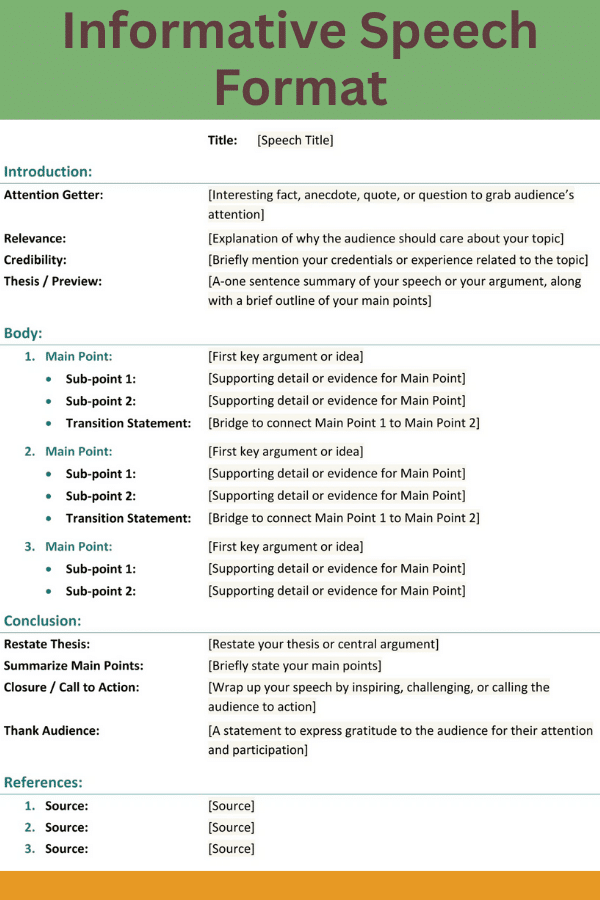
Speech writing takes time to perfect. Good speeches are researched thoroughly and leave the audience with memorable takeaways. However, some tips on ace speech writing can also be helpful.
1. Understand the audience.
Take time to understand the type of people listening to the speech. Evaluate if the chosen speech topics would be interesting or appealing to them. How big a group is it, and what are their experiences and expectations from the speech? Is a more in-depth and fact-based speech appropriate, or a more light-hearted inspirational one?
2. Choose the message of the speech.
Decide on a core message of the speech that will resonate with the topic. All points made within the speech must be around this core message. Shape the message to be relatable to the audience. Put enough content and research into it to show that the speaker cares about the topic. Also, the message should not be too hard or advanced to avoid confusion.
3. Research
This is the part that will take the most time. Take the time to do in-depth research. Exhaust all known resources on the topic. Write up all the ideas together and try to connect them. Look up numbers and statistics from Government websites. Put the content together in a rough format and rearrange them. Look for holes in the speech and fill them up.
4. Format of the speech
Depending on the goal of the speech, create a structure or an outline. Generally, most speeches have an introduction, the main body and a conclusion. Pace the speech to let the audience think, get their interest and drive into the main message. Do not make it too long, as people tend to have shorter attention spans.
5. Practice
All the most popular speakers in the world have taken the time to perfect their craft. They have had failures where their speeches did not work out as they intended. However, they got up and started again through practice. Get a friend or a mentor who can give honest opinions. Practice by standing in front of the mirror. Adjust the tone and the volume as necessary.
Let’s see what good speeches can look like with the help of a few speech writing examples.
If I Had a Superpower
Good Morning Everyone. Thank you for allowing me to talk on such an exciting topic. You hear the word superpowers, and one immediately thinks of being selfish. I wish I could be strong, I wish I were the smartest person etc. But what if we were to choose a superpower that can help the people around us?
I have the option to choose my superpower, I would choose the ability to find cures for diseases like Cancer. Of course, there is the topic of natural selection, but I have a reason why I want this superpower. So many people have been taken away from life-threatening diseases due to pure neglect. They could have gone on to make important discoveries and save more people. So many people would have been able to contribute positively to society had they not contracted a disease and passed.
With power comes great responsibility. I feel a superpower like this can be easily misused. I would therefore prefer not to have any superpower and find my way through my struggles.
Yoga and Its Benefits
Good Morning Principal M’am, teachers, and my classmates. On the occasion of Yoga Day, I prepared a short speech on the benefits of yoga. Hopefully, by the end of my speech, we will be doing yoga every day, not one day in a year.
On June 21, the world celebrates the ancient art of Yoga. Yoga is much more than a means of exercising. Our lives are super busy these days, and the stress builds up in us. Combined with our poor diets, we manifest diseases that stay with us for years. All of these can be tackled with Yoga. We have better immune systems and normal blood pressure levels and are healthier.
Who wouldn’t want to run around and play with our grandkids someday? I would surely like that. I plan to do yoga every day. What about you?
How often have people observed politicians on television giving awe-inspiring speeches? One common thread in most of these speeches is that they are brief, simple, and leave an impact. These are speeches often prepared by an expert, leaving one wondering how to write speech writing that creates a similar effect. However, it is also possible to replicate it at home for a speech at work or college. Writing speeches is easy. It includes proper structure, basic grammar, and speech framing to grab the audience’s attention.

Writing speeches requires knowledge of basic English grammar. Individuals with good writing skills and knowledge of writing speeches can use them to make earnings. Chegg provides opportunities to experts with good subject knowledge who can work part-time to answer student questions. Choose a subject to teach, take the qualifying test, choose work hours and start earning today.
Mastering speech writing opens doors to personal and professional growth. By improving your ability to communicate ideas clearly and persuasively, you will boost your confidence, influence others, and stand out in any setting. Remember that every great speech combines thoughtful preparation, genuine emotion, and a clear call to action.
Keep practicing, seek feedback, and study successful speakers to refine your craft. In 2025 and beyond, strong speech writing skills will help you share your story, inspire change, and achieve your goals, one impactful speech at a time.
Speech writing is the skill of crafting a clear message to present to an audience. It emphasizes clarity, flow, and impact.
Example: A student writes a 3-minute speech on “Clean India” for a school competition.
Tip: Always write as if you’re speaking; keep it conversational.
It helps convey ideas clearly, inspire people, and make your message stick.
Example: A leader writes speeches to motivate employees during a company event.
Tip: Start with a strong opening line to catch attention right away.
Introduction, body, conclusion, tone, language, and audience connection.
Example: A farewell speech begins with gratitude, shares memories, and finishes positively.
Tip: Always conclude with a strong closing thought; it lingers with the audience.
Start by understanding the topic, audience, and purpose. Then, draft an outline before writing full sentences.
Example: For a speech on “Time Management,” note 3 key points: planning, prioritizing, and avoiding procrastination.
Tip: Use a hook, such as a question, quote, or story, to begin effectively.
Using too many hard words, writing too much, or not making it friendly for the audience can be problems.
Example: A student reads a long, formal essay instead of a short, engaging speech.
Tip: Write short sentences; they are easier to speak and understand.
An essay is for reading, while a speech is for listening. This means speeches should be more interactive and conversational.
For example, instead of saying, “One must avoid pollution,” a speech could say, “Don’t we all wish to breathe cleaner air?”
Tip: Use a personal touch. Say “we” and “you” to connect with your listeners.
Yes, regular practice improves flow, confidence, and style. Reading and listening to great speeches also helps.
Example: A student writes short daily speeches on trending topics to sharpen skills.
Tip: Record yourself reading the speech aloud; it shows where you need to improve.