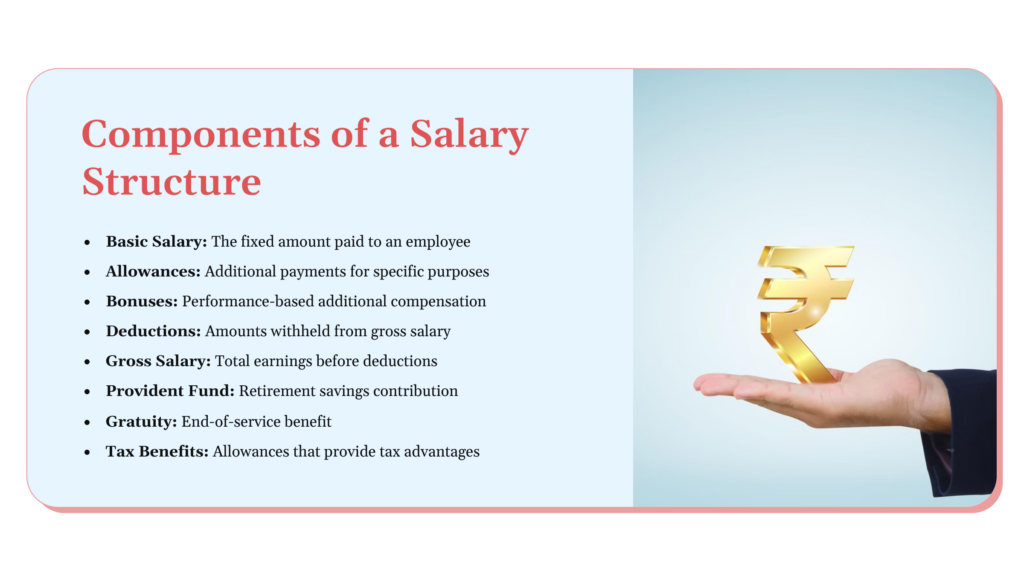
This includes basic salary, allowances (HRA, medical, etc.), bonuses, deductions (PF, taxes), and benefits, which contribute to total compensation.
CTC is the total cost to the company, covering all salary components, while in-hand salary is the amount received after deductions like taxes and provident fund.
Influenced by industry, company policies, job roles, experience, and location, helping employees negotiate and manage their finances better.
Table of Contents
The Salary Breakup Structure, also known as a CTC (Cost to Company) breakup, is a crucial yet often overlooked aspect of an employee’s financial understanding. Gaining a clear insight into your salary breakup empowers you to manage your finances more effectively and make well-informed career decisions. According to a LinkedIn survey, over 75% of employees in India find salary structures confusing, which can lead to misunderstandings regarding take-home pay, tax liabilities, and benefits.
A salary breakup provides a detailed overview of an employee’s total compensation by dividing it into specific components such as basic salary, various allowances, deductions, and additional benefits. This structure not only clarifies how your total package is organized but also helps you accurately calculate your take-home salary and manage your finances more efficiently.
The aim is to clarify the salary breakup structure by breaking down each component, providing a clear understanding of your earnings. Understanding your salary structure from basic pay and allowances to deductions and bonuses is essential for financial empowerment.
What is a CTC Salary Breakup Structure?
A CTC (Cost to Company) salary breakup structure outlines the different parts of your total salary. It breaks down your income into various components, each serving a specific purpose. This structured approach helps employees understand their earnings and the multiple deductions, ensuring transparency between employers and employees.
Salary Breakup Calculation
Salary breakup calculation is the process of dividing an employee’s Cost to Company (CTC) into various components like basic pay, allowances, deductions, and net take-home salary. It helps both employers and employees understand how much of the salary is taxable, non-taxable, and what the employee will actually receive.
Let’s look at some examples of salary structures to see how they differ based on roles and levels. Here’s how to figure out an employee’s net salary.
Example 1: Entry-Level Employee
Basic Salary: ₹15,000
HRA: ₹7,500
Conveyance Allowance: ₹2,000
Medical Allowance: ₹1,000
Special Allowance: ₹4,500
Gross Salary: ₹30,000 Deductions: ₹3,500 Net Salary: ₹26,500
Example 2: Mid-Level Manager
Basic Salary: ₹40,000
HRA: ₹20,000
Conveyance Allowance: ₹2,500
Medical Allowance: ₹2,000
Special Allowance: ₹10,000
Gross Salary: ₹74,500 Deductions: ₹8,000 Net Salary: ₹66,500
Example 3: Senior Executive
Basic Salary: ₹80,000
HRA: ₹40,000
Conveyance Allowance: ₹3,000
Medical Allowance: ₹3,000
Special Allowance: ₹20,000
Gross Salary: ₹1,46,000 Deductions: ₹16,500 Net Salary: ₹1,29,500
Customizing Salary Breakup for Employee Benefits
Many companies offer flexible salary structures, allowing employees to choose how their salary is broken up. This flexibility can help employees maximize their tax benefits and align their salary structure with personal financial goals.
Flexi-Pay: This option allows employees to adjust components like HRA, conveyance, and special allowances based on their needs.
Tax Optimization: Employees who live in rented accommodation or choose tax-exempt allowances can opt for a higher HRA.
Key Components of a Salary Structure
Understanding the components of your salary breakup is the first step to gaining clarity over your income. Let’s break down the typical components you will find in a salary structure:
1. Basic Salary
Definition: Basic salary is the core of your salary. It is a fixed part of your income and forms the basis for other salary components and benefits.
Characteristics: The basic salary is usually 40-50% of the total salary. It is fully taxable, and many other components, like allowances and contributions, are calculated as a percentage of the basic salary.
2. Allowances
Allowances are the benefits given to employees over and above the basic salary. They can be for specific purposes and can be either taxable or tax-free. Common allowances include:
House Rent Allowance (HRA): This is given to employees to cover their house rent expenses. HRA can be partially exempted from taxes based on certain conditions, such as the location of residence and the actual rent paid.
Dearness Allowance (DA): DA is primarily given to government employees to manage inflation. It is calculated as a percentage of the basic salary and is fully taxable.
Conveyance Allowance: This is provided to employees to cover their transportation costs between home and work. Up to a certain limit, the conveyance allowance is tax-free.
Medical Allowance: Medical allowances are given for healthcare expenses. Under certain limits, these can be tax-free if supported by bills.
Special Allowance: This is a residual category for any other benefits not covered under specific allowances. It is usually fully taxable.
3. Bonus and Incentives
Performance Bonus: Many companies offer bonuses based on the employee’s performance or the company’s profit. Bonuses are usually paid once a year and are fully taxable.
Incentives: These are additional payments to motivate employees. They could be for meeting targets or exceptional performance. Incentives can be regular or occasional, depending on the company’s policies.
4. Deductions
Deductions are subtracted from your gross salary to get your net salary (take-home pay). Common deductions include:
Provident Fund (PF): Both employees and employers contribute to the PF. The employee’s contribution is typically 12% of the basic salary, and it is tax-free up to a certain limit.
Employee State Insurance (ESI): This social security scheme provides medical and other benefits to employees as per the Employees’ State Insurance Actof 1948. It is deducted from the employee’s salary and contributed to the ESI fund.
Professional Tax: This is a state-level tax imposed on salaried employees, and it varies from state to state.
Income Tax (TDS): Tax Deducted at Source (TDS) is the tax deducted by your employer based on your income tax slab.
5. Gross Salary
Gross salary refers to the total earnings of an employee before any deductions. It includes the basic pay, house rent allowance (HRA), bonuses, and other allowances offered by the employer.
In-hand or Take-Home Salary
In-hand salary, also known as take-home salary, is the actual amount credited to an employee’s bank account after all applicable deductions. These deductions typically include Provident Fund (PF), Gratuity, Tax Deducted at Source (TDS), and Professional Tax.
Formula to Calculate In-hand Salary:
Net Salary = Basic Salary + Allowances – (PF + Gratuity + TDS + Professional Tax)
6. Employee Provident Fund (EPF or PF)
The Employee Provident Fund is a retirement savings scheme provided by the employer to help employees build a financial cushion for the future. Each month, a fixed percentage (usually 12%) of the employee’s basic salary is contributed to the fund, with the employer matching the same amount.
The accumulated amount can be withdrawn after one month of unemployment or during retirement. This fund forms a key part of an employee’s long-term financial security and is mandated under India’s retirement benefit policies.
7. Gratuity
Gratuity is a one-time lump sum payment made by an organization to its employees as a token of appreciation for their long-term service and dedication. Employees become eligible for gratuity after completing a minimum of 5 years of continuous service with the employer.
As per the Payment of Gratuity Act, 1972, the gratuity amount is typically calculated at 4.81% of the basic salary. It serves as a part of the employee’s retirement benefits and contributes to their financial stability post-employment.
Gratuity Formula (for employees covered under the Act):
Gratuity = (Basic Salary × 15 × Number of Years of Service) ÷ 26
Basic Salary: Last drawn basic pay (excluding bonuses and allowances)
15: Represents 15 days’ salary for each completed year
26: Number of working days in a month (as per the Act)
Example:
If an employee’s last drawn basic salary is ₹30,000 and they have completed 7 years of service:
After deducting allowances like PF, gratuity, and bonuses from the gross salary, the remaining amount is subject to income tax and professional tax. The tax liability is calculated based on the applicable income tax slab rates. Employees can opt for either the old tax regime (which includes various exemptions and deductions) or the new tax regime (with lower tax rates but no major deductions).
A salary slip is a document employers provide to their employees that outlines their earnings and deductions. Understanding how to read it can help you keep track of your income and manage finances better.
Gross Salary: This is your total salary before any deductions. It includes basic salary, allowances, bonuses, etc.
Deductions: This section lists all the deductions, such as PF, TDS, and professional tax.
Net Salary (In-Hand Salary): This is what you actually receive after all deductions. Net salary is calculated by subtracting deductions from the gross salary.
Example: Let’s consider a salary slip with the following details:
Component
Amount (₹)
Deduction
Amount (₹)
Basic Salary
43,750.00
EPF Contribution
5,250.00
House Rent Allowance (HRA)
21,875.00
Professional Tax
1,250.00
Conveyance Allowance
6,000.00
Child Education Allowance
4,000.00
Fixed Allowance (FA)
6,625.00
Gross Salary
82,250.00
Total Deduction
6,500.00
Total Net Payable
75,750.00
Salary Breakup Format
Given below is a simple salary breakup format with percentage used in India:
Component
Description
Percentage
Basic Salary
The fixed salary amount forms the base of the salary structure.
30-40%
House Rent Allowance (HRA)
An allowance to cover the cost of rented accommodation.
15-25%
Conveyance Allowance
An allowance to cover travel expenses related to work.
5-10%
Medical Allowance
An allowance is given to cover medical expenses.
5-10%
Special Allowance
The specific allowances paid by the company and it varies depending on the company’s policies and the employee’s position.
10-30%
Employee Provident Fund (EPF)
The employer matches the employee’s deduction towards retirement fund by contributing an equal amount.
12%
Total Fixed
55-75%
Difference Between CTC and In-hand Salary
Here’s a clear and concise table that outlines the key differences between Cost to Company (CTC) and In-hand Salary:
Aspect
Cost to Company (CTC)
In-hand Salary
Definition
The total amount a company spends on an employee, including all benefits, allowances, and deductions.
The actual amount an employee receives after deductions like taxes, provident fund, and other contributions.
Includes
CTC breakup: Basic salary, allowances (HRA, DA, etc.), bonuses, medical insurance, provident fund contributions, gratuity, and other perks.
Basic salary and allowances, minus deductions like PF, professional tax, TDS, and other contributions.
Purpose
Represents the total expenditure the employer incurs on an employee.
Represents the actual amount the employee takes home each month.
Components
All salary components, including both direct benefits (cash components) and indirect benefits (non-cash components).
Only cash components after mandatory and optional deductions.
Taxability
CTC includes taxable and non-taxable components.
In-hand salary is the net amount after applying all applicable taxes.
Bonuses and Perks
Included as part of CTC, even if paid out periodically (e.g., annual bonuses).
Not necessarily included in monthly in-hand salary; may be received separately.
Deductions
No deductions are made directly from CTC. CTC includes pre-deducted amounts like PF and insurance.
Deductions are applied before calculating the in-hand salary.
Negotiation
CTC is often used during salary negotiations to comprehensively view compensation.
In-hand salary is what employees usually focus on for their monthly budget and expenses.
Relevance
It is important to understand the total cost incurred by the employer for hiring an employee.
Important for employees to understand their actual monthly income for personal budgeting.
Calculation
Sum of all salary components and benefits provided to the employee.
Gross salary minus deductions (PF, taxes, professional tax, etc.).
Frequency
Represents annual or monthly CTC as part of the employment offer.
Monthly payment received after all deductions.
Importance of Salary Structure During Tax Planning
1. Tax-Free Allowances
Components like House Rent Allowance (HRA), Leave Travel Allowance (LTA), and meal/transport allowances can be partially or fully exempt from tax if structured correctly.
2. Maximizing Deductions
Salary-linked contributions such as Provident Fund (PF), National Pension Scheme (NPS), and gratuity qualify for deductions under Section 80C and 80CCD, reducing taxable income.
3. Choice Between Tax Regimes
A structured salary helps compare the old vs. new tax regime effectively to select the more tax-efficient option.
4. Reimbursements & Perks
Including elements like mobile, internet, or fuel reimbursements in the salary can be tax-free if claimed with proper bills.
5. Retirement Planning
Contributions to long-term savings (EPF, NPS, gratuity) not only reduce current tax but also build a financially secure retirement.
Conclusion
Understanding your salary breakup structure is crucial for effective financial planning. It clarifies your earnings, future savings, and the portion of your income allocated to taxes. Regularly reviewing your salary structure and consulting with your HR department can help you optimize your earnings, maximize tax savings, and secure a stable financial future.
A well-informed employee is better equipped to make smarter financial decisions. Therefore, take the time to fully understand your salary slip and the breakdown of your salary. It’s not just about what you earn, but how you manage and optimize your income that truly matters.
In-hand Salary = Gross Salary – Total Deductions (EPF + ESI + Gratuity + TDS + Professional Tax).
What is salary structure format?
A salary structure format typically includes base pay, allowances, bonuses, deductions, and benefits, outlined clearly for each position within an organization.
The formula for salary structure format for an employee would be: CTC = Gross Salary + EPF + Health Insurance.
What is 40000 CTC salary breakup?
A typical salary breakup for a ₹40,000 CTC (Cost to Company) may include the following components:
1. Basic Salary: ₹16,000 2. House Rent Allowance (HRA): ₹8,000 3. Conveyance Allowance: ₹2,000 4. Medical Allowance: ₹1,250 5. Special Allowance: ₹12,750 6. Provident Fund (Employer’s Contribution): ₹1,500 7. Professional Tax: ₹250
(Note: Actual breakup may vary based on company policies and local regulations.)
What is CTC and in-hand salary?
CTC (Cost to Company) is the total amount an employer spends on an employee. This includes various benefits and allowances. The in-hand salary is the actual amount an employee receives in their bank account after all deductions and taxes have been applied. In-hand salary is usually lower than the CTC. This is due to deductions such as taxes, provident fund contributions, and insurance premiums.
How is salary breakup calculated?
Salary breakup is typically calculated by dividing the total annual salary into various components. Common components include:
1. Basic Salary: 40-50% of total salary 2. House Rent Allowance (HRA): 20-50% of basic salary 3. Special Allowance: Remaining amount after other components 4. Provident Fund (PF): 12% of basic salary 5. Gratuity: 4.81% of basic salary (if applicable)
Adjust percentages based on company policy and local regulations.
How to give salary breakup?
To provide a salary breakup, include the following components:
1. Basic Salary 2. House Rent Allowance (HRA) 3. Conveyance Allowance 4. Medical Allowance 5. Special Allowance 6. Bonus/Incentives 7. Provident Fund (PF) Contribution 8. Professional Tax (if applicable) 9. Gross Salary 10. Net Salary
Ensure each component is clearly defined with corresponding amounts.
What is the standard salary structure?
The standard salary structure typically includes the following components:
Adjustments may vary based on industry, location, and company policy.
Authored by, Mansi Rawat Career Guidance Expert
Mansi crafts content that makes learning engaging and accessible. For her, writing is more than just a profession—it’s a way to transform complex ideas into meaningful, relatable stories. She has written extensively on topics such as education, online teaching tools, and productivity. Whether she’s reading, observing, or striking up a conversation while waiting in line, she’s constantly discovering new narratives hidden in everyday moments.