

relieving letter format

How To Write Relieving Letter - Best Formats, Uses, and Examples in 2025

Published on October 18, 2025
|
9 Min read time
relieving letter format

Quick Summary

  • A relieving letter is an official document issued by an employer confirming that an employee has formally left the organization.
  • It serves as proof of resignation acceptance and completion of exit formalities.
  • A clear and professional format ensures smooth transition and helps in future employment verification.

Table of Contents

A relieving letter is an essential HR document issued by an employer to formally acknowledge that an employee has been relieved of their duties and responsibilities after resigning from the organization. It serves as proof that the employee has fulfilled all necessary formalities, including serving the notice period, handing over tasks, and settling any dues. This letter is often required when joining a new organization, making it a crucial part of professional documentation for any transitioning employee.

When drafting a relieving letter format, it’s important to ensure clarity, professionalism, and adherence to company policies. A standard relieving letter includes key details such as the employee’s name, designation, department, last working day, and a confirmation that the resignation has been accepted. It may also include a note of appreciation for the employee’s contributions. For HR professionals and managers, maintaining a consistent and formal relieving letter format not only upholds the company’s reputation but also ensures smooth offboarding and future reference credibility. A relieving letter format outlines the official document issued by an employer confirming an employee’s resignation and successful exit process.

Read More: Resignation Letter Format with Samples

What is a Relieving Letter?

A relieving letter is an official document issued by an employer to an employee who has formally resigned from their position. It confirms that the employee has been relieved from their duties and has completed all necessary exit formalities, such as serving the notice period, returning company property, and clearing any dues. This letter acts as a formal acknowledgment of the employee’s departure from the organization and serves as a critical document for background verification and future employment.

Importance of a Relieving Letter?

  • Proof of Formal Exit: A relieving letter serves as official proof that the employee has resigned and been formally relieved from their duties, ensuring a documented and smooth separation from the organization.
  • Mandatory for Future Employment: Most organizations require a relieving letter during the hiring process to confirm that the candidate has no ongoing obligations or unresolved issues with their previous employer.
  • Validates Work Experience: Along with the experience certificate, a relieving letter adds credibility to an employee’s professional history, confirming their role, tenure, and final working day.
  • Helps in Background Verification: HR departments often use relieving letters during background checks to verify that the employee left their previous job ethically and completed all exit formalities.
  • Safeguards Employer and Employee Interests: It protects both parties legally by documenting that there are no pending liabilities or obligations, reducing the chances of future disputes or misunderstandings.
Earn more to Help Students Learn More

Relieving Letter Format

A relieving letter follows a specific format, as it is a professional and formal document. The relieving letter format for employee is a crucial aspect, ensuring the letter is clear and well-structured. It officially acknowledges the end of an employee’s tenure and must be drafted in a professional tone.
  • The letter typically begins with the company’s letterhead, followed by the date and the employee’s details such as name, designation, and employee ID.
  • It then states the employee’s last working day and acknowledges their resignation or termination. The body of the letter confirms that the employee has been relieved from their duties and that all company property has been returned.
  • It may include appreciation for the employee’s service and a note wishing them success in their future endeavors.
  • The letter should be signed by an authorized person, such as the HR manager or department head, and include their designation and contact information.
  • Using a formal tone and clear language is essential.
  • The letter serves as proof for the employee’s future employers that they left the previous job on good terms and completed the exit process.

Relieving Letter Format: Samples

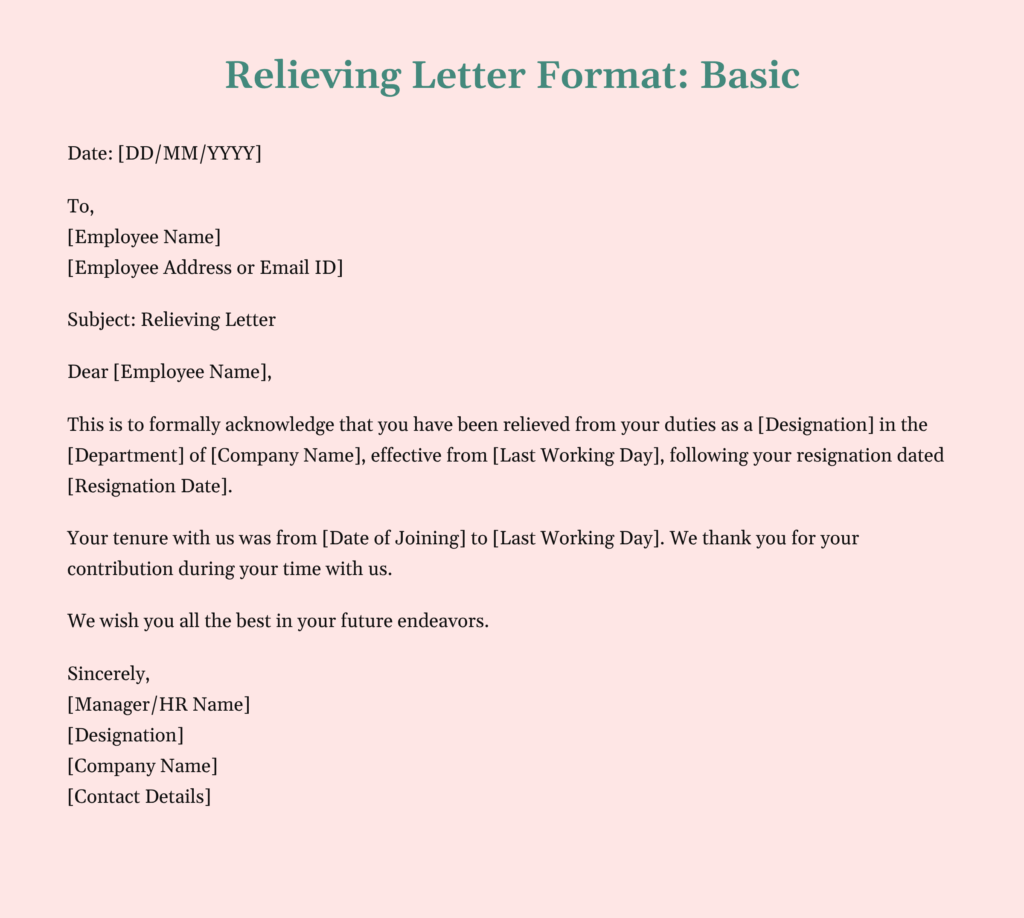
1. Basic Relieving Letter Template

relieving letter format


2. Detailed Relieving Letter Template (With Appreciation and Clearance Status)

Date: [DD/MM/YYYY]

To,
[Employee Name]
[Employee ID: ####]
[Employee Email/Address]

Subject: Relieving Letter

Dear [Employee Name],

This is to formally confirm that you have been relieved from your duties at [Company Name] as a [Designation] in the [Department], with your final working day being [Last Working Day]. You were associated with us from [Joining Date] to [Last Working Day].

We appreciate the contributions you made to the organization, especially in [mention specific achievements, if applicable], and your performance has been satisfactory throughout your tenure.

We also confirm that you have completed all exit formalities, and there are no pending dues or liabilities from your side.

We extend our best wishes for your future professional and personal success.

Warm regards,
[HR Manager’s Name]
Human Resources Department
[Company Name]
[Signature with seal]

3. Specialized Relieving Letter for Contract Employees

Example 1 – Contract Completion

Date: [DD/MM/YYYY]

To,
[Employee Name]
[Contractor ID: ###]

Subject: Relieving Letter Upon Completion of Contract

Dear [Employee Name],

This letter is to acknowledge the successful completion of your contractual assignment with [Company Name] as a [Designation], which commenced on [Start Date] and ended on [End Date].

We thank you for your services during the term of the contract. All responsibilities have been duly handed over, and there are no dues pending from your side.

We wish you success in your future assignments.

Sincerely,
[HR Manager Name]
[Designation]
[Company Name]

Example 2 – Early Termination of Contract

Date: [DD/MM/YYYY]

To,
[Employee Name]

Subject: Relieving Letter – Contract Termination

Dear [Employee Name],

This is to confirm that your contractual employment with [Company Name], initiated on [Start Date], has been concluded prematurely as of [Last Working Day], due to [brief reason if appropriate or “organizational changes”].

You are hereby relieved from all responsibilities. Necessary clearances have been completed, and there are no pending dues.

We thank you for your contribution during your tenure.

Regards,
[HR Manager Name]
[Company Name]

4. Specialized Relieving Letter for Terminated Employees

Example 1 – Termination Due to Performance

Date: [DD/MM/YYYY]

To,
[Employee Name]

Subject: Relieving Letter

Dear [Employee Name],

This is to inform you that your services with [Company Name] have been terminated, effective [Termination Date], following a performance review in accordance with company policy.

You are relieved from your duties as of [Termination Date]. We confirm that you have completed your handover and there are no dues from your end.

We hope you are able to grow and develop in your future opportunities.

Regards,
[HR Manager Name]
[Company Name]

Example 2 – Termination Due to Misconduct

Date: [DD/MM/YYYY]

To,
[Employee Name]

Subject: Relieving Letter

Dear [Employee Name],

Following an internal inquiry into the incident reported on [Date], your services have been terminated as per the disciplinary policies of [Company Name], effective from [Termination Date].

You are relieved from all roles and responsibilities with immediate effect. Please note that the necessary documentation has been processed, and any company property must be returned to the HR department.

We hope you understand the gravity of the matter and take necessary corrective actions in the future.

Sincerely,
[HR Manager Name]
[Company Name]

relieving letter format

Guidelines for Writing a Relieving Letter

1. Use Company Letterhead

  • Why: It authenticates the document and confirms that it is issued by an authorized representative of the organization.
  • Tip: Always print or generate the letter on official letterhead that includes the company logo, address, contact details, and registration number (if applicable).

2. Include Formal Salutation and Subject

  • Why: A formal salutation sets a professional tone, and a subject line makes the letter’s purpose clear.
  • Tip: Use “Dear [Employee Name]” and a clear subject like “Subject: Relieving Letter” or “Relieving Confirmation.”

3. Mention Accurate Dates

  • Why: Dates like the resignation date, last working day, and joining date validate the employment period and are crucial for background checks.
  • Tip: Double-check and clearly write all important dates in DD/MM/YYYY format to avoid ambiguity.

4. Use Clear and Concise Language

  • Why: The purpose of the letter is to provide a factual and straightforward confirmation of the employee’s exit.
  • Tip: Avoid jargon or overly emotional language. Stick to short, informative paragraphs that clearly communicate the message.

5. Express Gratitude and Professional Courtesy

  • Why: Ending on a positive note reflects well on the organization and leaves a good impression on the departing employee.
  • Tip: Include a simple line such as: “We thank you for your contributions and wish you success in your future endeavors.”

6. Add a Statement of Clearance (If Applicable)

  • Why: Confirms that the employee has completed all formalities and that there are no pending obligations or dues.
  • Tip: Use language like: “We confirm that you have completed all exit formalities and there are no dues pending from your side.”

7. Sign-Off by an Authorized Person

  • Why: The letter must be legally and officially valid, so it should be signed by a person with the authority to issue it—typically someone from HR or senior management.
  • Tip: Include the name, designation, and signature of the signatory along with company seal (if applicable). Avoid generic sign-offs.

8. Maintain a Neutral Tone (Especially in Termination Cases)

  • Why: Even in sensitive cases like termination, it’s essential to keep the language factual and non-inflammatory to avoid legal issues.
  • Tip: Avoid blame or emotional statements. Stick to terms like “as per company policy” or “based on the review process.”

9. Always Keep a Copy for Company Records

  • Why: Useful for future verification, legal, or HR audit purposes.
  • Tip: Save both digital and physical copies signed by both parties if possible.

10. Ensure Consistency Across All Employee Documents

  • Why: Uniform formatting and structure in HR documentation build trust and maintain professional standards.
  • Tip: Use standard templates and make sure the relieving letter aligns with offer letters, experience certificates, and other HR forms.

Read More: Prepare for Exit Interviews

Get Paid to Help Students Across the World - Earn With Chegg

Common Mistakes to Avoid in a Relieving Letter

1. Missing Key Dates

  • Why it’s a problem: Omitting the employee’s joining date, resignation date, or last working day can lead to confusion during background checks or future job applications.
  • Avoid this by: Always include the full employment duration with accurate dates in DD/MM/YYYY format.

2. Using an Informal or Casual Tone

  • Why it’s a problem: A relieving letter is a formal HR document; using casual language undermines its credibility and may appear unprofessional to future employers.
  • Avoid this by: Keeping the tone polite, concise, and strictly professional—avoid humor, slang, or emotional language.

3. Not Including an Authorized Signature

  • Why it’s a problem: A relieving letter without a signature and designation from a responsible authority (usually HR or reporting manager) may be rejected by future employers.
  • Avoid this by: Ensuring it’s signed, dated, and includes the name, title, and contact of the signatory, preferably on company letterhead.

4. Leaving Out Important Information

  • Why it’s a problem: Failing to mention the designation, department, or confirmation of clearance can create ambiguity about the employee’s role or whether they’ve completed all exit procedures.
  • Avoid this by: Including all relevant employment details such as role, tenure, department, final clearance, and a line of appreciation (if applicable).

5. Not Using the Company Letterhead

  • Why it’s a problem: A relieving letter without official branding may be questioned for authenticity.
  • Avoid this by: Always issuing the letter on your organization’s official letterhead that includes the logo, address, and contact information.

How to ask HR for a relieving letter

As an employee, follow the formal procedure to request the letter by writing to HR:

  • Draft an email to the HR Manager requesting the relieving letter. Keep it concise.
  • Inform of the date of resignation. Also, mention the designation or position for which you have resigned. Make sure to mention the exact tenure in the organization.
  • Mention the name of the reporting manager, if any. It makes it easy for the HR manager to communicate and reach out to the manager.
  • Request the formal document. Do mention the urgency of the situation.
  • Attach a copy of the resignation letter along with the email.
  • Wait for HR’s response. If there is no response, send a follow-up email requesting the relieving letter.
  • Contact the HR Manager or reporting manager if there is a delay.

After submitting their resignation letter, the employee requested a relieving letter. This request is a standard step in the resignation process, as the relieving letter serves as an official document confirming the employee’s release from their duties.

Conclusion

Many employees often overlook the importance of a relieving letter and mistakenly confuse it with a resignation letter. A resignation letter is written by an employee to formally request their resignation from a position. On the other hand, a relieving letter is issued by the employer, confirming the acceptance of the resignation and officially releasing the employee from their duties. It is an essential document that validates the employee’s smooth exit from the organization.

A relieving letter is important for both employers and employees. For employers, it serves as an official record of the employee’s departure and acknowledges the end of their tenure. It ensures that the notice period is completed and confirms the employee’s release from all company obligations, including the clearance of any pending dues or settlements. For employees, this document is crucial when joining a new organization, as it demonstrates a proper exit from the previous company.

Using pre-designed templates can make drafting a relieving letter more straightforward and efficient. Customizable formats allow employers to quickly create a formal and professional document tailored to specific needs. This article offers key information, examples, and relieving letter templates to help employers simplify the process and provide clear, well-structured communication during employee transitions. A well-crafted relieving letter ensures a smooth employee exit, serves as proof of employment completion, and supports future job opportunities with clear, professional documentation.

Frequently Asked Questions (FAQs)

Is a relieving letter mandatory?

While not legally mandated in all jurisdictions, a relieving letter is widely recognized as a professional best practice—especially in corporate settings. It serves as formal documentation confirming resignation acceptance, last working day, and cleared formalities. This makes it invaluable for both HR compliance and the employee’s future employment verification .

When should an employee receive the relieving letter?

A relieving letter is typically issued on or shortly after the employee’s last working day. In cases of termination or expedited exits, it may be provided immediately following completion of exit formalities. Employers often deliver both digital and physical copies for the employee’s records .

Give an example of a relieving letter sample?

A standard letter should contain:
• Date of issue
• Full employee details (name, designation, department, employee ID)
• Date of resignation and/or acceptance
• Last working day
• Confirmation of clearance (settlements, no pending dues)
• Optional—but recommended—appreciation note
• Authorized signature with name and designation
Optionally, details on final settlement timeline and return of company assets may also be included .

What if an employer refuses to issue the relieving letter?

If the employer delays or refuses to provide it, employees should follow up formally with HR in writing. They may escalate the request up the chain of command. In cases where the refusal is unjust and affects new employment, seeking legal or labor-office remedy may be warranted. It’s important both parties resolve exit and documentation issues amicably .

Can an employer deny a relieving letter?

Yes, an employer can deny a relieving letter if they believe the employee has not fulfilled their notice period, breached company policies, or left on unfavourable terms.


Authored by, Mansi Rawat
Career Guidance Expert

Mansi crafts content that makes learning engaging and accessible. For her, writing is more than just a profession—it’s a way to transform complex ideas into meaningful, relatable stories. She has written extensively on topics such as education, online teaching tools, and productivity. Whether she’s reading, observing, or striking up a conversation while waiting in line, she’s constantly discovering new narratives hidden in everyday moments.

Editor's Recommendations