


An informal letter format includes your address and date in the left corner at the top, then a friendly greeting such as “Dear [Name].” The body consists of an introduction, the body paragraphs with the substantial message, and conclusion paragraphs to extend best wishes, in addition to emotional wording. The letter is often signed off with a more personal closer (e.g., “Yours lovingly,” or “Regards,”) along with your signature.
An informal letter is a personal letter written to someone close to whom the individual may or may not have a professional relationship. These letters primarily address friends, family, or acquaintances. The purpose of these letters is usually to inform others about what is going on with them, and they are also used to ask others how they are doing.
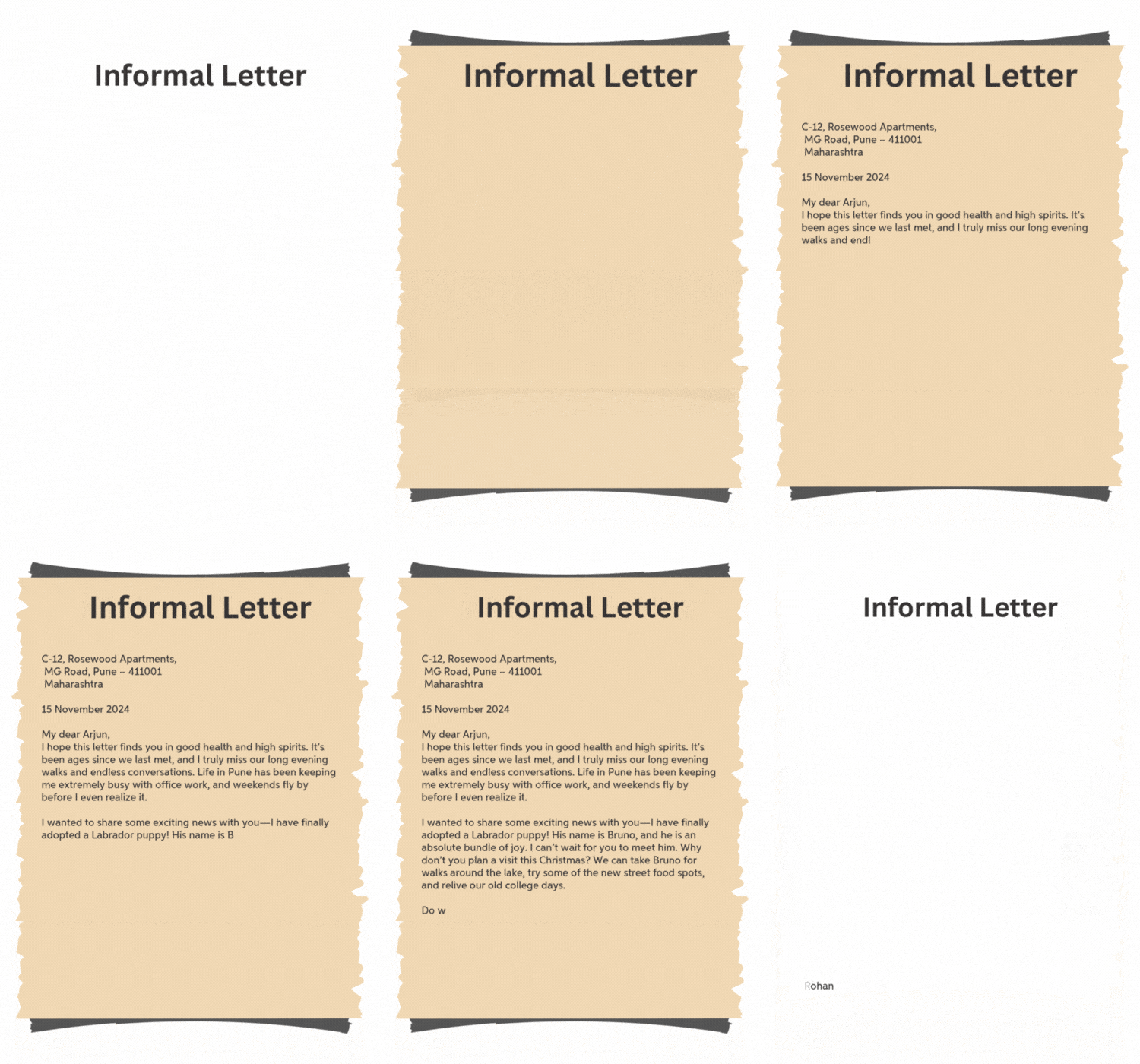
It is a friendly way of acknowledging others and casually checking in. The letter need not contain important information. It could be just a symbol of thinking about someone in one’s daily life.
Like any letter, there is a format to write an informal letter in English. There are a few easy guidelines that you can follow to be able to write impressive informal letters.
People write formal letters for professional purposes. The reader is someone of authority. So, the tone of the letter must be formal at all times.
An informal letter is very different from a formal letter in tone. It has a friendly aura to it. The words used and the purpose is always casual. There is no compulsion for an informal letter to have a specific purpose. A person can write an informal letter just because they feel like writing one.
Formal letters generally follow a standard format that cannot be changed drastically. Elements such as date, address, and salutations are pre-determined and must be used.
However, in the case of informal letter formats, there is no such hard and fast rule. Informal letter format is rough and needn’t necessarily be followed. As the letter is read by someone known, the matter discussed is personal. One can custom-write the letter, break paragraphs, and insert anything desired. Only a basic informal letter format needs to be followed.
A formal letter is for professional purpose. They could be business letters written to clients, partner companies, or authorities to register complaints and is always written in the third person.
An informal letter can be in the first, second, and third person. The letter is often addressed to friends, family, and other known relatives.
Formal letters are written in passive voice. Informal letter writing formats use the active voice. The sentences in formal letters may be long and complex, without contractions and abbreviations.
An informal letter is often short, simple, and for personal communication. It can be long or concise, depending on the writer’s whims. One can use idioms, metaphors, contractions, and abbreviations in an informal letter.
Formal letters are often to the point and only discuss the relevant matter. There is no beating around the bush, thus keeping it concise. An informal letter can be as long or short as desired. One can compose a long letter if there is a lot to communicate.
Read more: Formal Letter Format For Your Daily Use
There can be many contexts and needs for an informal letter. However, it is mostly employed for personal communication. The following are reasons we should be familiar with the informal letter format:

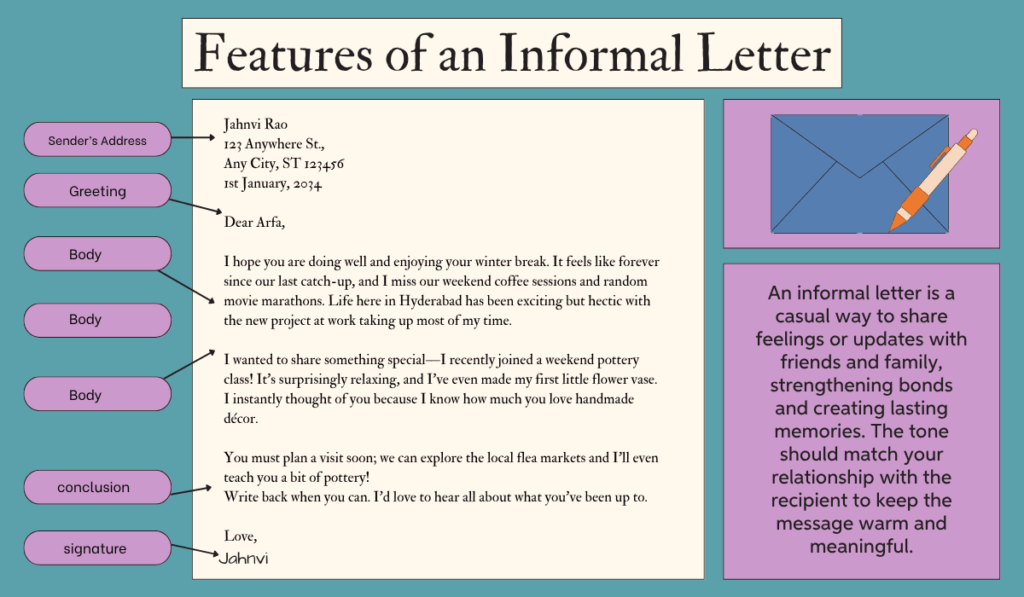
There are numerous formal and informal letter formats. At present, blocked/fully blocked informal letter formats are in use. In these, everything is left aligned.
The components of an informal letter format are as follows:
The first component of an informal letter format is the heading. This usually consists of the address line. Each address line is written below the other without making it a long sentence. The address of the sender is written first. The alignment followed in all standard letters is left.
The sender’s address must include pertinent details so that the receiver can write back if needed. Complete addresses with pin codes must be included. When writing to a different country, the country must be specified. The address is followed by the date of writing.
The greetings part of a letter follows the heading. In an informal letter, one can address the recipient as ‘dear’, their name, or both. For example, if the letter is to one’s friend named Steve (nicknamed Stevie), one can use the following greetings:
All these forms are acceptable in the informal letter format. If the letter is to Steve, an uncle, one could include that in the greeting:
This is a matter of personal choice. One can use a greeting based on how the person is generally addressed. Other forms of greeting used are:
Greetings in the informal letter format are quite flexible. If it is a friend or a sibling, slang or nicknames for the person are acceptable. When the letter is to elder relatives, Mr, Ms, or Mrs is used as applicable.
The body of the informal letter format is the third component that follows the greetings. Also called the main text, it consists of all the text the receiver should read.
In a friendly letter, the initial paragraph asks how the person is doing. A line should be skipped to make paragraphs. Common questions include asking about health, life in general, etc. One can ask about their studies and work if it is a student or a professional. For example:
The conclusion of the informal letter format is a significant part of the greeting. Short words should be used, and they should end with a comma. The last line should reflect that the writer enjoyed writing the letter. It should have a pleasant tone so the conclusion doesn’t feel sad. One can even include that they are awaiting a response to the letter.
Informal complimentary closes used in the informal letter format are as follows:
One can write their name or use a signature in the signature line of the informal letter format. The signature line should follow the complimentary close, leaving one or two spaces. One should address themselves as Mr, Mrs, or Ms as applicable. Nicknames may also be used.
Kartika Palace,
Sector 126,
Noida – 201304
Uttar Pradesh
24 February 2024
Dearest Hana,
I was overjoyed to learn you had graduated from high school and fulfilled your dream. I so wish I could personally congratulate you.
Hard work pays off! I have seen you work hard to achieve it all, and guess what? You did it, girl! I am so proud of you. I know you were scared, but I was always convinced you would pass with flying colours. Despite my best efforts, I was unable to attend the celebratory party.
I look forward to seeing you soon. Keep up the good work. Your prospects are excellent! My family expresses their sincere happiness for you, too.
With much love and regards,
Yours truly,
Pallavi
Sample 2:
44, ABQ Complex,
19th Cross Road
Chennai – 600006
Tamil Nadu
19 August 2024
Dear Mayug,
Hope you are doing well. How is work? Still the best employee?! I hope your parents are doing well. How are Timon and Simba? I miss their sloppy kisses so much!
I am inviting you to my birthday party on 8th September 2024. I have planned it at our family farmhouse. The party starts at 5 pm, and I expect to see you there. If you have questions about the venue, call Dada or me. I can also arrange for you to reach the train station.
It has been so long since we met, and I hope you can make it to the party. Can’t wait to see you again!
Take care.
Love and regards,
Komal
Sample 3:
B- 46, Sector 18,
Nehru Place,
Delhi – 400128
India
28 October 2024
My dear Shefali,
I hope everything is going well for you and your family. You know that my start-up strategy has taken up much of my time. We hardly get to spend meaningful time with our entire family. I have therefore organized a lavish gathering for us all.
Please visit me on 5th November 2024. Our whole family will be present, and we will relive moments we enjoyed during school days. I hope to see you and do the crazy things we used to do, like prank our cousins. The weather in Delhi is amazing, as usual. You will love it for sure.
I am waiting for your positive reply soon. See you soon!
Lovingly,
Aakarsh
Sample 4:
C-44, Sector 126
Raipur Village
Noida – 201303
Uttar Pradesh
2 April 2024
My dear Catherin,
I hope you are well. Mother and I have both been worried about you. Knowing you had a high fever and were being treated in the hospital was devastating.
Despite our best efforts, we could not visit you because of travel limitations. As the summer break has already begun, I was considering spending time with you in Noida. I want to show you around the city and meet my friends and family. Let’s go out and eat some food off the street! We can also relax close to the Hauz Khas Lake, maybe even hit the clubs.
Just the prospect of spending the holidays with you thrills me. I eagerly await your response.
Looking forward to hearing from you and seeing you.
Yours truly,
Suraj
The proper informal letter format helps you communicate warmth, sincerity, and authenticity. These qualities matter more than ever in 2025. Following a simple structure and adding your unique voice can strengthen relationships and make your messages memorable. Keep practicing, and you’ll see that informal letter writing becomes a valued way to connect with loved ones, regardless of the distance.

Informal Letter Format (Short):
Address & Date – Your address, then date
Salutation – Dear [Name],
Body – Friendly opening, main message, closing remark
Closing – Yours lovingly / Best wishes, [Your Name]
Example:123 Park Street Chennai – 600001 3rd Sept 2025 Dear Riya, Had a great trip to Ooty! Can’t wait to share stories. Yours lovingly, ABC
Tip: Keep it friendly and personal.
An informal letter is written to friends, family, or relatives to share news, feelings, or experiences.
Example: Writing to your friend about a recent vacation.
Tip: Keep it friendly and heartfelt, like a conversation.
Usually 3–4 paragraphs, but it can be shorter or longer depending on what you want to share.
Example: A short note about missing a friend or a longer letter describing a trip.
Tip: Focus on content, not length; keep it engaging.
Begin with a warm greeting and ask about the recipient’s well-being.
Example: “I hope you are doing well. I missed you a lot last summer!”
Tip: Make the opening friendly and natural, not stiff.
Conclude with good wishes, love, or a friendly note.
Example: “Take care and write back soon!”
Tip: Use closings like Yours lovingly, Best wishes, Lots of love to match the tone.
Yes, you can use simple, relaxed, and conversational language.
Example: “I had an amazing time at the beach, wish you were there!”
Tip: Avoid overthinking grammar; focus on sounding natural.
Start with the date at the top.
Add the recipient’s address (for formal letters).
Write a greeting (Dear [Name],).
Write the body: your main message clearly and politely.
Add a closing (Sincerely, Best regards, etc.).
Sign your name at the end.
Tip: Keep your tone and format suited to formal or informal letters.
You can start an informal letter by greeting the person and sending your regards. Then, clearly state the purpose of your letter.
Tip: Keep your tone friendly and natural to make the reader feel comfortable.
A formal letter is professional and straight to the point, stating your purpose and expectations clearly. An informal letter is casual and personal, written to someone you know well about anything you want to share.
Tip: Match your tone and style to the type of letter and your relationship with the reader.
Sender’s Address (optional)
Date
Greeting/Salutation (e.g., Dear [Name],)
Introduction (friendly opening)
Body (main message)
Closing (e.g., Best wishes, Take care,)
Signature (your name)
Tip: Keep each part personal and straightforward!