

When exam season approaches, one of the most common questions students ask is, “How to study fast and effectively?” Whether it’s preparing for a final exam, competitive test, or semester paper, learning how to study fast without losing focus or retention is the key to academic success.
In today’s fast-paced academic world, students face an overload of study material and limited time to cover everything. But the good news is you don’t need to study longer hours to score higher. Instead, you need the right study techniques for students that help you study smart, not just hard.
This detailed guide from Chegg India will walk you through proven strategies, effective study habits, and practical methods to help you study fast for exams, retain information better, and stay confident throughout your preparation

Understanding how the brain processes information is essential for mastering study tips for exams and developing effective study habits. The brain relies on short-term memory for temporary storage and long-term memory for lasting recall. Strengthening long-term memory is key to learning efficiently and remembering more.
Focus, repetition, and active recall are proven study methods that work: focused sessions reduce distractions, repetition reinforces neural connections, and testing yourself actively improves retention.
Neuroplasticity the brain’s ability to form new connections shows that techniques like visualization, spaced repetition, and teaching others help you study smarter, memorize faster, and adopt the best study strategies for exams. Applying these methods allows students to absorb information efficiently and maximize their learning potential.
Creating the right study environment is crucial to mastering exam preparation effectively. A well-structured space minimizes distractions, enhances focus, and allows students to study more innovatively and efficiently.
One of the best ways to master studying fast is to break down topics into smaller parts. A distraction-free area is essential for how to study effectively. A noisy or cluttered environment can hinder concentration and reduce productivity.
One of the best ways to master studying fast is to break down topics into smaller parts. Time management is key when students are learning study techniques. The Pomodoro Technique is an incredibly effective method:
One of the best ways to master studying fast is to break down topics into smaller parts. Music can aid focus if chosen wisely:
Optimizing your study space improves learning speed, allowing you to study fast and retain information efficiently.
One of the best ways to master studying fast is to break down topics into smaller parts. Your surroundings influence how fast you learn:
Fewer distractions = deeper focus.
One of the best ways to master how to study fast is to break down topics into smaller parts.. Being present in class regularly builds consistent learning momentum. Classes offer real-time explanations, live examples, and opportunities for active participation all of which boost memory and engagement.
Even if you’ve reviewed the material already, attending class reinforces learning and enables you to ask clarifying questions on the spot. Make class time a non-negotiable part of your study plan.
Students should use scientifically proven learning strategies to study efficiently and effectively retain information. If you’re wondering how to study fast, incorporating these tested strategies can significantly enhance your ability to absorb and retain information quickly and easily. Here are some of the students’ most effective methods to boost learning speed and efficiency.
Many students find studying challenging because they often rely on passive methods like rereading or excessive highlighting instead of actively engaging with the material. When figuring out how to study for exams, two of the most effective memory techniques are active recall and spaced repetition. These strategies help reinforce information, improve retention, and make learning more efficient, ensuring better performance on test day. One of the best ways to master how to study fast is to break down topics into smaller parts.
Instead of rereading your notes, challenge yourself to recall key points from memory.
This technique forces your brain to retrieve information actively, strengthening memory connections and making recall faster during exams.
Cramming might help in the short term, but long-term retention requires reviewing information optimally.
Testing yourself is a powerful learning tool. Use flashcards, mock quizzes, or apps like Brainscape and Quizlet to build question banks. Convert notes into Q&A pairs or create voice memos to quiz yourself verbally.
Combine retrieval practice with spaced repetition for best results. Reviewing mistakes immediately after a test improves retention significantly.
One of the most effective ways to study fast is by teaching what you learn. The Feynman Technique, developed by Nobel Prize-winning physicist Richard Feynman, promotes deep comprehension rather than rote memorization. By simplifying complex concepts and explaining them in your own words, you reinforce your understanding, identify gaps in knowledge, and improve retention, making the learning process faster and more effective.
Here’s how to use it:
This method forces you to break down complex topics and restructure them in your own words, making learning faster and more effective.
A mind map is a visual representation of a topic that helps you organize and connect ideas. Mind maps are invaluable for subjects like science, history, and business studies, where topics interconnect.
Mnemonics help quick recall by associating new information with familiar words, phrases, or patterns.
Not all students learn the same way. Identifying your learning style can help you study more efficiently:
Mastering speed-reading and effective note-taking strategies is essential for those looking to study fast while improving information retention. These techniques help process and absorb large volumes of material more efficiently, whether you’re preparing for exams or studying for personal growth. By incorporating these methods, students can enhance their learning speed and retention, making studying faster and more effective.
Speed reading is a skill that enables you to process information at a faster pace while maintaining comprehension. Here are key techniques to speed up your reading:
Mastering speed reading helps you process information quickly and prepares you for exams where time management is key.
Taking practical notes is essential for studying smartly and effectively retaining key concepts. Below are some proven methods that can enhance the quality of your notes, making it easier to review and recall important information when needed:
By applying speed reading and clever note-taking methods, students can study faster while improving long-term retention of information.
While making notes and planning is essential, how you review material matters even more. Educational research suggests using the following cognitive science-backed methods:
- Spaced Repetition: Instead of cramming, review information at gradually increasing intervals. This technique strengthens long-term memory.
- Active Recall: Rather than just reading your notes, test yourself on the material. Try closing your book and writing or speaking what you remember.
- Interleaving: Mix different topics or subjects in a single study session. This forces your brain to work harder and leads to better understanding.
Example: If you’re studying math and science, alternate between chapters instead of completing all math first, then science.
These methods make studying more efficient and help you retain information longer.
Today, in the digital era, technology can significantly enhance how to study smart by providing tools that make learning more engaging and efficient. Whether optimizing study sessions or quickly absorbing content, innovative platforms and apps can boost productivity and retention, helping students study faster with minimal effort.
Many apps leverage spaced repetition and organization to optimize learning, helping students understand concepts and how to study fast. These tools enhance memory retention by reinforcing information strategically, making studying more efficient and effective.
With the advent of AI, students can now use tools to generate quick summaries and explanations, making studying faster and grasping complex topics easier. These AI-powered tools enhance learning by breaking down information into simpler terms, helping students study smart and retain knowledge effectively.
Platforms like YouTube, Udemy, and Coursera allow students to access expert-led tutorials across various subjects. Video lectures cater to multiple learning styles, including visual and auditory, making complex topics easier to understand.
By incorporating these resources, students can enhance their studying efficiency, improve organization, and strengthen memory retention. Leveraging technology this way is a powerful strategy for those looking to study fast, making learning more accessible, engaging, and effective.
Creating a study timetable helps allocate your time wisely and avoids last-minute stress. Use tools like Google Calendar, Notion, or GoConqr to block out focused sessions and breaks.
Plan shorter sessions daily instead of long weekend marathons. Color-code subjects, assign goals per session and review your schedule weekly to stay aligned with academic deadlines and personal goals.
Besides content-focused tools, use productivity apps that enhance focus and motivation. Popular choices include:
These tools make studying more structured, engaging, and effective.
Fast studying is only effective if your brain is well-rested and your body is energized. Don’t overlook your physical and mental health:
Your brain is your most potent tool—take care of it.
The right tech can speed up your learning:
Use tools that support not distract from your goals.
It is crucial to study fast and retain information efficiently. Tuning your lifestyle is as vital as using effective study techniques while learning. It is essential to use effective study techniques, as getting enough sleep, maintaining a balanced diet, exercising regularly, and managing stress can significantly enhance brain function and focus. Students can optimize their learning potential by prioritizing physical and mental well-being and improving academic performance.
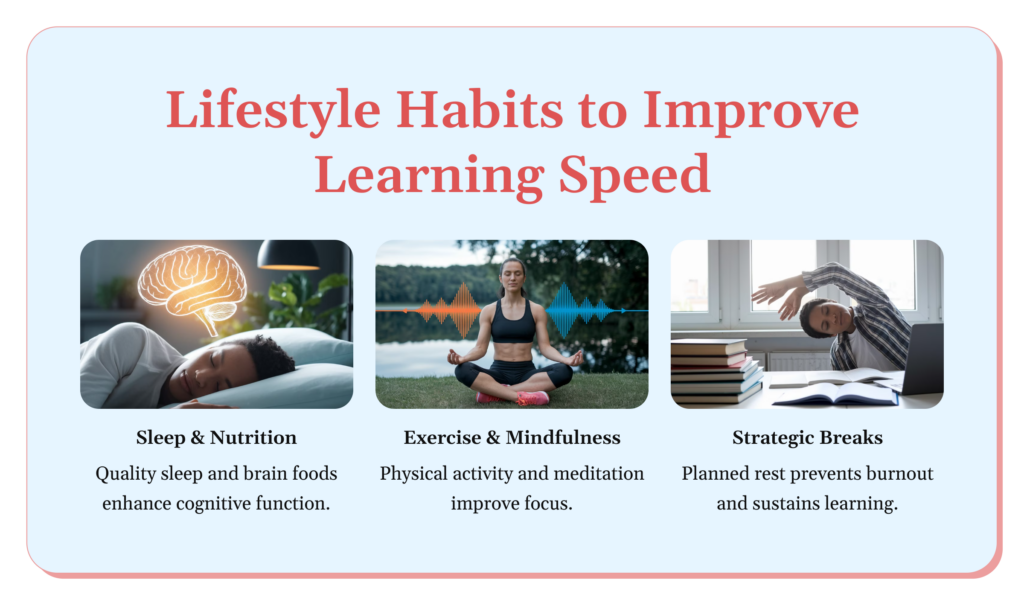
Sleeping 7-9 hours each night is essential for memory consolidation. Sleep helps transfer information from short-term to long-term memory, ensuring better recall. Without sufficient sleep, learning becomes slower and less effective. Nutrition also plays a vital role in cognitive function. Some brain-boosting foods include:
Physical activity promotes the flow of oxygen and nutrients to the brain, enhancing cognitive abilities and improving memory retention. Regular exercise also helps reduce stress, allowing you to study effectively without mental fatigue.
In addition, meditation and deep breathing exercises reduce stress hormones like cortisol, improving concentration and focus. Practicing mindfulness for just a few minutes daily can significantly improve one’s ability to study smart.
To keep you Burnout sharp, take quick breaks while you study. These breaks prevent your mind from getting tired and help your brain soak up information better. Don’t forget to drink enough water, too; not having enough can make it challenging to focus and stay alert, which makes learning harder.
When students use these everyday tricks, they can learn quickly, keep their energy up, and remember more of their studies.
Meet Aarav, a commerce student preparing for competitive exams. Initially overwhelmed, he shifted from passive reading to active recall using flashcards. He scheduled his day using the Pomodoro method and studied in 25-minute focused intervals.
He also joined a study group that met thrice a week and taught key concepts to his peers. Within 6 weeks, his mock test scores jumped by 25%. Aarav’s story shows that fast and effective studying is achievable with the right tools and discipline.
Every stage of education brings unique challenges. Adapting study methods accordingly ensures better results and lower stress.
While self-study has its benefits, joining study groups and teaching concepts to others can greatly enhance how to study fast and improve retention. Collaborative learning makes sessions more engaging, reinforces understanding, and strengthens long-term memory. Discussing ideas with peers helps you grasp concepts quickly and retain them longer, making your learning process both efficient and enjoyable.
Group study encourages discussion and the exchange of ideas, allowing students to gain fresh perspectives on how to study smart. Each participant’s contribution simplifies complex concepts, reinforces learning, and enhances understanding. Active recall is strengthened when students quiz each other, helping everyone remember the material more effectively. Peer teaching also enables students to articulate ideas clearly, identify knowledge gaps, and ensure deep comprehension.
Teaching others is one of the most effective ways to reinforce your understanding. Explaining a topic forces you to simplify and clarify concepts, making even difficult ideas easier to grasp. It also fosters critical thinking and problem-solving skills, as you anticipate questions, address misunderstandings, and explain concepts from multiple angles. Incorporating teaching into your routine transforms passive learning into active engagement, improving both memory and overall study efficiency.
Teachers and mentors are invaluable resources in your journey to study fast. Don’t hesitate to ask questions or seek clarification when concepts are unclear. Engaging with educators reinforces understanding and often provides new insights. Attend office hours, post queries on learning platforms, or follow up after class. Seeking feedback proactively improves comprehension and builds confidence.
When forming a study group, select members with similar goals and complementary strengths. Assign topics, quiz each other, and review challenging sections collaboratively. Rotate teaching roles explaining topics to peers deepens understanding for everyone. Keep groups small (3–5 members) and schedule regular sessions. Use shared online tools like Discord, Notion, or Zoom to coordinate efficiently. By combining group study and peer teaching, students can learn faster, retain more, and master concepts effectively.
During exams, flexibility is vital. Prioritize high-impact topics and allocate time based on subject difficulty. Use more active recall than passive reading. Review past papers, simulate timed exams, and focus on understanding question formats.
Also, adjust your environment minimize distractions, sleep well, and maintain a balanced diet. Adapting intelligently under pressure can significantly improve performance.
Studying fast isn’t just about techniques and schedules it’s also about caring for your body and mind. A healthy, well-rested brain processes and retains information much faster. Here’s how to stay physically and mentally prepared:
Good health supports good learning. When your body is balanced, your brain performs at its best.
Studying fast isn’t about cramming or rushing through material it’s about being intentional, focused, and strategic. Understanding how to study fast allows you to prioritize key concepts, manage your time effectively, and adopt study methods that actually work. By combining active recall, spaced repetition, and efficient note-taking with a distraction-free environment, you can absorb more information in less time, improve retention, and approach exams with confidence. Remember, effective studying is about quality, not just quantity.
To truly master how to study fast, integrate these techniques into your daily routine and adjust them to suit your personal learning style. Track your progress, review regularly, and use group discussions or peer teaching to reinforce understanding. Over time, these habits not only improve exam performance but also build lifelong learning skills that are invaluable for your academic and professional growth. Start small, stay consistent, and you’ll see noticeable improvements in both efficiency and results.
Read more: How to Study for Long Hours: 7 Effective Tips for Success

The fastest and most effective way to study is by using active recall (testing yourself instead of rereading), spaced repetition (reviewing at increasing intervals), and the Pomodoro Technique for time management. These strategies help you retain more in less time.
Quality matters more than quantity. For most students, 3–5 focused hours per day with breaks is ideal. Break study sessions into 25–50 minute chunks to avoid burnout and boost productivity.
Eliminate distractions by studying in a quiet space, turning off notifications, and using focus apps like Forest or Cold Turkey. Techniques like mindfulness, short breaks, and the Pomodoro method can help sustain 100% concentration.
It’s a spaced repetition strategy where you review material after 2 days, 3 days, 5 days, and 7 days. This method strengthens long-term retention and helps you remember concepts for exams.
Use memory techniques like mnemonics, mind maps, and the Feynman technique (teaching concepts in simple terms). Pair them with spaced repetition to retain information longer.
Top student favorites include:
Anki & Quizlet (flashcards with spaced repetition)
Notion & Evernote (organized note-taking)
Forest (focus timer)
Khan Academy & YouTube EDU (quick concept explanations)