It is not uncommon for students to search for ways to pass exams without studying. While most learners plan their preparation, many cram at the last moment, leading to stress and unfinished chapters. You are not alone if you have been stuck in this cycle before every exam. This guide offers practical suggestions and expert-backed strategies on how to pass without studying for exams even with limited preparation.
Passing exams without studying is extremely difficult and comes with significant risks. However, maximizing classroom learning by paying close attention to concepts during lectures can improve your chances. During the test, staying calm, answering easier questions first, eliminating incorrect options, and making educated guesses (when there’s no penalty) are effective strategies. That said, relying solely on shortcuts often results in a shallow understanding, which may affect your future academic and professional growth.
In this article, you will discover useful tricks and realistic insights into exam-taking strategies that can help when preparation time is limited. While there is no true substitute for consistent study, applying these methods can ease pressure, enhance performance, and guide you toward better exam outcomes.
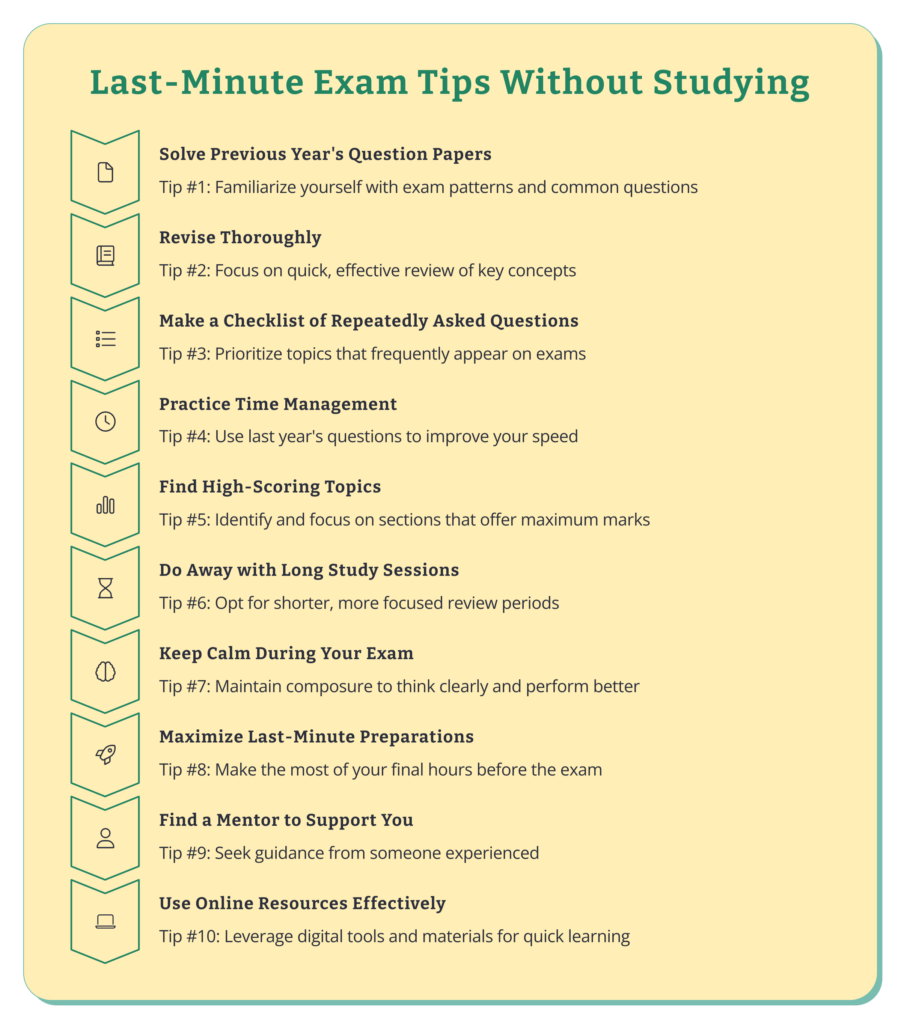
Students frequently search for tips on how to pass your exam without studying, but mastering concepts is the best way to succeed. If you are one of those who want to know how to pass in exam without studying, the approaches mentioned below might help you. Here are a few tricks about how to pass exams with top grades.
Nothing can be more helpful than reviewing the previous year’s question papers to help you prepare. Solving last year’s questions will help you gain insight into the exam type and pattern. You will understand the questionnaire format and mark distribution. Knowing all this information makes you feel confident and can work dedicatedly to ace the exam, which is part of the strategy for how to pass your exams without studying.
Reviewing previous year’s question papers will help you learn about the top questions that have come already. Using this knowledge, you can excel in your revision game. You can also manage the revision following the question pattern, which is a key element of how to score good marks without studying.
One of the most impactful benefits that you can reap by going through the previous year’s question papers is that you will gather knowledge on the repeatedly asked questions. This method will teach you how to pass your exams without studying by focusing on the most important topics and patterns.
When it comes to exams, every student gets scared of time management. It is one thing that can ruin your entire preparation. Make the most out of last year’s questions – practice the papers following a time constraint and stop being afraid. This approach is a key part of how to pass exams with good grades without studying, as it helps you get familiar with the exam format and boosts your confidence in handling time effectively.
This is known to be one of the result-oriented methods. If you don’t have much time life before your exam or you have several chapters to cover, you can follow these techniques to score well in the exam–
While researching how to score good marks without studying, it is discovered that time management is a crucial factor. We can understand the pressure you must be feeling to prepare for exams and how to write exams without studying. However, taking breaks once in a while can be fruitful. Let us tell you why – the long hours of cramming will lead your brain to stop processing the information you take in, and you may even get distracted often during your studies. Do these situations sound familiar to you? If yes, taking short breaks of some minutes or half an hour between your study periods would be wise, and it’s a great strategy for mastering how to pass without studying.
Taking breaks is especially important when preparing for board exams, as effective study techniques can help reduce stress and improve focus during this crucial preparation period.
Recommended reads: How to Study for Long Hours

You should keep calm before your exam too. You may mess with your study plans and practice time by not keeping calm. Exam jitters can get on your nerves, and you may experience discomfort. If you are worried about what to do 1 hour before the exam, you should not panic and remain calm.
You can always stop such situations by keeping tension at bay. You must thoroughly review the question papers and understand which questions you can attempt easily and which ones can be the hardest. Since you require managing time, you should attend easy ones first and then move to the toughest parts.
While some may wonder how to pass without studying, the key lies in adopting effective study techniques. If you have not studied adequately, you may not get good marks. If you are worried about passing only, you must not sit idle during the last hours before the exam. You should understand the syllabus, question pattern from previous years, and which questions you can answer quickly and easily. Read the notes and understand the outlines of the essential topics. You should not study unfamiliar topics because you might forget the important ones. These are all smart strategies for how to pass without studying, focusing on maximizing your efficiency and making the most of your time before the exam.
While you can do all the things on your own, it can be a great help if you can find a student mentor. The mentor will help you understand complex topics easily, keep a watch on your studies and teach you how to pass without studying. This way, you can manage time efficiently and excel in your studies. However, you must ensure this mentor has completed the grade you are in with good marks and has faced similar situations, providing valuable insights into how to pass without studying effectively.
In today’s digital age, there are numerous online resources available that can help you prepare for your exams. From video lectures to online tutorials, and study groups to online forums, the internet has made it easier than ever to access study materials and connect with others who are going through the same experience. To use online resources effectively, make sure to explore strategies and tips on how to pass without studying while focusing on key concepts and exam patterns to maximize your performance:
It’s tempting to find a way how to pass without studying, but effective studying is the real key to success. By using online resources effectively, you can increase your chances of passing your exams and achieving your academic goals.
When the exam is just around the corner, it’s important not to overstress yourself but instead focus on practical strategies that can help you perform well, even if you haven’t studied extensively. Whether you are naturally confident in exams or facing the pressure for the first time, last-minute preparations play a crucial role. There is no magic formula for passing without studying; rather, success depends on staying calm, applying smart techniques, and making the most of your existing knowledge.
For example, many students find it helpful to review class notes or summaries instead of starting new chapters at the last minute, as this reinforces what they already know. Another proven approach is to practice with past exam papers or sample questions, which boosts confidence and familiarizes you with the exam pattern. Additionally, simple steps like getting enough sleep the night before, eating a light but energy-rich breakfast, and arriving early at the exam hall can significantly impact your focus and performance.
By applying these real-life strategies, you increase your chances of doing well without putting unnecessary strain on yourself.
Memory techniques are strategies or methods used to aid in the retention and recall of information, simply helping you to memorize faster. These techniques leverage various cognitive processes such as visualization, association, and organization to make information more memorable.
i) Chunking: Another memory technique is chunking. In this method, you can store different information in groups to help you memorize concepts. For example, to memorize a long sequence of numbers- 349857632, you can try chunking them into smaller groups like 349 857 632.
ii) Mnemonics: Mnemonics are memory aids that help you remember information more effectively by associating it with familiar or easily recallable cues. For example, VIBGYOR helps in recognizing the colors of the rainbow (Violet, Indigo, Blue, Green, Yellow, Orange, and Red).
iii) Note it down: You can keep your memory afresh by following the old-fashioned method – write. You can keep a lot of information in your brain by writing it down while studying.
If the exam carries a negative mark, we will advise you to choose answers only if you are sure. You shouldn’t take wild guesses. However, you must attempt all the questions if the exam doesn’t have negative marking. Since your final marks will not decrease but may increase, you can make some wild guesses.
Never underestimate the power of a good breakfast, especially one rich in slow-release energy sources like oats or whole grains. Hunger and low blood sugar levels can be a significant distraction during exams.
Ensure you pack everything you need for the exam – pens, pencils, erasers, and any other stationery. Familiarize yourself with the route to the exam venue ahead of time to alleviate any last-minute anxiety about getting there.
Take a moment before you begin to plan out your time. Skim through the paper, noting question types and weighting. Begin with the sections you feel most confident about to build momentum.
Recommended reads: How to Score Good Marks in Maths
When faced with a difficult question, it’s easy to get stuck and unsure of what to do. However, there are several strategies you can use to increase your chances of getting the correct answer. Here are a few tips:
By following these tips, you can increase your chances of getting the correct answer and achieving success on your exams.
We can’t ignore that the exams shape our future and set our career path. While we have offered you tips and tricks to help you learn how to pass without studying, we will also encourage you to take tests seriously. These tips will support you in immediate situations and help you score top marks in the exam. You don’t always need to study hard to get top marks or pass. If you employ tactics and methods, such as how to pass without studying, you can excel in your exam exponentially.
Staying positive and motivated is crucial when it comes to passing exams. It’s easy to get discouraged and feel overwhelmed, but it’s essential to keep a positive attitude and stay focused on your goals. Here are a few tips to help you stay positive and motivated:
Maintaining the right mindset is just as important as academic preparation. Many successful students and experts emphasize that confidence and positivity can strongly impact exam performance. Here’s how you can stay motivated:
Exams are not just a test of knowledge-they are also a test of endurance. Prioritizing adequate sleep, nutritious meals, and hydration ensures your brain functions at its best. Many toppers credit their exam success not only to preparation but also to maintaining physical and mental well-being.
Evaluate numerous career choices to choose the right career path for yourself. Dive into our guide on Career Advice.
Start by reading all questions carefully, answering those you feel confident about first. Use elimination in multiple‐choice questions. Use general knowledge and logical inference to fill gaps. Keep track of time and avoid overthinking. Being relaxed and hydrated helps maintain clarity
If you haven’t studied, maximize what you already know: focus on exam patterns by reviewing past papers, attend class actively, use logical reasoning for unfamiliar questions, and stay calm during the test. Good sleep, a healthy breakfast, and careful time management also lift performance.
Even without heavy preparation, you can score well by focusing on exam strategy. Review past papers, understand marking patterns, and use logical reasoning for unfamiliar questions. Attempt what you know first, manage time wisely, and maintain calm focus. Proper rest, hydration, and a clear mindset boost recall and performance.
You should study hard and keep practicing to get good marks on the exam. You should know how to answer with examples. You must focus on reading texts more often. You should revise the previous year’s question papers to understand the mark distribution system and question pattern. This technique will help you become more confident in answering the exam.
To aim for full marks, thoroughly understand the exam format and marking scheme. Practice previous papers and mocks under timed conditions. Learn key details (definitions, formulas, structure), check answers carefully, avoid careless mistakes, and ensure presentation clarity. Consistency and feedback help you polish both correctness and completeness.
When unprepared, your focus should be on exam-hall performance. Read all questions first, start with high-confidence answers, and use reasoning for the rest. Write clearly, manage your time per section, and avoid leaving blanks. A positive, composed mindset often helps outperform expectations
Topping an exam without study is rare, but smart test-taking can maximize scores. Analyze paper patterns, practice summarizing key points, and improve answer presentation. Confidence, logical reasoning, and clarity in writing often impress evaluators. Combine calm focus, good time management, and structured thinking for best results.