


Did you know that over 100 million startups are launched globally every year, yet nearly 90% of them fail within the first few years due to lack of funding and poor financial planning? In the highly competitive landscape of modern e-commerce and entrepreneurship, securing capital becomes the biggest challenge for most founders. This is where bootstrapping a startup in India emerges as one of the best business funding strategies for entrepreneurs who want complete independence and control.
So, what is bootstrapping in business? Bootstrapping is the process of building a startup with personal savings, reinvested profits, or internal cash flow—without relying on venture capital, angel investors, or bank loans. While it comes with risks, it also empowers entrepreneurs with financial freedom, decision-making authority, and sustainable growth. In this guide, we’ll explore the meaning of bootstrapping in entrepreneurship, its advantages, challenges, and proven strategies to help you succeed as a self-funded entrepreneur in India 2025.

Bootstrapping is a statistical method that involves resampling a dataset with replacement to estimate the properties of a statistic (e.g., mean, variance, confidence intervals) or to assess its accuracy. It involves using personal savings, revenue generated by the business, and careful resource management to fund operations and expansion rather than seeking external funding from investors or loans.
If you have someone who is planning to start his own business, read this guide to know How to Write a Business Plan for Startup.
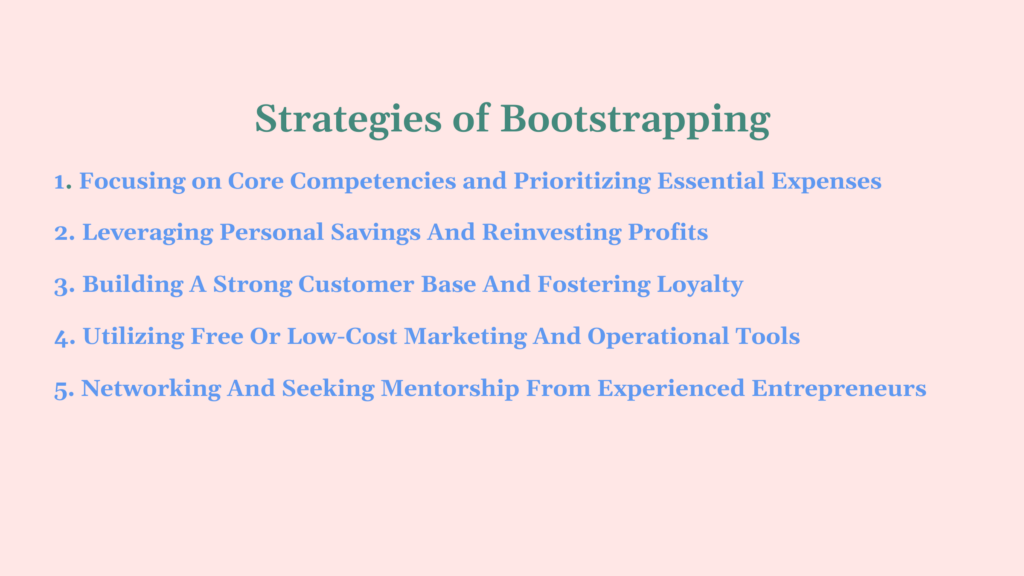
In a bootstrapped startup, every rupee counts, so focusing on core competencies and prioritizing essential expenses is key. Invest in what drives the most value—whether it’s customer acquisition, product development, or service quality—while cutting non-essential costs. By channeling limited resources into your strengths, you can build steady revenue, sustain growth, and succeed without external funding.
Leveraging your savings and reinvesting profits will help support the expansion of your business. When it comes to bootstrapping, you might struggle to secure traditional funding from sources such as venture capital. Seeking alternative sources like crowdfunding, grants, and personal savings can provide resources to your startup without giving up equity or control of the business.
Nurturing a loyal customer base is crucial for bootstrapping in business. It will give you more than positive feedback. When your customers feel acknowledged and valued, they will promote your brand, drawing in new audiences through positive referrals. This can lower your cost of acquiring new customers and lay a strong foundation for sustainable business growth.
Take advantage of free or low-cost tools and marketing resources like open-source software, cloud-based services, and freemium products. These can help you save money on infrastructure, software, and other essential tasks. You can also hire interns to help with tasks like design and marketing, which will help cut costs on long-term employee investment.
Networking and partnerships are essential for building relationships and collaborating with others to achieve common goals. In the context of bootstrapping, networking and seeking mentorship are valuable as they provide access to resources and expertise that you might lack. Additionally, you can network with other entrepreneurs to find potential partners and customers. This type of seamless networking can help your business gain valuable insights and potentially secure funding.
People choose bootstrapping—funding and growing a business without external investment—for several reasons:
Bootstrapping and building your business without external investment might sound challenging, but the benefits are substantial. From retaining full control to learning to adapt to challenges, bootstrapping can make you a better founder. Let’s explore some advantages of bootstrapping.
Bootstrapping is an excellent non-dilutive financing method. You and your co-founders will be the sole owners of your business, allowing you to have more control over its direction. This increased control lets you concentrate on building a solid foundation and perfecting your business operations for long-term development.
Accepting investments from external sources obligates you to them. However, with bootstrapping, you focus only on your team and customers. You control your business budget, set financial goals, and build strategies without investor interference.
It is no secret that today’s landscape is growing fast. When you understand the bootstrapping meaning in business, it encourages learning and growth. This approach drives you to build a profitable business model. With positive cash flow, you can transform your startup into a multinational business.
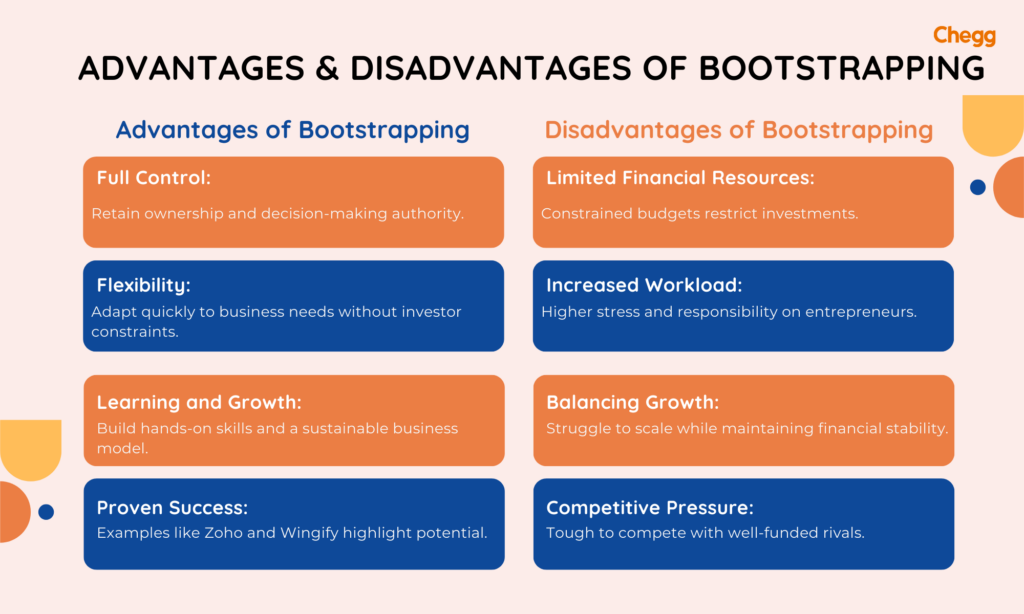
Bootstrapping isn’t the best option for every startup. While it can offer a plethora of benefits, bootstrapping also comes with its own set of challenges. Some of the key challenges are:
Bootstrapped businesses often struggle to achieve exponential growth. They focus on building their minimum viable products or keeping their operations intact. At the same time, they don’t want to spend too much when they invest on their own. With a relatively low budget, entrepreneurs struggle to balance growth with financial stability.
| Aspect | Advantages | Disadvantages |
|---|---|---|
| Control | Full ownership and decision-making freedom | No external guidance; all decisions on founder |
| Flexibility | Adaptable strategies and budgets | Limited resources can restrict growth |
| Learning & Growth | Develops skills and business acumen | High workload and pressure on entrepreneur |
| Financials | Retain equity; non-dilutive funding | Budget constraints may limit expansion |
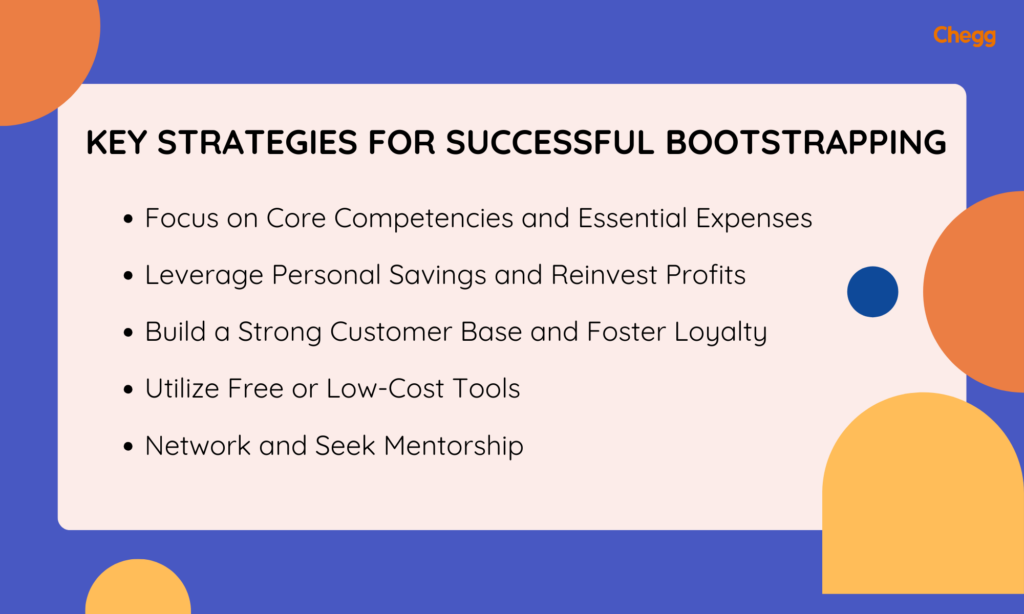
Here are 5 key points that define a Bootstrapped Success Formula:
Determining the most successful bootstrapping business can be subjective, varying based on criteria like revenue, impact, and industry recognition. Here are some examples of successful bootstrapped businesses:
Deals with – Online productivity tools and business software solutions.
Deals with – Conversion rate optimization (CRO) software.
These examples illustrate how bootstrapping can enable entrepreneurs to build successful companies through innovation, strategic focus, and effective leveraging of personal resources. Each founder’s commitment to their vision and initial investment of personal funds played crucial roles in the early stages of their companies’ growth and eventual success.
Case studies of successful companies that started with bootstrapping are mentioned below.
Founder: Sara Blakely
Industry: Fashion and Apparel
Founder: Michael Arrington
Industry: Media and Technology
Founder: Nick Woodman
Industry: Consumer Electronics
Read about Small scale business ideas for your business which require low investment.
Bootstrapping in business is more than just funding your startup without investors — it’s a mindset that combines independence, resourcefulness, and resilience. For entrepreneurs who value full control and sustainable growth, bootstrapping can be the best investment plan to build a profitable business. While challenges like limited resources and high workload exist, the rewards of ownership, flexibility, and long-term stability make it worth the effort.
To succeed, you need discipline, smart strategies, and the ability to adapt quickly to changing market conditions. If you’re ready to put in the hard work and embrace the power of self-funded entrepreneurship, bootstrapping can turn your business idea into a thriving success story in 2025 and beyond.
Bootstrapping is the art of building a business from the ground up without relying on outside investors or venture capital. Despite the risks, this approach offers unparalleled freedom and control over your entrepreneurial journey.
Bootstrapping in data analysis is a resampling technique where multiple samples are drawn with replacement from a dataset to estimate statistics, assess variability, and improve confidence in results without needing additional data.
Bootstrapping is a resampling technique where multiple samples are drawn with replacement from a dataset to estimate statistics, assess variability, and improve confidence in results without needing additional data.
In compiler design, bootstrapping refers to the process of writing a compiler in the same programming language that it is intended to compile. It’s a clever and efficient technique where a basic or partial version of the compiler (usually written in another language) is used to build a more advanced version of the compiler in its own language.
Bootstrapping is also known as the “resampling method” or “self-sampling”. It involves repeatedly drawing samples with replacement from a dataset to estimate statistics like means, variances, and confidence intervals without assuming a specific data distribution.
In a business context, “bootstrapping” means starting and growing a company by using your own resources rather than relying on external funding like loans or venture capital. It’s essentially self-financing, leveraging personal savings, initial sales, and reinvesting profits to fuel growth.
Bootstrapping forces startups to create sustainable business models from the start and generate revenue early on. This can build a more robust and viable business in the long term. Without external funding, startups have more flexibility to pivot if needed.
GoPro is known for its line of cameras that capture people in action—skiing, skateboarding, and skydiving, for example. It was valued at up to $3 billion when it went public in 2014, but GoPro was started as a small, bootstrapped company by founder Nick Woodman in 2002. He used a family loan to build his business.
Bootstrap marketing refers to the practice of promoting a business using minimal resources and budget. It is crucial for small businesses, especially startups, as it allows them to reach their target audience and build brand awareness without significant financial investment.


