

A maternity leave application is a formal letter submitted by an expecting employee to request time off from work before and after childbirth, as per the organization’s maternity leave policy. This letter not only notifies the employer of the upcoming leave but also helps ensure proper workflow planning during the employee’s absence. Writing a clear and professional letter format for maternity leave is crucial for maintaining transparency, fulfilling HR requirements, and fostering a supportive work environment.
The importance of a maternity leave letter lies in its role as a documented agreement between the employee and employer. It outlines key details such as the expected duration of leave, tentative dates of departure and return, and any handover plans, all in alignment with company guidelines. A well-structured maternity leave application that follows the right letter format for maternity leave demonstrates professionalism and helps the employee access the benefits and protections provided under the maternity leave policy without administrative delays.

A letter for maternity leave is a formal written request submitted by an employee to inform their employer about their intention to take time off due to childbirth. This letter typically includes details such as the expected start and end dates of the leave, reference to the company’s maternity leave policy, and any necessary handover or contact arrangements during the absence. It serves as an official record and helps ensure a smooth transition for both the employee and the organization, while also securing the employee’s rights to leave and related benefits.
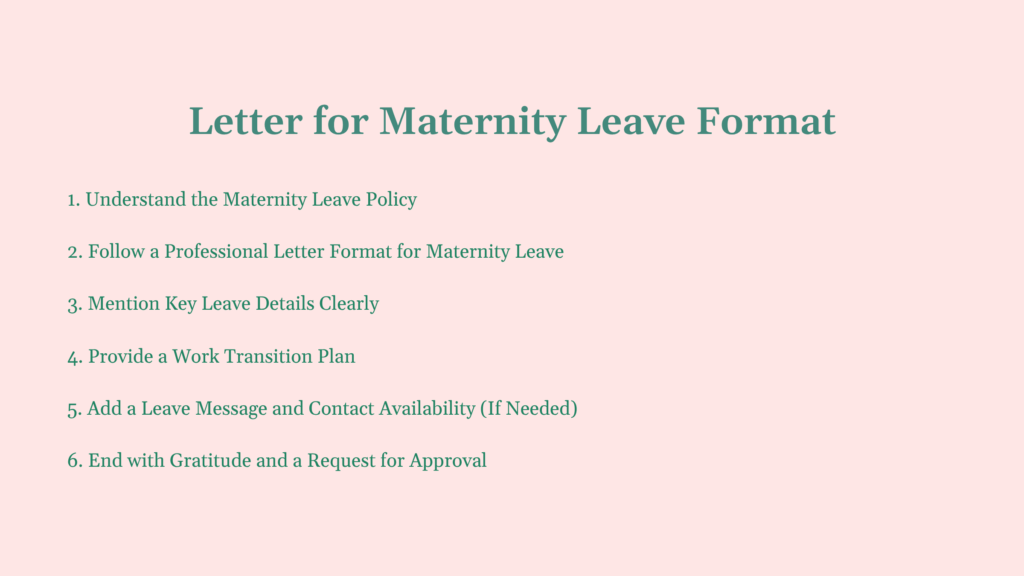
Before writing your letter, read your company’s maternity leave policy to understand your entitlements. Most policies align with the Maternity Benefit (Amendment) Act, 2017, which grants up to 26 weeks of paid leave for the first two children and 12 weeks for the third or more. You must typically be employed for at least 80 days in the past year to meet maternity leave eligibility.
Use a formal letter format including:
In the body of your maternity leave application, include:
Show initiative by outlining how your responsibilities will be managed during your absence. You may:
Incorporate a brief leave message assuring your employer of minimal disruption. You may optionally include whether you’ll be reachable during your leave for urgent matters. This balances your commitment to work with your personal boundaries.
Close the letter respectfully by:
To:
The Manager
[Company Name]
[Company Address]
Subject: Application for Maternity Leave
Respected Sir/Madam,
I am writing to formally request maternity leave starting from [Start Date] due to my upcoming delivery. As per my medical consultation, my expected due date is [Due Date], and I would like to begin my leave two weeks prior to that date.
I request a maternity leave of [X weeks/months] in accordance with the company’s maternity leave policy. I have handed over my responsibilities to [Colleague’s Name] during my absence and ensured a smooth transition.
Please let me know if any further documentation or procedure is needed.
Thank you for your understanding and support.
Sincerely,
[Your Name]
[Designation]
[Employee ID]
[Contact Details]
Subject: Maternity Leave Application
Dear [Manager’s Name],
I would like to apply for maternity leave starting from [Start Date] to [End Date] due to my upcoming childbirth. Kindly approve my leave as per the company policy.
Let me know if you require any medical certificates or documentation.
Thank you.
Best regards,
[Your Name]
[Employee ID]
Subject: Request for Maternity Leave
Dear [Manager’s Name],
I hope you are doing well. I am writing to inform you that I am expecting my baby around [Due Date], and I would like to begin my maternity leave from [Start Date]. I request leave for [Number of weeks/months], as per the company’s maternity policy.
I have coordinated with my team to ensure a smooth handover and will be happy to provide any assistance needed during the transition.
Please confirm the approval of my leave and let me know of any formalities.
Thank you for your support.
Best regards,
[Your Name]
[Department/Designation]
Subject: Maternity Leave Request with Possible Extension
Dear [Manager’s Name],
I am writing to formally request maternity leave from [Start Date] to [Tentative End Date], as my due date is [Due Date]. Depending on medical advice and recovery, I may require a short extension, and I will keep you updated accordingly.
I have completed all pending tasks and delegated responsibilities to [Colleague’s Name]. Please let me know if you need any additional information or documentation.
Thank you for your support and understanding.
Warm regards,
[Your Name]
[Employee ID]
Subject: Maternity Leave and Remote Work Request
Dear [Manager’s Name],
As I approach my due date on [Due Date], I would like to formally request maternity leave beginning [Start Date]. Prior to that, I would appreciate the option to work from home starting [Remote Work Start Date], due to health recommendations.
I plan to take [Number of Weeks] of maternity leave, in accordance with our HR policy. I have prepared a detailed handover and will ensure all responsibilities are transitioned effectively.
Thank you for your consideration and ongoing support.
Sincerely,
[Your Name]
[Department/Employee ID]
1. Maternity Benefit Act, 1961 (original statute)
Pradhan Mantri Matru Vandana Yojana (PMMVY)
Aims to cover wage loss, ensure safe deliveries, and promote nutrition and breastfeeding.
A cash transfer scheme for pregnant and lactating mothers (19+ years, first live birth).
A well-crafted maternity leave application is essential for ensuring a smooth and professional communication between an employee and the employer. It clearly states the employee’s intent to take leave, aligns with the organization’s maternity leave policy, and helps establish transparency regarding the expected duration of absence. Understanding one’s maternity leave eligibility—including the duration of leave, documentation required, and benefits entitled—ensures that employees can exercise their rights effectively while allowing employers to plan for workforce management during the absence.
The importance of adhering to a formal maternity leave application cannot be overstated, as it not only protects the employee’s rights but also supports a healthy work environment. With evolving labor laws emphasizing the welfare of expecting mothers, a clear maternity leave policy combined with accurate knowledge of maternity leave eligibility empowers women to balance their professional responsibilities with their health and family needs. Ultimately, this fosters employee satisfaction, reduces stress during maternity, and promotes a culture of support and compliance within the organization.
Read More: How to Request an Extension for Maternity Leave
A maternity leave application is a formal written request submitted by an employee to her employer, seeking time off for childbirth and postnatal recovery. It serves as official documentation, ensuring that the employer is informed in advance and can make necessary arrangements for work continuity during the employee’s absence.
The maternity leave policy in India, governed by the Maternity Benefit Act, 1961 (as amended in 2017), entitles female employees to 26 weeks of paid maternity leave for the first two children, and 12 weeks for subsequent children. To qualify, an employee must have worked for at least 80 days in the 12 months preceding the expected delivery date.
To be eligible for maternity leave in India, a female employee must:
Be employed with the same establishment for at least 80 days in the 12 months immediately preceding the expected delivery date.
Provide a medical certificate or doctor’s note confirming the pregnancy and expected delivery date.
Submit the maternity leave application within the stipulated time frame as per company policy.
Yes, under the Maternity Benefit Act, an employee can commence maternity leave up to 8 weeks (56 days) before the expected delivery date. The remaining leave can be availed after childbirth. This provision allows the employee to rest and prepare for childbirth while ensuring job security and paid leave.
A sample letter for maternity leave typically includes:
Subject: Request for Maternity Leave
Introduction: Employee’s name, designation, and purpose of the letter.
Details: Expected delivery date, requested leave period, and any arrangements for work delegation.
Closing: Contact information during leave and gratitude for consideration.