

A relieving letter is an essential HR document issued by an employer to formally acknowledge that an employee has been relieved of their duties and responsibilities after resigning from the organization. It serves as proof that the employee has fulfilled all necessary formalities, including serving the notice period, handing over tasks, and settling any dues. This letter is often required when joining a new organization, making it a crucial part of professional documentation for any transitioning employee.
When drafting a relieving letter format, it’s important to ensure clarity, professionalism, and adherence to company policies. A standard relieving letter includes key details such as the employee’s name, designation, department, last working day, and a confirmation that the resignation has been accepted. It may also include a note of appreciation for the employee’s contributions. For HR professionals and managers, maintaining a consistent and formal relieving letter format not only upholds the company’s reputation but also ensures smooth offboarding and future reference credibility. A relieving letter format outlines the official document issued by an employer confirming an employee’s resignation and successful exit process.
Read More: Resignation Letter Format with Samples
A relieving letter is an official document issued by an employer to an employee who has formally resigned from their position. It confirms that the employee has been relieved from their duties and has completed all necessary exit formalities, such as serving the notice period, returning company property, and clearing any dues. This letter acts as a formal acknowledgment of the employee’s departure from the organization and serves as a critical document for background verification and future employment.

A relieving letter follows a specific format, as it is a professional and formal document. The relieving letter format for employee is a crucial aspect, ensuring the letter is clear and well-structured. It officially acknowledges the end of an employee’s tenure and must be drafted in a professional tone.
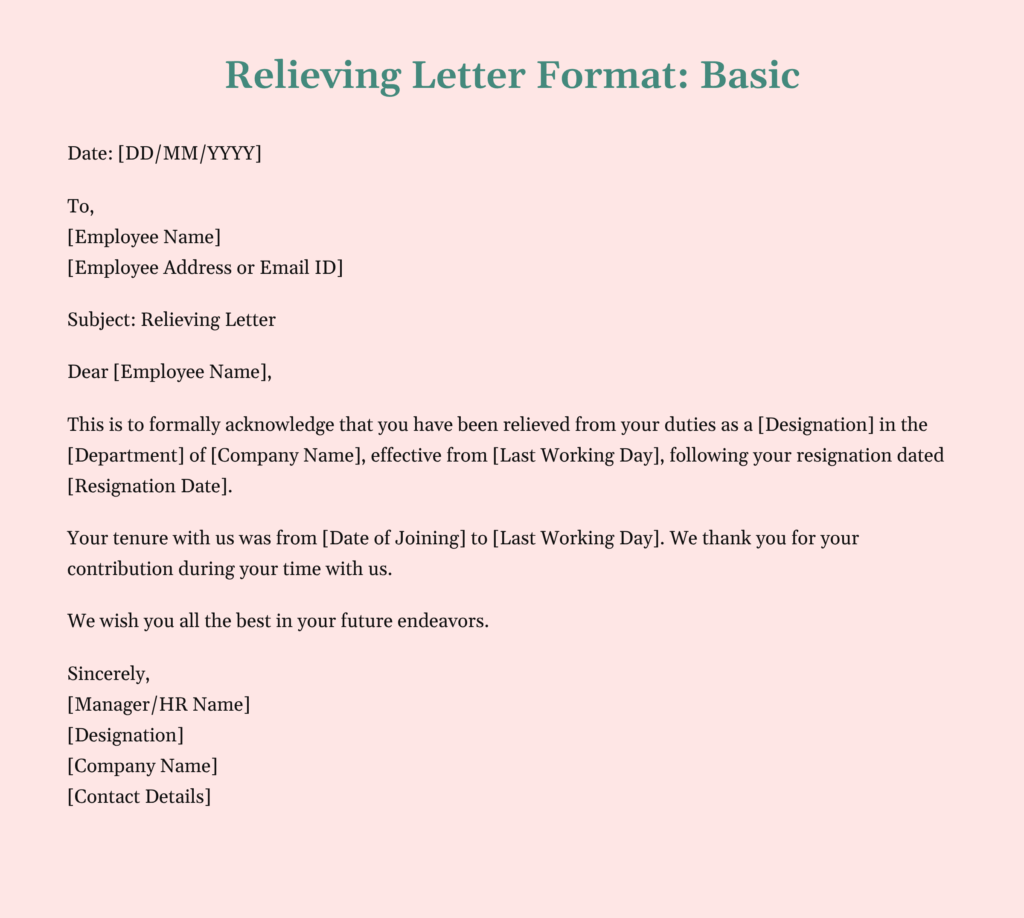
Date: [DD/MM/YYYY]
To,
[Employee Name]
[Employee ID: ####]
[Employee Email/Address]
Subject: Relieving Letter
Dear [Employee Name],
This is to formally confirm that you have been relieved from your duties at [Company Name] as a [Designation] in the [Department], with your final working day being [Last Working Day]. You were associated with us from [Joining Date] to [Last Working Day].
We appreciate the contributions you made to the organization, especially in [mention specific achievements, if applicable], and your performance has been satisfactory throughout your tenure.
We also confirm that you have completed all exit formalities, and there are no pending dues or liabilities from your side.
We extend our best wishes for your future professional and personal success.
Warm regards,
[HR Manager’s Name]
Human Resources Department
[Company Name]
[Signature with seal]
Date: [DD/MM/YYYY]
To,
[Employee Name]
[Contractor ID: ###]
Subject: Relieving Letter Upon Completion of Contract
Dear [Employee Name],
This letter is to acknowledge the successful completion of your contractual assignment with [Company Name] as a [Designation], which commenced on [Start Date] and ended on [End Date].
We thank you for your services during the term of the contract. All responsibilities have been duly handed over, and there are no dues pending from your side.
We wish you success in your future assignments.
Sincerely,
[HR Manager Name]
[Designation]
[Company Name]
Date: [DD/MM/YYYY]
To,
[Employee Name]
Subject: Relieving Letter – Contract Termination
Dear [Employee Name],
This is to confirm that your contractual employment with [Company Name], initiated on [Start Date], has been concluded prematurely as of [Last Working Day], due to [brief reason if appropriate or “organizational changes”].
You are hereby relieved from all responsibilities. Necessary clearances have been completed, and there are no pending dues.
We thank you for your contribution during your tenure.
Regards,
[HR Manager Name]
[Company Name]
Date: [DD/MM/YYYY]
To,
[Employee Name]
Subject: Relieving Letter
Dear [Employee Name],
This is to inform you that your services with [Company Name] have been terminated, effective [Termination Date], following a performance review in accordance with company policy.
You are relieved from your duties as of [Termination Date]. We confirm that you have completed your handover and there are no dues from your end.
We hope you are able to grow and develop in your future opportunities.
Regards,
[HR Manager Name]
[Company Name]
Date: [DD/MM/YYYY]
To,
[Employee Name]
Subject: Relieving Letter
Dear [Employee Name],
Following an internal inquiry into the incident reported on [Date], your services have been terminated as per the disciplinary policies of [Company Name], effective from [Termination Date].
You are relieved from all roles and responsibilities with immediate effect. Please note that the necessary documentation has been processed, and any company property must be returned to the HR department.
We hope you understand the gravity of the matter and take necessary corrective actions in the future.
Sincerely,
[HR Manager Name]
[Company Name]

Read More: Prepare for Exit Interviews

As an employee, follow the formal procedure to request the letter by writing to HR:
After submitting their resignation letter, the employee requested a relieving letter. This request is a standard step in the resignation process, as the relieving letter serves as an official document confirming the employee’s release from their duties.
Many employees often overlook the importance of a relieving letter and mistakenly confuse it with a resignation letter. A resignation letter is written by an employee to formally request their resignation from a position. On the other hand, a relieving letter is issued by the employer, confirming the acceptance of the resignation and officially releasing the employee from their duties. It is an essential document that validates the employee’s smooth exit from the organization.
A relieving letter is important for both employers and employees. For employers, it serves as an official record of the employee’s departure and acknowledges the end of their tenure. It ensures that the notice period is completed and confirms the employee’s release from all company obligations, including the clearance of any pending dues or settlements. For employees, this document is crucial when joining a new organization, as it demonstrates a proper exit from the previous company.
Using pre-designed templates can make drafting a relieving letter more straightforward and efficient. Customizable formats allow employers to quickly create a formal and professional document tailored to specific needs. This article offers key information, examples, and relieving letter templates to help employers simplify the process and provide clear, well-structured communication during employee transitions. A well-crafted relieving letter ensures a smooth employee exit, serves as proof of employment completion, and supports future job opportunities with clear, professional documentation.
While not legally mandated in all jurisdictions, a relieving letter is widely recognized as a professional best practice—especially in corporate settings. It serves as formal documentation confirming resignation acceptance, last working day, and cleared formalities. This makes it invaluable for both HR compliance and the employee’s future employment verification .
A relieving letter is typically issued on or shortly after the employee’s last working day. In cases of termination or expedited exits, it may be provided immediately following completion of exit formalities. Employers often deliver both digital and physical copies for the employee’s records .
A standard letter should contain:
• Date of issue
• Full employee details (name, designation, department, employee ID)
• Date of resignation and/or acceptance
• Last working day
• Confirmation of clearance (settlements, no pending dues)
• Optional—but recommended—appreciation note
• Authorized signature with name and designation
Optionally, details on final settlement timeline and return of company assets may also be included .
If the employer delays or refuses to provide it, employees should follow up formally with HR in writing. They may escalate the request up the chain of command. In cases where the refusal is unjust and affects new employment, seeking legal or labor-office remedy may be warranted. It’s important both parties resolve exit and documentation issues amicably .
Yes, an employer can deny a relieving letter if they believe the employee has not fulfilled their notice period, breached company policies, or left on unfavourable terms.