


India’s young entrepreneurs are reshaping the global business landscape in 2025. With 85,000+ government-recognized startups and over 115 unicorns valued above $400 billion, India ranks as the world’s 3rd-largest startup ecosystem. Youth-led ventures are driving innovation across 60+ sectors, including IT, agribusiness, FMCG, and healthcare solidifying India’s position as a global startup powerhouse.

Ritesh Agarwal, one of the youngest entrepreneurs in India, founded OYO Rooms in 2013 at 19. Born into a Marwari family in Cuttack, Odisha, he began his entrepreneurial journey at just 17 with Oravel Stays, a budget hotel and guest housing platform. Passionate about coding, Ritesh started learning to code at 10. His love for travel inspired him to create affordable accommodation options across India, eventually leading to the founding of OYO Rooms.
OYO started as a budget hotel service but quickly became a global hospitality company offering affordable stays. Recognized in Forbes 30 Under 30, Ritesh has received several accolades for his contributions to India’s startup ecosystem. Today, OYO is a global brand in countries like China, Malaysia, and the U.S. Ritesh’s focus on innovation and customer satisfaction has fueled OYO’s success, making him a leading figure among young entrepreneurs in India and an inspiration for emerging talent. The journey of a rising young businessman in India proves that age is just a number when it comes to success.
Nikhil Kamath and his brother Nithin co-founded Zerodha, one of India’s largest retail financial brokerage firms. Born in Bangalore in 1986, Nikhil developed an early interest in finance and began trading in the stock market. He is known for revolutionizing the investment landscape in India with low-cost, tech-driven solutions. Zerodha charges zero brokerage on equity delivery trades, making it one of the most affordable brokerage firms in the country.
Zerodha’s success is attributed to its low fees and user-friendly platform. Nikhil Kamath, a prominent figure among young entrepreneurs in India, also focuses on philanthropy, supporting financial literacy initiatives, and contributing to charitable causes. Along with his brother, he co-founded True Beacon, an asset management firm, and they are ranked among India’s top 100 wealthiest individuals by Forbes. Nikhil’s contributions have made him a key player in India’s entrepreneurial landscape.
Bhavish Aggarwal, a prominent figure among young entrepreneurs in India, co-founded Ola Cabs, one of India’s fastest-growing businesses. Born on August 25, 1985, in Punjab, India, he graduated with a B.Tech in Computer Science from IIT Mumbai. After working at Microsoft Research for two years, earning two patents, and publishing three papers, Bhavish started a blog and later founded Desitech. He initially launched olatrip.com, a site offering travel packages, before focusing on Ola.
Founded in 2010 with Ankit Bhati, Ola Cabs addressed the transportation problem for people without vehicles, offering cars, bikes, and auto rickshaws. With over 1.5 million driver partners and operations in 250+ cities worldwide, Ola has become a global leader. Bhavish has been featured in “30 Under 30” by Hindustan Times and Forbes and named “Entrepreneur of the Year” by The Economic Times. Ola also plans to expand into the electric vehicle market and launch an IPO next year.
Vijay Shekhar Sharma, one of the leading young entrepreneurs in India, was born on June 7, 1978, in Uttar Pradesh, India, into a middle-class family. After completing his Bachelor of Commerce from the University of Delhi, he sold SIM cards for extra income during college. With a passion for technology, he founded One97 Communications in 2000, which later became the parent company of Paytm.
Initially launched as a mobile recharge platform, Paytm expanded into bill payments, digital wallets, flight bookings, and more. In 2015, Paytm became India’s first fintech unicorn. Despite fierce competition and regulatory challenges, Vijay led the company’s growth, launching Paytm Mall and Paytm Payments Bank. Known for his innovative ideas and risk-taking in business, he remains a key figure among young entrepreneurs in India.
Peyush Bansal, one of the prominent young entrepreneurs in India, was born on April 26, 1985, in Delhi. He is the founder of the popular eyewear brand Lenskart. After completing his Bachelor of Engineering from McGill University, Canada, Peyush started SearchMyCampus in 2007, a platform to address college students’ challenges, such as housing and jobs.
In 2010, Bansal co-founded Lenskart with Amit Chaudhary and Sumeet Kapahi. Today, Lenskart operates over 500 stores and was valued at over $1 billion in 2020, entering the unicorn club. Bansal holds an 8.21% stake in the company and has a net worth of Rs 600 crores.
Recognized in Fortune India’s “Top 40 Under 40,” Peyush also judges Shark Tank India and has launched several other successful ventures, including Flyer, Watchkart, Bagskart, and JewelsKart. Known for his innovative approach, he has revolutionized India’s online eyewear market, becoming a leading figure among young entrepreneurs in India.
Sachin Bansal, one of the most prominent young entrepreneurs in India, is the co-founder of Flipkart, one of India’s largest e-commerce companies. In 2007, Sachin and Binny Bansal launched Flipkart, which has since become a leader in the Indian e-commerce space, with a valuation exceeding $15 billion. Flipkart offers a wide range of products, including electronics, fashion, home appliances, and more, attracting millions of active users.
Today, Flipkart is the largest e-commerce platform in India, and Sachin has made several successful investments in other sectors, including financial technology and healthcare. Flipkart has also acquired companies like Myntra and PhonePe. Sachin acquired a majority stake in Chaitanya Rural Intermediation Development Services Private Limited (CRIDS) & NBFC. As one of the wealthiest individuals in India, Sachin’s success story exemplifies the spirit of young entrepreneurship in India, showing the drive and determination needed to revolutionize industries.
Young changemakers from Meghalaya:
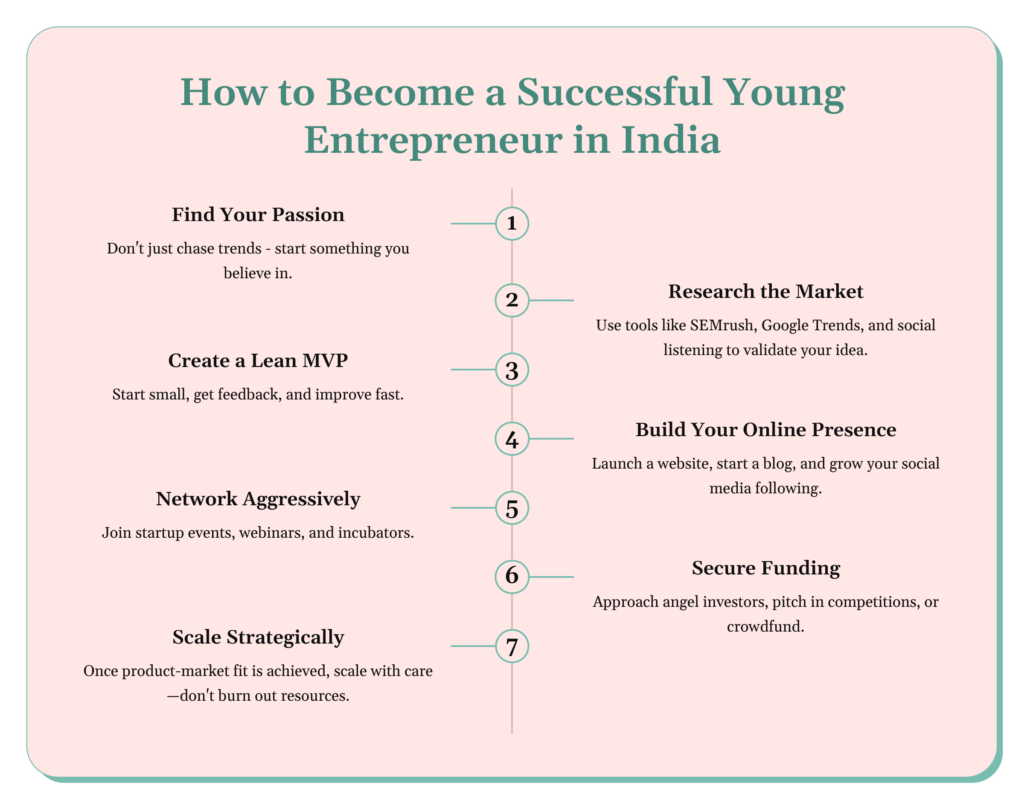
Starting a business should be driven by passion and dedication, not just for the sake of it. For young entrepreneurs in India, it’s essential to genuinely care about the business idea and approach it with seriousness. Begin by identifying the type of business that suits you and gather online and offline resources to understand the market.
Next, define your unique selling point (USP). In a competitive market, young entrepreneurs must provide value and differentiation to stand out. This USP is crucial for business success.
Many young entrepreneurs in India make the mistake of pursuing glamorous businesses, like event management, for easy money without considering the challenges. These can include late nights, last-minute travel, and inventory management. Often, those who aren’t fully invested in their business end up closing it. Therefore, choosing a company you’re truly passionate about is vital.
A strong, reliable network is invaluable for entrepreneurs in India. Many successful entrepreneurs actively share guidance on social media, offering an excellent opportunity to connect with them. Building relationships with these experts can lead to better investment opportunities.
Ways to connect with prominent entrepreneurs include:
The goal is to build a network of passionate, professional, and driven individuals who can help advance your business. These are common mistakes that most Indian entrepreneurs commit. Furthermore, they will also act as a guiding light through tough times.
Demand and supply are the cardinal rules of any business. Young entrepreneurs in India should analyze the target market and identify the market gap. They should fill that gap with value-added solutions that competitors have failed to provide.
Identifying the market gap is critical in developing a successful, sometimes ignored, or misunderstood business. Bridging the gap between customer/client expectations and market supply might be a game-changer for Indian enterprises. It is critical guidance and a must-have for achieving corporate objectives.
After analyzing the gap in the market, come up with innovative solutions to fulfill the demand. Products or services should provide something different and better than existing supplies.
Suppose there is a Bengali colony in the town of Kerala. There is sufficient demand for Bengali cuisine, but no proper supply. A wise young entrepreneur would open a Bengali food joint, hire a Bengali cook, and provide a taste of Bengal in Kerala. Authentic Bengali cuisine with a classical set-up will attract more customers.
One of the most successful young entrepreneurs of the 21st century, Mark Zuckerberg, said, “The biggest risk is not taking any risk.”
Young entrepreneurs in India must persist in their dreams, not be afraid of failure, and take risks. As they say, failure is part of success.
Some of the key advantages of taking risks that young entrepreneurs should be aware of are as follows –
Recommended Read: 10 Successful Entrepreneurs in India and their Net worth
Customers and clients are always right; businesses must listen to them to succeed. In addition, modern customers have a short attention span.
Customers or Clients are highly mobile. Young entrepreneurs in India must understand that the current market has alternatives for every product category. Therefore, one should understand their audience before exposing themselves to this diverse market.
The following tips will help Young entrepreneurs in India understand their audience better –
The crucial expert advice here is to focus on millions of netizens because an online presence is vital for the success of any business.

Young entrepreneurs wear multiple hats at once, so they need to pay special attention to every department. However, as the firm grows, involvement in every area becomes difficult.
The solution is to bring in professionals and delegate job roles. This will help business people focus on their expertise and expand the firm. Along with expert professionals for delegation, stay connected with successful entrepreneurs in India.
Established businesspeople and experienced professionals help with mentorship. Even as CEOs of a firm, people require sound advice to make the right decisions at different business stages. Therefore, always be open to learning. Listen to industry experts on TEDx, Podcasts, YouTube, and more.
Some of the key advantages of the delegation that young entrepreneurs in India enjoy are as follows –
Make a marketing mix with proper weightage of required media platforms. Young entrepreneurs should consider a media type according to their target market. However, multiple media can be used to cover the maximum target market and generate qualified leads.
Some of the critical media channels that Young Entrepreneurs in India can utilize are as follows:
Significant social media platforms such as Facebook, Instagram, YouTube, Pinterest, Snapchat, Quora, and others are great ways to promote one’s business.
A significant number of Indians use social media every day. Young entrepreneurs in India should leverage this pool of prospects. Develop groups on Facebook, WhatsApp, and YouTube. It will bring new leads and a loyal customer base.
One can also promote their brand on podcasts. These platforms discuss business, HR, social issues, etc. Many famous entrepreneurs in India have successfully built their brands on these platforms.
Young entrepreneurs in India can advertise and market their products or services using TV, FM radio, movies, documentaries, etc. Broadcast media is still a primary source of entertainment and information for millions across India.
Print media like magazines, newspapers, books, brochures, and others have a limited but long-lasting impact on target customers.
The rise of young entrepreneurs in India is not just a trend. It’s a movement. From tier-1 cities to remote towns, a new generation of dreamers is changing the face of business. Whether they are the youngest entrepreneurs in India or seasoned startup founders under 30, their stories reflect grit, innovation, and vision.
Now is the best time to start for those ready to take the plunge. India’s startup ecosystem is rich with opportunity, support, and inspiration. So, take that first step, solve a real problem, and who knows? You could be the next young business tycoon in India.
Tilak Mehta, who founded the company, ‘Paper n Parcels’ at 13, is considered the youngest entrepreneur in India.
Aryan Nangia, a dynamic young entrepreneur, is transforming education and innovation through initiatives like LaunchPad and The Other Side.
The 12-year-old entrepreneur in India is Harshini Reddy, founder of Learn2Earn. She created an online platform to teach coding and financial literacy to kids, aiming to empower young minds with essential skills for the future.
Tilak Mehta, who founded Paper n Parcels at the age of 13, has a company that is now worth Rs. 100 crores.
Neha Narkhade is the youngest woman entrepreneur in India. She founded Confluent and appeared in the IIFL Wealth Hurun India Rich List 2022.
1. Kaivalya Vohra (21) – Co‑founder of Zepto, the quick‑commerce grocery app valued at ₹9,100 cr, transforming urban logistics with instant deliveries
2. Shashvat Nakrani (26) – Co‑founder & CEO of BharatPe, a fintech startup empowering merchants with UPI payments using a single QR code
3. Ananya Birla (mid‑20s) – Founder of Svatantra Microfin and new beauty venture BCPL, recognized in 2025 as a leading young leader driving microfinance and beauty innovation
Some of the most successful startups founded by teens in India include:
1. Paper n Parcels by Tilak Mehta – a logistics startup valued at ₹100 crore.
2. Learn2Earn by Harshini Reddy – an edtech platform teaching coding and finance to kids.
3. LaunchPad by Aryan Nangia – a youth-led platform for innovation and startup incubation.


