

Written communication in offices refers to the process of conveying information, ideas, and instructions through written messages such as emails, reports, memos, and official letters. It is a fundamental aspect of professional interactions that ensures clarity, accuracy, and a permanent record of correspondence within an organization. But what is written communication? Simply put, it is the deliberate use of written language to share messages among employees, management, clients, and other stakeholders. This form of communication allows for detailed explanations and thoughtful expression, helping to avoid misunderstandings that can arise from verbal exchanges.
The importance of written form of communication in offices cannot be overstated. It serves as a critical tool for documentation, providing a reliable reference that supports decision-making and accountability. Effective written communication also enhances professionalism and helps maintain consistency across the organization’s messaging. In addition, it facilitates remote work and collaboration across different time zones by allowing information to be shared asynchronously. Overall, mastering written communication is essential for building strong relationships, improving workflow, and achieving business objectives efficiently.
Written communication refers to the exchange of information through written language, serving as a primary means of conveying ideas, instructions, and updates in office environments. Written language is the primary medium for conveying information in written communication. Written form, such as emails, reports, and memos, is used to ensure clarity and record-keeping. The written word is the fundamental element of written communication, enabling clear and organized expression of information.
The sender is the person who initiates the written communication. The sender must identify the intended audience to tailor the message for maximum impact. In an office, the sender is responsible for creating and crafting the message with clarity and purpose.
The message is the core content or information being conveyed in the written form of communication. It includes the ideas, instructions, or data that need to be shared. The message should use appropriate words and concise language to ensure clarity and avoid misunderstandings, making it easier for the receiver to grasp the intended meaning.
The medium, also known as the communication channel, refers to the channel through which the written message is delivered. Common mediums in an office include emails, memos, reports, official letters, and internal communication platforms.
The receiver is the individual or group who reads and interprets the written communication. Understanding the receiver’s background, role, and level of knowledge helps the sender tailor the message for maximum clarity and impact.
Feedback is the response from the receiver that confirms whether the message was understood as intended. It helps close the communication loop by allowing for questions, clarifications, or follow-up actions. Effective feedback ensures that the written communication achieves its purpose.

Emails are the primary mode of written communication in modern offices. They are used for internal communication between employees as well as external communication with clients, vendors, and stakeholders. Emails provide a quick and efficient way to exchange information, request approvals, share updates, and maintain a formal record of correspondence.
Reports and proposals are essential written communication tools used to convey research findings, performance summaries, and strategic plans. Other examples of formal written communication in business include financial statements, legal documents, and marketing strategies. These documents help in decision-making and provide a factual basis for discussions and planning.
Memos and circulars are internal office forms of written communication used to inform employees about policies, procedures, changes, or important announcements. They are typically brief, formal, and targeted to specific departments or teams.
Meeting agendas and minutes are official records of what is to be discussed and what has been discussed in a meeting, respectively. Meeting minutes are used to summarize key points and decisions made during meetings, ensuring that all critical information is clearly recorded.
Letters and notices are formal types of written communication typically used for legal, contractual, or administrative purposes. Legal agreements and formal correspondence are also important forms of official written communication. Another advantage in this format is its legal validity, formality, and clarity, which make it suitable for critical business interactions.
Many offices use internal chat tools like Slack, Microsoft Teams, or Google Chat for quick written communication among team members. These tools facilitate quick personal interactions and often allow for immediate response among team members. While these are more informal compared to emails or memos, they still fall under written communication.
Training manuals and handbooks are detailed forms of written communication designed to onboard new employees and guide existing staff. They outline company policies, processes, and best practices. The advantage of this type of written communication is its consistency and comprehensiveness—everyone receives the same information, helping maintain uniform standards across the organization.
To ensure effective communication in the office, professionals must have a solid grasp of grammar, punctuation, and vocabulary. Proper grammar is essential to avoid confusion and maintain professionalism. Without good language skills, written communication can come across as unclear or careless, leading to misunderstandings in the workplace.
One of the most valued skills in written form of communication is the ability to write clearly and concisely. Office communication needs to be direct and to the point, without unnecessary fluff. Clarity ensures that the purpose of the message is easily understood, which is a core goal of effective written communication.
A well-structured message is a hallmark of good written form of communication in the office. Writers should logically organize their content using headings, bullet points, and paragraphs to improve readability. Organized written communication not only looks professional but also helps the reader absorb information more efficiently.
Understanding how to use the right tone is critical for proper written form of communication in an office setting. Whether the communication is formal, neutral, or friendly depends on the context and the recipient. A respectful and professional tone enhances the impact of written communication and builds stronger workplace relationships.
Before sending any office document, email, or report, proofreading is essential. One of the most overlooked but crucial skills in written form is editing content for grammar, tone, and clarity. Well-edited written communication reduces errors and ensures the message reflects professionalism and attention to detail.
1. Poor: “Hey. Send that report.”
Good: “Hi Priya, could you please send the monthly report by 3 PM today? Thanks!”
2. Poor: Long-winded, unclear subject lines
Good: Clear, action-driven subject lines like “Action Required: Submit Expense Report by Friday”
3. Poor: Mixing personal tone in formal emails
Good: Matching tone to context — professional, respectful, and polite in work emails
4. Poor: Wall of text in a proposal or email
Good: Using bullet points, headings, or bolding to break up content and guide the reader
5. Poor: No call to action
Good: Ending with a clear next step, e.g., “Please review and respond by Tuesday.”
1. Lead with the main idea: Start your message with the most important information (BLUF method).
2. Use short paragraphs: 2–3 sentences max per paragraph improve readability, especially online.
3. Be specific: Replace vague terms like “soon” with “by 5 PM today” or “within 2 working days.”
4. Cut filler words: Words like “really,” “very,” “just,” or “actually” often dilute the message.
5. Match tone to audience: Friendly but professional for colleagues; formal for external clients or leadership.
1. Take a break before editing: Fresh eyes help you spot errors and improve clarity.
2. Read aloud: Helps catch awkward phrasing or overly long sentences.
3. Use tools: Grammarly, Hemingway Editor, or QuillBot can highlight passive voice, complexity, or grammar issues.
4. Get feedback: Ask a peer or supervisor to review important communications before sending.
5. Edit in layers: First for content and structure, then for clarity, then for grammar and polish.
1. Be concise in chats: Keep messages short and to the point on platforms like Slack or Teams.
2. Avoid misinterpretation: Emojis and tone can be misunderstood—keep it clear and professional.
3. Consider time zones: When working with global teams, phrase requests to be asynchronous-friendly (e.g., “no rush, reply when convenient”).
4. Respect digital etiquette: Avoid overusing caps, avoid spamming “?” or “!!”, and keep replies timely.
5. Write with cultural awareness: What’s considered polite or assertive varies across regions—be thoughtful when writing across cultures.
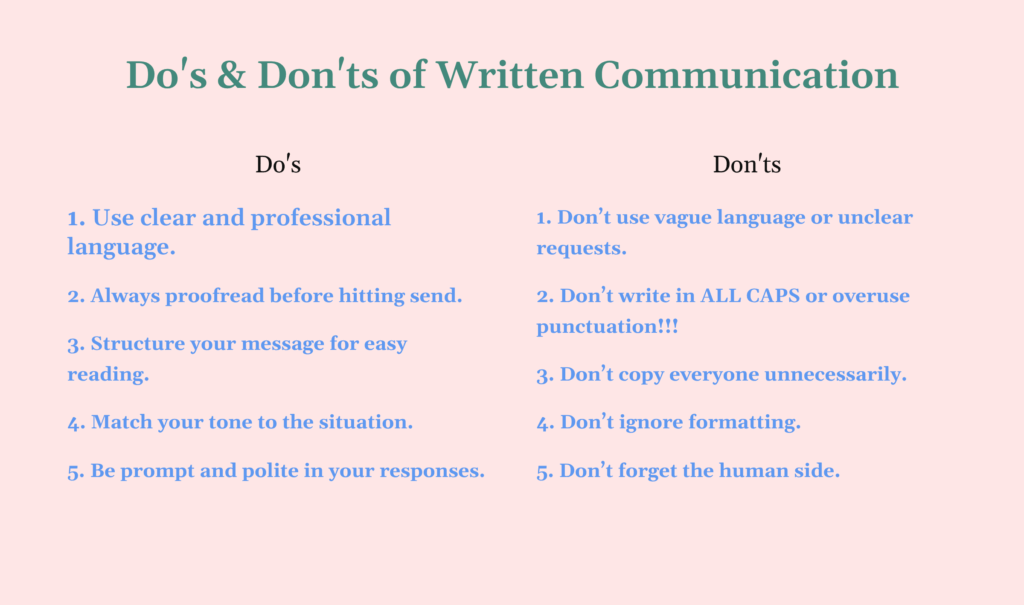
Dos
Avoid slang or overly casual phrases. Whether you’re emailing your manager or messaging a teammate, clarity and professionalism go a long way.
Typos and grammar mistakes can damage your credibility. Take a moment to read your message out loud — it helps catch errors you might otherwise miss.
Use bullet points, short paragraphs, and clear headings in longer communications. This helps your reader process information quickly.
Be friendly, but stay professional. A casual tone might work for internal messages, but formal reports or external emails require a more polished approach.
Timely replies show respect and reliability. Even a quick acknowledgment like “Received, I’ll get back to you by tomorrow” is better than silence.
Don’ts
Instead of “Please do this soon,” say “Please send the final draft by 5 PM today.”
It can come across as aggressive or unprofessional. Use emphasis sparingly and appropriately.
Be mindful with CC/BCC. Only include people who need to be part of the conversation.
Long, unbroken text blocks are hard to read. Break up your message to improve engagement and comprehension.
A simple “Hope you’re doing well” or “Thanks for your help” adds warmth and builds rapport—even in professional exchanges.
Read More: Improve Communication Skills
Written communication plays a vital role in ensuring the smooth and efficient functioning of any office environment. It provides a clear and permanent way to document ideas, decisions, policies, and procedures. Unlike verbal communication, written messages can be referenced later, reducing misunderstandings and improving accountability. From emails to reports and official letters, written communication enables professionals to share information in a structured, formal, and consistent manner.
Moreover, the importance of written communication extends beyond documentation—it strengthens professionalism, enhances collaboration, and supports effective decision-making. It allows teams to communicate across departments and even time zones without losing clarity. When done well, it boosts productivity and ensures everyone is aligned with organizational goals. In today’s digital workplace, mastering written communication is not just beneficial—it’s essential for success.
In today’s fast-paced, digital-first world, strong written communication is no longer optional—it’s essential. Whether you’re drafting an email, preparing a report, or messaging a colleague, your ability to express ideas clearly and professionally shapes how you’re understood and perceived. Effective writing minimizes confusion, builds trust, and drives results across teams and time zones. By refining this skill, you not only enhance your individual performance but also contribute to smoother collaboration and long-term success in any career.

Written communication is the process of sharing information, ideas, or messages through written symbols like letters, emails, reports, memos, or social media posts. It ensures that messages are recorded and can be referred to later.
Example: A company based in Mumbai sends internal emails, prepares official reports, and shares policy updates in writing to communicate clearly with employees and stakeholders.
Tip: Focus on clarity, correctness, and proper formatting. This makes written communication effective and professional.
Written communication involves sharing information through written forms. Common examples include:
Emails, for formal or informal communication within or outside the organization.
Reports, detailed documents that present data, analysis, or project updates.
Memos, short notes for internal communication within a company.
Letters, formal communication with clients, suppliers, or stakeholders.
Social media posts, which share information, updates, or announcements online.
Example: A Mumbai-based company emails employees about policy updates, publishes quarterly reports, circulates memos internally, sends letters to clients, and posts updates on LinkedIn.
Tip: Focus on clarity, brevity, and professionalism in each written form; this ensures effective communication.
Written communication is generally classified into three main types:
Formal Written Communication: Official documents like reports, letters, memos, and emails that follow organizational rules.
Informal Written Communication: Casual messages such as personal emails, notes, or chat messages within teams.
Technical Written Communication: Specialized documents like manuals, instructions, or technical reports intended for specific audiences.
Example: A Mumbai-based IT firm sends official reports (formal), team chat messages (informal), and user manuals for software (technical).
Tip: Focus on using the right type of writing for the audience; this makes communication more effective.
Written communication offers several benefits in business and professional settings:
Permanent Record. It provides documentation for future reference.
Clarity. Messages can be carefully structured to avoid confusion.
Professionalism. Formal writing improves credibility and trust.
Wide Reach. It can be shared with multiple people through emails, reports, or publications.
Legal Proof. It serves as evidence in disputes or legal matters.
Example: A Mumbai-based company emails policy updates, publishes reports, and keeps official letters for records. This ensures clarity, professionalism, and accountability.
Tip: Focus on accuracy, clarity, and proper formatting. This maximizes the advantages of written communication.
A written communication PDF is a digital document that explains or gives examples of written communication in a clear format. It usually includes definitions, types (formal, informal, technical), benefits, and real-world examples. PDFs are popular for study notes, company guides, or educational materials because they are easy to share, maintain formatting, and serve as a permanent reference.
Example: A student or professional in Mumbai might download a written communication PDF with email templates, report formats, and memo examples for reference.
Tip: Use PDFs as a reliable and organized source to learn and apply written communication concepts effectively.
The four main methods of written communication are:
Letters, formal messages sent to clients, suppliers, or stakeholders.
Memos, short internal notes for employees or departments.
Reports, detailed documents that present data, analysis, or updates.
Emails, fast and convenient communication for both internal and external purposes.
Example: A Mumbai-based company sends letters to clients, circulates internal memos, publishes quarterly reports, and emails updates to employees.
Tip: Choose the right method based on purpose and audience. This ensures effective communication.
Effective written communication includes these seven key elements:
Sender, the person or organization sending the message.
Message, the information, idea, or content being communicated.
Encoding, the process of putting the message into words, symbols, or visuals.
Channel/Medium, the method used to send the message, such as email, letter, or report.
Receiver, the person or audience receiving the message.
Decoding, the process by which the receiver interprets or understands the message.
Feedback, the response or reaction from the receiver that ensures the message is understood.
Example: A Mumbai-based company sends an official email (message) from HR (sender) to employees (receiver). Employees read and understand it (decoding) and reply if needed (feedback) via the same email channel.
Tip: Focus on all seven elements to ensure clear and effective communication.
Writing can be classified into several types based on purpose and style:
Narrative Writing tells a story or describes events, like novels or personal stories.
Descriptive Writing focuses on detailing people, places, or things.
Expository Writing explains facts, concepts, or ideas clearly, such as reports or essays.
Persuasive Writing aims to convince the reader of a viewpoint, for example, advertisements or opinion pieces.
Creative Writing uses imagination and originality, including poems, scripts, and short stories.
Example: A student from Mumbai writes a descriptive essay for school, a report for work, and social media posts to persuade readers about a cause.
Tip: Understand the purpose of each type. This makes writing more effective and engaging.