Effective workplace communication includes verbal, non-verbal, written, and visual types, each playing a key role in improving teamwork, solving problems, and avoiding mistakes.
Verbal communication ensures clarity, non-verbal cues reveal emotions, written communication allows for detailed documentation, and visual tools enhance understanding.
Mastering these forms of communication boosts productivity, builds strong relationships, and fosters a positive work environment, helping employees succeed and contribute to the company’s success.
Table of Contents
Communication is how people share information with each other. It helps us to understand and work together. In the workplace, good communication is important because it helps everyone do their jobs well and avoid mistakes. There are different types of communication, and knowing how to use them properly can make a big difference at work. Studies reveal that 55% of communication is non-verbal, 38% is tone of voice, and only 7% is actual words. This highlights how much our body language influences our communication.
The four main types of communication are verbal, nonverbal, written, and visual. These categories encompass how we use spoken words, body language, written text, and visual elements to convey messages.
In this blog, we will talk about the different types of communication and why they are significant in the workplace.
What is Communication?
Communication refers to the interchange of information or thought or idea or feeling between individuals or groups. It can occur in many ways, including spoken or written words, gestures, body language, facial expressions, and through digital instruments.
What are the Different Types of Communication?
There are four main types of communication: verbal, non-verbal, written, and visual. Each type of communication has its own role, and all are important in their own way. Let’s take a closer look at each type.
1. Verbal Communication
Verbal communication is when we talk to each other using words. It can be face-to-face, over the phone, or through video calls. Verbal communication is quick and allows for instant feedback. This is helpful when you need to share information or solve problems fast.
In the workplace, verbal communication is used in meetings, presentations, and one-on-one conversations. It helps teams stay on the same page and avoid misunderstandings. Good listening skills are also part of effective verbal communication.
2. Non-Verbal Communication
Non-verbal communication includes body language, facial expressions, and eye contact. Even without speaking, we can send messages through our actions and behavior. For example, crossing your arms might show that you are upset, while smiling shows that you are happy.
In the workplace, non-verbal communication is important because it shows how we feel about something, even when we are not saying anything. For example, during a meeting, your body language can show if you are interested or bored. Good non-verbal communication can make you seem more confident and engaged at work.
3. Written Communication
Written communication involves sending messages through writing. This can include emails, reports, memos, or text messages. Written communication is important in the workplace because it allows people to share detailed information that can be saved and referred to later.
In a professional setting, writing clearly and concisely is very important. A well-written email or report shows that you are organized and professional. Written communication is also helpful when you need to give instructions or explain things in detail.
4. Visual Communication
Visual communication uses images, charts, graphs, or videos to share information. Sometimes, it is easier to understand something when you can see it. For example, a graph can make it easier to understand data, while a video can explain a complicated process in a simple way.
In the workplace, visual communication is often used in presentations, training, and marketing. It helps make information more engaging and easier to understand. Using visual communication can also help you stand out during meetings or presentations.
Effective Communication Skills in 2025
In addition to the methods of communication, effective communication skills also assist you in delivering your message. If you search for communication skills online, you will find many concepts that might confuse you. But you do not need to understand everything to be an effective communicator. You just need to know the fundamentals! Think about S.P.E.A.K. as a tool to help you communicate effectively with others. Here is what each letter stands for:
S – Use Clear and Simple Language: It is a good idea to keep things simple, so the person you are communicating with can understand you. Always be aware of what words the person will be gets, so the message you share makes sense to them. The purpose of communication is to make sense!
P – Provide Detail: Provide important details, so people can really understand what you are talking about, so provide examples that take the edge off. Use something they know to compare with your experience. If something is too difficult to understand, compare it to something they are already familiar with.
E – Express the Truth: It is always advised to tell the truth, because that is how you build relationships. Lying is never a good thing, and make sure you know the truth before telling something to others.
A – Listen at all times: Communication is not always about talking, please listen to those who are talking and think about what they are saying before communicating. Listen to understand, not merely to speak.
K – Kindness: Always be kind and respectful to others no matter if you agree with them or not; treat them how you would want to be treated. Keep your tone calm and polite as how you say something matters as much as what you say. If you maintain respect, you are showing maturity and equipping yourself for a positive conversation. A respectful conversation allows for dialogue that is positive and productive.
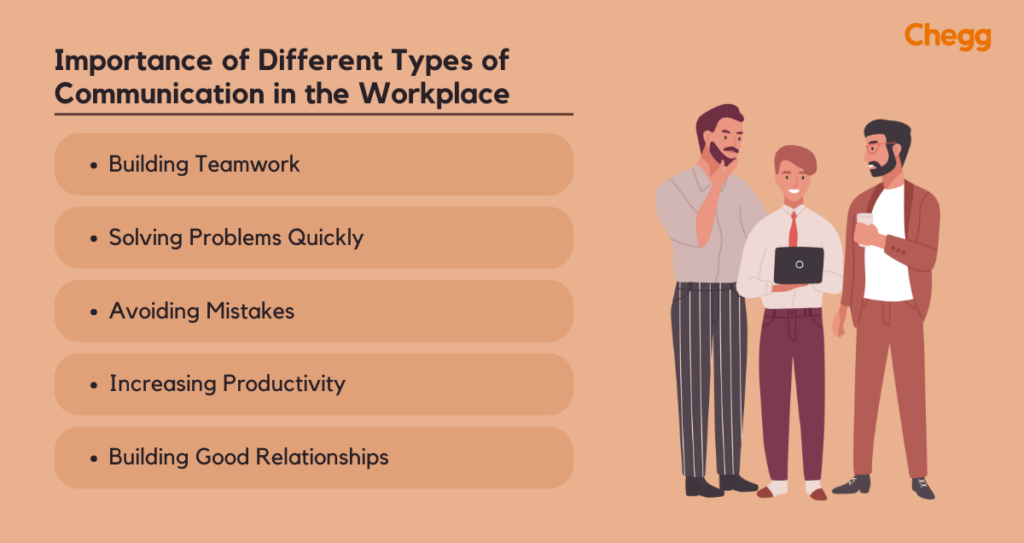
Importance of Different Types of Communication in the Workplace
types of communication
Good communication is important in the workplace for many reasons. It helps people work together, understand each other, and solve problems. Let’s see why different types of communication are important at work.
Building Teamwork
Teamwork is very important in the workplace, and good communication helps teams work together better. Using the right types of communication can make sure everyone knows what they need to do. It also helps build trust among team members. Verbal communication can be used in team meetings, while written communication can keep everyone informed through emails and updates.
Solving Problems Quickly
In the workplace, problems can happen, but good communication helps solve them quickly. When people use different types of communication, like talking in person or writing emails, they can share their ideas and find solutions faster. Non-verbal communication can also help by showing how people feel about a situation, which helps others understand the problem better.
Avoiding Mistakes
Clear communication helps avoid mistakes at work. When instructions are given clearly, whether verbally or in writing, people are less likely to make errors. Visual communication, like charts or diagrams, can also help by making instructions easier to understand.
Increasing Productivity
Good communication helps employees work more efficiently. When the types of communication are used properly, it saves time and energy. For example, a quick phone call (verbal communication) can solve a problem faster than a long email exchange. Visual communication can also make meetings more productive by making complex information easier to understand.
Building Good Relationships
Strong relationships at work are built through effective communication. When employees understand each other, they can work better together. Verbal and non-verbal communication help build personal connections, while written communication can help maintain professional relationships through polite and clear messages.
Essential Tips to Improve Your Communication Skills
Misunderstanding exists in all kinds of communication. An effective communicator will make an effort to lessen the potential of misunderstanding and convey the message in a powerful way. So let’s jump right into some actionable tips for effective communication! General tips for all communication
Verbal communication tips
Nonverbal communication tips
Written communication tips
Visual communication tips
Common Tips For All Types Of Communication
The following suggestions will help you improve all four types of communication:
Reduce the potential for misunderstanding. Identify barriers in each step of the communication process and try to eliminate them to the greatest extent. For example, if your audience speaks a foreign language, try to get a translator.
Know your audience. When you know the demographics of your audience, you can convey a communication message that relates to their understanding and knowledge.
Ask for feedback from the audience. Feedback allows you to check if your listener received your message as you intended. Your feedback will allow you to make changes during the communication process in the future to help prevent misunderstanding and confusion.
Choose the right channel of communication. There are many different types of communication channels available in today’s technology, including phone, email, text message, social media, radio, TV and live online broadcasts. Every channel has its advantages and disadvantages. Therefore, it is important to decide which communication channel is wanted. For example, the live broadcasting of an event could be the most effective way to share news with a large audience, while complex, technical data may be more appropriate to send with a printed document.
Verbal Communication Tips
To improve verbal communications:
Speak confidently with a strong voice. Use a loud and clear voice to ensure everyone can hear when speaking to a group of people. Make your voice show confidence in the ideas you are attempting to communicate. Use positive body language alongside your verbal communication.
Listen patiently. Active listening is the basis of good verbal communications. Whether in a one-on-one conversation, or in a team meeting, it is important to listen to others, which will ensure a sense of importance and participation to others, and likely lead to them listening more closely to you. You will also get a sense of what your audiences want and what they think.
Be clear and succinct. Select your words based on the level of your audience. For example, convert technical jargon into normal language when speaking to non-technical audiences. If necessary, replace filler words, like “um” and “OK”, with a pause to take a breath, so that these words do not detract from your audience’s attention.
Nonverbal Communication Tips
Here are a few advice to help you improve your nonverbal communication:
Experience your emotions. Try to notice if you experience a change in your body when you experience each of the emotions. For example, you may calibrate yourself to check in with confusion and all of a sudden find yourself picking at your fingernails without even knowing. When you can feel your body react to your emotions, you can make a movement to adjust the reaction or your behavior.
If you notice your body language, you can attempt to change negative postures and expressions each time you notice them. For example, you may feel exhausted after the day is over and begin to notice that at the end-of-the-day team meeting your shoulders are often slumped over. Change your posture as soon as you notice your slumped shoulders. With time, you will be able to take control over the way your body is communicating emotions and feelings.
Observe the body language of others. If you see some gestures and expressions that seem to resonate for another person, feel free to leverage them for yourself. For example, if you observe someone who smiles and does nothing in a response to a sarcastic comment- rather than flow back- then you may want to try that strategy for yourself in a similar situation.
Written Communication Tips
Here are some tips to improve your written communication skills:
Be brief and clear. Keeping it brief and clear will reduce confusion and save time. Be clear in you message. Keeping it simple can help reduce misunderstanding. Only include background information that your recipient needs to know. For example, you might include a lot of detail in technical documents and not as much in marketing material.
Be aware of possible interpretation. In verbal communication, you have the added support of tone, expression and body language to help the reader understand your message. To the reader, since they cannot hear your tone, they might interpret your message in various ways. Eg. they might not determine if it was a joke or a possible serious statement.
Proofread your writing. If you write a letter, an email, or any other piece of writing, make sure you proofread the writing before you send it. You can also request someone else to review your writing. Whether it is a peer, colleague or professional editor, using someone else’s critical eye will help you catch mistakes and improve your written communication.
Gather samples of good writing. When you come across a well-written email, pamphlet, or document, keep it in a file. You can then make use of it when you next need to write a similar piece of communication.
Visual Communication Tips
Here are a few suggestions for visual communication:
Get feedback on the visuals, if any, you want to include. Sometimes, visuals that you want to include in a communication may complicate the concept instead of clarifying it. Getting an outside perspective is a great way to determine whether you have an effective visual or not.
Consider your audience. Only include visuals that your audience will understand. If necessary, try explaining the visuals to them in as clear terms as possible.
Wrapping up
In conclusion, the different types of communication—verbal, non-verbal, written, and visual—are all important in the workplace. Each type of communication plays a role in helping employees work together, solve problems, and avoid mistakes. Knowing how to use these types of communication can make a big difference in how successful you are at work.
Good communication builds strong teams, increases productivity, and creates a positive work environment. By using the right types of communication, everyone can do their best work and contribute to the success of the company.
The 4 types of communication are: Verbal Communication – Speaking through words, face-to-face or over calls. Non-Verbal Communication – Body language, facial expressions, posture, gestures. Written Communication – Emails, reports, messages, letters. Visual Communication – Images, charts, graphs, symbols.
Why is non-verbal communication important?
Non-verbal communication plays a crucial role in interactions by conveying emotions, reinforcing messages, and building relationships. Facial expressions, posture, eye contact, and gestures often communicate more than words and help in understanding the speaker’s true intentions.
Why is written communication important in the workplace?
Written communication is essential in the workplace for clarity, documentation, and professionalism. Emails, reports, and memos ensure that information is recorded accurately, reducing misunderstandings and providing a reference for future communication.
How is digital communication different from traditional communication?
Digital communication involves electronic mediums such as emails, social media, and video calls, whereas traditional communication includes face-to-face interactions, phone calls, and printed documents. Digital communication allows for faster and broader reach, while traditional methods often provide a more personal touch.
What is the significance of visual communication?
Visual communication is significant because it helps convey complex ideas quickly and effectively through images, charts, infographics, and videos. It enhances understanding, engages audiences, and makes information more memorable.
What are the common types of barriers of communication in a workplace setting?
Some common types of barriers of communication in workplaces include: Language barriers Psychological barriers (stress, emotions) Physical barriers (noise, distance) Cultural barriers Technological barriers (slow internet, software issues)
What are the main types of nonverbal communication?
The key types include: Facial expressions Gestures Body language/posture Eye contact Touch (haptics) Tone of voice (paralanguage) Use of space (proxemics) Appearance Silence
What are the main types of verbal communication?
The main types include: Oral Communication (e.g., face-to-face conversations, speeches, phone calls) Written Communication (e.g., emails, reports, texts, letters)
Which types of communication skills are most useful in the workplace?
In the workplace, verbal, written, and non-verbal communication are key. Good listening and presentation skills are also highly valued by employers.
What are the main types of business communication?
The main types of business communication are: Internal Communication (Upward, Downward, and Horizontal) External Communication (with clients, vendors, stakeholders) Formal Communication (meetings, reports, policies) Informal Communication (casual conversations, chats)
Authored by, Mansi Rawat Career Guidance Expert
Mansi crafts content that makes learning engaging and accessible. For her, writing is more than just a profession—it’s a way to transform complex ideas into meaningful, relatable stories. She has written extensively on topics such as education, online teaching tools, and productivity. Whether she’s reading, observing, or striking up a conversation while waiting in line, she’s constantly discovering new narratives hidden in everyday moments.