

To ask your HR representative to negotiate your salary, you need to do your market research, remain enthusiastic about the new role, and articulate your specific value through past accomplishments. When the offer comes down, respond with a data-backed range as a counteroffer, be open to negotiating the whole overall package, including benefits and bonuses, but never come off as overly aggressive or hostile. Salary negotiation with HR should remain professional and positive throughout.
This article outlines proven strategies to negotiate your salary successfully with HR, find out the salary range for similar work in the job market, present your argument confidently, respond to counteroffers, and maintain professionalism when negotiating salary with HR. You will also learn common pitfalls to avoid and tips for keeping a constructive relationship with your employer to negotiate your salary. With preparation and the right frame of mind, you can reframe negotiating your salary into a positive experience for you and your organization.
Salary negotiation with HR is a critical step in securing fair compensation that reflects your skills, experience, and value to the company. It sets the foundation for financial growth and job satisfaction throughout your career. Many candidates miss out on higher earnings simply because they don’t negotiate or underestimate their worth.

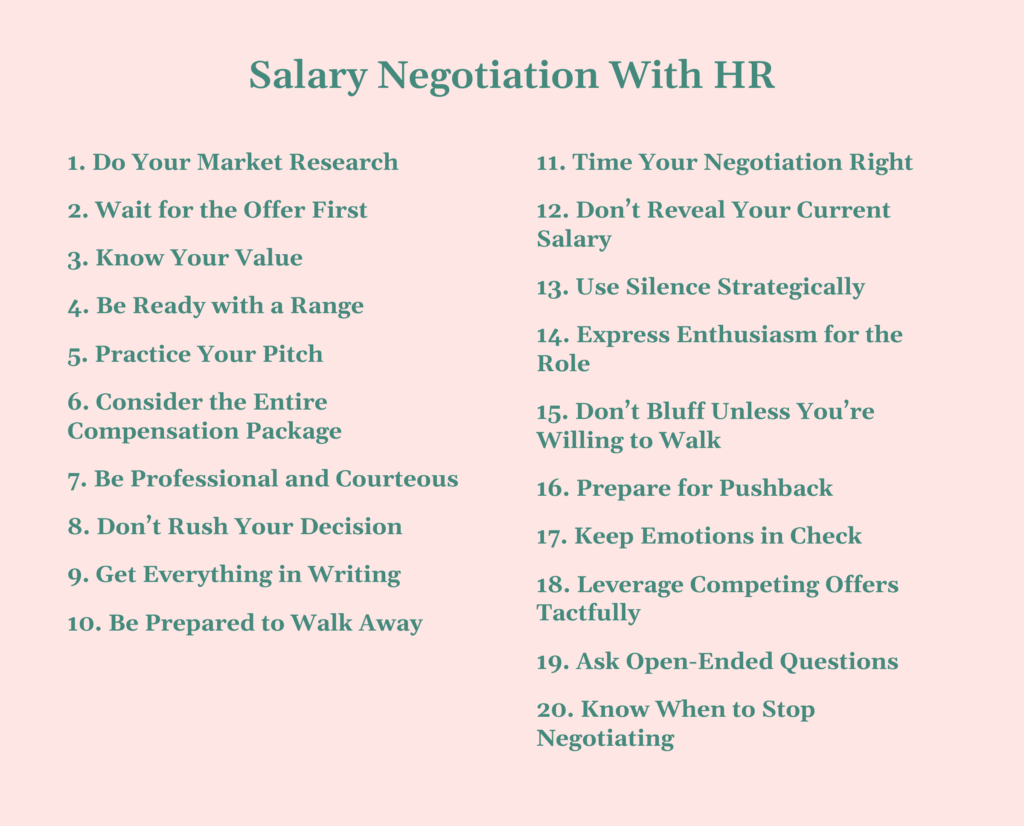
Be sure to approach the conversation about pay confidently but respectfully. Understand your market value and come prepared to explain what makes you valuable. Remember, salary negotiation tips with HR: talk only about your skills and value, not just numbers.
Before negotiating, gather reliable salary data from platforms like Glassdoor, LinkedIn Salary, or Payscale. Compare your role, experience, location, and industry to understand what’s reasonable clearly. Having data strengthens your position and shows you’ve done your homework.
Let the employer present the initial offer so you have a baseline from which to work. Bringing up salary too early can weaken your negotiating power. Once you have an offer, you can make informed counter-proposals.
Highlight your achievements, certifications, unique skills, and contributions to previous employers. Quantify your impact wherever possible, e.g., revenue growth, time saved, or customer satisfaction. The more value you demonstrate, the stronger your case for higher pay.
Prepare a realistic salary range based on research and your personal expectations. Ensure the low end is still acceptable, while the high end reflects your true worth. This flexibility allows for a smoother negotiation.
Rehearse your negotiation points so you can speak with clarity and confidence. Avoid emotional appeals and focus on the value you bring. Practicing with a friend or mentor can help you refine your tone and delivery.
Don’t fixate solely on the base salary. Evaluate benefits like bonuses, vacation days, health insurance, stock options, and remote work flexibility. Sometimes the overall package can compensate for a lower salary offer.
Approach the conversation respectfully and avoid confrontational language. HR professionals appreciate candidates who are collaborative and professional. Being polite builds goodwill and increases the chances of a favorable outcome.
If you need time to evaluate the offer, ask for it. A day or two to reflect allows you to weigh the full compensation and prepare any follow-up questions. Rushed decisions can lead to regrets or missed negotiation opportunities.
Once terms are agreed upon, ask for an official offer letter that reflects your negotiated salary and benefits. This protects both you and the employer. Verbal agreements can lead to misunderstandings later.
If the offer doesn’t meet your minimum requirements and negotiations stall, be ready to decline politely. Knowing when to walk away shows confidence and self-worth. It may even prompt the employer to reconsider and improve the offer.
Timing can influence your negotiation success. Discuss salary after you’ve demonstrated your value in interviews before signing anything. If possible, negotiate when the company is actively hiring or expanding, as it shows they’re ready to invest.
If asked about your current salary, redirect the conversation toward your expectations or market rates. Revealing your current pay may anchor the offer lower than you deserve, especially if you’re underpaid.
After stating your expectations or responding to an offer, pause and wait. Silence can create pressure and encourage HR to reconsider or increase the offer. Don’t feel compelled to fill every gap in conversation.
Show genuine interest in the position and the company. Make it clear you’re excited about the opportunity, but just that you want to ensure the compensation reflects your qualifications. A positive attitude keeps the conversation constructive.
Avoid making false claims about other offers or opportunities. If you say you’re considering another offer, be prepared to back it up or leave. HR professionals can often tell when you’re bluffing, which can harm your credibility.
HR may say the offer is fixed or that there’s little flexibility. Be ready with responses like: “I understand, but based on my research and experience, I believe a range of X to Y is fair.” Stay firm but respectful.
Even if the offer is disappointing, stay calm and professional. Emotional reactions, like frustration or anger, can derail the conversation. Treat it as a business discussion, not a personal conflict.
If you have other offers, use them strategically, not aggressively. Say, “I’ve received another offer with a higher compensation, but I’m very interested in your role. Is there room to match or improve the offer?”
Instead of only making demands, ask: “Is there flexibility in the salary range?” or “What can we do to get closer to X?” Open-ended questions invite discussion and show you’re open to finding a win–win solution.
Once you’ve reached a fair agreement, stop pushing. Over-negotiating can make you seem difficult or ungrateful. Know when to accept and shift the focus to making a strong start in your new role.
This open-ended question invites discussion without sounding too aggressive. It gives HR a chance to explain their constraints or offer more.
This helps you understand the basis of their offer, whether it’s based on internal budgets, market data, or company policy.
By tying your request to your qualifications, you show that you’re not just negotiating for the sake of it, you’re backing it with value.
This shifts the focus from just salary to the scope and impact of the position, opening the door for a broader compensation discussion.
If the base salary isn’t flexible, this question can lead to options like quarterly bonuses, commissions, or project-based rewards.
This shows you’re thinking long-term and can help you understand how quickly your compensation might grow in the future.
This helps you evaluate benefits like health insurance, retirement plans, paid time off, and perks that may balance out the base salary.
Companies often have budget flexibility for one-time costs, even when the salary is fixed. It’s a smart way to boost your total compensation.
This can help you determine where you fall within the company’s pay scale and whether there’s room for upward movement.
This question flips the script and invites HR to tell you what’s needed to justify a better offer, perhaps more experience, skills, or responsibilities.
Sample Answer:
“Thank you for the offer. I’m excited about the opportunity to work with your team. Based on my research and the value I can bring to this role, is there any flexibility in the salary or total compensation?”
Sample Answer:
“Based on my skills, experience, and current market trends for similar roles, I’m targeting a range of $75,000 to $85,000. I’m open to discussing the full package and finding a number that works for both of us.”
Sample Answer:
“I understand, thank you for your transparency. If salary is capped, would there be room for a signing bonus, additional vacation days, or a performance review in six months to revisit compensation based on results?”
Sample Answer:
“Certainly. In my last role, I led a project that increased customer retention by 15%, and I bring over five years of experience in this industry. Combined with my specialized certifications, I believe that justifies a slightly higher starting point.”
Sample Answer:
“If the total package aligns with what I’m looking for, especially in terms of growth opportunities and long-term potential, then yes, I would be very happy to move forward with your offer.”
Sample Answer:
“I understand the current offer and appreciate it. If there’s limited flexibility now, would it be possible to revisit the salary after a 3- or 6-month performance review? I’m confident I can demonstrate strong results early on.”
Sample Answer:
“I’m very interested in long-term growth here. Can you share how salary progression typically works within the first year? Knowing there’s a clear path forward would make me feel confident in accepting the offer.”
Sample Answer:
“To better understand the long-term fit, can you tell me how performance evaluations work and how they influence compensation? I like to set clear goals and align them with company expectations.”
Sample Answer:
“Thank you for the salary offer. Before making a final decision, could you walk me through the full compensation package, including benefits, bonuses, and any equity or retirement plans, so I can evaluate everything holistically?”
Sample Answer:
“I completely understand if the salary is fixed. In that case, are there any other areas, such as remote work flexibility, professional development budgets, or extra leave, that could be part of the negotiation?”

Here are five important tips on what to avoid while negotiating salary with HR, to help you keep the conversation smooth and professional:
While it’s essential to be confident, coming across as too pushy or entitled can alienate HR. Keep the tone respectful and collaborative rather than confrontational.
If you share your minimum acceptable salary too soon, it can limit your negotiation leverage. Try to discuss your value and expectations before disclosing exact numbers.
Bringing up coworkers’ salaries can create tension and is often seen as unprofessional. Focus on your own skills, experience, and market research instead.
Focusing only on base salary might cause you to miss out on valuable benefits like bonuses, stock options, or flexible work arrangements. Look at the full picture before pushing too hard on salary alone.
Threatening to decline the offer if your terms aren’t met can backfire if you’re unprepared to follow through. Use ultimatums sparingly and only when you have alternative options.
Knowing how to negotiate salary with HR is critical to obtaining the compensation that will set you up for a successful career. You can reach a mutually beneficial salary agreement by researching salary market trends, communicating your accomplishments, and engaging in discussions respectfully and confidently. Negotiation is not only about the numbers.
Negotiation is about understanding your worth and relaying that throughout the conversation process. With preparation and time to clarify salary negotiations, you can navigate these discussions successfully and build towards many career advancement opportunities. Remember that your worth in salary negotiation is not only about the number but also your worth in a dynamic job market. Remember to advocate for your worth!
Yes, it’s okay to negotiate; HR expects it.
For example: “I’m excited about the role, but based on my experience, is there flexibility on the offer?”
Tip: Know your market value before asking.
To discuss CTC with the HR, be polite and clear.
For example: “Thanks for the offer. Could you please break down the CTC so I can better understand the fixed, variable, and benefits parts?” This helps you see what you’ll take home and assess the offer thoroughly.
Tip: focuses on your take-home pay and growth rather than just the total number.
It’s okay to ask for a raise if you’ve earned it.
For example, you might say, “I’ve taken on more responsibilities and delivered strong results; based on that and market standards, can we discuss a salary increase?”
A good tip is to time this conversation after a significant achievement or during your performance review.
A warning sign in salary negotiation is unclear salary details, high pressure to accept quickly, or unwillingness to discuss CTC.
For instance, maybe it is an unacceptable warning sign if HR is going to say to you, How about this, “Take it or leave it,” and provide no discussion.
Tip: If HR isn’t clear or respectful of you now, this may be an indication of the company’s culture.
To justify a higher salary, show your value with specific results, market research, and relevant experience.
For example, “Based on my performance, added responsibilities, and industry benchmarks, I believe a higher salary better reflects my contribution.”
Tip: keep it professional and focus on facts, not personal needs.
A 10% raise can be good.
for example, it’s reasonable if you’re moving from analyst to senior analyst with moderate added duties. But it might be low if you’re stepping into a manager role with big responsibilities.
Tip: Compare with market rates to see if they match the role.
Is the salary negotiable based on my experience?
What benefits are included (bonuses, insurance, etc.)?
How often are salary hikes or reviews done?
Tip: Ask politely, stay confident, and focus on your value.
“I need more money because I have bills.”
“I’ll take whatever you offer.”
“My friend makes more here.”
“If you don’t pay me more, I’ll leave.”
Tip: Stay professional and focus on your skills and value, not personal needs or pressure.