

The principles of management are basic rules that guide managers in their efforts to plan, organize, lead, and control resources in pursuit of organizational goals. The best-known set of principles of management comes from Henri Fayol.
He proposed 14 principles about organizing work, including division of work, unity of command, equity, and stability of tenure, to enhance organizational efficiency and performance. The principles provide a basis for decision-making and are thought to be true and applicable to any type of organization.
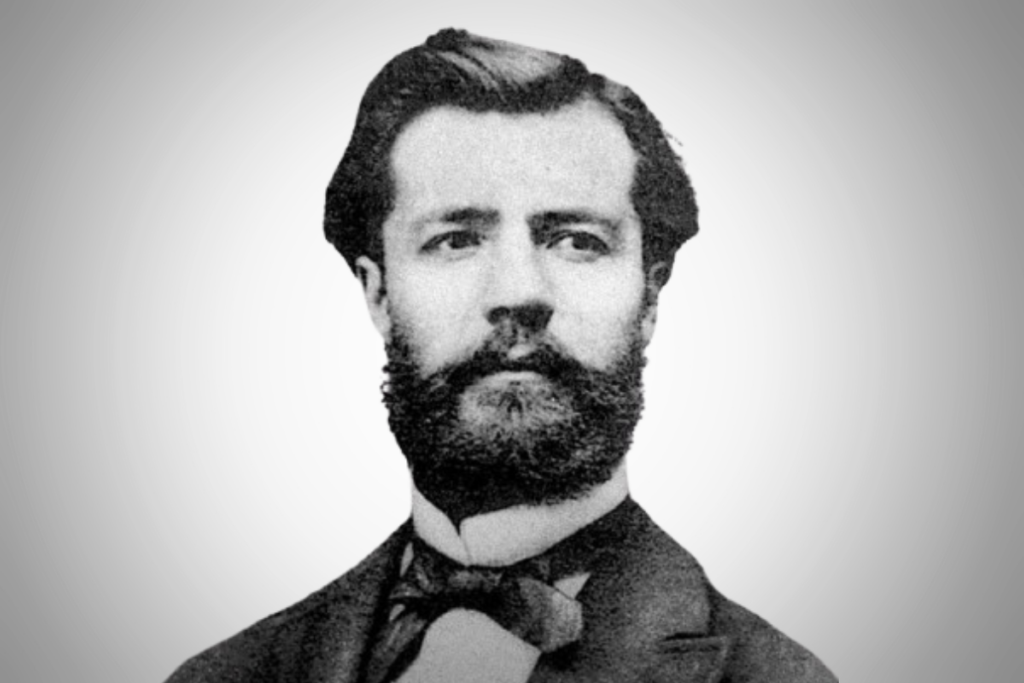
Henri Fayol was a distinguished French mining engineer who significantly contributed to management. He began his career at the French mining company Commentry-Fourchambault and Decazeville, where he quickly rose through the ranks due to his exceptional skills and leadership qualities. Eventually, Fayol became the general manager and director of the company, a position that allowed him to implement and refine his management theories.
Known as the “Father of Modern Management Theory,” Fayol’s work was groundbreaking in the early 20th century. His principles of management provided a structured approach to managing organizations, which was revolutionary at the time. Fayol’s ideas were not just theoretical; they were practical guidelines that could be applied across various industries, making them highly influential in modern management practices.
Henry Fayol 14 principles of management are crucial because they offer a foundational framework for effective management practices. These versatile principles can be applied in different organizational contexts, from small businesses to large corporations. By understanding and implementing Fayol’s principles, managers can address common challenges more effectively, improving organizational efficiency and communication.
For instance, Fayol’s principle of division of work helps optimize employee productivity by assigning tasks based on individual expertise. His emphasis on authority and responsibility ensures that employees are empowered to make decisions while being accountable for their actions. These principles collectively contribute to a more organized, efficient, and harmonious workplace, essential for achieving business goals.
Management principles are the rules that help you lead a team or run a business smoothly. They are super important because they give you a clear path to follow when making decisions and organizing your work. Henri Fayol’s principles, also known as Fayol’s, are foundational, providing a structured approach to planning, organizing, and controlling. Here’s how these principles shape the way a company operates:
Henry Fayol laid a strong foundation for management by providing 14 principles. His insights led to the creation of the Principles of Management book, a foundational text that details 14 key principles essential for effective management. These principles explain the principles of management and illuminate their functions, helping businesses achieve their goals efficiently. Let’s explore each principle with a detailed explanation and real-life examples.
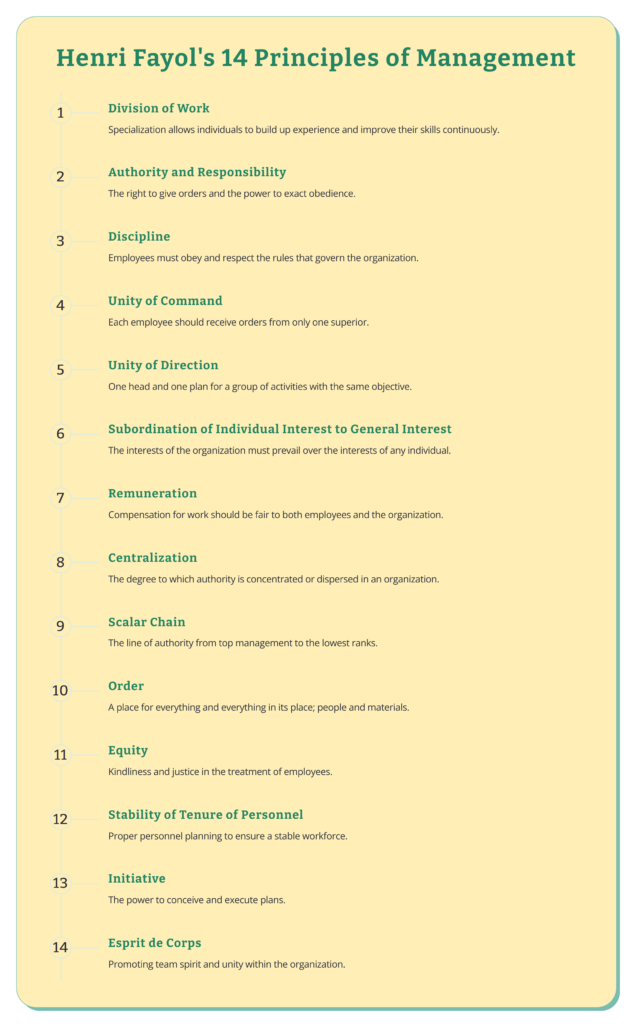
What it means: Specialize tasks among people to increase efficiency.
Example: In a factory, one person operates machinery while another assembles parts. This specialization makes workers skilled at specific tasks, leading to faster production and fewer mistakes.
Why it’s essential: Specialization maximizes productivity and expertise, making the work process smoother and more efficient.
What it means: With power comes the obligation to achieve tasks effectively.
Example: A restaurant manager has the authority to set shifts but is also responsible for covering absences to ensure the restaurant operates smoothly.
Why it’s essential: Balancing authority with responsibility ensures leaders are accountable, fostering a responsible management culture.
What it means: All must respect and follow rules and agreements.
Example: Employees adhering to a company’s time management policies, like clocking in and out, promotes fairness and order within the workplace.
Why it’s essential: Discipline maintains order, ensures fairness across the board, and upholds the integrity of organizational processes.
What it means: An employee should receive orders from one superior only.
Example: A marketing team member reports only to the marketing head, avoiding confusion and conflicting instructions from multiple leaders.
Why it’s essential: This clarity in command prevents confusion and conflicting instructions, enhancing decision-making and accountability.
What it means: Teams with the same objective should be directed by a single plan and leader.
Example: One sales manager drives all sales activities and ensures the team’s efforts align with the company’s sales targets.
Why it’s essential: It ensures that all efforts are strategically aligned, maximizing cohesion and efficiency in achieving organizational goals.
What it means: The company’s general interest should come before the individual interest when at work, prioritizing organizational goals over personal desires.
Example: A team member passes up a personal opportunity for training during a critical project phase to ensure team success.
Why it’s essential: It promotes teamwork and alignment with the company’s goals, ensuring that personal goals do not derail the organizational objectives.
What it means: Workers must be fairly paid for their services to motivate and sustain them.
Example: A commission model in sales not only incentivizes greater sales volume but also compensates salespeople for their direct contribution to the company’s revenue.
Why it’s essential: Fair compensation reduces employee turnover and boosts morale, directly impacting productivity and satisfaction.
What it means: The extent to which decisions are taken from the top or delegated to lower levels.
Example: A small business owner makes all the key decisions, ensuring consistency and clarity, but may delegate daily operational decisions to trusted managers.
Why it’s essential: Balancing centralization and decentralization helps in quick decision-making while also empowering employees.
What it means: A clear line of authority from top management to the lowest ranks.
Example: A customer service issue being escalated through defined levels of management to ensure the appropriate authority resolves it.
Why it’s essential: Ensures clarity in command and communication, making the organizational structure clear and functional.
What it means: Everything should have its place, and everyone should be in their place.
Example: In a retail store, products are organized categorically, and staff are assigned specific sections to manage.
Why it’s essential: Maintains organization and efficiency, making operations smooth and preventing chaos.
What it means: Employees should be treated kindly and justly.
Example: Addressing employee grievances impartially, ensuring no one feels undervalued or mistreated.
Why it’s essential: Builds organizational loyalty and trust, enhancing employee satisfaction and productivity.
What it means: High employee turnover should be avoided as it costs the company and disrupts operations. Emphasizing job security is crucial for employee retention and organizational efficiency.
Example: Offering career development and growth opportunities to retain talent and reduce recruitment costs.
Why it’s essential: Stability increases productivity as experienced employees are more efficient and knowledgeable about company processes.
What it means: Encouraging employees to take action and innovate.
Example: A tech company allows developers to spend time on personal projects that may benefit the company.
Why it’s essential: It nurtures creativity and innovation, leading to business growth and adaptation in a changing market.
What it means: Promoting team spirit and unity among employees.
Example: Team-building activities that create a sense of belonging and cooperation among team members.
Why it’s essential: It enhances morale and productivity, as employees work better when they feel connected and supported.
As Henry Fayol laid down, these principles outline essential managerial practices. They also provide a timeless guide that helps organizations function effectively, quickly adapt to changes, and achieve their objectives.
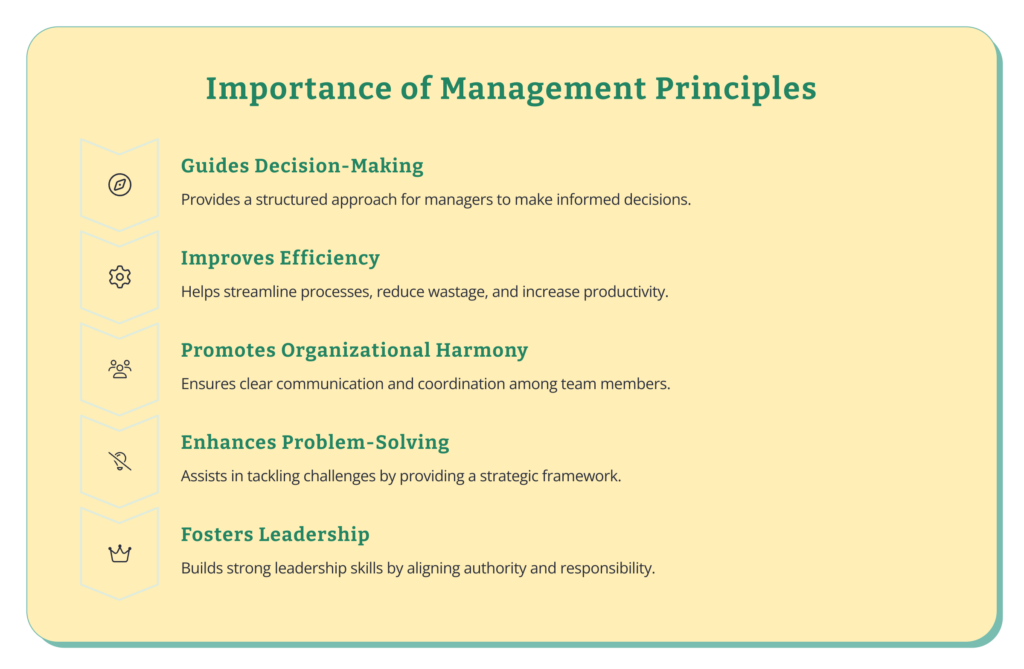
Applying Fayol’s principles of management in practice involves a deep understanding of each principle and tailoring them to meet the organization’s specific needs. Managers can use these principles as a framework for decision-making and problem-solving, adapting them to traditional and modern management practices.
For example, the principle of division of work can be effectively applied by assigning tasks to employees based on their skills and expertise, thereby enhancing productivity and reducing errors. The principle of authority and responsibility can be implemented by ensuring that employees have the necessary authority to complete their tasks and are held accountable for their performance. Similarly, the principle of discipline can be enforced by establishing clear rules and regulations and ensuring consistent adherence.
Managers can significantly improve job satisfaction and productivity by integrating 14 principles of Henry Fayol into daily operations. These principles promote a positive work culture, reduce stress and conflict, and enhance communication and decision-making. Additionally, they foster a sense of belonging and respect among employees, which is crucial for maintaining high levels of engagement and motivation.
50% of the managerial personnel don’t feel effective even after 1 year of job. Understanding key aspects of management principles makes any business work better and faster. These principles boost how well an organization functions by ensuring everyone is on the same page and knows what to do. Here’s how these principles make a difference:
Discipline is crucial in a management job as it fosters positive interrelations among team members and helps achieve project goals.
Here are some tangible ways principles of management help in different places:
By adhering to these management principles, every business or organization can work better, be more organized, and achieve its goals. It’s like knowing the rules of a game, playing becomes easier, and you often win.
Henri Fayol, often hailed as the father of modern management theory, was a French engineer who significantly influenced our understanding of management today. He kicked off his career at the Compagnie de Commentry-Fourchambault-Decazeville, a mining company that was struggling during the peak of the Industrial Revolution in France. With determination and strong leadership, he worked his way up and ultimately revitalized the company.
In 1916, Fayol released his groundbreaking book, “Administration Industrielle et Générale.” In this work, he shared the valuable lessons he learned from managing people and organizations, laying the foundation for what we now refer to as administrative theory. One of his most notable contributions was the introduction of the 14 Principles of Management, an early and impactful effort to establish management as a distinct profession, highlighting the importance of leadership and organization over mere technical skills.
His concepts revolutionized management, transforming it from a hands-on, trial-and-error approach into a formal discipline, and they continue to be taught in business schools around the globe today.
Even though Henri Fayol’s 14 Principles of Management are still highly regarded and utilized in many organizations today, they haven’t been without their share of criticism.
Fayol’s approach, often referred to as Fayolism, has been labeled by some as too inflexible, primarily catering to traditional, top-down management styles. It focuses on order, discipline, and well-defined chains of command, which can be effective in structured environments like factories or government offices.
On the flip side, critics point out that this model doesn’t allow much room for flexibility or employee involvement. In the fast-paced, collaborative workplaces of today, employees are often encouraged to take initiative, think outside the box, and participate in decision-making. Fayol’s theory doesn’t always mesh well with this modern approach, making it seem a bit outdated in certain contexts.
So, while Fayol certainly laid down a crucial foundation for management as a field, his principles may not be the best fit for every organization, especially those that prioritize innovation, autonomy, and a more dynamic management style.
Divide the work – Everyone does what they’re best at.
Give authority with responsibility – Power comes with accountability.
Keep discipline – Respect rules and roles.
One boss per person – No confusion.
One plan, one goal – Stay focused.
Team > individual interest – Company goals come first.
Pay fairly – Reward people for their work.
Balance control – Don’t micromanage; don’t go hands-off.
Clear chain of command – Everyone knows who to report to.
Stay organized – People and things in the right place.
Be fair – Treat everyone kindly and equally.
Job security matters – People work better when they feel stable.
Encourage ideas – Let people take initiative.
Build team spirit – A united team works best.
Tip: These are timeless, even modern companies use them to lead better.
Planning-Involves determining what you want to accomplish and how.
Organizing-Putting people and things in the right place.
Staffing-Hiring and training the right people to do it.
Directing-Asking, encouraging, and leading others to do it.
Controlling-Checking to see that we are on track and addressing any issues that are happening.
Tip: One way to think about it is like a process of leading a team project: plan it, organize it, staff it, lead them, and check on it along the way.
This is oriented toward “how to manage people and work most effectively.”
Example: One principle is “Unity of Command” – each employee should only report to one boss to prevent confusion.
Tip: The principles help make teams more productive, organized, and engaged in their work.
Planning – Identifying goals and determining how to achieve them.
Organizing – Coordinating resources and tasks on time.
Leading – Influencing and motivating people for accomplishment of goals.
Controlling – Monitoring progress and identifying opportunities for improvement.
Tip: These four steps are a cycle – plan it, organize it, lead it, and continue to improve it!
It avoids confusion, mixed instructions, and workplace conflicts.
Example: If a designer reports to both the marketing head and the product manager, they may get conflicting tasks. One clear boss = smoother work.
Tip: Fewer bosses, clearer communication!
Henri Fayol is recognized as the father of management.
He was a French engineer who provided the 14 principles of management and showed us how to better manage teams through planning, organizing, leading and controlling.
Tip: His thoughts are over 100 years old but still apply today, that’s why he’s the OG of management!