


Entrepreneurial skills include all of the skills needed to start, run, and grow a business. They include, but are certainly not limited to, leadership, communication, problem solving, financial management, and flexibility. Efficient entrepreneurs also have strong networking and time management skills, along with a willingness and ability to innovate and take risks.
In today’s fast-paced and ever-evolving business landscape, possessing strong entrepreneurial skills is more crucial than ever. Whether you’re a budding entrepreneur or a seasoned business owner, honing these skills can significantly impact your success.
This blog will explore the critical entrepreneurial skills you need, how to develop them, and why they are essential for your journey.
Entrepreneurial skills are the qualities and abilities that help individuals start, manage, and grow a business successfully. These skills enable entrepreneurs to recognize opportunities, tackle challenges, and make smart decisions. They are valuable not only for business owners but also for self-employed professionals. Developing an entrepreneurial mindset is essential for success, as it fosters innovation, strategic thinking, and resilience. These skills also play a key role in building strong relationships with customers, teams, suppliers, and investors, ultimately helping businesses stand out and thrive.
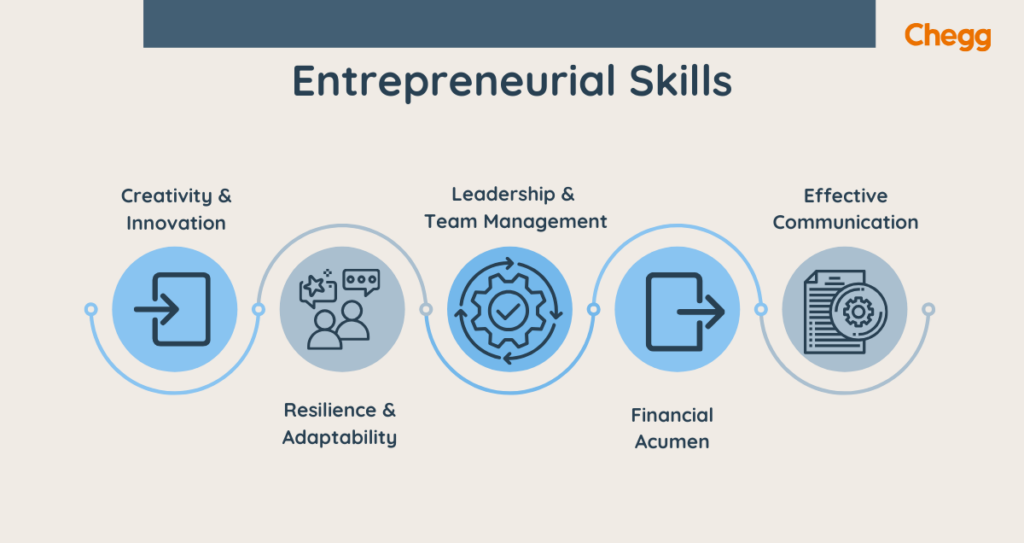
To build and grow a successful business, entrepreneurs need a mix of hard and soft skills. These skills help them innovate, manage risks, adapt to changes, lead teams, and make strategic decisions. Below are some of the key entrepreneurial skills that are essential for success:
Business management skills are attributes that an entrepreneur must possess in order to either run a business themselves or ensure that all business goals are achieved. Entrepreneurs who have this skill set are able to supervise and manage the operations of different departments, because they have in-depth knowledge of all business functions. Business management skills include multitasking, delegation of responsibilities and important business decision making.
All entrepreneurs must be able to communicate clearly with clients, team and all other stakeholders. They must have exceptional written and verbal communication skills, whether this is verbal communication in meetings or conveying reports and messages through emails regarding the project. In addition to communicating effectively, an entrepreneur must also be an excellent listener, this way to identify what the project requires and when discussing ideas in meetings.
Networking entails creating and managing relationships with other professional entities to expand and propel a business. Proper networking abilities cultivate future opportunities and help develop a brand. Networking provides entrepreneurs with opportunities to meet others with similar interests, create future teams and keep in touch with industry changes. Networking is one of the most discussed skills for entrepreneurs because through a healthy network, they can meet professionals to fund their ideas, connect with individuals who have professional business skills and gain feedback on their new business or idea.
Learning how to take risks responsibly and wisely is one of the most essential entrepreneur skills to understand. Employees with an entrepreneurial way of thinking will never hesitate to take risks because they realize how calculated risks can lead to enormous success. They view risk as an opportunity to learn and elevate their business model. Employers are looking for applicants who can take risks to earn potential rewards and profit.
Critical thinking is an entrepreneurship skill that objectively assesses the information and reaches a rational conclusion. Critical thinking allows an entrepreneur to evaluate a situation and formulate a logical solution to the problem. Employers are looking for candidates that demonstrate critical thinking because this skill is useful in evaluating problems and building strategies for business expansion.
Typically, a critical thinker is autonomous, competent and reflective. A critical thinking skill allows entrepreneurs to logically link ideas, evaluate information, identify discrepancies in work, analyse arguments and solve complex issues. The skilled critical thinker will not simply memorise information but use the information to provide valuable meaning.
Entrepreneurs are often engaged in challenging and unexpected circumstances. For example, it may be a venture capitalist denying any further funding for a project or team member refusing to work in accordance with the project guidelines; the entrepreneur must have strong problem-solving skills to manage the stressful situation, effectively and calmly identify different possible solutions in a timely manner. A strong problem-solving skill would ensure the entrepreneur reaches their business objective.
Creativity, though highly useful yet sometimes undervalued in an online scenario, can validate that what underpins innovation is creative thinking that enables an individual to look at issues from various perspectives. Those creative-thinking entrepreneurs are rarely concerned about taking a road less traveled. They not only think out-of-the-box but also seek input from someone belonging to another field to gain a fresh perspective. This aspect, among others, makes god creative thinking qualities one of the high-demand traits in anonymity because it allows whomever it is perceived to be in the linkage according to what connects them to see patterns even when there are no patterns and thus create innovative options to fix the ills of the business.
Good customer service supports the brand and builds loyalty. Whenever it is needed in an industry, the quality of customer service will define the prospects for business growth. Customer service skills help an entrepreneur interact with potential customers for anything ranging from interacting with them to discussing funding options.
For entrepreneurs, resource, investment analysis, and ROI estimation should be a second instinct. They must also know how to use accounting and budgeting software to manage all financial operations. Once an entrepreneur develops financial skills, they will not overspend and are bound to use available resources efficiently and effectively.
Possessing effective leadership skills is important to engage colleagues, empower the workforce, and provide direction to reach shared goals. Successful leadership is all about leading by example, but great leaders will know when to take on a leadership role and when to work collaboratively as a team member and peer. Entrepreneurs that are proficient in leadership skills can motivate employees, manage the operation, and delegate tasks to achieve business goals.
Good time management helps to maximise productivity and organise your workspace. Entrepreneurs with time management and organisational skills can differentiate between various levels of task priorities, ensure tasks are completed on time, and avoid procrastination. To guarantee that projects are delivered on time, entrepreneurs will examine their own timing and that of their teams, set time limits on tasks completed each day, complete the primary and strategic tasks first, assign specific work to others, develop a to-do list, and ultimately use technology to keep the workspace organised.
Technical and hard skills are those that are acquired by using digital tools and software. Entrepreneurs need to have the right technical skills to use their planning, marketing and budgeting software efficiently. Learning how to use their software provides entrepreneurs with a hands-on experience with their projects, enables them to track sales and budgets, and provides familiarity with managing a project.
You can cultivate entrepreneurial skills by focusing on the following areas: –
Entrepreneurial skills are crucial not only for launching a business but also for ensuring its long-term success and growth. Here’s a deeper look into why these skills are essential:
Entrepreneurs with keen observational skills can spot gaps in the market that others might miss. This ability to identify unmet needs or emerging trends allows them to develop innovative solutions and capitalize on these opportunities. By staying attuned to market dynamics, entrepreneurs can position their businesses to meet demand effectively and gain a competitive edge.
Risk management is one of the fundamental entrepreneurial skills. Entrepreneurs must anticipate potential challenges and devise strategies to navigate them. This involves thorough market research, financial planning, and contingency planning. By proactively addressing risks, entrepreneurs can minimize their impact and ensure the stability and resilience of their business.
Innovation is at the heart of entrepreneurship. Entrepreneurs are constantly seeking ways to improve their products and services to better meet customer needs. This drive for continuous improvement fosters a culture of creativity and adaptability within the organization. By embracing new technologies and methodologies, entrepreneurs can keep their offerings relevant and competitive.
Networking is one of the vital entrepreneurial skills that involves establishing and nurturing relationships with industry peers, potential partners, investors, and customers. A strong network provides access to valuable resources, advice, and opportunities. Entrepreneurs who excel at networking can leverage these connections to support their business growth, gain insights, and collaborate on new ventures.
To become a successful entrepreneur, you must work on building essential skills and qualities. Here are key ways to foster entrepreneurial abilities:
By consistently working on these aspects, you can strengthen your entrepreneurial mindset and increase your chances of long-term success.
Entrepreneurship comes with challenges like risks, long hours, and a lack of job stability. However, for those passionate about turning their ideas into reality, it can be highly rewarding. Here’s why entrepreneurship
can be a great career choice:
Despite the uncertainties, entrepreneurship skills offer freedom, growth, and the chance to make a real difference.
Entrepreneurial development is a continuous process that requires dedication and effort. By focusing on creativity, resilience, leadership, financial acumen, and communication, you can enhance your ability to succeed in the competitive business world. Remember, the journey of entrepreneurship is a marathon, not a sprint. Stay committed, keep learning, and embrace challenges along the way.
By following these tips and continuously improving your entrepreneurial skills, you’ll be on your way to achieving your business goals and making a lasting impact in your industry.
Entrepreneurial skills are the essential abilities needed to start and manage a business. They involve creativity, strategic planning, risk-taking, and effective project management.
Every entrepreneur must have a mix of hard and soft skills, including strategic planning, execution, strong communication, financial knowledge, and a willingness to keep learning.
Entrepreneurship is the ability and willingness to start, manage, and grow a business while taking risks to earn a profit. Key skills include customer service, communication, financial management, teamwork, and leadership.
An entrepreneur is a person who launches and runs a business while handling its risks. They are innovators who challenge existing industries and drive change.
Here are the 5 C’s of Entrepreneurship:
1. Character – Represents the entrepreneur’s trustworthiness, integrity, and reputation.
2. Cash Flow – Ensures steady financial movement to sustain and grow the business.
3. Collateral – Assets that can be used as security for loans or investments.
4. Capital – The funds needed to start and expand the business.
5. Conditions – External factors like market trends, competition, and economic climate affect the business.
Learning entrepreneurial skills helps you think creatively, solve problems, and take initiative. It builds confidence, improves decision-making, and prepares you to handle real-world challenges—whether you’re starting a business or working in any job.
Yes, many colleges, universities, and government initiatives offer diploma, certificate, and degree programs focused on entrepreneurship and business development.
Schemes like Startup India, Skill India, and the Pradhan Mantri Yuva Yojana (PMYY) aim to support budding entrepreneurs with training, funding, and mentoring.
It Includes creativity, risk-taking, innovation, problem-solving ability, and a strong vision for growth.
While managerial skills focus on maintaining operations, entrepreneurial qualities drive innovation, risk-taking, and growth.
AI has changed the way entrepreneurs work by empowering them with data analysis and decision-making capabilities, automating the uncreative, and giving insight into consumer behaviors. It is crucial that today’s entrepreneurs have at least minimal understanding and skill in operating tools with AI for marketing, product development, and customer service.
Efficiency with AI will give entrepreneurs an edge over others. Companies that are able to use AI efficiently will achieve efficiencies with costs, speed, and identify new market opportunities, giving them a competitive advantage.