


In 2025’s fast-evolving business landscape, having a clear, flexible, and well-defined business strategy is no longer optional it’s essential for survival and growth. A strong business development strategy empowers organizations to set measurable goals, allocate resources efficiently, and stay competitive amid rapid digital transformation and changing customer expectations.

By integrating data-driven insights, innovation, and sustainability, businesses can future-proof their operations, unlock new opportunities, and achieve consistent performance. In an era of rising competition and market volatility, a tailored strategy acts as your roadmap for long-term success, guiding every decision toward growth and profitability.
In this guide, you’ll discover why a strategic business plan matters more than ever in 2025 and how to design one that drives measurable, sustainable success.
Business strategy refers to a comprehensive plan that a company follows to achieve specific goals, compete effectively, and create value over the long term. It involves decisions on resource allocation, target markets, product offerings, pricing, and positioning to build a sustainable competitive advantage in the marketplace.
In 2025, businesses need to craft personalized strategies that are adaptable and tailored to their specific market position, goals, and resources.
As we go through the complexities of the business world in 2025, we can no longer afford to take spontaneous action to address market changes. A clear and proactive business strategy will provide the vision and direction necessary to steer your company through the chaos. The competitive landscape is fiercer, customers are more demanding, and technological advancements are disrupting traditional industries at an unprecedented pace.
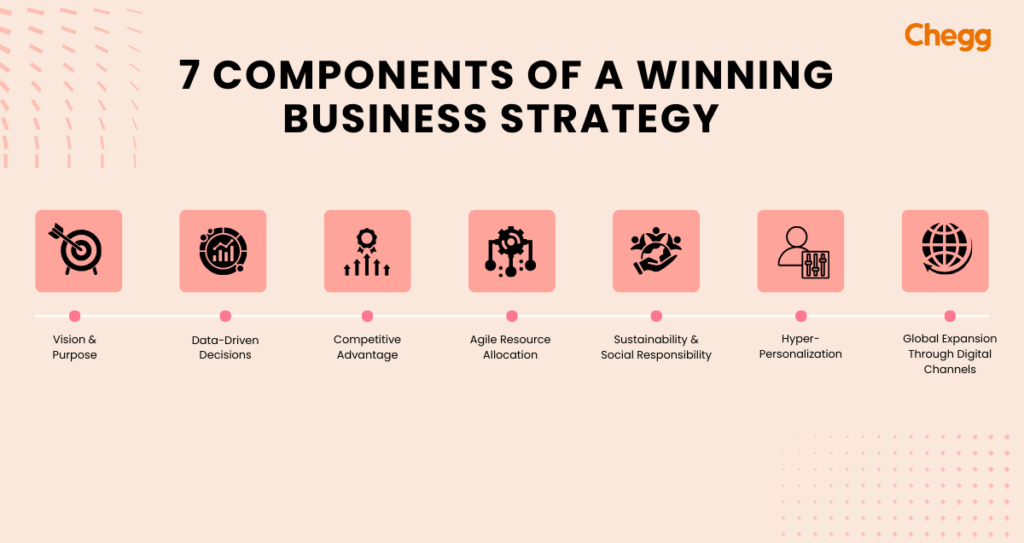
There are different types of business strategy. Building a successful strategy in 2025 involves understanding the key components that drive growth and sustainability. Below are the five critical elements:
A clear and compelling vision is the heart of your strategy. It tells everyone in your organization why you exist and what you’re working toward. But in 2025, simply having a vision isn’t enough. You need to embed it into the very fabric of your company culture, ensuring that every decision made aligns with your long-term purpose.
With the explosion of data analytics and AI, businesses now have more insights than ever before. Your strategy in 2025 must leverage these technologies to make data-driven decisions. Whether it’s understanding customer behavior or predicting market trends, a strategy rooted in data will allow you to stay ahead of the competition.
What sets you apart from your competitors? In 2025, finding and maintaining your competitive advantage is more challenging than ever. Whether it’s through innovation, cost leadership, or niche focus, your business strategy must clearly define how you will outperform your rivals and sustain that edge over time.
Your strategy needs to ensure optimal use of resources—whether it’s talent, technology, or finances. In 2025, the ability to quickly reallocate resources based on changing market conditions is crucial for survival.
Consumers in 2025 are looking for more than just products they want to support brands that are ethical, sustainable, and socially responsible. Your business strategy should incorporate initiatives that reflect these values, not only because it’s the right thing to do but because it will win you loyal customers.
Customers today expect a highly personalized experience. In 2025, businesses that fail to customize their offerings will fall behind. Your strategy should include methods for gathering and analyzing customer data to deliver personalized solutions at scale.
Thanks to the digital revolution, expanding your business across borders has never been easier. In 2025, companies can scale globally with minimal physical infrastructure. Your business strategy should explore how to leverage digital channels to reach international markets without massive overhead costs.
Start by revisiting your company’s vision and aligning it with the current business landscape. Is your vision still relevant? Does it reflect the direction you want to take in 2025 and beyond? Revisiting your vision means regularly reviewing and refining your company’s long-term purpose and direction to ensure it remains aligned with market realities, customer expectations, and internal capabilities. Markets shift, industries evolve, and businesses grow. What made sense five years ago may need adjusting today. Revisiting the vision helps maintain relevance and focus

A detailed SWOT (Strengths, Weaknesses, Opportunities, Threats) analysis will give you a comprehensive understanding of both internal and external factors that can impact your business. Use this analysis to fine-tune your business strategy and address any gaps.
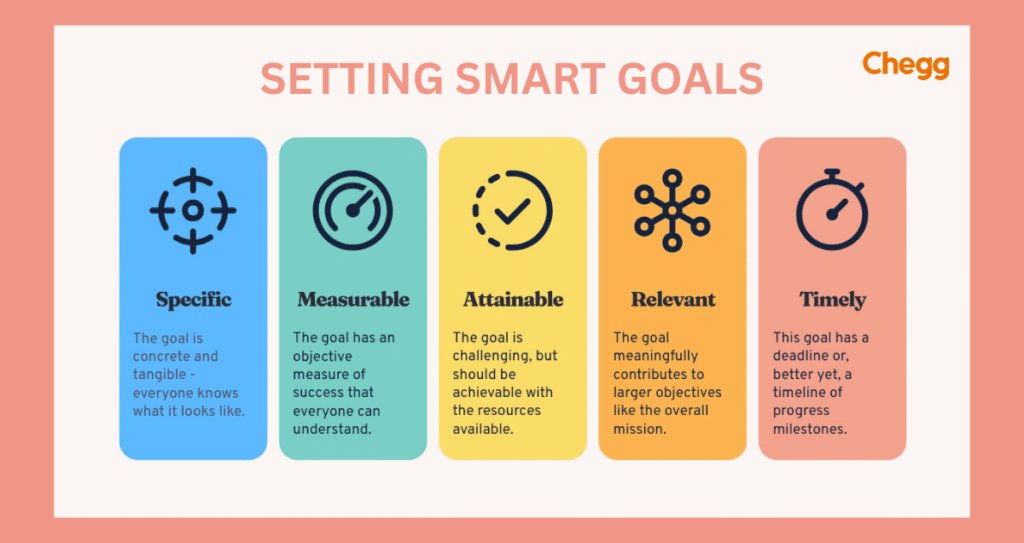
Setting vague or broad goals will not work in 2025. Your business strategy must include SMART (Specific, Measurable, Achievable, Relevant, Time-bound) goals that provide clear direction. This refers to creating clearly defined targets that can be tracked and evaluated using data. Often linked to the SMART framework (Specific, Measurable, Achievable, Relevant, Time-bound). Big-picture strategies can’t succeed without actionable milestones. Measurable goals turn vision into results.
It is important to do an analysis of the marketplace of the business that you have or wish to start. It is important to examine the external business environment to understand industry trends, customer needs, competitor behavior, and emerging opportunities or threats. By understanding where the market is heading, companies can position themselves proactively instead of reactively.
Having a competitive edge means possessing a unique advantage that allows a company to outperform its rivals whether through superior product quality, pricing, innovation, customer service, brand loyalty, or operational efficiency. A core goal of strategy is to define and sustain a competitive edge that’s hard for others to replicate.
Building a comprehensive framework refers to creating a structured, end-to-end approach that guides strategic planning, decision-making, and execution. It typically includes clear objectives, methodologies, metrics, and accountability structures. Without a solid framework, strategies often lack cohesion and fail in implementation.
If you are looking at which are the first steps you should consider when constructing an online business strategy Incorporate the latest technologies into your business strategy. Whether it’s using AI to streamline operations or leveraging big data to inform your marketing efforts, technology should be a cornerstone of your plan. Leveraging technology means using digital tools and platforms strategically to improve efficiency, drive innovation, enhance customer experience, or gain a competitive advantage. Technology is not just an enabler it’s often a core driver of modern strategy.
The world of business is constantly changing, and your strategy needs to be flexible. Build regular review processes into your strategy to ensure you can pivot when necessary. This refers to embracing a mindset of continuous improvement, where strategies are treated as dynamic and evolving not set in stone. It emphasizes responsiveness and learning from data, feedback, and outcomes. No plan survives first contact with reality. Strategy should be flexible, allowing room to pivot or refine based on performance and market signal.
Business strategy is the big picture. It’s the long-term vision and overarching plan that defines where a company wants to go and how it plans to get there. Think of it as the “why” and the “what” behind the business’s major moves. Business tactics, on the other hand, are the day-to-day actions and short-term decisions that support the larger strategy. They’re the “how” the specific methods or steps teams take to execute the strategy.
| Aspect | Business Strategy | Tactics |
|---|---|---|
| Time Frame | Long-term | Short-term |
| Focus | Bigger goals and the overall vision; comprehensive planning for growth and direction | Specific actions or steps to achieve defined strategic goals |
| Scope | Covers the entire organization and involves multiple departments or branches | Narrower in scope; focuses on individual teams, departments, or functions |
| Flexibility | More stable and changes less frequently | Highly adaptable; changes often based on conditions and desired outcomes |
When making a business strategy one must also keep in mind the fastest growing sectors in India to understand which industries are booming in India, so that you can build your strategy accordingly.
Choosing the right business strategy is crucial for success and requires evaluating multiple aspects of your organization and market:
As 2025 unfolds, a future-ready business strategy is no longer optional it’s the foundation of lasting success. The most effective strategies are adaptable, data-driven, and innovation-focused, helping organizations stay resilient amid constant change.
By embracing emerging trends such as AI integration, remote collaboration, and sustainability, and by aligning goals with smart resource management, you can design a business strategy that not only adapts but accelerates growth. Build for today, plan for tomorrow, and position your business to thrive well beyond 2025.
Recommended Read:
The 7 elements of a business strategy are Vision and Purpose, Data-Driven Decisions, Competitive Advantage, Agile Resource Allocation, Sustainability and Social Responsibility, Hyper-Personalization and Global Expansion.
The 4 levels of business strategy are: corporate strategy, business unit strategy, functional strategy, and operational strategy.
The 4 steps for a successful business strategy are:
1. Set clear goals: Define specific, measurable, and achievable objectives.
2. Analyze the market: Understand industry trends, competition, and customer needs.
3. Develop a plan: Create actionable steps to achieve goals.
4. Execute & monitor
The 5 points of strategy are: Clear objectives, Competitive advantage, Market positioning, Resource allocation and Execution plan.
A SWOT analysis in business is a strategic framework for identifying a company’s internal Strengths and Weaknesses, and external Opportunities and Threats, to help make better strategic decisions and improve business outcomes.
A business strategy is a high-level plan that outlines how a company will achieve its long-term goals and objectives by creating a competitive advantage in its market.
Common business strategies include cost leadership, differentiation, focus strategy, and growth strategy. These approaches help in strategy development by guiding companies on how to compete, attract customers, and expand efficiently in their target markets.
Aligning strategy across your organization is key: Think of your company’s strategy like a tree: the corporate strategy is the trunk, business units are the branches, and functional areas are the leaves. Each level needs to work together to support overall growth.


