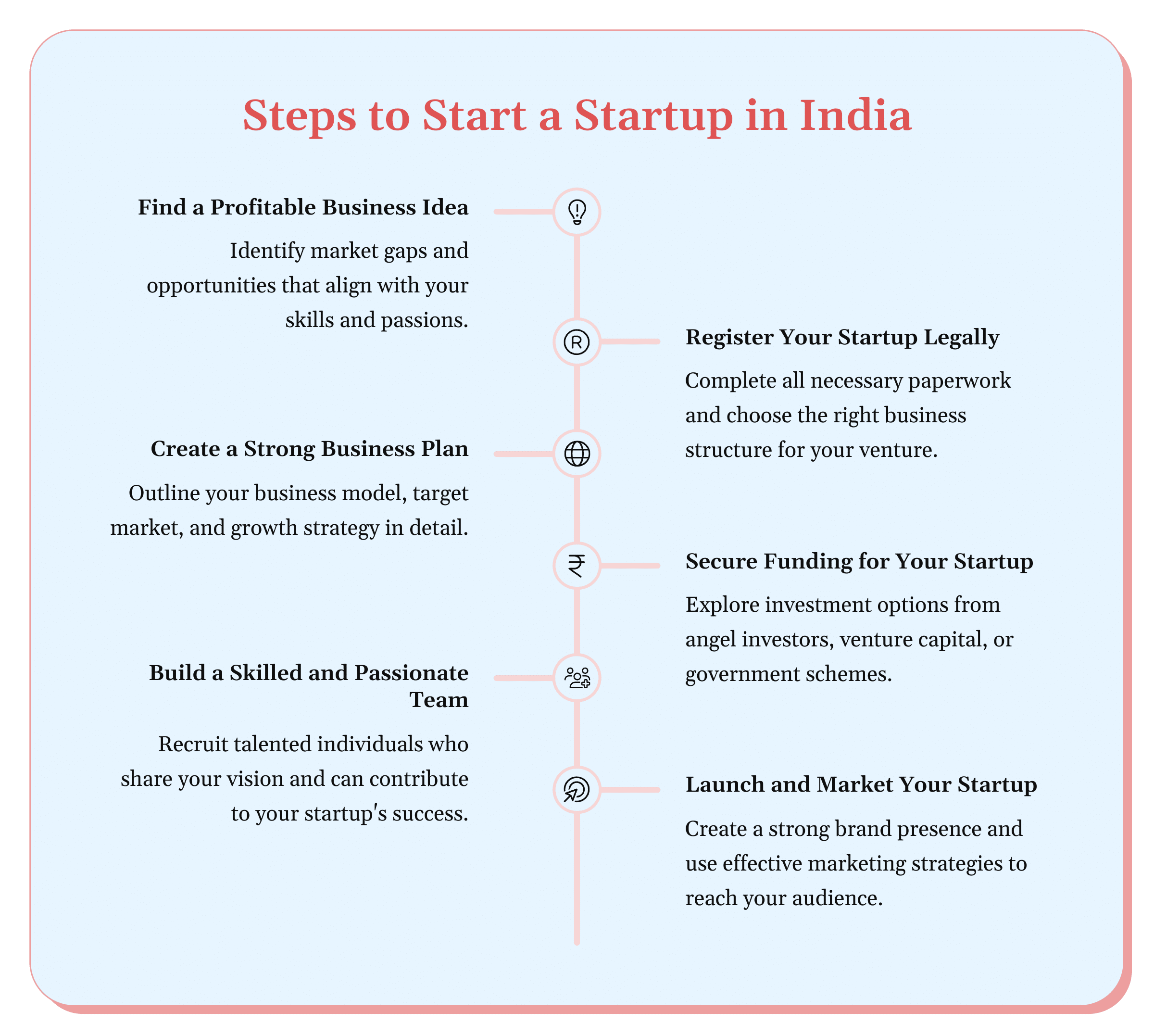
Starting a startup in India in 2025 offers vast opportunities with government support and a growing ecosystem of 159,000+ DPIIT-recognized startups.
Success requires a profitable idea, legal registration, solid planning, funding, a skilled team, and effective marketing.
Using government schemes, adapting to challenges, and scaling strategically ensures sustainable growth and competitiveness.
Table of Contents
Starting a startup in India in 2025 presents an exciting opportunity, fueled by innovation, digital growth, and supportive government schemes like the Startup India Initiative. India now boasts the world’s third-largest startup ecosystem, spanning fintech, e-commerce, healthcare, and more, with major hubs in Bangalore, Delhi, and Mumbai. Despite challenges like occasional startup closures, the sector is maturing, with a focus on sustainable growth, increasing women entrepreneurs, and promising trends for 2025.
Whether you’re a student, aspiring entrepreneur, or small business owner, this guide simplifies the process of starting a startup in India from legal registration, funding, and compliance to scaling your business. Explore actionable steps, low-investment options, and expert strategies tailored to the Indian ecosystem to launch and grow a successful startup faster and smarter.
What is a Startup?
A startup is a newly established business that aims to solve a problem by offering innovative solutions. Unlike traditional businesses, startups often focus on growth and scalability. The Government of India defines a successful startups in India as:
A company that is less than 10 years old.
Has an annual turnover of less than ₹100 crore.
Works towards innovation, development, or improvement of products/services.
The Startup Ecosystem in India
India is the third-largest startup ecosystem in the world. As of January 31, 2025, the Department for Promotion of Industry and Internal Trade (DPIIT) has officially recognized 161,150 startups under the Startup India initiative.
Key Growth Drivers:
Government support – Various schemes, tax benefits, and regulatory relaxations.
Growing digital infrastructure – High internet penetration and smartphone adoption.
Top Startup Sectors in India
Here is the list of startup companies in India:
Sector
Notable Startups
E-commerce
Flipkart, Nykaa
Fintech
Paytm, Razorpay
Edtech
Byju’s, Unacademy
HealthTech
PharmEasy, Practo
SaaS
Freshworks, Zoho
How to Start a Startup in India?
Starting a startup in India can be an exciting and rewarding journey, but it requires careful planning, research, and execution. Whether you’re an aspiring entrepreneur or someone with a unique business idea, following a structured approach can increase your chances of success. Below is a detailed, step-by-step guide on how to start up a company in India to help you launch your startup smoothly.
Step 1: Find a Profitable Business Idea
The foundation of a successful best startup in India begins with a solid business idea. This idea should address a real-world problem and offer a solution that people are willing to pay for.
How to Identify a Profitable Business Idea?
Find a Market Gap: Look for problems that people face daily and think about how you can solve them.
Research Industry Trends: Analyze the latest trends and growing industries in India, such as e-commerce, fintech, edtech, and health tech.
Know Your Target Audience: Understand the needs, preferences, and pain points of your potential customers.
Validate Your Idea: Conduct surveys, seek feedback, and test your concept on a small scale before investing heavily.
A well-researched business idea forms the backbone of your best startup in India, so take time to refine it before moving to the next step.
Step 2: Register Your Startup Legally
To operate legally, you need to register your startup in India with the relevant authorities. Here’s how you can registering a startup in India:
Choose the Right Business Structure
Private Limited Company (Pvt Ltd): Suitable for businesses seeking investment and scalability.
Limited Liability Partnership (LLP): Best for small businesses that want limited liability without a corporate structure.
Sole Proprietorship: Ideal for freelancers or single-person businesses but offers no liability protection.
Complete the Registration Process
Register with Startup India: Visit the official Startup India website and apply for recognition to access government benefits.
Get GST Registration: If your business revenue exceeds ₹20 lakh annually, register for GST to comply with tax regulations.
Obtain Business Licenses: Depending on your industry, you may need specific licenses such as an FSSAI license for food businesses or an MSME registration for small enterprises.
Legal registration ensures that your startup in India operates without legal hurdles and qualifies for government incentives.
Pro Tip: Registering with DPIIT gives tax exemptions & easier compliance.
Step 3: Create a Strong Business Plan
A well-structured business plan acts as a roadmap for your startup in India, helping you stay on track and attract potential investors.
Essential Elements of a Business Plan
Company Vision and Mission: Define your long-term goals and what your business stands for.
Market Research: Analyze competitors, target audience, and market demand for your product or service.
Revenue Model: Explain how your startup will make money, whether through product sales, subscriptions, or advertising.
Marketing Strategy: Outline how you will promote your business using digital marketing, social media, and traditional advertising.
Financial Projections: Estimate your expenses, profits, and break-even point to ensure financial stability.
A strong business plan not only guides your startup in India but also improves your chances of securing funding from investors.
Step 4: Secure Funding for Your Startup
Most businesses require initial capital to get started. There are several ways to fund your startup in India, depending on your needs and business model.
Funding Options for Startups
Bootstrapping: Self-funding your business using personal savings or borrowing from friends and family.
Angel Investors: High-net-worth individuals who invest in startups at an early stage in exchange for equity.
Venture Capitalists (VCs): Firms that invest in startups with high growth potential in return for equity stakes.
Crowdfunding: Raising money from the public through platforms like Kickstarter and Indiegogo.
Government Schemes: The Indian government offers schemes like MUDRA loans and Startup India Seed Fund for new businesses.
Finding the right funding source can help your startup in India grow faster and scale effectively.
Step 5: Build a Skilled and Passionate Team
A successful startup in India requires a team of dedicated professionals who share your vision and can drive the business forward.
Key Roles to Hire for Your Startup
Marketing & Sales Experts: To promote your product and attract customers.
Product Developers: To design and improve your offering, whether it’s a physical product, app, or service.
Financial Managers: To handle budgeting, taxation, and revenue management.
Customer Support Team: To provide excellent service and retain customers.
Hiring the right people will ensure that your startup in India grows efficiently and maintains a strong foundation.
Pro Tip: Offer ESOPs to attract talent with low initial salaries.
Step 6: Launch and Market Your Startup
Now that your startup in India is registered and ready to go, it’s time to launch and attract customers. A well-planned launch strategy can make a huge difference in your startup’s success.
How to Market Your Startup Effectively?
Create a Website: A professional website builds credibility and allows customers to learn about your offerings.
Use Social Media: Platforms like Instagram, LinkedIn, and Twitter help in brand awareness and engagement.
Invest in SEO & Content Marketing: Optimizing your website for search engines ensures organic traffic and higher visibility.
Offer Discounts & Promotions: Attract initial customers by giving limited-time discounts and referral bonuses.
Collaborate with Influencers: Partner with social media influencers to promote your product to a larger audience.
An effective marketing plan ensures that your startup in India gains visibility and starts generating revenue from the beginning.
Starting a startup in India requires careful planning, legal compliance, and strong execution. By following these steps choosing a profitable idea, registering legally, creating a business plan, securing funding, hiring a great team, and marketing effectively you can set up a successful venture.
Government Initiatives Supporting Startups in India
The Startup India initiative, launched in 2016, provides various benefits to entrepreneurs, including:
1. Startup India Registration Benefits
Tax exemptions under Section 80-IAC and Section 56 (Angel Tax Exemption).
Simplified compliance and self-certification for labor and environmental laws.
Easy access to government funding through the Startup India Seed Fund Scheme (SISFS).
2. Government Schemes for Startups
Pradhan Mantri Mudra Yojana (PMMY): Provides collateral-free loans up to ₹10 lakh.
Standup India Scheme: Supports women entrepreneurs and SC/ST individuals with loans between ₹10 lakh and ₹1 crore.
Fund of Funds for Startups (FFS):Provides funding support to startups through SEBI-registered venture capital firms.
Startup Registration Process in India
To officially register your startup, follow this step-by-step process:
Choose your business structure.
Register your business with the Ministry of Corporate Affairs.
Get a Digital Signature Certificate (DSC) and Director Identification Number (DIN).
Obtain a PAN and TAN.
Open a current bank account.
Apply for GST registration if required.
Register on the Startup India website to access benefits.
Essential Legal Aspects to Start a Startup
For starting a startup in India and making it a private limited company, you have to consider many legal terms and conditions. Some legal aspects are as follows.
1. Choose Your Business Entity
Choosing the right legal structure for your business is vital for its long-term success. You can register your start-up as a sole proprietorship, partnership, limited liability partnership (LLP), or private limited company. Each entity type comes with different tax obligations, liability protections, and ownership structures, so it’s important to select the one that fits your business goals. Consulting a legal advisor can help you make the right decision.
2. Licensing
Many startups require different licenses that you need to obtain. For example, any food business would require an FSSAI license. You cannot start your own company unless you have a license. Likewise, other businesses will require a license that you must obtain.
3. Business Registration
To start a business in India, you must register your startup in India and get a GST registration. However, you will need an import and export license for international business.
4. Patent and Trademark
If you have a new and innovative business or idea, you should get a trademark and a patent. It is not compulsory, but it will protect your intellectual property and secure your business in the long run.
5. Establishing the Market
This is the most important step to help you launch and sustain a startup in the market. You have to spend a huge amount studying the market and creating a good marketing plan. Here are the steps you can use in marketing.
Target Audience: You have to identify your target audience according to your product and service. The target audience should be pre-determined before product development.
Market Segmentation: You will need to segregate the market according to your target audience. Your priority will be whatever market has the best response.
Consumer Satisfaction: The product must have the ability to satisfy consumer needs. You must use a mixed product, place, and price to satisfy your target audience.
Advertisement and Promotion: A fair amount of investment must be in advertising and promotion. You can advertise your product through an advertising firm or use other methods like social media advertising.
Market Analysis: Always check your product performance in the market. If the analysis is positive, follow up on the method. And if it is negative, change your strategies.
To start a startup company in India, you must follow all these aspects. These aspects must also be flexible, which means you can change them at any moment according to business requirements.
Successful Startups in India
Many Indian startups have gained global recognition. Here are some notable examples:
Flipkart: One of India’s biggest e-commerce platforms, Flipkart revolutionized online shopping in the country. It was later acquired by Walmart in 2018 for $16 billion, making it one of the largest e-commerce deals in history.
Paytm: A leading digital payment platform, Paytm allows users to make payments, transfer money, and shop online. It played a crucial role in India’s transition to a cashless economy and has expanded to other financial services like banking and investments.
Zomato: A popular food delivery and restaurant aggregator, Zomato helps people order food, read restaurant reviews, and find dining options. It has expanded to multiple countries, making it a well-known name in the global food industry.
Byju’s: One of the largest EdTech (Education Technology) startups in the world, Byju’s offers online learning for students of all ages. It provides interactive video lessons, test preparation courses, and personalized learning experiences, helping millions worldwide.
Ola: Often called India’s alternative to Uber, Ola is a ride-sharing platform offering cabs, auto-rickshaws, and even electric vehicles. It has expanded operations to other countries like Australia, New Zealand, and the UK.
These startups showcase India’s ability to innovate, compete, and grow on a global scale, making the country a major player in the startup ecosystem.
How to Scale Your Startup in India?
Once your startup is successfully established, the next step is to focus on growth and expansion. Scaling a business requires strategic planning, efficient operations, and strong marketing efforts. Here are some key strategies to help you scale your startup in India:
Expand Your Customer Base Through Digital Marketing
Use online marketing techniques such as SEO, social media advertising, and email marketing to reach a larger audience. Running targeted ads on platforms like Google, Facebook, and Instagram can help attract new customers and increase brand awareness.
Partner with Influencers and Industry Experts
Collaborate with social media influencers, bloggers, and industry professionals to promote your startup. Influencer marketing helps build trust and credibility, allowing you to connect with potential customers in a more authentic way.
Optimize Operations Using Automation and AI Tools
Implement automation software and AI-powered tools to streamline business operations. For example, using chatbots for customer support, CRM software for sales management, and AI-driven analytics can enhance efficiency and save time.
Explore Global Markets for Wider Reach
If your product or service has international demand, consider expanding beyond India. Research global market trends, understand customer preferences, and set up international partnerships to scale your business in new regions.
Build a Strong Brand Presence on Social Media
Consistently engage with your audience on platforms like Facebook, Instagram, LinkedIn, and Twitter. Share valuable content, success stories, and customer testimonials to strengthen your brand and increase customer loyalty.
By implementing these strategies, your startup can achieve sustainable growth, attract more customers, and establish a strong presence in the competitive market.
Challenges Faced by Startups in India
Starting a business comes with its own set of challenges. Here are some common issues and solutions:
Challenge
Solution
Lack of funding
Apply for government schemes, seek investors
Regulatory hurdles
Hire a legal consultant for compliance
Market competition
Focus on innovation and customer experience
Talent acquisition
Offer equity benefits and a strong work culture
Scaling difficulties
Develop a scalable business model
Despite these challenges, the best startup companies in India are vibrant and full of opportunities. With the right support and resources, startups can overcome these obstacles and achieve success.
Tips to Make Your Startup Successful
To increase the chances of success for your startup in India, follow these strategies:
Focus on Customer Needs: Solve real problems for your target audience.
Leverage Digital Marketing: Use social media, SEO, and online ads for visibility.
Adapt and Innovate: Stay updated with industry trends and modify your strategy accordingly.
Network and Collaborate: Join startup communities and attend industry events.
Manage Finances Wisely: Keep track of cash flow and avoid unnecessary expenses.
Current Status Related to Startups in India
India’s startup ecosystem in 2025 will be a global powerhouse, ranking third after the US and China, with over 159,000 startups, 120+ unicorns, and 5,000+ deeptech ventures. Despite challenges like funding dips and infrastructure gaps, the ecosystem thrives on innovation, government support, and a young, tech-savvy population. Below is a detailed look at the current status, trends, challenges, and outlook for Indian startups in 2025.
Key Statistics
Total Startups: 159,157 DPIIT-recognized startups as of January 15, 2025, up from 500 in 2016.
Unicorns: Over 120 startups valued at $1B+, including new entrants like Rapido, Ather Energy, Perfios, and Zepto.
Funding: $4.05B raised across 446 equity funding rounds by April 2025, a 36.8% drop from $6.41B in 1,030 rounds in 2024.
IPOs: 61 IPOs in 2025 (till April), down from 353 in 2024, with 23 startups preparing for public listings, including Ather Energy, CarDekho, and Zepto.
Jobs Created: Estimated 3.25M jobs by 2025, with 40,000 new jobs added in 2018 alone.
Women-Led Startups: 73,151 startups with at least one woman director (48% of total by December 2023).
Geographic Spread: Bengaluru remains the top hub, but 50% of startups emerge from Tier-2/3 cities like Indore, Jaipur, and Ahmedabad.
Conclusion
Starting a startup in India in 2025 is both rewarding and challenging. By mastering legal requirements, exploring diverse funding options, leveraging government schemes like Startup India, and learning from successful entrepreneurs, you can create a thriving business. Stay compliant, avoid common pitfalls, and continuously innovate to maintain a competitive edge.
With dedication, strategic planning, and perseverance, your startup can achieve sustainable growth and long-term success. Take the first step today and turn your entrepreneurial vision into reality!
A startup in India is defined as an entity under 10 years old, with a turnover of less than ₹100 crore, working towards innovation, development, or improvement of products or services.
Which is the best startup in India?
Some of the top startups in India include CRED, PharmEasy, and Razorpay, known for their innovation and impact across fintech, healthcare, and payment solutions.
How can I start my own startup in India?
To start a startup in India, first validate your idea and research the market. Then, create a business plan, choose a legal structure, and register your startup business in Bangalore. Secure funding if needed, build a strong team, and develop a marketing strategy.
How much money is required to start a startup in India?
The cost to start a startup in India can vary widely depending on the type of business. On average, it ranges from INR 50,000 to INR 2 lakh. However, some businesses can be started with minimal investment or even no money at all.
How to apply for a startup in India?
To register your startup, visit the Startup India portal. Ensure your business meets the eligibility criteria, such as being less than 10 years old and having an annual turnover under ₹100 crore.
What are the best Startup ideas in India?
Some great best startup ideas in India include e-commerce platforms, mobile apps, online education, digital marketing agencies, and sustainable products. It’s important to identify a gap in the market and offer a unique solution.
How to register a startup company in India?
To register a startup company in India, you need to obtain a Digital Signature Certificate (DSC) and a Director Identification Number (DIN). Then, reserve a company name, file incorporation documents with the Registrar of Companies (ROC), and obtain a PAN and TAN.
How can I find investors for my startup in India?
You can approach angel investors, venture capital firms, crowdfunding platforms, or participate in startup pitch events and incubators.
Authored by, Samiksha Samra Digital Content Writer
Samiksha is a writer with a passion for sharing ideas and a knack for detail. She loves turning concepts into meaningful, engaging content. With a strong background in research and content strategy, she crafts clear, easy-to-understand narratives that resonate with readers. Her curiosity drives her to explore new subjects, ensuring every piece she creates is both insightful and impactful.