Visual merchandising strategies for retail success in 2025 boost customer engagement and drive sales.
Explore creative visual merchandising ideas for clothing stores in 2025 to stand out.
Learn what is visual merchandising in retail marketing 2025 for career opportunities and brand growth.
Table of Contents
Visual merchandising is a powerful strategy in modern retail, shaping how products are presented to influence consumer behavior. From retail displays to engaging window displays, businesses are actively seeking skilled professionals for visual merchandising jobs. But before diving into the field, understanding the visual merchandising meaning and answering “what is visual merchandising” is key. In this guide, we explore how visual merchandising transforms stores into immersive brand experiences.
What is Visual Merchandising?
Visual merchandising is an essential retail marketing tool. It uses display strategies like window displays to entice consumers to enter the store.
Retail accounts for 10% of India’s GDP. The country’s growing middle class is one of the main drivers of retail growth. And each brand has exactly seven seconds to grab the attention of this rapidly growing market. Visual merchandising is important to encourage consumer interaction with the brand.
Understanding the primary goals of Visual merchandising can help you figure out how to catch your audience’s attention.
Aspect
Focus
Purpose
Example
Store Layout
Efficient space use and accessibility.
Increase sales and attract walk-ins.
Place impulse-buy items near checkout counters.
Highlighting Features
Tools to illustrate product benefits.
Help customers find and understand products.
Use signage to direct customers to their favorite brand.
Revenue Growth
Visual merchandising as a silent salesperson.
Boost sales through effective displays.
Strategic product placement and strong visual appeal.
Visual Merchandising – Eligibility Criteria
Here’s a matrix table detailing the eligibility criteria for a career in visual merchandising:
Eligibility Criteria
Details
Education
– Basic: High school diploma or equivalent. – Advanced: Degrees or certificates in fashion management, retail marketing, or visual marketing may be preferred or required.
Experience
– Entry-Level: May not require prior experience. – Advanced Roles: Relevant work experience in retail or visual merchandising is often needed.
Skills
– Understanding the brand – Analytical skills – Commercial awareness – Computer literacy – Communication skills – Creative flair
Technical Skills
– Proficiency in design software (e.g.,Adobe Creative Suite) – Knowledge of visual merchandising techniques
Personal Attributes
– Strong attention to detail – Ability to work under pressure – Teamwork and leadership skills (for advanced roles)
This table summarizes the key eligibility criteria for starting and advancing in a visual merchandising career.
Visual Merchandising – Key Components
Aspects
Effect
Example
Color
Affects mood and emotions.
Using bright colors to energize or calm colors for relaxation.
Lighting
Highlights products and attracts customers.
Spotlights on featured items or soft lighting for ambiance.
Messaging
Influences purchasing decisions with words and phrases.
Catchy slogans or informative labels on packaging.
Sounds
Adds store personality and attracts attention.
Background music or promotional messages.
Scents
Evokes positive feelings and memories, linking them to the brand.
Enhances display with interactive or digital elements.
Touch screens for product info or promotional videos.
Types of Visual Merchandising
A visual merchandiser is skilled at capturing attention and enticing the customer to enter the store. You can look into implementing numerous strategies to make your space interactive and user-friendly. There are various types of visual merchandising in retail.
Element
Description
Interior Displays
Displays arranged inside the store, including products and decor.
Store Layout
How the store is organized, including product placement, store flow, points of sale, and dressing rooms.
Mannequins
The type, styling, and positioning of mannequins to communicate messages to customers.
Point of Purchase Display
Signage, decor, and physical structures at the checkout area.
Bundling
Displaying related products together to show how they can be used together.
Store Environment
Displays that highlight new products, encourage additional purchases and create seasonal interest.
Window Displays
Displays in store windows that attract the attention of passersby and potentially bring in more customers.
Outdoor Signage
Signs outside the store that communicate what the business is and set the tone for the space.
Exterior Fixtures
Items like marquees, banners, and awnings that create the first impression of the store.
Seasonal Displays
Choices like flooring and materials create a physical representation of the brand’s style.
Product Information
How product details are communicated, including labels, signs, typeface, and content tone, reflecting the brand.
Design Decisions
Choices like flooring and materials that create a physical representation of the brand’s style.
Steps to Create a Successful Visual Merchandising Display
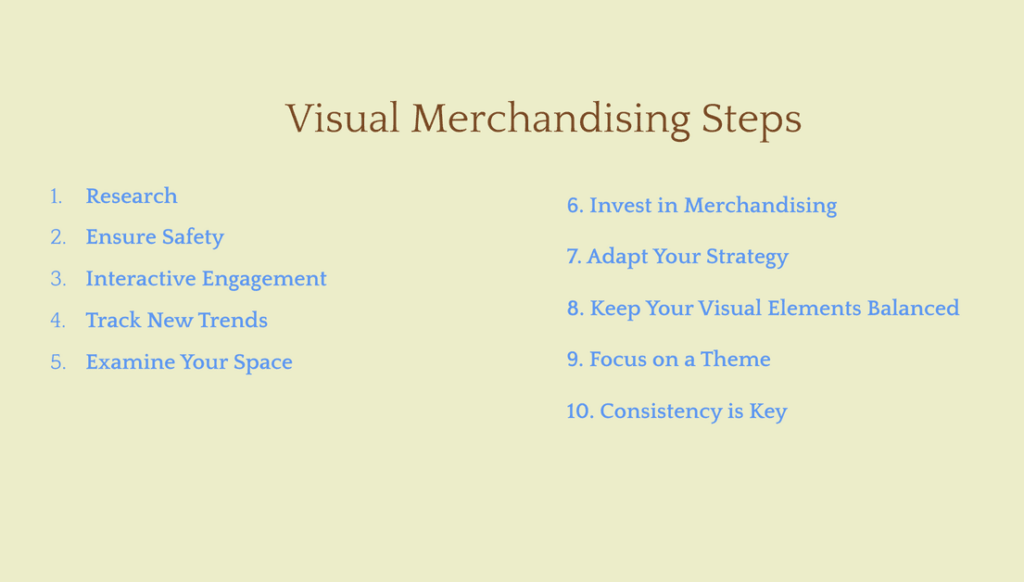
The primary goal of VM is to engage and encourage potential customers to visit the store. Follow these 10 simple steps to design an unrivaled display.
1. Research
Gathering insights into your target audience’s interests and pain points is essential as a retailer. Understand what your competitors are offering to the consumers and their marketing tactics as well. Use their marketing “negative space” to your advantage to connect with your target demographic. Incorporate these insights into elements of your visual merchandising plan.
2. Ensure Safety
Visual merchandising in retail involves the use of various heavy fixtures. It’s important to ensure the security of these fixtures. If installed incorrectly, it might seriously injure customers and retail employees.
3. Interactive Engagement
Encouraging customer interaction and sparking their curiosity can help boostbrand engagement. Let your customers actively engage with your brand. It’s important to appeal to their sense of curiosity and wonder when planning your display visuals. For example, augmented reality allows your customers to interact with your brand.
4. Track New Trends
Fashion merchandising trends are continuously updating. You must stay on top of these trends to remain relevant in the market. Everyone is fighting for the same seven seconds of attention from consumers. Utilizing current trends will keep your brandat the forefront of customers’ minds.
5. Examine your Space
Before you finalize a VM plan, first analyze your space. Improved space understanding will enable better customer experiences. A well-designed space will help set a positive brand image in the mind of your consumer.
6. Invest in Merchandising
Efficient visual merchandising has the power to enhance brand recognition and recall. Your goal is to improve the buying experience of your customer by understanding their requirements.
7. Adapt your strategy
The success of each campaign depends on how you optimize it. Once a campaign is live, track its performance by measuring your product sales against footfalls. You can boost your sales by making changes when required. You can choose to change either the layout or the product colors in the display to better the consumer experience.
8. Keep your Visual Elements Balanced
It’s important to understand how much of your display visuals are needed. While the visual elements need to draw attention they must be balanced. After all, the purpose of visual merchandise is to improve the purchaser’s experience. Be selective when choosing the colors and themes for your display.
9. Focus on a Theme
A thematic display will help differentiate new season products, sales, and other promotions for the consumer. Furthermore, It gives each launch a personality that sticks with the consumer. Analyze the emerging trends and finally combine them with the idea of the product to finalize a theme.
10. Consistency is Key
Themes may change with trends and each new product. However the brand voice and image must remain consistent. Once your brand image is cemented in the consumer’s minds you can build on it with consistency. It’ll help establish trust in your consumer base.
The landscape of visual merchandising is transforming with new and emerging technologies. Fashion merchandising, for example, uses AR Tech to demonstrate the product without a trial. Some of the technological advancements helping enhance customer engagement and repaving the landscape of VM are –
Augmented Reality
More businesses are using augmented reality to draw in customers. The AR display at Tilly’s in California is among the best instances of how to draw attention and get people to stop. Finally, The store’s augmented reality display showcased products floating mid-air alongside other animated characters.
Virtual Trials
Thanks to virtual try-ons, customers can now experience merchandise without trying it on. Saks Fifth Ave partnered with Rock Paper Reality to create a virtual reality experience. Customers could check out the Saks clothes rack through their phones or smart glasses. Additionally, the experience included recommendations for related clothing and accessories.
QR Code Integration
The Starbucks Reserve store in Mumbai is one of the finest examples of QR integration. All you need to do is to scan the QR code at the entrance. Further, The store’s surreal painting comes to life on the phone screen as you move your camera over it.
Interactive Display
Visual merchandisers are coming up with innovative ways to interact with customers. In 2013, the team at Nike installed interactive displays in various stores around London to promote their new products. Besides, The displays were powered kinetically and some encouraged passersby to jump high to emulate a basketball dunk.
You can increase your reach by implementing new innovative technologies. In addition, The 3D try-on technology from Lenskart is one illustration of this. Their 3D try-on tech enables customers to test out their many offerings from their homes.
Visual Merchandising – Great Examples
Store
Technique
Description
Impact
Apple Store
Product Demonstration and Clean Layout
Sleek, minimalist design with products arranged on tables for hands-on engagement.
Highlights product features and encourages interaction.
IKEA
Room Settings
Fully furnished room setups to demonstrate how products can be used in a real home.
Helps customers visualize products in their own space.
Sephora
Interactive Displays and Tester Stations
Interactive displays and clear signage to guide customers through different product categories.
Enhances customer experience by allowing product testing.
Nike
Eye-catching displays featuring athletes and the latest products in action.
Eye-catching displays featuring athletes and latest products in action.
Grabs attention and communicates brand identity.
This table focuses on four prominent examples of visual merchandising and their impacts.
Visual Merchandising Jobs
Visual merchandising jobs focus on creating visually appealing displays and store layouts that attract customers and drive sales. These roles are primarily found in retail environments, where professionals design the layout, product displays, and overall atmosphere of a store to enhance the shopping experience.
1. Visual Merchandiser Role: Responsible for creating eye-catching window displays, in-store layouts, and promotional setups that drive sales and reflect brand identity. Key Tasks: Product placement, signage, seasonal décor, mannequin styling. Average Salary (India): ₹3.5 – ₹6 LPA Key Skills: Creativity, retail trend awareness, spatial design, visual storytelling.
2. Visual Merchandising Manager Role: Oversees a team of merchandisers to ensure all displays align with brand guidelines, store standards, and marketing campaigns. Key Tasks: Team management, budgeting, campaign planning, vendor coordination. Average Salary (India): ₹6 – ₹12 LPA Key Skills: Leadership, strategic planning, communication, design direction.
3. Display Designer Role: Designs specific visual displays from concept to execution, working closely with marketing and store operations teams. Key Tasks: Concept creation, 3D modeling, prop selection, design execution. Average Salary (India): ₹4 – ₹7 LPA Key Skills: Graphic design, CAD software, attention to detail, innovation.
4. Retail Stylist Role: Styles clothing or merchandise to create visual stories that attract shoppers and highlight key trends. Key Tasks: Outfit curation, product combinations, trend-based displays. Average Salary (India): ₹3 – ₹5 LPA Key Skills: Fashion sense, product knowledge, styling expertise, trend forecasting.
5. Store Planner Role: Focuses on store layout and flow, ensuring that product placement enhances customer experience and maximizes sales. Key Tasks: Space planning, traffic flow optimization, planogram creation. Average Salary (India): ₹5 – ₹10 LPA Key Skills: AutoCAD, retail analytics, space management, architectural knowledge.
6. Set Designer (Events/Fashion Shows) Role: Creates temporary event or promotional setups, like those used in fashion shows, ad shoots, or pop-up events. Key Tasks: Mood boards, stage layout, prop setup, theme execution. Average Salary (India): ₹4 – ₹8 LPA Key Skills: Set design, art direction, 3D visualization, teamwork under deadlines.
What Are the Best Visual Merchandising Strategies?
Create a Multisensory Experience Effective visual merchandising strategies go beyond visuals to engage all five senses: sight, sound, touch, smell, and taste. This sensory branding enhances customer connection and encourages longer store visits in retail visual merchandising.
Use Color Psychology and Lighting Colors influence emotions and buying decisions. Combine complementary colors with strategic lighting to highlight products and create moods that align with your brand identity.
Design Clear Store Layouts and Flow A well-organized store layout guides customers naturally through different sections, increasing exposure to more products. Use signage and pathways to make navigation intuitive.
Group Related Products Together Retail visual merchandising leverages product bundling by displaying complementary items side-by-side, encouraging additional purchases and increasing average transaction value.
Incorporate Eye-Catching Signage Use creative and informative signage to draw attention, communicate offers, and tell your brand story. Signage supports both navigation and promotional efforts.
Refresh Displays Regularly Keep your visual merchandising strategies fresh by updating displays to reflect seasons, trends, or new arrivals, maintaining customer interest and relevance.
Leverage Technology Incorporate digital elements such as QR codes, interactive screens, or augmented reality to enhance customer engagement and create immersive retail visual merchandising experiences.
Maintain Brand Consistency Ensure all visual elements colours, themes,and signage align with your brand’s voice and message to build trust and recognition over time.
Conclusion
In today’s competitive retail landscape, visual merchandising plays a crucial role in attracting customers and enhancing their shopping experience. Understanding the visual merchandising meaning and mastering the art of effective retail displays can significantly boost brand visibility and sales. If you’re asking, “what is visual merchandising?” it’s the strategic placement and presentation of products to influence buying decisions. For those looking to build a creative career, Visual Merchandising Jobs offer exciting opportunities across the fashion and retail industries. By investing in strong visual strategies, brands can convert casual browsers into loyal customers and stand out in a crowded market.
The design and layout of a store should engage the consumer and promote accessibility. The 4 elements of visual merchandising to consider when planning a store layout are - 1. The Exterior Display 2. The Interior Display 3. The Store Interior 4. The Store Layout
What does a visual merchandiser do?
A visual merchandiser optimizes the store layout to best enhance the customer experience. They are well-versed in how to utilize a retail space efficiently to boost sales. They also develop consistent strategies for brand communication in retail settings.
What is visual merchandising meaning?
Putting related items together can make customers buy more. For instance, placing salsa and tortilla chips next to each other often leads shoppers to buy both instead of just one.
What are the two types of visual merchandising?
Mannequins: The way you choose, style, and place mannequins can send messages to your customers. Point of Purchase Display: The signs, decorations, and setup at the checkout area are part of visual merchandising.
What is the role of a visual merchandiser?
A Visual Merchandiser’s role involves creating and maintaining visually appealing displays in retail environments to attract customers and increase sales. They are responsible for designing, arranging, and presenting products to enhance the customer experience and promote sales. This includes developing and implementing visual merchandising strategies, creating signage, arranging lighting, and potentially sourcing display materials.
Which skills are essential for a visual merchandiser?
A visual merchandiser needs creativity, strong communication, an eye for detail, knowledge of design principles, proficiency with design software, and the ability to understand customer behavior and brand identity.
Is visual merchandising considered a part of marketing?
Yes, visual merchandising is a key aspect of marketing as it enhances brand presentation, attracts customers, and influences purchasing decisions through strategic product displays and store layouts.
What is visual merchandising in retail?
Visual merchandising in retail is the strategic design of store layouts and retail displays to attract customers, highlight products, and boost sales by creating an engaging and visually appealing shopping experience.
What are Visual Merchandising courses?
Visual Merchandising courses teach creative display techniques, store layout planning, and brand presentation skills to attract customers. They are ideal for careers in retail design, marketing, and visual merchandising jobs.
Authored by, Samiksha Samra Digital Content Writer
Samiksha is a writer with a passion for sharing ideas and a knack for detail. She loves turning concepts into meaningful, engaging content. With a strong background in research and content strategy, she crafts clear, easy-to-understand narratives that resonate with readers. Her curiosity drives her to explore new subjects, ensuring every piece she creates is both insightful and impactful.