AI, automation, and analytics are revolutionizing logistics operations for greater efficiency and lower costs.
Profitable 2025 logistics ideas include smart warehousing, trucking, eCommerce fulfillment, and freight tech.
Success depends on innovation, compliance, and a strong focus on customer satisfaction.
Table of Contents
In 2025, the logistics business is being revolutionized by AI, automation, and real-time analytics. Modern logistics goes beyond transportation and warehousing it creates smart, data-driven supply chains that connect manufacturers, suppliers, and customers seamlessly. By using AI for route optimization, demand forecasting, and warehouse automation, businesses can lower costs, speed up deliveries, and improve customer satisfaction while building sustainable and efficient operations.
What Is a Logistics Business?
A logistics business manages the planning, storage, and transportation of goods, services, or information, ensuring timely delivery and efficient supply chain operations.
Defining logistics as a business operation
Logistics meaning the process of planning, implementing, and managing the movement and storage of goods, services, and information from origin to consumption.
A logistics business coordinates transportation, warehousing, inventory, packaging, and supply chain management, which is essential in effective logistics management.
The goal is to deliver products efficiently, minimizing costs and delays, while enhancing customer satisfaction.
In essence, a logistics acts as the critical link between manufacturers, suppliers, and customers by overseeing all operations required to move products seamlessly through the supply chain. Many successful logistics companiesexcel at integrating strong logistics management practices to achieve this.
How logistics businesses support commerce and manufacturing?
Logistics companies ensure raw materials arrive on time for manufacturers, preventing production delays.
They manage the movement of finished goods to wholesalers, retailers, and consumers, maintaining steady commerce through expert logistics management.
Efficient logistics reduce inventory costs, increase supply chain responsiveness, and help businesses meet customer demands promptly.
By supporting both production and distribution, logistics play an indispensable role in driving economic growth and enabling global trade. Their expertise in managing complex supply chains through logistics management helps businesses save money and operate smoothly.
Role of B2B and B2C logistics
B2B logistics: involves moving goods between businesses such as manufacturers to wholesalers or retailers. It focuses on bulk shipments, freight optimization, and coordination across multiple partners.
B2C logistics: delivers products directly to individual consumers, requiring quick last-mile delivery, flexible shipping options, and a strong emphasis on customer experience.
With the surge of eCommerce, the B2C logistics segment of a logistics has grown rapidly, pushing innovations like real-time tracking and faster delivery windows. Both B2B and B2C logistics are essential for a successful logistics to meet diverse market needs and are common themes in logistics ideas today.
Why Is Logistics Important in Business?
Benefits for businesses
Cost control: Efficient logistics management helps businesses reduce transportation, warehousing, and inventory expenses, leading to significant cost savings.
Customer satisfaction: Timely delivery and accurate order fulfillment enhance customer experience and build loyalty.
Operational efficiency: Streamlined logistics processes improve overall productivity by reducing delays and minimizing errors.
The logistics meaning goes beyond just moving goods it’s about optimizing the entire supply chain to support business goals. A well-run logistics business ensures that products are delivered on time, in good condition, and at the lowest possible cost, which directly contributes to a company’s profitability and is a major focus of logistics companies.
Role in various industries
In eCommerce, logistics businesses are vital for managing order fulfillment, last-mile delivery, and returns, helping online retailers meet high customer expectations through superior logistics management..
For manufacturing, logistics ensures the smooth flow of raw materials and components, enabling uninterrupted production.
In retail, efficient logistics mean shelves are stocked, and products are available when and where customers want them.
Across industries, a strong logistics business underpins success by providing reliable, flexible, and scalable supply chain solutions. As global markets become more competitive, the importance of logistics in business continues to grow, making logistics business ideas centered on innovation and efficiency increasingly relevant.
Profitable Logistics Business Ideas You Should Consider in 2025
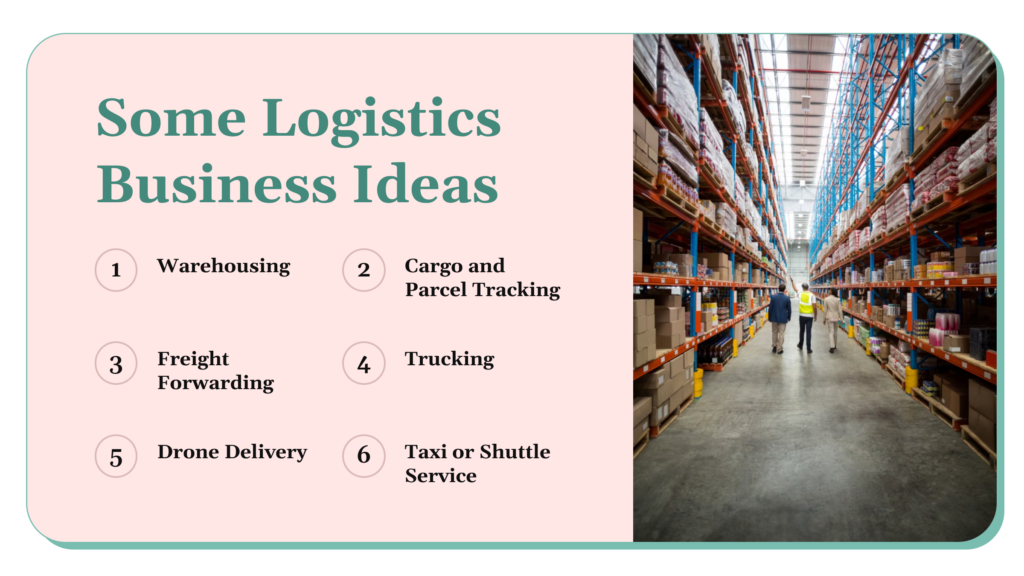
1. Warehousing
Storage facility services for goods
Types include private, public, bonded, and automated warehouses
Supports inventory management and product safety for manufacturers and retailers, a core part of logistics management
2. Fulfillment and Distribution Center
Tailored for eCommerce companies and D2C brands
Provides pick, pack, and ship services
Helps businesses meet fast delivery expectations, a hot trend in logistics business ideas
3. Order Fulfillment Software
SaaS solutions for inventory and shipping automation
Ideal logistics business idea for tech entrepreneurs focusing on logistics management improvements
Reduces errors and streamlines order processing
4. Cargo and Parcel Tracking
Uses GPS and IoT technology
Enhances consumer transparency and delivery confidence, important for logistics companies in today’s market
Growing demand for real-time shipment tracking
5. Freight Forwarding
Manages international shipping documentation and logistics
Great opportunity for small businesses in global trade
Helps clients navigate customs and regulatory complexities, often supported by effective logistics management
6. Trucking
Offers local, regional, and long-haul freight services
Requires effective fleet management strategies
Remains a core logistics business idea with steady demand among logistics companies
7. Drone Delivery
Focus on last-mile delivery innovation
High growth potential despite regulatory challenges
Suitable for urban and hard-to-reach areas
8. Logistics Training
Provides professional courses and skill development
Includes certifications and compliance training
Addresses industry workforce shortages and improves logistics management quality
9. Taxi or Shuttle Service
Corporate and private transport solutions
Serves urban and intercity markets
A practical logistics business idea with consistent demand
10. Moving Company
Residential and office relocation services
Operates locally or over long distances
Combines logistics with customer service
11. Vehicle Rental
Commercial or personal vehicle rentals for logistics use
Operates via franchise or independent models
Helps businesses scale delivery capacity without owning assets
These logistics business ideas present promising opportunities for 2025, combining traditional services with innovative tech-driven solutions to meet evolving market needs. Understanding the logistics meaning helps entrepreneurs select the best idea to implement.
How to Start a Logistics Business?
1. Conduct Market Research
Analyze the demand for logistics services in your target region or industry.
Identify your potential customers (manufacturers, retailers, eCommerce brands, consumers).
Study competitors’ offerings, pricing, strengths, and weaknesses, especially among existing logistics companies.
Discover market gaps where your logistics business can add value.
2. Develop a Business Plan
Estimate startup costs, operating expenses, and projected revenue.
Conduct SWOT analysis to evaluate internal and external factors.
Define marketing and sales strategies to attract and retain customers.
Prepare the business plan to help secure funding from banks or investors.
3. Choose a Business Model
Decide between asset-heavy (own vehicles, warehouses) or asset-light (aggregator, facilitator) models.
Consider capital requirements, operational control, and scalability.
Align your choice with your experience and long-term vision.
4. Register Your Business
Select appropriate legal structure: sole proprietorship, LLP, or Pvt Ltd.
Complete all legal registrations with government authorities.
Ensure compliance with all local and national regulations.
5. Set Up Your Infrastructure
Establish warehouses or storage facilities as needed.
Purchase or lease delivery vehicles suitable for your logistics operations.
Implement logistics management software for automation (inventory, routing, tracking).
Invest in technology platforms for order processing and customer communication.
6. Hire a Skilled Workforce
Recruit experienced drivers with knowledge of routes and safety standards.
Employ warehouse operators trained in inventory control and handling procedures.
Hire IT staff to manage software and technology systems.
Build a customer support team to handle inquiries and maintain client relationships.
7. Develop a Marketing Strategy
Use digital marketing techniques like SEO, social media, and email campaigns.
Build partnerships with manufacturers, retailers, and eCommerce companies.
Attend trade shows and industry networking events to increase brand visibility.
Focus on customer service excellence to foster loyalty and referrals.
Understanding your logistics business’s core strengths is essential for standing out in a competitive market.
Identify your unique competencies, such as technology, niche focus, or customer service, which are key factors in effective logistics management.
Evaluate what your competitors, including other logistics companies, lack and where you excel.
Focus your resources on these strengths to deliver superior value.
By concentrating on what your logistics business does best, you can differentiate yourself and build a loyal customer base, a crucial insight for logistics business ideas.
2. Develop a Business Plan
A well-structured business plan acts as a roadmap for your logistics business’s growth.
Set clear, measurable goals related to improving logistics management.
Update your strategies regularly to adapt to market changes and evolving demands in the logistics industry.
Monitor performance indicators and revise plans as necessary to stay competitive with other logistics companies.
Continuously refining your business plan keeps your logistics business agile and prepared to capitalize on new opportunities, a fundamental part of how to start logistics business guidance.
3. Understand the Regulations
Compliance with all logistics-related regulations protects your business from legal and operational risks.
Stay informed about local, national, and international transport laws affecting logistics companies.
Follow safety standards for vehicles and warehouses, integral to successful logistics management.
Keep up with customs and import/export regulations if handling international shipments.
A logistics business that prioritizes regulatory compliance avoids penalties and builds trust with customers and partners, an important aspect of logistics meaning in practice.
4. Obtain Permits and Licenses
Maintaining valid permits and licenses is crucial for uninterrupted logistics operations.
Track renewal dates diligently to prevent lapses.
Ensure all vehicles and facilities meet licensing requirements as mandated for all logistics companies.
Stay updated on any regulatory changes affecting permits.
Keeping permits and licenses current strengthens your logistics business’s credibility and operational reliability, essential knowledge in how to start logistics business successfully.
5. Line up Financing
Securing sufficient funding supports both day-to-day operations and long-term growth of your logistics business.
Explore options such as bank loans, venture capital, and angel investors.
Maintain transparent financial records to build investor confidence, often a challenge in new logistics business ideas.
Plan for contingencies to handle market fluctuations or unexpected expenses.
Reliable financing enables your logistics business to invest in infrastructure, technology, and talent needed for success, a critical step in how to start logistics business.
Building and maintaining strong customer relationships is vital for sustained success in the logistics business.
Use Customer Relationship Management (CRM) systems to track client interactions and optimize logistics management.
Offer service guarantees and timely communication to enhance trust, helping your business compete with other logistics companies.
Develop B2B contracts to secure recurring business and stabilize revenue streams.
A customer-centric logistics business fosters loyalty, encourages referrals, and creates stable revenue streams, an effective strategy in any logistics business ideas.
Benefits of Starting a Logistics Business in India
Starting a Logistics Business in India: Key Advantages
1. Increased Efficiency
Access to improving transport networks, including highways, railways, and ports, boosts logistics management capabilities.
Advanced technology adoption in warehouses and delivery services benefits emerging logistics companies.
Streamlined supply chains reduce delays and costs, a core part of logistics meaning in India.
Increased efficiency helps your logistics business deliver faster, reducing operational costs and improving client satisfaction, vital for thriving logistics business ideas.
2. Improved Customer Satisfaction
Faster delivery times meeting growing consumer expectations are a key focus of logistics companies.
Transparent tracking and communication systems reinforce the logistics meaning of reliability.
Customized solutions for diverse industries and markets drive business growth.
When your logistics business prioritizes customer satisfaction, it builds stronger relationships and gains repeat business, an advantage emphasized in how to start logistics business guides.
3. Reduced Costs
Competitive labor and operational costs compared to many global markets offer cost advantages in logistics management.
Government incentives and policies supporting logistics infrastructure facilitate startup success.
Economies of scale through bulk transportation and warehousing benefit new logistics companies.
Cost savings enable your logistics business to offer competitive pricing while maintaining profitability, an important consideration in many logistics business ideas.
4. Increased Revenue
Rising demand from booming eCommerce, manufacturing, and retail sectors fuels growth.
Opportunities to expand into specialized logistics services open new market niches.
Growing domestic and international trade fuels business volume for expanding logistics companies.
These factors contribute to sustained revenue growth for logistics businesses willing to innovate and scale, a key goal for entrepreneurs learning how to start logistics business.
5. Job Creation
Employment opportunities across transport, warehousing, IT, and customer service grow with the sector.
Skill development initiatives supported by the government and private sector enhance logistics management expertise.
Contribution to economic growth through workforce expansion benefits the wider community.
Starting a logistics business benefits you and positively impacts the wider community through job creation, a strong motivator in many logistics business ideas.
6. Enhanced Competitiveness
Access to modern infrastructure and digital tools positions logistics companies to compete globally.
Ability to compete with global logistics players through innovation strengthens business sustainability.
Supportive policies aimed at making India a global logistics hub enhance the country’s logistics meaning.
Your logistics business can leverage India’s competitive environment to establish a strong market presence domestically and internationally, a key takeaway in how to start logistics business planning.
Five Successful Logistics Startups
The logistics business landscape is full of innovative startups that have transformed how goods move globally. Here are five successful logistics startups that set benchmarks in the industry:
Flexport: Digital Freight Forwarding
Provides a cloud-based platform for managing international shipping.
Simplifies complex freight forwarding with real-time tracking and analytics, enhancing logistics management.
Offers end-to-end visibility, reducing delays and costs, showcasing the power of tech-driven logistics companies.
Flexport’s success highlights the growing importance of technology-driven logistics business ideas.
ShipBob: eCommerce Fulfillment
Specializes in fulfillment services tailored for eCommerce and D2C brands.
Offers pick, pack, and ship solutions with integrated inventory management.
Helps small and medium-sized businesses scale efficiently, demonstrating effective logistics management.
ShipBob demonstrates how logistics businesses can cater to booming online retail markets, a popular area in logistics business ideas.
Freightos: Freight Marketplace
Operates a digital marketplace for comparing and booking freight shipping.
Provides instant price quotes and booking services for international freight.
Enables greater transparency and competition in freight pricing, an example of innovative logistics management.
Freightos shows the value of marketplace platforms in streamlining operations for modern logistics companies.
Convoy: Trucking Network
A digital freight network connecting shippers with trucking carriers.
Uses machine learning to optimize routes and reduce empty miles.
Focuses on sustainability and efficiency in trucking, illustrating cutting-edge logistics management.
Convoy’s model illustrates how logistics businesses can leverage technology to improve trucking services, inspiring new logistics business ideas.
Transfix: Carrier-Broker Platform
Provides a platform connecting carriers and shippers for efficient freight brokerage.
Offers automated load matching and real-time shipment tracking.
Improves service reliability and reduces operational costs, exemplifying modern logistics companies.
Transfix underscores the power of digital platforms in modernizing traditional logistics businesses, an important concept in how to start a logistics business.
Conclusion
2025 is the perfect time to launch a logistics venture, fueled by AI, eCommerce expansion, and next-generation supply chain solutions. By embracing innovative ideas and warehouse automation, entrepreneurs can create operations that are both efficient and scalable. Focusing on market insights, compliance, and smart technology integration sets the stage for long-term success, enabling your business to deliver exceptional value and stay ahead of evolving customer needs.
Top logistics companies in India include Blue Dart, DTDC, Delhivery, Gati, Ecom Express, Safexpress, TCI Express, DHL Express India, Shadowfax, and FedEx India. These firms offer services across courier, warehousing, freight, and last-mile delivery segments.
How is logistics defined in business?
Logistics involves planning, implementing, and controlling the movement and storage of goods from origin to consumption efficiently.
What are the main revenue sources for logistics companies?
Logistics firms earn money through transportation fees, warehousing charges, freight forwarding, and value-added services like tracking and packaging.
What is a logistics business?
In business, logistics is the management of the flow of goods, from their point of origin to their final destination, and the storage of raw materials, in-process goods, and finished products.
Is logistic business profitable?
Yes, the logistics business can be very profitable due to increasing demand, especially from e-commerce, but profitability depends on factors like the chosen niche, scale, pricing, and operational efficiency.
What are the 7 Rs of logistics?
The 7 R’s of Logistics are a set of principles for efficient supply chain management, ensuring the Right Product, Right Quantity, Right Condition, Right Place, Right Time, to the Right Customer, at the Right Price.
What are the three types of logistics?
Logistics can be broken down into three different categories: inbound, outbound, and reverse.
Who is the father of logistics?
There is no single “father of logistics,” but Augustine Warner Robins is often credited as the father of modern logistics for his work in the U.S. military, while Julius Caesar is frequently mentioned for his ancient military supply chain innovations.
Authored by, Samiksha Samra Digital Content Writer
Samiksha is a writer with a passion for sharing ideas and a knack for detail. She loves turning concepts into meaningful, engaging content. With a strong background in research and content strategy, she crafts clear, easy-to-understand narratives that resonate with readers. Her curiosity drives her to explore new subjects, ensuring every piece she creates is both insightful and impactful.