


In today’s fast-paced digital world, understanding what is B2B is essential for any company aiming to grow. The B2B (business-to-business) model revolutionizes commerce by facilitating transactions between businesses rather than individual consumers. A robust B2B website plays a crucial role in streamlining operations, boosting sales, and fostering long-term partnerships. As business-to-business interactions continue to expand, companies leveraging effective B2B platforms gain a competitive edge. Exploring what is B2B and utilizing the right b2b website tools are key strategies for modern businesses seeking sustainable growth and enhanced profitability.
B2B (Business-to-Business) refers to a business model where one business sells products or services to another business, rather than directly to consumers.
B2B means “Business to Business” where transactions happen between companies, not individual customers.
Examples of B2B:
Key Characteristics:
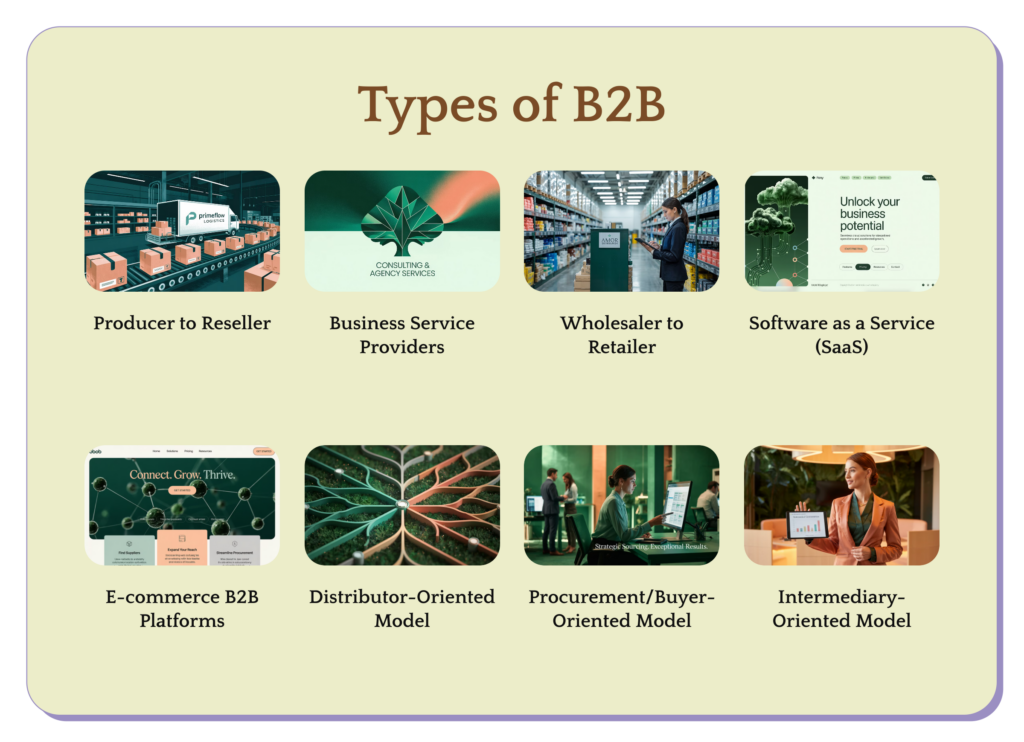
1. Producer to Reseller (Manufacturer → Wholesaler/Retailer)
2. Business Service Providers
3. Wholesaler to Retailer
4. Software as a Service (SaaS)
5. E-commerce B2B Platforms
6. Distributor-Oriented Model
7. Procurement/Buyer-Oriented Model
8. Intermediary-Oriented Model
Every business needs to purchase products and services from other businesses to launch, operate and grow. B2B commerce supports these activities. A company uses B2B suppliers to procure products and services, such as the raw materials they need for production, office space, office furniture, computer hardware and software. The food that companies stock in their kitchens and the signs displayed on their office buildings are also examples of products and services purchased from suppliers.
B2B suppliers are more likely to engage in long-term business relationships with their customers compared to B2C companies. B2C transactions often involve ad hoc purchases from individual consumers, whereas B2B suppliers can expect more frequent and predictable purchases from businesses for goods and services. Many B2B suppliers sell specialized and customized products tailored to businesses’ specific needs.
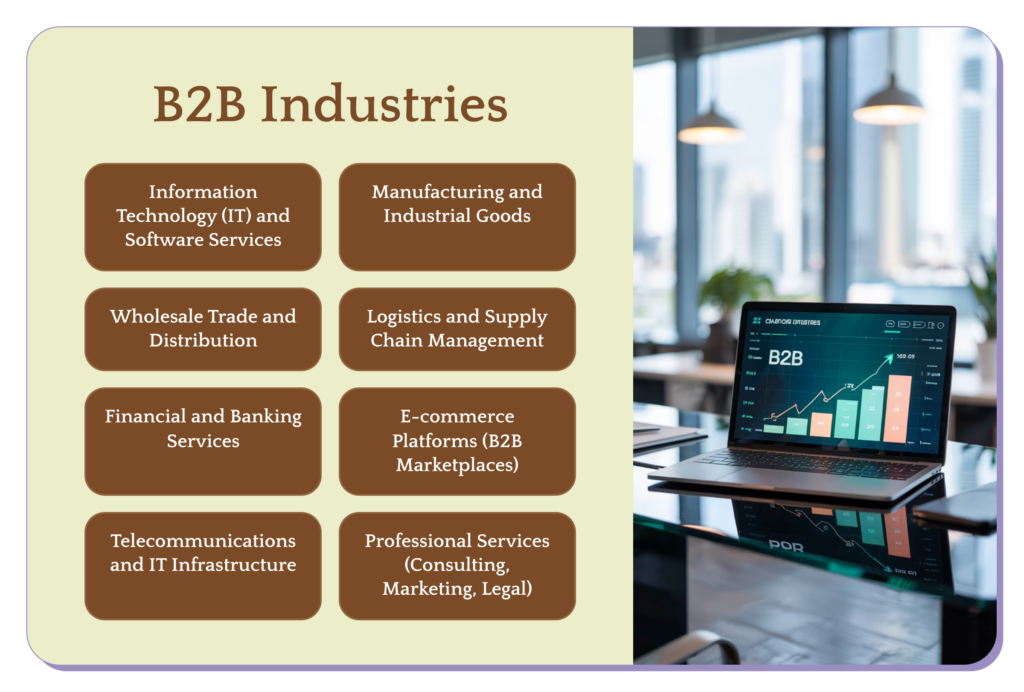
1. Information Technology (IT) and Software Services
2. Manufacturing and Industrial Goods
3. Wholesale Trade and Distribution
4. Logistics and Supply Chain Management
5. Financial and Banking Services
6. E-commerce Platforms (B2B Marketplaces)
7. Telecommunications and IT Infrastructure
8. Professional Services (Consulting, Marketing, Legal)
Business-to-business commerce refers to transactions between businesses, often facilitated by the internet. Commerce, which involves commercial dealings, is crucial for a society’s financial stability. Traditionally, commerce occurred offline, but with technological advancements, it now primarily takes place online, becoming e-commerce when conducted through the internet.
By reading the definition of commerce it is quite clear how it operates. But when the word business-to-business is added before commerce then the explanation changes a bit. Let’s assume you are an individual buyer, and you are buying a product from a shop. Here also a commercial transaction takes place.
Now, instead of an individual buyer, when a company places bulk orders to another company, business-to-business commerce takes place. The full form of B2B is business-to-business. When a relationship is established between two entities, the meaning of business-to-business commerce becomes clear.
The idea of a business-to-business trading strategy suits e-commerce best. One possible reason behind this is the best exposure to global trade. In the case of e-commerce, all business moves are made through the Internet. So, business-to-business is a type of eCommerce that stands for online trading culture. In other words, the e-commerce and business-to-business models complement each other.
Nowadays, the ideology of e-commerce is widespread. All around the globe, e-commerce is ruling. Some notable reasons for its high popularity are,
All of these advantages are why e-commerce and business-to-business are advancing commercial transactions to another level. If you look at the statistics for the last few years, it will become clear. The graph of the companies using this model shows an unexpected rise. Besides, they are also able to cut additional expenses. Improved service quality plays a vital role in satisfying consumers.
The number of advantages the business-to-business model offers is truly commendable. This trading strategy brings a new era into the commercial sector. Experts hope that the advancement of technology will benefit the entire industry to a great extent. Moreover, business-to-business is a type of eCommerce that stands for fast and inexpensive services. On that note, business-to-business-to-business e-commerce serves the purpose of every entity. Some of the benefits of this business structure include,
Businesses aim to reduce costs while maximizing profits, but often have to compromise on margins. The Business to Business model eliminates this by utilizing automation, which lowers expenses and increases income by reducing the need for manual labor and improving efficiency.
E-commerce provides a global platform that enhances exposure for both sellers and consumers, boosting sales and customer acquisition. Companies with a larger customer base tend to experience positive growth, making the Business to Business model ideal for those struggling with limited reach. Additionally, e-commerce allows sellers to set competitive prices for their products.
The Business to Business model focuses on profitability and consumer-centricity while prioritizing data preservation for long-term success. With the help of ERP software, businesses can easily analyze bulk data and track growth, ensuring minimal risk of data loss and easy retrieval of historical information.
Less intervention from 3rd party makes the entire experience for both sellers and buyers. There is no additional broker fee and even no chance of misleading quotation. The usage of a forthright structure brings complete transparency to business-to-business e-commerce. Moreover, companies involved in business-to-business get the scope to design their product catalogue. In this way with less dependency, they can attract their target consumers. Here digital marketing plays a valuable role in attracting the target consumer group.
There is no doubt that any e-commerce platform offers global exposure to sellers. When your company is involved in business-to-business then choosing e-commerce is the best option. Because when your company gets familiar with the business-to-business model then it is time for global exposure. To gain a hold on the foreign market there is no exception for e-commerce. As a result, the sales team grows and with sales, the company will face a sound amount of profit. Besides, global exposure adds extra value to the brand of the company.
The business-to-business model is known for driving rapid growth and success, as evidenced by successful entities using it. It offers significant profit margins and helps businesses capture new consumers and markets easily, pointing to future success. However, experts can also predict market downturns, as the model’s design signals potential failure when success is not achieved. By analyzing trading records, experts can foresee trends and changes.
Business-to-business models facilitate transactions between two different business entities, providing mutual benefits to both parties. Here’s how B2B Business models operate:
1) Identification of Business Needs: Business to Business begin with one business identifying a need for products or services that another business can provide. This can range from raw materials for manufacturing to specialized services.
2) Search and Selection Process: The buyer business then conducts research to identify potential suppliers or service providers that can fulfil their requirements. This process may involve comparing prices, quality, reliability, and other factors.
3) Negotiating and Contracting: Once suitable service providers are identified, the buyer starts negotiations to finalize terms and conditions, including pricing, delivery schedules, payment terms, etc.
4) Order Placement and Fulfillment: After reaching an agreement, the buyer places orders with the selected supplier or service provider. The supplier then fulfils these orders within a specified timeframe.
5) Payment and Invoicing: Upon receipt of the products or services, the buyer makes payments to the supplier as per the payment terms.
6) Post-Sale Support and Relationship Management: B2B transactions often involve ongoing relationships between buyers and sellers. Suppliers may provide post-sale support, such as maintenance services or technical assistance to ensure long-term relationships.
7) Evaluation and Feedback: Both parties should evaluate the performance of the business relationship, providing feedback to each other for continuous improvement.
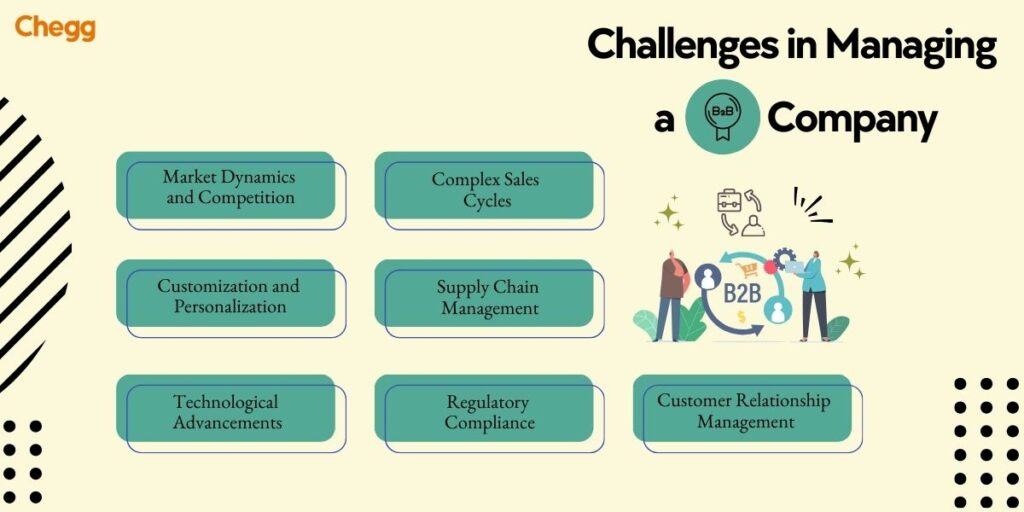
Running a B2B business involves several challenges that require careful management and planning. Some of the key challenges are:
1) Complex Sales Cycles: B2B sales sometimes involve complex sales cycle compared to business-to-consumer (B2C). This complexity may stem from the need to navigate multiple decision-makers, address specific business needs, and overcome issues in the sales process.
2) Customer Relationship Management: Building and maintaining strong relationships with Business to Business customers is essential for long-term success. However, managing these relationships can be challenging, especially when dealing with diverse customer needs, and communication.
3) Customization and Personalization: Delivering personalized products or services while maintaining operational efficiency and scalability can pose significant challenges for B2B.
4) Supply Chain Management: Business-to-business companies managing complex supply chains involve multiple suppliers, distributors, and risk management strategies.
5) Market Dynamics and Competition: Business-to-business markets are often highly competitive. Staying abreast of market dynamics, competitor strategies, and emerging trends is crucial for staying competitive in this space.
6) Technological Advancements: Rapid technological advancements, such as digitalization, automation, and data analytics, are transforming the B2B landscape. Using technology to streamline operations, enhance customer experiences, and drive innovation is essential for business-to-business companies.
7) Regulatory Compliance: B2B companies must navigate various regulatory requirements and industry standards.
Both business-to-business and business-to-consumer (B2C) selling involve commercial transactions, and they differ in several ways:
1) Target Audience: B2B selling targets other businesses as customers, whereas B2C selling targets individual consumers.
2) Purchase Volume: Business-to–business transactions involve larger purchase volumes and higher transaction values than B2C transactions.
3) Decision Making: Business-to-business purchases require input from multiple decision-makers within the buying organization, whereas B2C purchases are usually made by individual consumers based on personal preferences and needs.
4) Relationship Duration: Business-to-business relationships tend to be long-term and ongoing, with recurring purchases and continuous engagement, whereas B2C transactions are often one-off.
5) Sales Cycle Length: Business-to-business sales cycles are longer and more complex, involving multiple stages of negotiation, customization, and contract finalization, whereas B2C sales cycles are usually shorter and more straightforward.
6) Marketing Approach: B2B marketing focuses on demonstrating value, solving business problems, and building trust through educational content and targeted communication channels, whereas B2C marketing focuses on emotional appeal, brand awareness, and buying triggers.
Read More: 20 Unique Business Ideas to Set Yourself Apart
Despite so much demand, many people still do not know about business-to-business. So, if you wish to enhance their knowledge by sharing your erudition, then Chegg offers the best platform. Be a subject matter expert and start working with us. There is no strict time to log in and log off. Rather, get the scope of work from your home at your ease. In addition, you will enjoy global exposure and get a chance to meet and greet experts. To get an eye-catching career, you must build up a strong professional circle. Chegg offers you the best professional network ever. So, what are you waiting for? All you need to do is just Sign In!

The Business-to-Business (B2B) model has transformed how companies operate by focusing on transactions between businesses rather than individual consumers. Understanding what is B2B is crucial for modern enterprises aiming to expand efficiently and build lasting partnerships. A well-designed B2B website plays a vital role in this ecosystem by facilitating seamless communication, bulk transactions, and customized solutions tailored to business needs. As industries continue to evolve, embracing B2B strategies and leveraging powerful b2b websites will remain key drivers of growth, profitability, and innovation in the competitive business landscape.
Recommended Read :
B2B stands for Business-to-Business. It refers to a business model where transactions or services take place between two companies, rather than between a business and individual consumers. Examples include manufacturers selling to wholesalers or software companies providing tools to other businesses.
The business-to-business example denotes the name of those companies that have already implemented this model. For example, Facebook, Linked In, Skype, etc.
B2B means a business transaction between 2 different companies. B2C denotes business transactions between a company and an individual customer.
There is a total of 4 types of business-to-business. These are Forthright, Networking, Hybrid, and Managerial.
Amazon is a business-to-business entity.
The meaning of b2b commerce hints at the usage of the ideology of business-to-business in a commercial transaction. The commercial transaction involves 2 different business entities. So, it plays a vital role in every sale of a company.
Netflix primarily operates as a B2C (Business-to-Consumer) company because it provides streaming services directly to individual subscribers.
A B2B website is an online platform where businesses sell products or services to other businesses. It facilitates lead generation, client communication, secure transactions, and showcases offerings to help grow business partnerships efficiently.
The top 10 B2B websites in India include IndiaMART, TradeIndia, Alibaba India, Udaan, Justdial, ExportersIndia, Moglix, Connect2India, GlobalSources, and Indiamart Wholesale, offering trusted platforms for business networking and trade.


