

Sales is essential because it is the lifeblood of the business, generating revenue for growth (regardless of actual “growth”). Beyond simply being a generator of income, sales roles are designed not only to counteract the effects of adverse events, but also for personal improvements and development, whether it’s better communication/interpersonal abilities, having a way to make money, and who wouldn’t want a great relationship?
Sales interviews can vary widely—some focus on experience and education, while others assess how well your personality fits the team. However, one question almost always comes up: “Why sales?”
This question may be phrased differently, but the essence remains the same. While it seems simple, your response can determine whether you land the job or continue your search. Recruiters evaluate candidates based on negotiation abilities, communication skills, confidence, and adaptability. Many applicants find sales interviews challenging, as they often include unexpected questions designed to test quick thinking and persuasive skills.
In this guide, we’ll explore how to craft a strong response to the “Why sales?” question, helping you stand out from the competition and impress hiring managers.
Salespeople play a crucial role in a business’s success. They maintain connections with clients, generate revenue, and help companies produce more revenue, driving growth. The salesperson has to be good at both marketing and selling.
The question “Why did you choose sales?” is a staple in any sales interview, and for good reason: it gives insight into the candidate’s interest in and passion for sales.
Some potential benefits for those conducting interviews are:
Understanding a person’s motivations via the question “Why sales?” can provide insight into who they are and what they value. The interviewers can use this information to assess better the candidate’s compatibility with the company’s culture.
How an applicant reacts to this “Why sales?” question can give insight into their conversational skills.
The interviewer can gauge whether or not the applicant has the clear communication skills necessary to develop effective sales strategies.
Interviewers may use this “Why sales?” query as a litmus test for candidates’ enthusiasm for the sales position. Those enthusiastic about sales are more likely to be hired than those just searching for any job.
The interviewer can learn more about the candidate’s long-term professional goals from their response to this question. The questionnaire may help the candidate advance their career if they see sales as a launching pad for other roles within the company.
Overall, the question, “Why sales?” can benefit interviewers in gauging a candidate’s cultural fit, communication abilities, interests, and goals, and lead to a more well-informed hiring decision.
Before your sales interview, be prepared to answer the key question: “Why are you interested in sales?” Your response should be short, engaging, and persuasive—similar to an elevator pitch. Aim for 30 seconds to a minute to capture interest without over-explaining.
By crafting a well-thought-out, genuine response, you can impress recruiters and boost your chances of landing the job.
When answering a typical sales interview, there are many questions to consider, but “Why sales?” is still one of the most popular:
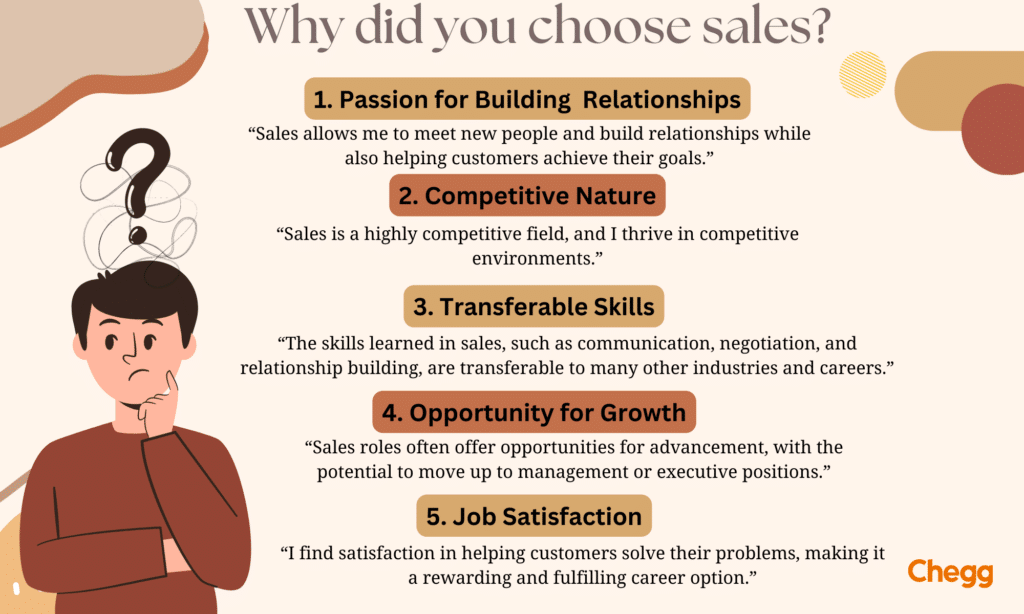
“Why are you interested in sales?” The questionnaire might ask right after you sit. If you’re fresher to sales, look at your professional or personal history. Find out if it has anything to do with what you’d be trying to sell. If so, base your answer on what you learned from that. Suppose you’re trying to sell restaurant technology:
“I worked as a manager and server in a high-end restaurant for 10 years. So, I spend a lot of time programming and teaching employees how to use different POS systems. I know how it works. More notably, I know precisely what owner-operators need. I also know how to market the item as a solution to the existing problems.”
Thoroughly research the company and show what you know about them. This might mean bringing up recent events (positive ones). Or, talk about an aspect of the company’s mission statement that fits into your core values:
“I was thrilled to learn that you’ve recently gone international, and I am very excited that your product ABC will be coming out soon. I would love to work on the sales team that markets products to people worldwide. It is time to apply my abilities and expertise to your company.\”
Say you’ve worked in the same field for a long time. Still, you’d like to quit where you are. Discuss what you can contribute to the team and why you’d like to switch:
“In my present job, I’m responsible for the tri-state area. I am interested in sales since I know the area and potential buyers well. I would be delighted to put my ties into Company Z and show them a new, better, cheaper product.”
Read more: Why Do You Want to Work Here? – Answer Effectively

During a sales interview, asking insightful questions shows your interest in the role and helps you understand the company better. Here are some key questions to ask the interviewer:
These questions can help you gain valuable insights and make a strong impression during your interview.
When answering this common interview question, what you don’t say is just as important as what you do say. Avoid these mistakes to leave a positive impression:
The “Why Sales?” question is a great chance to showcase your strengths, motivation, and preparedness. Avoid these pitfalls, and you’ll stand out as a strong, confident candidate.
Below are a few tips that will help you with “why sales interview questions. It will help you show your love and interest in sales.
The most crucial thing is to answer questions honestly. There is no one right answer. Companies want to see your motivation for your work. There may be low sales in your job. It’s important to show that you can keep yourself going. Companies want self-starters who don’t need direction.
Try to answer questions in a way that fits each company. This approach indicates that you have done market research. Research the company you are interviewing for. Try to find out how they might be a good fit. Ensure that the company fits your curiosity in sales for this question. Suppose you love selling products that help people, and this company offers medical devices.
You must know why you want to join sales. and how to apply those reasons to jobs. Now, you can put them all together. Come up with an answer that you can say in no more than three minutes.
When you apply for sales jobs, you should be able to explain what drives you. Ask yourself, “Why do I want to work in sales?” and answer honestly. It will help you prepare.
In any job, but especially in sales, making a good first impression on lead generation, buyers, and clients is essential. This advice can be used in any job. Making a good first impression on your interviewer can show you have the skills to win clients’ trust and business. You can do several important things to make a good first impression.
After you’ve worked on your resume and written the best cover letter that helped you land an interview, it’s time to focus on your answer. Practising for your sales interview can help you make a good first impression on the person who will hire you. Following the steps in this blog, you can discuss your skills and decide if a job is right for you.
No two sales interviews are ever the same. Sometimes, you may want to highlight your education and marketing techniques. Some interviewers might be more interested in how your personality will fit in with the team they already have.
For career aspirants aiming to excel in sales interviews, understanding how to address common questions is key. Explore our 5 tips on how to answer “What Are Your Career Aspirations” to enhance your interview responses.
Evaluate numerous career choices to choose the right career path for yourself. Dive into our guide on Career Advice.
Express your genuine interest in building relationships, solving problems, and helping customers find value, while highlighting your passion for communication and goal-driven work.
Example:
“I want to work in sales because I enjoy connecting with people, understanding their needs, and providing solutions that truly help them. I’m motivated by targets and love the challenge of turning a ‘maybe’ into a ‘yes’.”
Tip:
Personalize your answer by mentioning any relevant skills or experiences you have, like teamwork, persuasion, or past customer service roles.
I’m motivated by the challenge of meeting and exceeding targets, the opportunity to build meaningful relationships, and the satisfaction of helping customers solve problems with the right solutions.
Example:
In my previous role, closing a difficult deal after understanding a client’s unique needs gave me a huge sense of accomplishment and drove me to improve even more.
Tip:
Be authentic share specific examples or personal values that fuel your drive in sales, whether it’s problem-solving, competition, or helping others.
Research the company and its products thoroughly. Practice common sales interview questions. Prepare examples that show your communication skills, problem-solving ability, and success in meeting targets.
Example: Before my last sales interview, I studied the company’s market, rehearsed my explanation of product benefits, and prepared stories about how I managed demanding clients and closed deals.
Tip: Use the STAR method (Situation, Task, Action, Result) to organize your answers clearly and show your impact.
The best answer clearly shows your understanding of the sales process. It highlights your communication and persuasion skills, and it demonstrates how you have successfully met or exceeded sales goals with real examples.
Example: When asked about handling rejection, a strong answer would be: “I see rejection as a chance to learn. After a ‘no,’ I ask for feedback, figure out what I can improve, and follow up later. This approach helped me turn 30% of rejections into future sales.”
Tip: Always support your answers with specific examples and results. Make sure your responses align with the company’s values and sales style.
I choose sales because I enjoy building relationships, solving problems, and the excitement of working toward clear goals where my efforts directly impact results.
Example: In my previous role, I loved helping customers find solutions that fit their needs. Seeing my sales numbers grow motivated me to keep improving.
Tip: Be honest and focus on what truly drives you, whether it’s the challenge, interaction with people, or the satisfaction of closing deals.
A good answer highlights your passion for connecting with people, solving their problems, and the challenge of meeting targets while advancing in your career.
Example: “I chose a sales job because I enjoy the changing nature of the role, the chance to help customers find suitable solutions, and the satisfaction of achieving and exceeding goals.”
Tip: Customize your answer to showcase your skills, such as communication, resilience, and negotiation, that make you a strong candidate for sales.
You should hire me because I have strong communication skills, a customer-focused attitude, and a proven track record of meeting and surpassing sales targets. This way, I will positively impact your team’s success.
Example: In my last role, I increased sales by 20% in six months by building trust with clients and customizing solutions for their needs.
Tip: Support your answer with specific achievements and connect your strengths to the company’s goals.
Sales is the best job because it combines human interaction, problem-solving, and precise results. This combination allows you to grow in your career while directly impacting a company’s success.
Example: Maya loves sales because each day presents new challenges and chances to connect with clients. She feels fulfilled when her hard work leads to real business growth.
Tip: Show your excitement for the fast-paced nature of sales and how it aligns with your skills and career goals.