
Following up after an interview is a crucial yet often overlooked step in the job search process. Many candidates assume that once the interview ends, their work is done. In reality, sending a professional follow-up email not only leaves a lasting positive impression but also shows the recruiter that you are genuinely serious about the role. According to recruitment experts, a significant portion of a recruiter’s time—nearly two-thirds—is spent conducting and reviewing interviews. This means a well-crafted follow-up email can help keep you top of mind among many applicants.
From my career counseling experience, I’ve seen that candidates who consistently send thoughtful follow-ups are more likely to advance to the next stage. Research by CareerBuilder also suggests that nearly 22% of hiring managers are less likely to move forward with candidates who don’t send a thank-you or follow-up email. Using a structured follow-up email template ensures your message is professional, concise, and respectful of the recruiter’s time. Whether it’s after a phone screening or a first-round interview, a timely follow-up communicates professionalism, enthusiasm, and attention to detail—all qualities employers value.
Why Send a Follow Up Email After Interview?
It keeps additional details about your job application fresh in the interviewer’s mind, which can be valuable if they consider interviewing multiple candidates.
Sending a timely follow-up message or backup email shows you are proactive and respect the hiring manager’s time and decision-making process.
It depends on the company’s hiring process and the interviewer’s preference. Sending multiple follow-up emails can be seen as a sign of persistence and enthusiasm, but don’t overdo it. Remember, the hiring process can take time, and the final hiring, decision-making, re-making, and recruitment process may involve multiple stakeholders.
Follow up Email After Interview Samples
Here are different follow-up email scenarios after an interview, tailored to various situations:
1. Standard Follow-Up After an Interview
Subject: Thank You for the Opportunity
Dear [Interviewer’s Name],
I hope you’re doing well. I wanted to take a moment to thank you for the opportunity to interview for the [Job Title] position at [Company Name]. I enjoyed our conversation and learning more about [specific topic discussed].
I’m very excited about the possibility of joining your team and contributing to [mention a specific way you can add value]. Please let me know if there’s anything else I can provide to assist in your decision-making process.
Looking forward to your response.
Best regards,
[Your Name]
2. Follow-Up After No Response (1-2 Weeks Later)
Subject: Checking In on the [Job Title] Position
Dear [Interviewer’s Name],
I hope you’re doing well. I wanted to follow up to see if there are any updates regarding the [Job Title] position. I remain very interested in the opportunity and am eager to contribute my skills to [Company Name].
Please let me know if there’s anything else I can provide to assist in the decision-making process. Looking forward to hearing from you.
Best,
[Your Name]
3. Follow-Up After a Final Round Interview
Subject: Appreciate the Opportunity to Interview
Dear [Interviewer’s Name],
I sincerely appreciate the time and effort you took to speak with me throughout the interview process for the [Job Title] role. Meeting with you and the team reinforced my enthusiasm for joining [Company Name] and contributing to [specific team goal or project].
If there are any additional steps I can take or if further information is needed, please let me know. I look forward to your decision and hope to have the opportunity to work together.
Best regards,
[Your Name]
4. Follow-Up to Provide Additional Information
Subject: Additional Information for the [Job Title] Position
Dear [Interviewer’s Name],
I really appreciate the opportunity to interview for the [Job Title] role at [Company Name]. During our conversation, we discussed [specific topic], and I wanted to share some additional insights/resources that might be helpful:
[Provide the document, portfolio link, or relevant information.]
Please let me know if there’s anything else I can provide. Looking forward to staying in touch!
Best,
[Your Name]
5. Follow-Up After Receiving Another Job Offer
Subject: Follow-Up on Interview Status
Dear [Interviewer’s Name],
I hope you’re doing well. I wanted to follow up regarding the [Job Title] position at [Company Name]. I remain very interested in this opportunity and truly enjoyed our discussions.
I wanted to inform you that I have received another job offer but would love to consider [Company Name] as my top choice. If there are any updates regarding the hiring decision, I’d appreciate any insight on the timeline.
Looking forward to your response!
Best,
[Your Name]
6. Follow-Up to Decline an Offer
Subject: Thank You for the Opportunity
Dear [Interviewer’s Name],
I truly appreciate the opportunity to interview for the [Job Title] position at [Company Name] and the time you and your team took to meet with me. After careful consideration, I have decided to pursue another opportunity that aligns better with my current goals.
This was a difficult decision, as I was very impressed with [Company Name] and your team. I hope our paths cross again in the future and wish you continued success in your search for the right candidate.
Thank you again for your time and consideration.
Best regards,
[Your Name]

Structure of a Follow-Up Email After Interview
1. Greeting
- The follow up email after an interview should always start with a greeting from the interviewer. Addressing the interviewer with ‘Dear’, ‘Hi’, or ‘Respected’ is customary.
- Use customary Mr/Mrs/Ms as per the need to address the interviewer. This brings the formal tone of the interview follow-up email. Post it; you should write the name or surname of the interviewer.
2. Thanking the Interviewer
- It is unprofessional to start the mail directly with the topic. You should start by thanking the interviewer for giving time for the interview.
- Phrases like ‘Thank you for the opportunity,’ ‘Thank you for meeting for the interview,’ and ‘Thank you for discussing the job profile’ act as great email starters.
- This sets the tone for the email and helps the candidate formalize the situation before introducing the main content. This is important for the post-interview follow-up email.
3. Reiterating Interest in the Position
- Follow up emails after an interview for the job should always reflect your interest. It should not look too pushy, but the point has to be put subtly for the interviewer to understand your stand for the job.
- This part is critical as if not mentioned properly. The email would place you in a bad light. So, it is advisable to go through the follow-up email after the interview drafts to send the proper follow-up email.
4. Mentioning any Additional Information
- The follow-up email after an interview should address the subject line in detail. This part addresses the content of the mail. The mail should give the details about why the mail has been written apart from showing your interest towards the job.
- The email should not only talk about your interest but should do the work of following up on the interview, providing more information on certain discussions, or adding more qualifications to strengthen your chances for the job profile.
5. Closing
- The formal follow-up email needs proper closure. So always use phrases like ‘Looking forward to hearing from you soon’ or ‘Waiting for your reply.’ This would close the mail.
- Always start as ‘Regards’, ‘Sincerely’, or ‘Best’ followed by your full name, phone number, and email id. Another important part of follow-up after the interview is to put your signature at the bottom. It is unprofessional to ignore it or write it informally. This would help the interviewer identify and reach out to you if required.
Also Read: Steps to Write a Job Offer Acceptance Email (With Examples)
Tips for Writing an Effective Follow-Up Email After Interview
After understanding the basic structure of writing a follow-up email after an interview, let’s look at some tips for writing an effective follow-up email after an interview.
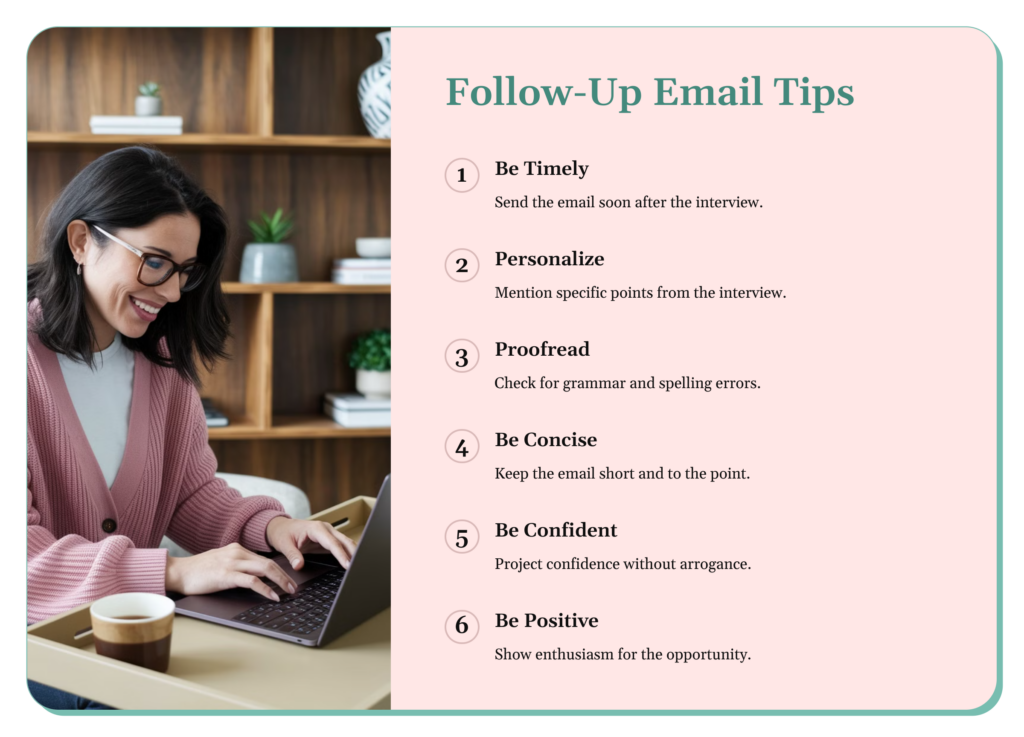
1. Be Timely
Sending mail timely is very crucial. It is important to send an email after the job interview application process over, even if you forgot to sign off or add something. But if you are looking for a follow-up email after an interview, give it time before emailing for updates. It is not right to keep sending the interviewer emails regularly if you do not receive any update regarding the next job interview date; sending a follow-up email after an interview for a job is okay.
A quick note and thank you email a few weeks after the interview date for the second interview should be sent immediately. This puts the attention of the interviewer on the additional questions for your second interview.
2. Personalize your Email
Framing a personalized email paints a positive picture in the interviewer’s mind. It is an important art while framing the follow-up email after the interview. Always put some points that were discussed during the interview. This would help to jog the interviewer’s memory and strengthen your interest in the position for the job profile.
3. Use Correct Grammar and Spelling
It will be a nightmarish experience if an after-interview or follow up make-up email lands up in the interviewer’s inbox full of grammatical and spelling errors. It would decrease your chance of getting selected for the job role after the second interview.
Do not forget to check the spelling of the company name and the interviewer’s name. Spelling the company name wrong may offend the interviewer. So, it is important to proofread your email and check with grammar software, if required, before sending the mail. An error-free email with crisp content heightens the effect of a serious follow up message back-up email after the job interview. There are a few softwares that are allows you to get tone, while checking for grammar within your content i.e. – Grammarly.
4. Keep it Short and Sweet
No one has the time to read lengthy emails, especially if it is an after interview follow up email or back-up to previous email already. It is unnecessary to stretch the mail by putting all the points discussed and other details. This would make the interviewer disinterested. So, always keep the email short and crisp. Put all the required points in a few words. The whole email body should cover the content while not extending it. A powerful subject line and a strong body would convey the message clearly and put your profile in the interviewer’s mind.
5. Be Confident and not arrogant
There is a thin line between confidence and arrogance. While writing a perfect follow up email back-up email, taking care of the words and content right words, you are typing is important. Always check twice before sending it.
6. Be Positive
Make sure to have good manners and a positive approach as it is essential in Professional Conversations. Showcase your enthusiasm and eagerness for the opportunity.
It is okay to interview examples with a few examples and display a few reasons for your qualifications and experience but not to interview examples and show that only you can handle the job profile because of your experience. This would help the interviewer to make better sense and discard your name from the list.
Special Scenarios for Follow-Up Emails
Following up after an interview is important, but different situations require different approaches. Tailoring your message shows professionalism and genuine interest. Here are some common scenarios and how to handle them:
If Given a Task/Assignment – Submit the work with appreciation, highlight a relevant skill, and ask about next steps.
After a Panel Interview – Thank all interviewers, highlight a key takeaway, and express excitement about contributing.
When Hiring Is Delayed – Politely check in on the timeline while reaffirming your interest.
After a Great Interview but No Response – Reiterate enthusiasm, reference a specific discussion, and gently ask for updates.
After a Second Interview with No Clear Next Step – Thank the panel, ask about next steps, and confirm continued interest.
If Rejected but Want to Stay in Touch – Express gratitude, wish them success, and show openness for future roles.
If You Made a Mistake – Clarify the point respectfully and provide the correct information.
Also Read:
- Email for Job Application: The Ultimate Guide to Success
- Powerful Email Format Tips for Success (2025)
Conclusion
Follow-up emails after an interview are an important part of the job cycle. The candidate should start the email by greeting, thanking the interviewer, focusing on your interest in the job, and closure.
You should focus on sending the email without any grammar and spelling errors. Always remember to keep the email short, crisp, and to the point. Always personalize your email to the right amount while adhering to the timeline of sending the email. Your post-interview follow-up email should make you look confident and not arrogant. So, this is how to write a follow-up email correctly and efficiently after an interview.
Sending a follow up interview email shows professionalism, reinforces your interest in the role, and keeps you on the recruiter’s radar.
Ace your job interviews with tailored tips for a great first impression! Explore more Interview Tips with us.
Other Related Reads:
Frequently Asked Questions (FAQ’s)
How do you send a follow-up email after no response?
Always start your email with greetings, followed by asking courteously, correctly, and efficiently after an interviewee regarding the status update on the job interview. Be sure to wait for a week or the timeline the interviewer had asked for before sending the mail. When following up on a recent job interview process or with job seekers, it is important to address interview feedback and hiring managers respectfully and professionally to maintain a positive relationship.
How soon should I follow up email after the interview?
It depends on the follow-up email. If it is for an update, wait for a week or the timeline requested by the interviewer. You can do it immediately after the phone interview if you want to provide some information. This is a good practice and the proper way to follow up with an email after the interview. Always mention the specific interview date in the subject line of your follow-up email to remind the interviewer’s time of your conversation.
What should I include in a follow-up email after the interview?
The subject line of follow-up email after the interview result should always start with a greeting, followed by a greeting. Personalize the subject line of the subject line and cover letter of your email and crisply put your content. The body should talk about your content in 2-3 lines. Close your email with signatory messages and your signature.
How do you write a formal follow-up email after the interview template?
Always start your email thread with greetings, followed by thanking the interviewer. Crisply put your content, followed by closure statements. This is the proper way of writing a full interview follow-up email after the interview process. Using a full interview follow-up email template can help ensure your communication is professional and effective.
What to say in a follow up email after an interview?
Follow-up thank you email after interview sample
I wanted to say thank you for interviewing me (today/yesterday). All the information you shared about the business made me more excited about the role. I’m excited to learn about the progress of my application and hope we get to meet again soon.