
Are you interested in medical technology and want to be part of healthcare? A B.Sc. in Radiology could lead you to a fulfilling career in diagnosing and monitoring diseases with imaging equipment. The need for skilled radiology professionals is growing in hospitals and clinics across India. This degree provides good job prospects, practical experience, and the opportunity to make a real difference in patient care. In this guide, you’ll find all the information you need about the B.Sc. Radiology course, including eligibility and career opportunities in 2025 and beyond.
Bachelor of Science in Radiology (BSc Radiology) is a 3-year graduate program. It is one of the best paramedical courses for students who want to have a medical practice in diagnostics using radiation technology. It is a specialized field within the broader discipline of medical imaging.
The BSc Radiology program provides students with a comprehensive understanding of these imaging techniques, their principles, and their clinical applications. Its curriculum typically combines theoretical knowledge with hands-on training, aiming to develop competent, skilled radiographers who can safely operate imaging equipment and produce high-quality diagnostic images. B.Sc Radiology is sometimes also offered as B.Sc Radiology and Imaging Technology, focusing not just on radiology but also on advanced imaging techniques like MRI, CT Scan, Ultrasound, etc.
| Course Name | BSc Radiology |
| Course Level | Undergraduate |
| Time Duration | Three years |
| Minimum Eligibility Required | 10+2 in Science Stream |
| Entrance Exams | NEET, AIIMS |
| Modes of Admission | Entrance exam or Merit-based |
| Fees for the Entire Course | From Rs. 10,000 to Rs. 10 lakhs |
| Top Recruiters | AIIMS, Government Hospitals, Fortis Hospitals, Manipal Hospitals, Apollo Hospitals |
| Job Profile | Radiographer, radiation protection specialist, X-ray technician, therapy radiographer, medical image analyst |
Admission to BSc Radiology is primarily through entrance exams. Some of the top entrance exams include:
| Institute Name | Description | Estimated Radiology Course Fees |
|
AIIMS Delhi, New Delhi | AIIMS Delhi is one of the premier medical colleges in India. It is duly recognised by the UGC and Medical Council of India and has secured 1st rank for the second time in the NIRF 2019 in the medical category. Making it a great choice to pursue Radiology courses. |
INR 50,000/year |
|
CMC Vellore, Tamil Nadu | CMC Vellore was established in 1900 by Dr MGR Medical University in Chennai, Tamil Nadu. In 2019, the NIRF ranked it third. It offers multiple undergraduate and postgraduate programs in medicine, such as BSc Radiology. |
INR 1,00,000/year |
|
Institute of Liver and Biliary Science (ILBS), New Delhi | ILBS is an autonomous institute that provides an international center of excellence for diagnosis, management, training, and research. It is a deemed university by the University Grants Commission. |
INR 1,50,000/year
|
|
KGMU, Lucknow | King George’s Medical University (KGMU), established in Lucknow in 1911, is recognized by the UGC. It offers various medical courses, including BSc Radiology. |
INR 2,00,000/year |
|
BMCRI, Bangalore | Bangalore Medical College and Research Institute (BMCRI) is one of the top medical colleges in Karnataka and India. It is an autonomous institute in Bangalore and is affiliated with the Rajiv Gandhi University of Health Sciences. |
INR 2,50,000/year |

| College Name | Location | Course Duration | Approx. Fees (Per Year) | Affiliation |
|---|---|---|---|---|
| AIIMS (All India Institute of Medical Sciences) | Ansari Nagar | 3 Years | ₹1,500 – ₹5,000 | AIIMS Autonomous Institute |
| Jamia Hamdard University | Hamdard Nagar | 3 Years | ₹1,00,000 – ₹1,50,000 | Deemed to be University |
| Institute of Public Health and Hygiene (IPH&H) | Mahipalpur | 3 Years | ₹60,000 – ₹80,000 | UGC Approved |
| Rajiv Gandhi Paramedical Institute | Rajouri Garden | 3 Years | ₹70,000 – ₹90,000 | Recognized by UGC |
| Impact Paramedical and Health Institute | Uttam Nagar | 3 Years | ₹50,000 – ₹75,000 | Recognized by UGC |
| Delhi Paramedical and Management Institute (DPMI) | Kalkaji | 3 Years | ₹60,000 – ₹85,000 | Affiliated to NSDC |
| Virohan Institute of Health and Management Sciences | Lajpat Nagar | 3 Years | ₹70,000 – ₹1,00,000 | NSDC and Skill India |
The eligibility criteria for BSc Radiology vary from college to college. However, the general eligibility criteria are as follows :
Admission to the BSc Radiology course is based on performance in the entrance-level examinations. These are some of the essential points for BSc Radiology admissions :
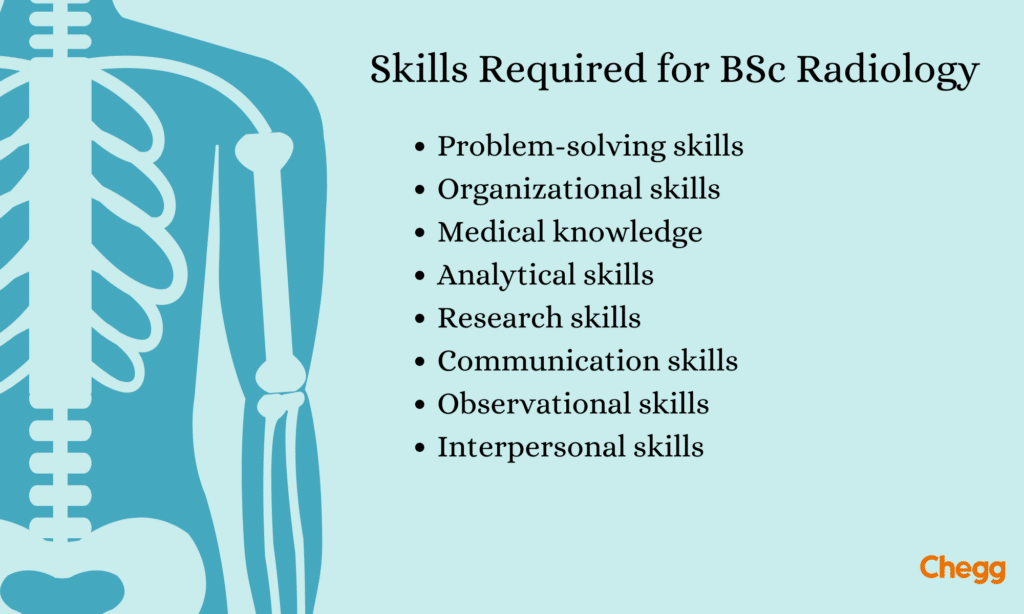
Succeeding in a BSc Radiology program requires a specific skill set, including :
Read more:
BSc Anesthesia – Course Details and Jobs 2025
Courses and Career after B.Sc. Nursing in India
BSc consists of 6 semesters and a BSc radiology course duration of 3 years, which helps students obtain detailed knowledge about radiology. These are the BSc Radiology subjects and syllabus :
|
Semester-I |
Semester-II |
|
Pathology |
General radiography |
|
Anatomy |
Fundamentals of computer science |
|
Physiology |
Radiation hazards and protection |
|
Generation and properties of X-ray |
Communication and personality development skills |
|
Semester-III |
Semester-IV |
|
General radiography 2 |
MRI 1 |
|
CT Scan 1 |
Environmental Science |
|
Ultrasound |
Organizational behaviour |
|
Semester-V |
Semester-VI |
|
Nuclear medicine and PET scan |
Intervention in diagnostic radiology |
|
MRI 2 |
Human resource |
|
CT Scan 2 |
Anaesthesia in diagnostic radiology |
|
Doppler and Echography |
|
Read More- BSc Cardiology Courses Details and Jobs in 2025
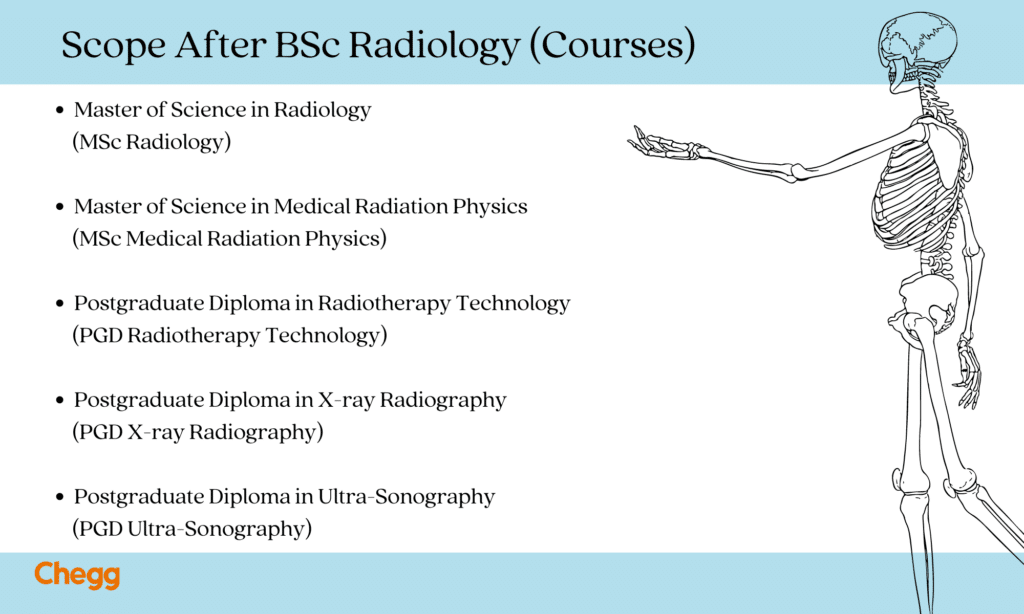
Becoming an X-ray technician after a BSc in Radiology is one good choice. As an X-ray technician, you take X-rays of the patient’s internal anatomy. You’ll help physicians to identify and diagnose diseases, illnesses, and injuries. You must also ensure that the patients are exposed only to a limited amount of radiation.
Radiographers operate X-ray equipment and produce high-quality diagnostic images identifying internal abnormalities and injuries. Some diagnostic images that radiographers produce using specialized equipment are sonography, computed tomography, mammography, vascular interventional radiography, and MRI.
Therapy Radiographer, also known as radiation therapist, is another great career to choose after completing a BSc in Radiology. As a therapy radiographer, you work with the oncology teams to determine the best course of radiation treatment for the patients. They work under the supervision of radiation oncologists and specialize in planning and executing radiotherapy treatments. Radiation therapy is one of the most important treatments in treating cancer patients.
As the name suggests, radiation protection specialists use scientific techniques and equipment to monitor and measure radiation and ensure safety at the workplace. It is a good job to do after BSc Radiology courses. In this job, you advise, assist, supervise and train employees regarding radiation safety compliances.
An MRI technician is a medical professional who operates magnetic resonance imaging (MRI) machines. You can become an MRI Technician after a BSc in Radiology, where you use a noninvasive medical imaging technique that uses a strong magnetic field and radio waves to create detailed images of the body’s internal structures.
Becoming a radiology consultant after a BSc in Radiology is a great field. These doctors specialize in the diagnosis and treatment of diseases using medical imaging techniques. They use a variety of imaging modalities, including X-rays, CT scans, MRIs, and ultrasounds, to create images of the body’s internal structures. Radiology consultants work in a variety of settings, including hospitals, clinics, and imaging centers. They may also work as part of a team of doctors, including surgeons, oncologists, and cardiologists.
A radiology sales representative is a healthcare professional who sells radiology equipment and services to hospitals, clinics, and other medical facilities. You can choose this career after a BSc in Radiology if you have a strong understanding of radiology technology and can explain the benefits of their products and services to potential customers. Radiology sales representatives also need to be able to build relationships with customers and develop trust.
Becoming a CT technologist is another choice that you can pursue after studying for a BSc in radiology. As a CT Technologist, you will operate computerized tomography (CT) scanners to produce cross-sectional images of internal organs and tissues for the diagnosis of medical issues of patients. As CT technologists, you must have a strong understanding of anatomy, physiology, and pathology.
Top 15 Career Options in Biology- Skills & Salary
Choosing a B.Sc. in Radiology is a great choice for anyone interested in healthcare and technology. With the right education and hands-on training, you will be ready to enter a lively, expanding field that values skill and care. Keep up with the latest developments, seek out internships, and continually improve your skills to ensure a successful and respected career as a radiology professional in India’s healthcare system.
Dive into our comprehensive Career Advice section for valuable insights and resources to propel your career forward.
Read more- BSc Courses and Jobs in India
BSc Radiology provides multiple options in terms of careers in medical imaging diagnostics centers and hospitals – there’s a steadily growing demand for qualified radiologists and technologists.
Example: A graduate is employed in a multi-specialty hospital as an MRI/CT scan technologist.
Tip: consider engaging in higher studies or certification programs in specialized imaging to aid career advancement and the salary.
In India, the average salary for fresh graduates fluctuates between ₹3–5 LPA, while those with experience in radiology can expect salaries in the range of ₹6–12 LPA and higher.
For instance: a radiology technologist might earn a salary of ₹25,000–₹40,000 per month, working for a private hospital.
Tip: Higher certifications and having a position in the top hospitals can support highest salaries in radiology.
BSc Radiology graduates are not called doctors—they are radiology technologists/technicians. Only people with MBBS or MD in Radiology are called doctors.
Example: A BSc Radiology graduate, therefore, can assist doctors using X-ray, MRI, CT, and other machines but is not a doctor.
Tip: If you want to be a radiologist doctor, you must do your MBBS and MD in Radiology later.
Indeed, radiology is a great job that has a high need in hospitals and imaging centers, leading to job security and job advancement.
For example, a radiology professional who works with an advanced MRI scanner and a CT scan has job stability and income with the potential for career advancement if they continue to get further education and experience.
Tip: for prospective radiology workers is to know of and embrace new imaging technologies to stay relevant in the field.
A BSc Radiology degree usually has 6–8 core subjects which include Anatomy, Physiology, Radiation Physics, Imaging Techniques, Pathology and Medical Ethics each of which can be completed over a 3-year time period.
For example: first year will relate to the anatomy and physiology of all body systems then years 2 and 3 will relate to X-ray, MRI, CT, and ultrasound techniques.
Advice: include extra practical training during your years of study; this will enhance your clinical capability on the machines and help you to stand out when seeking employment.
Both are excellent career paths – BSc Nursing allows for a very wide range of career options in India and internationally, while BSc Radiology has a more specialized focus with an increasing demand in the field of diagnostic imaging.
Example: A BSc Nursing graduate can work in hospitals all around the world, while a BSc Radiology graduate will be limited to taking feed from MRI, CT, and X-ray machines (and not working with laboratory type technologists…).
Tip: Choose according to your personal interest – if you want to work with people directly, choose Nursing; if you want to work with technology and diagnostics, choose Radiology.