In today’s uncertain job market, finding a high-paying and reliable income source is more important than ever. However, identifying the highest paying jobs in India that also match your skills and interests can be challenging.As of 2025, salary trends continue to rise, especially in sectors like technology, finance, healthcare, and consumer services. With India expected to create over 550 million jobs by 2030, there are growing opportunities in fields offering lucrative packages and career growth.
Finding the highest paying jobs in India is one of the biggest goals for job seekers in 2025. Whether you’re a fresher looking for the most paid jobs in India or an experienced professional aiming for career growth, knowing which industries offer the highest salary jobs in India per month can give you a clear advantage.
From top 10 highest paying jobs in India like commercial pilots, doctors, and chartered accountants to highest paying government jobs in India such as IAS and IPS officers, the opportunities are vast across both private and public sectors. With India’s job market expanding rapidly, industries like IT, banking, healthcare, aviation, and civil services continue to dominate the list of paid jobs in India.
This article will guide you through the highest salary jobs in India across key industries, helping you choose a career that combines financial stability, growth potential, and passion.In this article, we’ll explore the most paid jobs in India across key industries to help you choose the right path.
Even at the beginner level, these jobs offer a decent salary package. However, the experience can help you earn more.
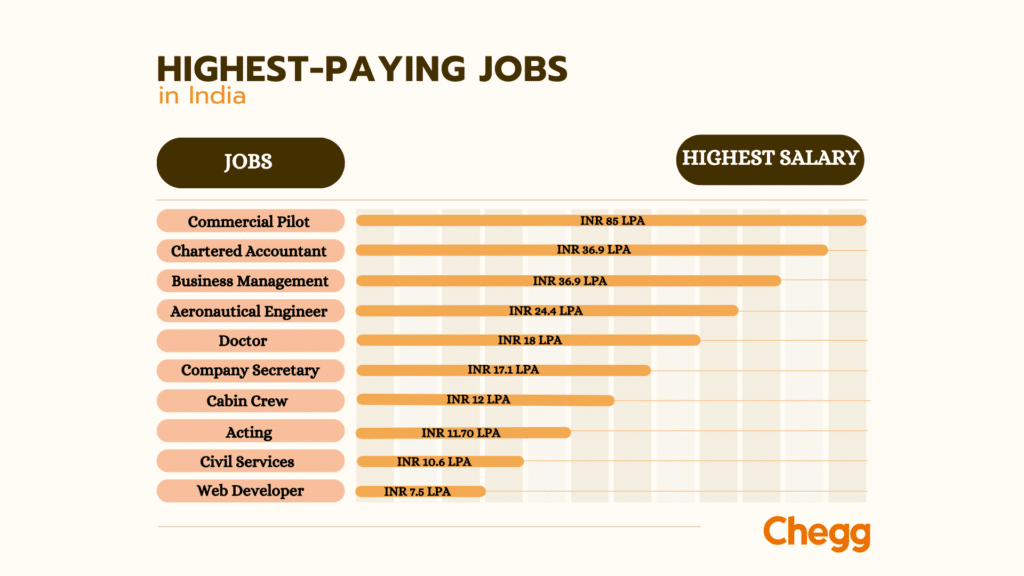
| Job Title | Average Salary (₹ LPA) | Key Qualification |
| Commercial Pilot | ₹85 LPA | 10+2 with PCM + Pilot License |
| Chartered Accountant | ₹36.9 LPA | CA (ICAI) Certification |
| Doctor (MBBS) | ₹18 LPA | MBBS + Internship |
| Business Manager | ₹25.6 LPA | BBA + MBA |
| Civil Services Officer | ₹10.6 LPA | Graduation + UPSC |
| Web Developer | ₹7.5 LPA | 10+2 + Coding Skills |
| Company Secretary | ₹17.1 LPA | CSEET + Company Law Expertise |
| Cabin Crew | ₹12 LPA | 10+2 + AME CET |
| Aeronautical Engineer | ₹24.4 LPA | B.Tech in Aerospace Engineering |
| Sales & Marketing Head | ₹30 LPA+ | MBA + Industry Experience |
Business management experts or business analysts are the people who come on top in the list of highest paying jobs in India. Companies outside or within India perform campus recruitment for such jobs, where they hire candidates directly from colleges and institutes. It is the most paid job in India that requires a great deal of qualification or experience.
Becoming a business management expert or a business analyst in India typically involves a combination of education, skills development, and practical experience.
1. Educational Background: Pursue a bachelor’s degree in a business-related field such as Business Administration, Management, Finance, or Economics. Ensure that the program you choose covers key business concepts and provides a solid foundation in business management.
2. Specialise with a Master’s Degree (Optional): Consider pursuing a Master’s degree in Business Administration (MBA) or a related field to gain in-depth knowledge and specialisation. While not mandatory, an MBA can enhance your career prospects, especially for senior roles.
Doctors get employed in hospitals in their last year of MBBS. And they keep working in their post-graduation, and through other courses too. With experience, they work for their clients too, which simultaneously increases their earnings. The emergency cases they take up also help them earn more. Hence, this job is the highest paying jobs in India.
Becoming a doctor in India typically involves the following steps:
1. Higher Secondary Education: Ensure you have a strong foundation in science subjects (Physics, Chemistry, Biology) during your 11th and 12th grades.
2. Medical Entrance Exams: Take national-level medical entrance exams like NEET (National Eligibility cum Entrance Test), which is a common entrance test for admission to undergraduate medical programs in India.
3. Earn a Bachelor’s Degree in Medicine (MBBS): Enroll in a recognised medical college for a Bachelor of Medicine and Bachelor of Surgery (MBBS) program. This typically takes 5.5 years, including a one-year internship.
4. Internship: After completing the MBBS program, undergo a compulsory rotating internship for one year in a recognised hospital.
5. Register with the Medical Council of India (MCI): After successful completion of the internship, you need to register with the MCI or the respective State Medical Council.
6. Prepare for Postgraduate Studies (Optional): If you wish to specialise in a specific field, you can pursue postgraduate studies (MD/MS) after completing your MBBS. Entrance exams for these programs include NEET PG.
7. Obtain a License: Acquire a medical license to practice from the State Medical Council or Medical Council of India.
The cabin crew includes the flight attendants who deliver the pilots’ instructions or the co-pilots. It is one of the highest paying jobs in India. They are responsible for taking care of the needs of the passengers. They are required to decently greet the passengers, guide them to their seats, and take care of the passengers to ensure a good flight. The cabin crew provides information on the set of actions in case of emergencies.
1. Educational Background: Most airlines require candidates to have completed their 10+2 (Higher Secondary) education. While there is no specific stream or course requirement, a background in any discipline is generally accepted.
2. Aviation and Hospitality Courses: Some individuals opt to pursue courses related to aviation, travel, or hospitality to gain relevant knowledge and skills. While not mandatory, these courses can be advantageous and may make you stand out in the competitive selection process. There are no mandatory subjects to be taken up in the 10+2; however, internships in hospitality etc, can come in handy. This can enhance your communication skills and provide you with a foundation in customer relations, which is crucial for cabin crew roles.
3. Cabin Crew Training Programs: Enroll in a cabin crew training program offered by recognised aviation training institutes. These programs cover essential aspects of the job, including safety protocols, emergency procedures, and customer service.
CA is a well-reputed profession and also one of the highest paying jobs in India. The CA certification is offered by the Institute of Chartered Accountants of India (ICAI). A Chartered Accountant is responsible for regulating and controlling all the accounting operations of a company. Chartered Accountants are in high demand in India as well as in foreign countries and are among the most paid jobs.
Becoming a Chartered Accountant (CA) in India involves a structured process governed by the Institute of Chartered Accountants of India (ICAI). Here is a step-by-step guide to becoming a Chartered Accountant in India:
1. Educational Background: The first step to becoming a CA is to earn a bachelor’s degree in commerce, accounting, or a related field. The University Grants Commission (UGC) or the All India Council for Technical Education (AICTE) should recognise the degree.
2. Register for the CA Course: Enroll for the CA Course with the ICAI. The CA course is divided into three levels:
3. Complete Articleship Training: Undergo three years of articleship training with a practising chartered accountant. This practical training provides hands-on experience in accounting, auditing, and taxation.
4. Appear for the CA Final Exam: The CA Final Course is the last and final stage of the Chartered Accountancy (CA) program administered by the Institute of Chartered Accountants of India (ICAI).
To pass the CA Final Exam, candidates must secure a minimum of 40% marks in each paper and an aggregate of 50% marks in each group.
5. Undergo General Management and Communication Skills Course: Complete the Advanced ICITSS (Advanced Integrated Course on Information Technology and Soft Skills) during the last two years of the Articleship.
6. Enroll as a Member: After successfully passing the CA Final exam and completing the required practical training, enroll as a member of the ICAI.
7. Obtain Membership Certificate: Receive the Membership Certificate from the ICAI, officially recognizing you as a Chartered Accountant.
Related Read: Salary of a Chartered Accountant in India
Becoming a professional pilot is not just a job but a dream for many. It requires a very strong-headed person to fly in the sky, and it is one of the highest paying jobs in India as well. The pilot job is one of the most reputable and most paid jobs.
Physics, chemistry, and maths are the compulsory subjects that people aspiring to be pilots need to have. Mental and physical fitness are also necessary. There are some established rules regarding the specific height and weight of an individual that are mandatory. Many learning institutions provide theoretical as well as practical knowledge about pilot training.
Becoming a commercial pilot in India involves several steps, including obtaining the necessary education, flight training, and certifications.
1. Educational Background: Complete your 10+2 (Higher Secondary) education with Physics and Mathematics as compulsory subjects. Having a strong foundation in these subjects is crucial for pilot training.
2. Choose a Recognized Flying School: Select a flying school recognised by the Directorate General of Civil Aviation (DGCA) in India. Ensure that the school offers a Commercial Pilot License (CPL) program.
3. Class 1 Medical Certificate: Obtain a Class 1 Medical Certificate from a DGCA-approved medical examiner. This certificate ensures that you meet the medical fitness requirements for a commercial pilot.
4. Private Pilot License: Enroll in a Private Pilot License (PPL) course at the flying school. This involves both ground school and flight training. You need to accumulate a specified number of flight hours, including solo and cross-country flights.
5. Ground School Training: Complete ground school training, which covers subjects like air regulations, navigation, meteorology, and aviation safety. Pass the relevant examinations conducted by the DGCA.
6. PPL Examination: After completing the required flight hours and ground school training, appear for the PPL examination conducted by the DGCA.
7. Commercial Pilot License (CPL) Course: Once you have obtained your PPL, enrol in a CPL course at the flying school. The CPL course includes advanced flight training, navigation, and instrument flying.
8. Flight Hours Requirement: Accumulate the required total flight hours, which include both solo and dual flight hours. The specific flight hour requirements may vary, but generally, it is around 200 hours.
9. CPL Examination: Pass the CPL examination conducted by the DGCA. This exam covers both theoretical and practical aspects of flying.
10. Acquire Additional Ratings (Optional): Obtain an Instrument Rating (IR), which allows you to operate an aircraft using instruments alone. This is a crucial step for a commercial pilot, and a Multi-Engine Rating, allowing you to fly aircraft with multiple engines.
11. Commercial Pilot License (CPL): After completing all the necessary training and meeting the flight hour requirements, you can apply for a Commercial Pilot License from the DGCA.
An aeronautical engineer’s main job is designing and implementing aircraft and propulsion systems. They are responsible for studying the aerodynamic performance of aircraft and construction materials. Their job is chiefly concerned with the aircraft. It is the best career-oriented field for people who are interested in the field of aeronautics. The aeronautical engineers are paid very well. That is why it is one of the highest paying jobs in India. However, it is also the most challenging field of engineering.
Becoming an aeronautical engineer in India involves a systematic educational and training process.
1. Educational Qualification: Complete your 10+2 (Higher Secondary) education with Physics, Chemistry, and Mathematics as compulsory subjects. A strong foundation in these subjects is essential for aeronautical engineering.
2. Entrance Exams: Appear for engineering entrance exams in India, such as JEE Main or other state-level entrance exams. Achieving a competitive score is crucial for securing admission to a reputable engineering college.
3. Pursue a Bachelor’s Degree in Aeronautical Engineering: Enroll in a Bachelor’s program in Aeronautical Engineering at a recognised engineering institute or university. The program typically lasts for four years and covers subjects like aerodynamics, propulsion, materials, structures, and avionics.
4. Pursue a Master’s Degree (Optional): While not mandatory, some aeronautical engineers choose to pursue a Master’s degree (M.Tech) in Aeronautical Engineering or a related field for further specialisation and career advancement.
The term itself is self-explanatory. The acting profession is the most competitive in India. The acting profession is much more than a glamorous profession. It is a dream for many youngsters in the country.
There are several acting schools and institutes where people apply to learn and master acting skills. People dwell in this pool of people because the earning prospects of this job are quite impressive. Hence, being one of the highest paying jobs in India, it is crowded with enormous aspirants.
The company secretary is one of the best-paid jobs in India. In India, there is huge competition among students for CS. The Institute of Company Secretaries of India (ICSI) conducts exams for students every year. After qualifying, which candidates can become CS?
Becoming a Company Secretary in India involves a structured process governed by the Institute of Company Secretaries of India (ICSI). Here’s a step-by-step guide:
1. Educational Background: Complete the 10+2 (Higher Secondary) education in any stream (except Fine Arts). There is no specific stream requirement.
2. Enroll for the Foundation Program: Register with the ICSI for the Foundation Program. The program consists of 3 stages
3. 15-Month Practical Training: Undergo 15 months of practical training after passing the Executive Program. This training can be started after passing either one or both modules of the Executive Program.
4. Membership of ICSI: On successful completion of the Professional Program and management training, apply for Associate Membership of the ICSI.
A web developer is responsible for the creation, maintenance, and development of websites. They work closely with web designers to deliver high-quality and innovative web solutions. Web developers also document and test software to ensure optimal performance. With machine learning automating repetitive tasks, designers can focus on creativity and efficiency. Web development offers excellent career growth and financial rewards and ranks among the highest paying IT jobs in India, especially for skilled developers with in-demand expertise.
Getting into Computer Science or IT-related fields in India involves a combination of education, skills development, and practical experience.
1. Educational Background: Pursue a bachelor’s degree in Computer Science, Information Technology, or a related field. Common undergraduate degrees include a B.Tech (Bachelor of Technology) in Computer Science, a B.E. (Bachelor of Engineering) in Information Technology, or a B.Sc. (Bachelor of Science) in Computer Science.
2. Build a Strong Programming Foundation: Learn and master programming languages commonly used in the industry, such as Java, Python, C++, or JavaScript. Practice coding regularly to strengthen your problem-solving skills.
3. Explore Specialisations: Identify specific areas within Computer Science or IT that interest you, such as web development, mobile app development, cybersecurity, data science, artificial intelligence, or cloud computing.
4. Pursue Advanced Degrees: Consider pursuing a Master’s degree in Computer Science or a related field for in-depth knowledge and specialisation. While not mandatory, advanced degrees can open doors to higher-level roles and research opportunities.
5. Certifications: Obtain industry-recognised certifications to enhance your credibility and demonstrate expertise in specific technologies or frameworks. Certifications like CompTIA, Cisco, Microsoft, or AWS can be valuable.
UPSC conducted for recruiting candidates to higher civil services of the Indian Government is one of the toughest and most prestigious exams in the world. With successful candidates earning high-ranking government positions, it ranks among the highest paying government jobs in India, offering job security, benefits, and high respect in society. jobs in India, offering excellent financial rewards and career growth.
UPSC recruits candidates for various civil services, such as the Indian Administrative Service (IAS), the Indian Police Service (IPS), and the Indian Foreign Service (IFS).
Becoming a civil servant in India involves a competitive and rigorous examination process conducted by the Union Public Service Commission (UPSC).
1. Educational Qualification: Possess a bachelor’s degree in any discipline from a recognized university. There are no specific requirements for the type of degree.
2. Understand the Examination Structure: The Civil Services Examination (CSE) consists of three stages:
3. Final Selection: The Personality Test is the last stage of the Civil Services Exam. After the UPSC Exam, the Commission conducts a Personality Test, which is 275 Marks. The interview is a lengthy process, and the panel consists of subject matter experts, bureaucrats, educationists, and the board chairperson.
The final merit list is prepared based on the combined scores of the Main Examination and the Personality Test.
4. Complete the IAS Training at LBSNAA: LBSNAA (Lal Bahadur Shastri National Academy of Administration, Mussoorie) is a crucial part of the training process for civil servants in India. The training at LBSNAA serves as a common platform for officers from various services, fostering a holistic understanding of governance and public administration. The academy plays a pivotal role in shaping the future leaders of the Indian bureaucracy, emphasizing the values of public service and leadership.
Chegg allows you to earn extra income by taking a few hours out of your day. If you are an expert in any subject, like engineering, earth science, maths, business, etc., you can become a Q&A expert at Chegg. As an expert, you have to answer questions related to the subject.
You will be paid for every correct answer. It is a part-time job that will allow you to work from the comfort of your home and will give you all the benefits, including working as per your schedule and timely payments.

| Industry | Job Title | Average Salary (₹ LPA) | Highest Salary (₹ LPA) |
| Government | IAS/IPS/IFS | ₹10–20 LPA (with allowances) | ₹30 LPA+ (top-level posts) |
| Medical | Doctor (MBBS/MD/MS) | ₹10–20+ LPA (specialists) | ₹80+ LPA (top surgeons) |
| Nurse | ₹3–6 LPA | ₹8–10 LPA | |
| Finance | Chartered Accountant | ₹7–25 LPA | ₹30+ LPA |
| Company Secretary | ₹6–18 LPA | ₹20+ LPA | |
| Business Manager | ₹15–40 LPA | ₹50+ LPA (senior roles) | |
| Aviation | Cabin Crew | ₹5–8 LPA | ₹12–15 LPA |
| Pilot | ₹18–50 LPA | ₹70–85 LPA | |
| Media & Arts | Actor/Actress | ₹3–8 LPA | ₹12 LPA |
| IT & Tech | Web Developer | ₹6–16 LPA | ₹20+ LPA |
| Aeronautical Engineer | ₹6–15 LPA | ₹20+ LPA | |
| Chemical Engineer | ₹5–12 LPA | ₹15 LPA |
Here is a list of jobs broken down by various industries based on their average and highest salaries.
Investment banking, software engineering, and medical careers stand out as some of the most financially rewarding options in India. Here’s a closer look at these professions:
1. Investment Bankers: These professionals are vital in the financial landscape, providing expertise on mergers, acquisitions, and raising capital. The high-pressure environment and significant responsibilities are matched by impressive financial rewards.
2. Software Engineers: As the technology sector continues to thrive, major companies like Google and Microsoft, along with numerous startups, are offering attractive salaries and perks to lure skilled individuals. Proficiency in programming, data science, and artificial intelligence is especially sought after.
3. Medical Professionals: Surgeons, specialists, and other healthcare workers are in high demand due to the essential nature of their roles. The need for quality medical care ensures that these professionals receive substantial compensation.
Additionally, other lucrative fields in India include management consulting, data science, and various legal professions. With the right skills and qualifications, these roles rank among the highest paying jobs in India after 12th, offering substantial financial growth opportunities.
Starting a career might be difficult, but amazing opportunities abound! These in-demand Highest Salary Jobs in India per month provide significant income potential for recent graduates:
Choosing the right career is a big decision that can shape your future. Here are some simple steps to help you find the right path:
Here are some expected job trends specific to India:
In this article, we have discussed the highest paying jobs in India. But you should not just look at the pay and make your decision. Your interests, ambitions, and skills should also be taken into consideration before making a decision.
Choosing a career option is an important step in life. Hence, deciding on the basis of management may hamper you in the future. Assess yourself, identify your potential, and gear up for any job opportunity, whether it’s work from home or the office, choose what suits you.
Read More:
In India, several jobs offer high salaries, including specialized medical professions like surgeons and physicians, roles in the IT sector like AI and ML engineers, and positions in finance like investment banking. Additionally, management consultants and commercial pilots are also among the highest earners.
Chartered Accountancy offers exciting salary packages in the accounting field. CA is considered to be one of the highest paying jobs in India after 12th as well as abroad. The basic salary of a CA fresher ranges around INR 7 Lakhs per annum, and it goes up to an annual salary of INR 36 Lakhs. With increased experience, Chartered Accountants tend to earn a huge income.
There are equal opportunities in every career field. With your potential and skills, you have to discover the suitable one for yourself. However, the management field can be a good career option. It is open to all; students from any discipline can pursue an MBA. Pursuing an MBA from a recognised institute can offer you excellent job opportunities.
The need for doctors will never cease; hence, it is considered the highest demanding job. A huge number of students take up MBBS to become doctors, but a very small percentage of students end up completing MBBS. It is one of the highly competitive fields, but it offers very high salary packages. An experienced doctor can earn more than INR 17 Lakhs per annum.
The highest-paying profession is that of an anesthesiologist, boasting a median annual salary of approximately ₹2 crore per year. This position entails the administration of anesthesia and the careful monitoring of patients throughout surgical procedures. Achieving this role demands significant education and training, usually culminating in a doctoral degree.
In India, what constitutes a good salary can differ significantly, but for those in mid-level positions, it generally falls between INR 15,000 and INR 40,000 each month. This variation highlights the country’s economic diversity and the changing landscape of the job market. Typically, higher salaries are more common in major cities and specialized sectors.
A salary of 1 crore per month is exceptionally high in India and is typically found in senior leadership positions within large corporations or specialized, high-demand fields. While specific job titles vary, roles like CEO, CFO, or Managing Director of large multinational companies often command such salaries, as do some highly specialized roles in finance, technology, and consulting.
Several high-level, specialized, or entrepreneurial roles can potentially earn ₹10 lakh per month in India. These include positions in fields like medicine, finance, technology, and management, as well as opportunities for successful entrepreneurs. Specific examples include surgeons, investment bankers, tech leaders, and individuals with successful businesses.
Yes, a 22 LPA (Lakhs Per Annum) salary in India is generally considered a good salary, especially when compared to the national average. It offers a comfortable standard of living and allows for savings and investments, particularly outside of high-cost metro cities.
Yes, roles in tech like Data Analysts, Machine Learning Experts, and Software Engineers offer freshers ₹5–12 LPA based on skill and demand.
Consider your skills, interests, and long-term goals along with market demand, required qualifications, and growth opportunities before choosing a career.