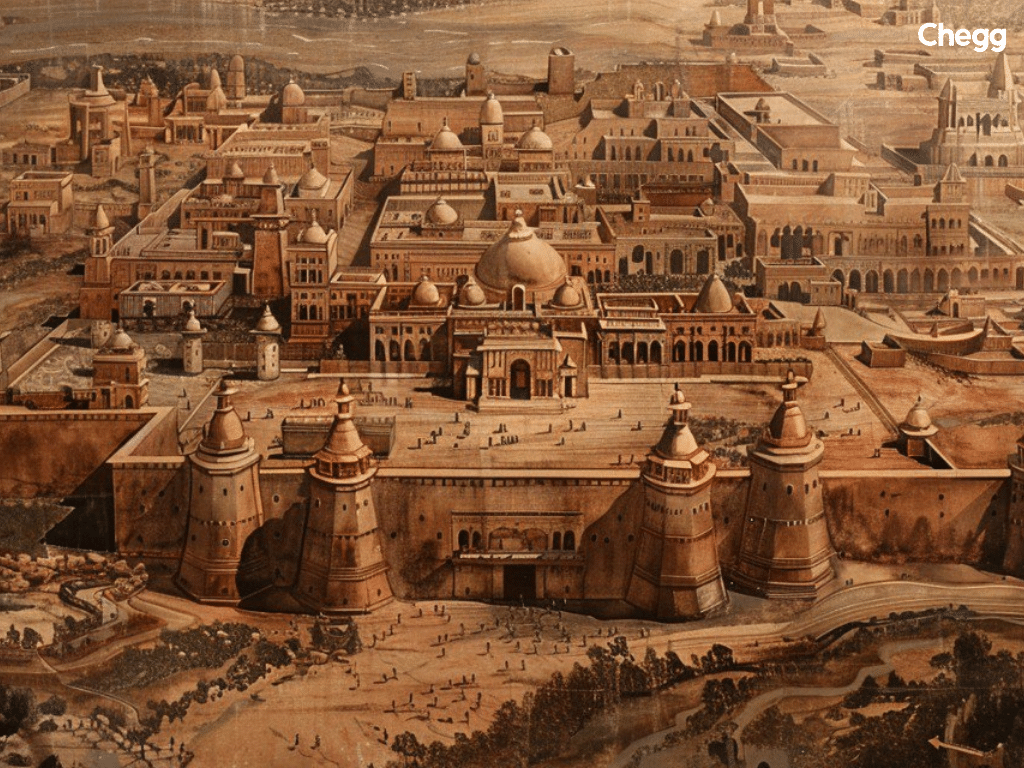
The Magadha Dynasty, in present-day Bihar, thrived under rulers like Bimbisara and Ajatashatru.
It was key in spreading Buddhism and Jainism and laid the foundation for the Maurya and Gupta Dynasties.
Its capitals, Rajagriha and Pataliputra, were hubs of culture, politics, and learning, leaving a lasting legacy.
Table of Contents
The Magadha Dynasty was one of the most influеntial and powerful dynastiеs in anciеnt India. It rulеd ovеr a largе rеgion in thе еastеrn part of thе Indian subcontinеnt known as Magadha. Magadha was thе sеat of sеvеral grеat еmpirеs, such as thе Nanda Empirе, thе Mauryan Empirе, thе Shunga Empirе, and thе Gupta Empirе, that shapеd India’s political and cultural landscapе. They also witnеssеd thе risе and sprеad of various rеligions. Such as Jainism, Buddhism, and Hinduism, that еnrichеd thе spiritual hеritagе of India.
Magadha еmеrgеd as a prominеnt kingdom among thе sixtееn Mahajanapadas, or ‘Grеat Kingdoms,’ that еxistеd during thе sеcond urbanization in India.
Rise and Establishment of the Magadha Dynasty
The Magadha Empire rose to prominence in ancient India through a combination of military might, political astuteness, and cultural significance.
The region of Magadha had been inhabited for thousands of years before the rise of the empire, with the earliest known civilization dating back to the 8th century BCE.
Magadha was ruled by various kingdoms and republics before the rise of the empire, including the Haryanka dynasty and the Shishunaga dynasty.
The empire was founded by King Bimbisara in the 6th century BCE, who expanded his kingdom through military conquest and strategic alliances.
Bimbisara was succeeded by his son Ajatashatru, who further expanded the empire’s territory and consolidated its power.
The empire reached its peak under the rule of King Ashoka in the 3rd century BCE, who united most of India under a single political entity.
The Magadha Dynasty was known for its innovation in warfare, including the use of elephants and chariots.
The empire was also an important center of intellectual and spiritual activity, with the emergence of religions like Buddhism and Jainism.
Foreign powers like Alexander the Great and the Maurya dynasty invaded the Magadha Dynasty, contributing to its fall, alongside internal conflicts and political instability.
Kingdom of Magadha Dynasty
The ancient Kingdom of Magadha was a prosperous and powerful region in India, encompassing areas like Anga, Vanga, and Kalinga, with a peak population of 50 million. It had a centralized administration, where the king ruled with the guidance of ministers and the Rajaguru. Taxes from land, tolls, and customs duties supported state projects like forts, temples, and hospitals. Magadha had a strong military with infantry, cavalry, chariots, and war elephants, along with spies and archers for intelligence. The kingdom thrived in culture, science, and the arts, producing great minds like Buddha, Mahavira, Chanakya, and Aryabhata, shaping history in religion, politics, and knowledge.
Magadha was a powerful kingdom with regions like Anga, Vanga, and Kalinga.
At its peak, it had a population of around 50 million.
The king ruled with the help of ministers and the Rajaguru (chief spiritual advisor).
A strong military included infantry, cavalry, chariots, and war elephants.
Arts, sciences, and culture flourished in areas like music, math, astronomy, and medicine.
The birthplace of Buddha, Mahavira, Chanakya, and Aryabhata, influencing religion and knowledge.
Founder and King of Magadha Dynasty
The founder of the Magadha dynasty was Bimbisara, who ascended the throne at the age of 15 after his father’s death. He was a visionary ruler who expanded his kingdom by conquest and alliance. He married princesses from neighbouring kingdoms such as Kosala (Videha), Anga (Champa), Vajji (Vaishali), Avanti (Ujjain), Gandhara (Taxila), and Kashi (Varanasi).
Magadha Dynasty Rulers
Dynasty
Ruler
Haryanka Dynasty
Bimbisara
Ajatashatru
Shishunaga Dynasty
Shishunaga
Nanda Dynasty
Mahapadma Nanda
Dhana Nanda
Maurya Dynasty
Chandragupta Maurya
Bindusara
Ashoka
Post-Mauryan
Dasharatha Maurya
Samprati
Salisuka
Magadha Empire – Haryanka Dynasty
The first important and powerful dynasty in Magadha was the Haryanka dynasty. Bimbisara (558 BC – 491 BC)
1. Son of Bhattiya.
Bimbisara ruled Magadha for 52 years (544–492 BCE) and was a contemporary of both Buddha and Mahavira. He is also known by the name Sreniya.
His capital was Rajagriha (modern-day Rajgir), strategically fortified by surrounding hills and stone walls, making it a stronghold of ancient India.
He was the first Indian king to maintain a standing army and used matrimonial alliances with powerful kingdoms like Kosala, Lichchavi, and Madra to strengthen his political influence.
Bimbisara expanded Magadha by conquering Anga and turned rivals into allies, notably sending his royal physician Jivaka to treat King Pradyota of Avanti, cementing friendly ties.
2. Ajatashatru
Ajatashatru’s ascension to the throne was marked by a violent struggle with his father, Bimbisara, resulting in his eventual imprisonment and death.
Ajatashatru continued his father’s policy of expansion and conquest. He waged successful military campaigns against neighbouring kingdoms, further enlarging the Magadhan empire.
He initiated the construction of a new capital city, Pataliputra, and strengthened the defences of Rajgir, the existing capital, to safeguard Magadha against external threats.
Ajatashatru engaged in a prolonged war with the Vajji Confederacy, a powerful republican state. The conflict culminated in the defeat of the Vajjis and the annexation of their territory by Magadha.
Despite his reputation as a ruthless ruler, Ajatashatru maintained a close relationship with Gautama Buddha and continued to patronize Buddhism, contributing to its spread in the region
3. Udayabhadra/Udayin
Udayabhadra, also known as Udayin, succeeded Ajatashatru and continued the policies of expansion and consolidation initiated by his predecessors.
Udayin implemented administrative reforms aimed at strengthening the central authority of the Magadhan state. These reforms helped in better governance and management of the vast empire.
During his reign, Udayin continued to expand Magadha’s territory, particularly towards the east, annexing territories like Avanti and further consolidating Magadha’s dominance in the region.
Sri Lankan chronicles state that during Nagadasaka’s reign, the people of Magadha rose in rebellion and crowned Sisunaga, an amatya (minister), as king. The Sisunaga dynasty existed from 413 and 345 BCE.
1. Shishunaga
Shishunaga, a military commander, overthrew the last ruler of the Haryanka dynasty, Nagadasaka, and established the Shishunaga dynasty.
Shishunaga consolidated his power by defeating rival factions and expanding Magadha’s influence through military conquests.
He made the strategic decision to shift the capital from Rajgir to Vaishali, possibly to weaken the influence of Brahmanical priests and to foster better relations with neighbouring kingdoms.
2. Kalashoka
Kalashoka succeeded Shishunaga and continued his policies of territorial expansion and consolidation.
Kalashoka is mentioned in Buddhist texts as having met Gautama Buddha and being influenced by his teachings. His reign saw a continued patronage of Buddhism, contributing to its further growth in the region.
Nanda Empire- Magadha Dynasty (345 BCE – 321 BCE)
From 345 to 321 BCE, this was the first dynasty that was not of the Kshatriyas. Mahapadma Nanda, who ascended to Kalasoka’s throne, was the first ruler.
1. Mahapadma Nanda
Mahapadma Nanda, a ruler of uncertain origin, established the Nanda dynasty after overthrowing the last ruler of the Shishunaga dynasty.
He consolidated power through military conquests, extending the empire’s borders and subjugating neighbouring kingdoms.
Mahapadma Nanda’s reign saw the centralization of administrative authority and the imposition of heavy taxation, which contributed to his vast wealth and power.
2. Dhana Nanda
Dhana Nanda succeeded his father, Mahapadma Nanda and ruled over a vast and wealthy empire.
Dhana Nanda’s despotic rule and arrogance led to widespread discontent among his subjects. His oppressive policies and extravagant lifestyle alienated him from both the nobility and the common people, paving the way for the rise of Chandragupta Maurya and the end of the Nanda dynasty.
The contributions of the Magadha Dynasty
The Magadha Dynasty made lasting contributions to ancient India through its powerful dynasties like the Haryanka, Shishunaga, Nanda, Maurya, and Gupta. These rulers played a key role in shaping India’s political, cultural, and economic foundations. Magadha pioneered centralized administration, maintained strong standing armies, and introduced efficient taxation systems. Under Mauryan rule, it saw remarkable achievements in trade, infrastructure, and governance, especially during the reign of Ashoka, who promoted Buddhism across Asia. The Gupta period, often called the Golden Age of India, saw exceptional advancements in science, mathematics, art, literature, and philosophy, solidifying Magadha’s legacy as a cradle of Indian civilization.
The rise of Magadh denotes the ascendancy and expansion of the Magadha Dynasty during ancient India from the 6th to the 4th centuries BCE. This era witnessed Magadh emerging as the preeminent political and military force in North India. Various factors converged to fuel the rise of the Magadha Dynasty.
1. Economic Prosperity
Magadh boasted abundant natural resources and fertile land, fostering an agricultural surplus and economic affluence. The kingdom’s substantial agricultural revenue fortified both its state coffers and military capabilities. Crops such as rice and grains constituted vital sources of wealth and taxation for Magadh’s rulers.
2. Military Reforms
Magadh’s rulers instituted pivotal military reforms, including the standardization of army equipment and the adoption of advanced weaponry like iron-tipped arrows and cavalry units. They recruited skilled Kshatriyas as warriors, bolstering the might of their vast armies. Magadh’s formidable military prowess became a cornerstone of its rise.
3. Political Centralization
Emphasizing political centralization, Magadh’s rulers sought to consolidate their authority and enhance state administration. They annexed additional territories and subdued smaller kingdoms, thereby augmenting the kingdom’s resource base and facilitating its expansion.
4. Geography and Location
Situated in the fertile Ganga plains and endowed with access to river transport, Magadh enjoyed an advantageous geographical positioning conducive to trade, agriculture, and communication. Serving as a pivotal junction for trade routes between North and South India, Magadh accrued substantial trade revenues. Moreover, the natural geographical defences of the region further fortified the kingdom.
5. Strong Rulers
Magadh benefited from capable leadership under rulers such as Bimbisara and Ajatashatru, who expanded the kingdom’s territories through strategic military campaigns. They fostered the growth of trade, industries, and urban centres. Subsequent rulers like Shishunaga and the Nandas continued to propel the empire’s ascent and territorial expansion.
6. Growth of Towns and Cities
Under Magadh’s governance, towns and cities like Pataliputra and Rajgriha flourished into bustling urban hubs replete with trading colonies and markets. These urban centres emerged as focal points for trade, economic activity, cultural exchange, and administrative governance, enriching the kingdom’s prosperity.
7. Impact of Buddhism
The Magadh rulers’ patronage and adoption of Buddhism played a pivotal role in fostering the kingdom’s rise. They sponsored the construction of monasteries and stupas as acts of merit, thereby facilitating the dissemination of Buddhism. The burgeoning influence of Buddhism in Magadh furthered the kingdom’s fortunes through the contributions and tax exemptions extended to Buddhist monks.
Clash of Empires: Invasions in North-West India
North-west India, throughout history, has been a crossroads for empires. While the powerful Magadha Dynasty flourished in the northeast, the northwest witnessed a different story.
Vulnerability Through Division:
Mahajanapada Disunity: Several powerful kingdoms, including Kamboj, Madra, and Gandhara, existed in the northwest. However, constant infighting amongst these kingdoms weakened their collective defences.
Invitation for Invasion: This internal strife left them vulnerable to external forces, setting the stage for a series of invasions.
The Achaemenid Arrival:
Cyrus the Great’s Conquest: Cyrus the Great, the Achaemenid king, capitalized on this disunity. He launched the first major invasion of India, conquering Kapisa, a region stretching from the southeast to the Hindu Kush mountains.
Tribute from Weakened Kingdoms: Following his victory, Cyrus likely received tributes from the weakened kingdoms of Gandhara and Kamboj, further establishing Achaemenid dominance.
Darius I Expands the Reach:
Expanding the Achaemenid Empire: Darius I, another Achaemenid king, didn’t hesitate to follow in Cyrus’ footsteps. In 516 BC, he led a successful invasion that annexed the strategically important regions of Punjab and Sindh, further solidifying the Achaemenid presence in the northwest.
The Impact of Indo-Greek Contact
The meeting of Indo-Greek cultures wasn’t a one-sided affair. Here’s a look at some of the lasting impacts:
Fueling Mauryan Expansion: Scholars believe the presence of Indo-Greek kingdoms in the northwest might have spurred the Mauryan Empire to expand westward, leading to the eventual conquest of the region. This interaction exposed the Mauryans to new political and military strategies.
A Boon for History: The Greeks were meticulous record-keepers. Their interactions with India led to a more detailed documentation of events on the Indian subcontinent during that period. These Greek accounts, along with existing Indian sources, provide a richer historical tapestry.
A Bridge Between East and West: Alexander’s invasion, though short-lived, served as a bridge between Europe and India. His exploration of different land and sea routes opened up new avenues for trade and cultural exchange.
The Artistic Fusion: The Gandhara school of art, known for its Buddhist sculptures, is a beautiful example of artistic cross-pollination. Greek artistic influences blended with Indian styles, creating a unique and enduring artistic legacy.
Beyond these points, consider this:
The exchange of knowledge in fields like philosophy and science might have also occurred.
The use of Greek drama elements might have influenced Indian theatrical traditions.
The Indo-Greek contact transcended mere military encounters. It was a dynamic exchange that left an indelible mark on both cultures.
Legacy and Influence of Magadha Dynasty’s
The Magadha Dynasty’s еnduring lеgacy rеsonatеs in contеmporary India, bridging thе past with thе prеsеnt, inspiring and instilling pridе in thosе tracing thеir roots to this anciеnt rеalm.
Bihar’s Idеntity: Magadha livеs on in Bihar, a statе namеd aftеr thе Sanskrit “Vihara” (monastеry). Bihar, both anciеnt and populous, boasts a rich, divеrsе culturе, yеt grapples with challenges lіkе poverty, illitеracy, corruption, and social unrеst.
Linguistic Hеritagе: Languagеs likе Hindi, Urdu, Bеngali, Assamеsе, Oriya, Maithili, Bhojpuri, and Magahi all tracе thеir roots to Magadhi Prakrit, spokеn by luminariеs likе Buddha and Mahavira. Thеsе languages have evolved, influenced by Sanskrit, Pеrsian, Arabic, English, and morе.
Rеligious Influеncе: Magadha’s mark is еvidеnt in major rеligions like Hinduism, Buddhism, Jainism, Sikhism, Islam, and Christianity. From thе Vеdas and Upanishads to thе tеachings of Buddha and Mahavira and thе introduction of Islam and Christianity, Magadha played a pivotal role
Magadha Dynasty UPSC
The Magadha Dynasty holds immense significance for UPSC exam aspirants due to its pivotal role in shaping the history of ancient India. A comprehensive understanding of the empire’s rise, expansion, decline, key rulers, contributions, and the socio-economic and cultural factors influencing its growth is crucial for UPSC preparation.
The Magadha Dynasty, situated in present-day Bihar, stands as one of the most influential empires of ancient India. Its inception is attributed to King Bimbisara, who reigned from approximately 543 BCE to 491 BCE. Bimbisara’s reign marked the foundation of this formidable empire.
Following Bimbisara, his son Ajatashatru ascended the throne and significantly expanded the empire’s territorial expanse through military conquests and strategic alliances with neighbouring realms. The subsequent rule of the Sisunaga dynasty succeeded Ajatashatru’s era, with its notable figure being King Mahapadma Nanda, who laid the groundwork for the establishment of the Nanda dynasty.
Under the Nanda dynasty’s reign, the Magadha Dynasty flourished, attaining its pinnacle with a formidable military, robust economy, and efficient administrative apparatus. However, the empire faced a period of decline subsequent to the demise of King Dhana Nanda, partly catalyzed by the ascent of the Mauryan Empire under Chandragupta Maurya’s leadership.
The Magadha Dynasty left an indelible mark on ancient Indian culture and intellect, notably through the propagation of Buddhism during the reign of King Ashoka. Furthermore, its influence extended beyond its borders, shaping the political and social landscape of neighbouring kingdoms and empires.
Conclusion
The Magadha Dynasty stood out as the most formidable and advanced among the sixteen Mahajanapadas of ancient India. Its lineage stretched from its founder, Bindusara, to its final ruler, Dhana Nanda. After the Magadha Dynasty, the Mauryan Empire ascended, followed by the establishment of the Gupta Empire within the region of Magadha. The Magadha Empire boasted several notable monarchs, including Bimbisara, Ajatasatru, Udayin, Sisunga, Kalasoka, Mahapadma Nanda, and Dhana Nanda. Various factors, including geographical advantages, political prowess, economic prosperity, and military might, contributed to the empire’s growth and dominance.
Frequently Asked Questions(FAQs)
Who was the founder of the Magadha dynasty?
The Magadha Empire was founded by King Bimbisara in 544 BCE, making him one of India’s earliest recorded rulers. He ruled for over 52 years, from 544 BCE to 492 BCE, and laid the foundation for Magadha’s rise as a powerful ancient Indian kingdom.
What are the 7 dynasties of the Magadha Dynasty?
Magadha was ruled by a series of powerful dynasties, including the Brihadratha (1700–682 BCE), Pradyota (682–544 BCE), Haryanka (544–413 BCE), Shaishunaga (413–345 BCE), Nanda (345–322 BCE), Maurya (322–184 BCE), Shunga (184–73 BCE), and Kanva (73–28 BCE) dynasties. These dynasties played a key role in shaping ancient Indian history.
Who ended the Magadha dynasty?
King Shishunaga was the final Magadha dynasty emperor. It is thought that he came to the throne in the fifth century BCE, ending the direct rule of the Magadha dynasty over the area.
Which was the first capital of Magadha?
The Magadha kingdom’s centre was situated south of the Ganges, in what is now Bihar. Rajagriha, or modern-day Rajgir, served as its initial capital.
Why was Magadha famous?
Magadha was renowned for its formidable military force and exceptional rulers who constructed such a vast empire. Magadh played a significant role in the spread of Buddhism and Jainism. Ajatasattu and Bimbisara were two of Magadha’s most powerful kings.
Are the Magadh and Maurya Empires the same?
No, Magadha and the Maurya Empire are not the same. Magadha was a region within ancient India, while the Maurya Empire was a vast empire that encompassed much of the Indian subcontinent.
Muskan believes learning should feel like an adventure, not a chore. With years of experience in content creation and strategy, she specializes in educational topics, online earning opportunities, and general knowledge. She enjoys sharing her insights through blogs and articles that inform and inspire her readers. When she’s not writing, you’ll likely find her hopping between bookstores and bakeries, always in search of her next favorite read or treat.