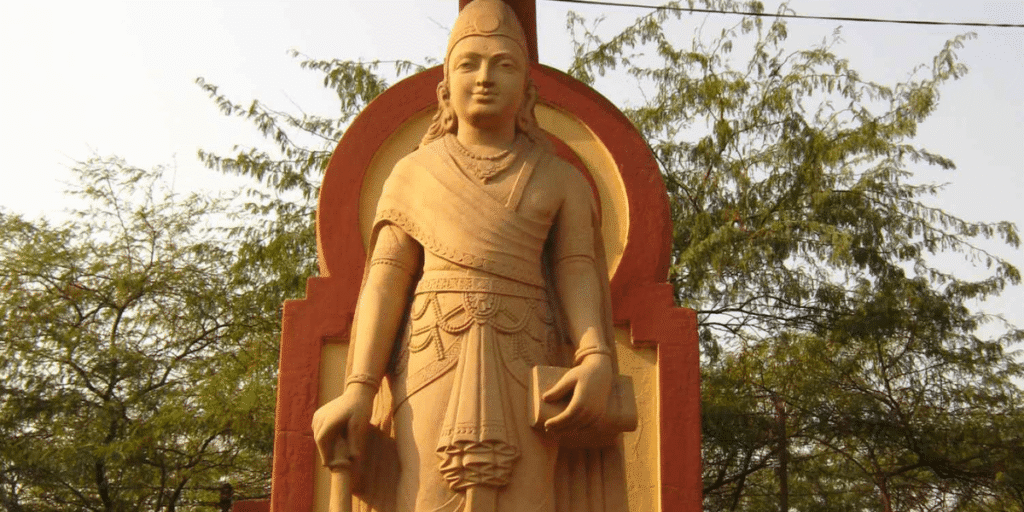
The Maurya Empire is a big and very old empire in Indian history. Chandragupta Maurya, a great king in India, started it.
The Maurya Empire started when Chandragupta, with the help of his teacher Chanakya, defeated the Nanda Dynasty. Chandragupta made important government, economic, and army changes from 321 BCE to 297 BCE.
Chandragupta Maurya is very important in Indian history. He united the different parts of India into one strong area, stopping the confusion and instability in the region. His leadership and management skills started a golden period in Indian history.
Overview of Chandragupta Maurya
| Aspect | Details |
|---|---|
| Full Name | Chandragupta Maurya |
| Birth | c. 340 BCE (Exact date unknown) |
| Birthplace | Pataliputra (modern-day Patna,Bihar) |
| Dynasty | Maurya Dynasty |
| Father | Unclear; possibly of humble or royal origins |
| Wife | Durdhara |
| Son | Bindusara |
| Mentor | Chanakya (Kautilya) |
| Rise to Power | Overthrew Dhana Nanda of the Nanda Empire |
| Reign | c. 321–297 BCE |
| Achievements | Unified Northern India; Founded Maurya Empire |
| Religion | Converted to Jainism in later life |
| Death | c. 297 BCE, at age 42 |
| Place of Death | Shravanabelagola, Karnataka |
| Cause of Death | Fasting (Sallekhana) |
History of the Maurya Empire
- Chandragupta overthrew the Nanda Dynasty and founded the Maurya Empire in 322 BCE with the help of Chanakya.
- He took advantage of the instability caused by Alexander the Great’s army retreating and expanded his influence across central and western India.
- By 316 BCE, he had conquered Northwestern India, defeating Alexander’s satraps (local governors).
- Chandragupta repelled an invasion by Seleucus I, gaining more territory west of the Indus River.
- The Maurya Empire became one of the largest in the world under his rule, uniting small kingdoms into a single vast empire.
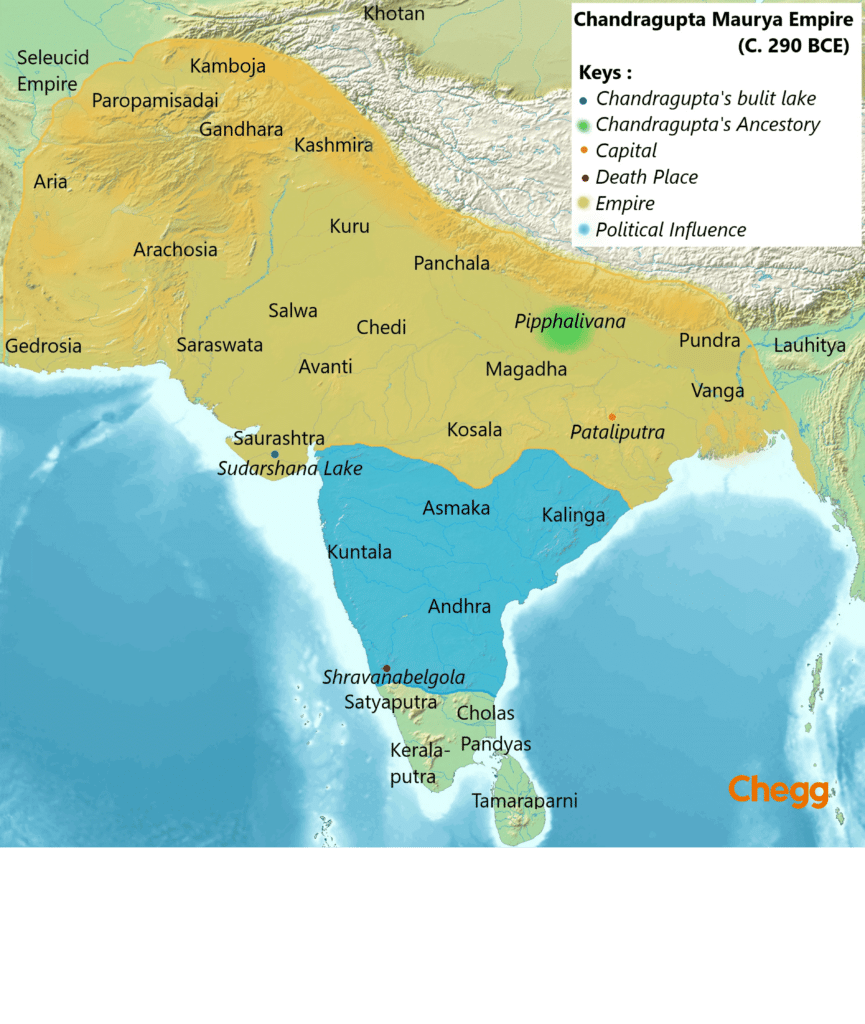
- The empire stretched from Bengal and Assam in the east to Afghanistan and Balochistan in the west, and from Kashmir and Nepal in the north to the Deccan Plateau in the south.
- After ruling for 23 years, Chandragupta abdicated and became a Jain monk.
- He chose to fast to death (Sallekhana) and left his royal life behind.
- Humanize 123 words
Important Rulers of the Mauryan Empire
- Founder: United northern India and established a strong central administration.
- Bindusara: Expanded the empire southward and maintained efficient rule.
- Ashoka: Converted to Buddhism after a war, promoting peace and Dharma (righteousness) across the empire.
The Chandragupta Maurya who Established the Mauryan Dynasty
Here are a few significant insights concerning Chandragupta’s wife, son, and father.
Historical Context
During Chandragupta’s time, India was fragmented into multiple kingdoms, and the Greeks under Alexander the Great were making inroads into the Indian subcontinent. In this time of battles, Chandragupta handily established the most remarkable kingdom of ancient India.
Family Background
His early life remains shrouded in mystery, with scholars offering varied theories about his origins. Some believe he came from a humble background, while others suggest he had royal ancestry. Some texts even mention that his father was a peacock tamer, adding to the intrigue.
Who was the Father of Chandragupta Maurya?
Chandragupta Maurya’s rise is often celebrated as a self-made ascent from modest beginnings, guided by Chanakya. The claim of “Sarvarthasiddhi Maurya” as his father is not backed by strong historical evidence, and should be treated as legendary or symbolic rather than factual
The exact details of Chandragupta’s early life remain elusive, and various historical texts offer conflicting narratives. Nevertheless, his rise to power and the establishment of the Mauryan Empire stand as a significant milestone in Indian history.
Chandragupta Maurya Wife
Wife of Chandragupta, Durdhara, played a pivotal role in shaping the early Mauryan Empire. While popular accounts often describe her as the daughter of Dhana Nanda, historical sources like Mahavamsa-tika suggest she was Chandragupta’s first cousin. Tragically, Durdhara passed away before witnessing the birth of their son, Bindusara, due to a poisoning incident linked to Chanakya’s schemes.
Who was the Second Wife of Chandragupta?
Helena was a Seleucid princess, daughter of Seleucus I Nicator, the founder of the Seleucid Empire. This marriage was a strategic alliance between the two powerful empires, solidifying peace and fostering cultural exchange. While there is no concrete evidence of her having children with Chandragupta, her influence on the Mauryan court and the cultural exchange between India and Greece is significant.
Who was the Son of Chandragupta?
Chandragupta’s son, Bindusara, succeeded him as the second emperor of the Maurya dynasty. He carried forward his father’s legacy, expanding the empire and solidifying the foundation of one of India’s greatest dynasties.
Chandragupta Maurya family tree
| Generation | Details |
|---|---|
| Paternal Lineage | Uncertain: Competing theories about Chandragupta’s father being a “Moriya” clan chief or from a less noble background. |
| Maternal Lineage | Chandragupta’s mother; he was raised by a cowherd after his biological father’s death. |
| Chandragupta Maurya | Founder of the Maurya Empire. |
| Descendants | Son: Bindusara, who succeeded him as emperor. |
| Grandson: Ashoka the Great, renowned emperor of India. |
This table provides a clear and concise overview of his known family lineage and descendants.
Social Background
Many historians debate his social background. Some believe he belonged to the Kshatriya (warrior) caste, while others believe he was from a lower caste.
Influence of Upbringing
Challenges and struggles marked Maurya’s upbringing. Undoubtedly, it influenced his later life and decisions. His determination and strategic alliances honed during his early years enabled him to overthrow the Nanda dynasty and establish the Mauryan empire.
Rise to Power
Here’s the long story, in short about his rise to power.
Journey to becoming king: Meeting with Chanakya
Chandragupta’s journey to becoming king was guided by his teacher and godfather, Chanakya. Chanakya was a famous teacher and Brahmin sage, also known as Kautilya. Chanakya saw the qualities of great leaders in him, so he decided to mentor him. This partnership proved to be a game-changer in Indian political history.
Building the Mauryan Empire
Under the guidance of Chanakya, Chandragupta jumped on a mission to establish a great grand empire. Chanakya formulated genuine strategies to dismantle the mighty Nanda dynasty, which held sway over a large part of northern India.
By skillfully employing diplomacy or espionage and military tactics, they defenestrated the Nanda dynasty and laid the foundation of the Mauryan Empire.
Uniting Northern India
With the reins of power in his hands, he moved on a campaign to unify Northern India’s scattered and divided territories. He defeated the rulers of various regions, for instance, the mighty Seleucid Empire in the northwest, and integrated them into the Mauryan domain. His reign marked a new era of political cohesion and administrative effectiveness in ancient India.
Reasons Why Chandragupta Maurya Was a Revolutionary Emperor?
- Founded the Maurya Empire: He unified most of the Indian subcontinent under one powerful empire for the first time.
- Overthrew the Nanda Dynasty: Rose from humble beginnings and defeated a mighty ruling dynasty with the guidance of Chanakya.
- Centralized Administration: Established a well-organized administrative system that laid the foundation for efficient governance.
- Diplomatic Success: Formed strategic alliances, including a treaty with Seleucus I of the Greek empire, expanding his influence.
- Embraced Jainism: Later in life, he renounced power and adopted Jainism, reflecting his deep spiritual transformation.
Military Campaigns and Expansion
Here are details about his military raids and expansion during Chandragupta’s reign.
Military Campaigns and Conquests
Maurya learned military tactics from his master Chanakya. He launched a series of highly planned conquests. At the start, he tried to conquer the territories controlled by the erstwhile Nanda dynasty as they all were at main trading points. With Chanakya’s invaluable assistance, he successfully conquered them. Once he secured control over the Gangetic plain, he shifted his focus to the northwestern parts of India.
Northwestern Conquests
One of Chandragupta’s most significant victories in the northwest was against the Seleucid Empire led by Seleucus I Nicator, a former general under Alexander the Great. After a series of confrontations, the Mauryan Empire compelled Seleucus to relinquish vast tracts of land encompassing present-day Afghanistan and parts of Pakistan.
Chandragupta presented Seleucus with 500 war elephants as a token of goodwill, fostering a diplomatic bond between the two mighty empires.
Diplomacy and Alliances
Chandragupta was good at balancing military prowess with diplomatic finesse. Post the conflict with Seleucus, he forged diplomatic ties with the Hellenistic. Moreover, he nurtured amicable relations with the kingdoms of Deccan and southern India.
Thereby ensuring peace and stability across the region. This strategic approach expanded his empire and created a network of alliances that bolstered his position as a formidable ruler in the ancient world.
Administration and Governance in the Mauryan Empire
Here are some glimpses of the Administration and Governance in the Mauryan Empire.
Administrative Structure
The Mauryan Empire was divided into four big areas, with the principal city at Pataliputra. Every region was driven by a lord or a high-positioning honourable responsible for the government, equity, and armed force in his space.
These areas were then parted into smaller parts called feuds, and each feud was overseen by authorities appointed by the central government (Ruler). These authorities were liable for gathering cash-making regulations and focusing on public works.
The Mauryan government was exceptionally coordinated with an unmistakable authority structure, each with explicit positions and obligations.
Taxation Law and Justice
Experts noticed that the Mauryan Empire had policies to ensure fair and just taxes. The main income for the empire and its nobles was land tax, which officials chosen by the king collected. The king decided the tax rate mostly based on the land’s fertility.
There were also taxes on goods, tolls, and trade. The legal system followed the principles of dharma (righteousness), and courts made decisions with the king as the highest authority. Punishments were based on how serious the crime was, and people could appeal decisions.
Bureaucratic Systems and Centralization of Power
In the Mauryan Empire, there was a high degree of centralization of power, or in other words, there was a concentration of power at the hands of the king and his administration. The king was aided and advised by his council of ministers, who advised him on various matters.
The administration was bureaucratic in which officials appointed by the central government were responsible for various functions, for example, revenue collection or maintenance of law and order and public works. The selection of the administrators is based on a codified test, just like today’s competitive exams.
Role of Chandragupta in Indian Culture
Here are some important roles in Indian Culture:
Contributions to Art Literature and Architecture
Chandragupta was a patron of art and literature, which led to a flourishing of creative expression and writing during his reign. However, much of the art and architecture from this period have yet to survive due to the climatic and war conditions of the medieval age.
Many ancient history scholars believe that the Mauryan period marked a significant advancement in Indian art by developing stone carvings and monumental architecture, while others consider the Chola period. The Mauryan period also saw the development of early Indian literature, although most of the works from this period are now lost.

Support for Scholars, Philosophers, and Learning
Chandragupta was a patron of learning and supported many scholars and philosophers at his court. The famous Jain monk Bhadrabahu was a spiritual teacher of Chandragupta, and many historians believe that Chandragupta adopted Jainism in his later years under his influence. This support for Jainism helped promote the religion and its teachings.
Cultural Legacy and Lasting Impact
Chandragupta’s rule is known as the start of another period in Indian history. His admiration for human expression, writing, and reasoning improved a rich and energetic culture. His reception of Jainism likewise lastingly affected Indian culture as it contributed to the spread of Jainism and its values of non-violence and sympathy towards the poor. Generally speaking, Chandragupta’s impact on Indian culture was long-lasting.
Chandragupta Demise
The exact details surrounding Chandragupta’s death remain a mystery. Historians debate both the date and the circumstances.
Jain Beliefs and Abdication: Based on historical evidence and tradition, he is believed to have embraced Jainism in his later years. Inscriptions from Karnataka (5th-15th centuries CE) link him to the Jain saint Bhadrabahu.
A Life of Austerity: It’s likely that Chandragupta abdicated the throne, renounced worldly possessions, and followed Bhadrabahu to live an ascetic life. This aligns with the Jain practice of sallekhana, a voluntary fast undertaken to achieve spiritual liberation.
Legacy Endures: While the exact cause of his death remains unknown, Maurya’s 24-year reign laid the foundation for the vast Mauryan empire. He was succeeded by his son Bindusara, followed by the legendary Ashoka the Great.
Bindusara (Son): The Second Mauryan Emperor
Bindusara, son of Chandragupta, reigned from 297 to 273 BC. He inherited a vast empire and is credited with:
- Expanding the territory: Bindusara likely extended the Mauryan Empire southward, possibly reaching Mysore.
- Continuing strong rule: He maintained the efficient administration established by his father.
- Nicknames and recognition: Greek sources referred to him as “Amitrochates” (slayer of foes), highlighting his military prowess.
- A father’s trust: He appointed his son, Ashoka, as the viceroy of Ujjain, hinting at Ashoka’s potential for future leadership.
Bindusara’s reign ensured the continued growth and stability of the Mauryan Empire, paving the way for Ashoka’s transformative era.
Conclusion
Chandragupta Maurya founded the Mauryan Empire in ancient India, overcoming significant challenges to build one of the subcontinent’s strongest empires. Guided by his mentor Chanakya, he unified the fragmented regions of northern India, established a centralized and efficient administration, and promoted arts, architecture, and learning. He expanded his empire across vast territories, including parts of modern-day Afghanistan and Pakistan, creating one of the largest empires in Indian history. His military prowess, diplomatic alliances, and eventual embrace of Jainism influenced Indian politics, society, and culture for generations. Chandragupta is remembered as an exceptional ruler, visionary leader, cultural patron, and unifier of India.
Read More:-
- Maurya Dynasty: A Journey into Ancient Indian History
- Chanakya: Biography, Ethics, and Interesting Facts
- Mughal Dynasty (1526-1857)
- Gupta Dynasty: Chandragupta I
- 7 Pillars of Arthashastra
- The Kalinga War: Bloodshed, Remorse and the Rise of Buddhism
Frequently Asked Questions (FAQs)
Who was Chandragupta Maurya?
He was the founder of the Mauryan Empire in ancient India. He ruled from 321 BCE to 297 BCE.
How did Chandragupta Maurya come to power?
He overthrew the Nanda Dynasty with the help of his mentor, Chanakya, and established the Mauryan Empire.
What are some achievements of Chandragupta Maurya?
He bound together the vast majority of the Indian subcontinent and laid out serious areas of strength for administration and advanced exchange and trade.
What happened to Chandragupta Maurya after his reign?
He abdicated the throne in favour of his son Bindusara and became a Jain monk. He eventually died by voluntary starvation as a Jain practice known as “Sallekhana.”
Who was the last ruler of the Mauryan Empire?
Brihadratha was the last ruler of the Mauryan Empire. He was assassinated by his commander-in-chief, Pushyamitra Shunga, who later founded the Shunga Dynasty, marking the end of the Mauryan reign.
Who is the real wife of Chandragupta?
Chandragupta’s real wife was Durdhara, a daughter of a nobleman.
Did Chandragupta Maurya have a Greek wife?
Yes, Chandragupta Maurya is believed to have married a Greek princess named Helena (also called Berenice). She was the daughter of Seleucus I Nicator, founder of the Seleucid Empire. This marriage was part of the 305 BCE peace treaty between the Maurya and Seleucid Empires, strengthening diplomatic ties, ensuring territorial agreements, and fostering early Indo-Greek cultural exchange.
Who fought the Kalinga War and who won it?
The Kalinga War was fought between Emperor Ashoka’s Maurya Empire and Kalinga. Ashoka won, but the bloodshed led him to embrace Buddhism and non-violence.
Who was the first king of India?
The first king of India is widely considered to be Chandragupta Maurya. He founded the Maurya Empire in 321 BCE, unified most of the Indian subcontinent under one rule, and established a strong centralized administration that laid the foundation for future Indian empires.