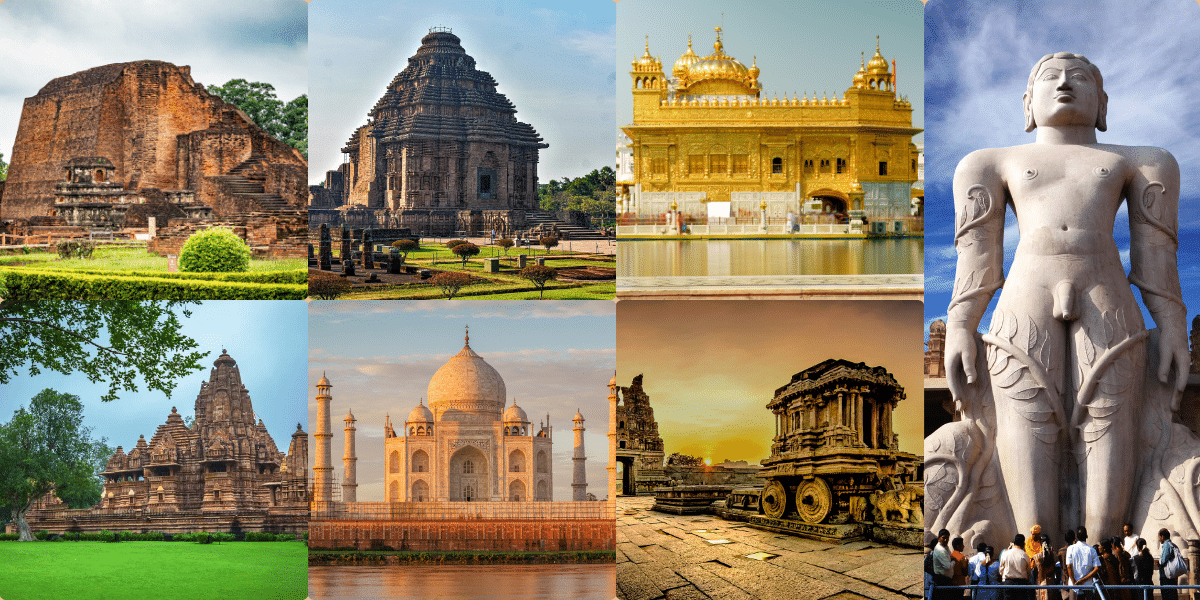
India, renowned for its vast cultural diversity and varied ways of life, has been shaped by numerous civilizations and dynasties throughout its history. The 7 Wonders of India list epitomizes this rich diversity, representing our ancestors’ exceptional creativity and innovation through their remarkable architectural achievements.
The 7 wonders of India were designated to honor and preserve these historic landmarks for future generations. While they are crucial in illustrating India’s architectural evolution, they are vital to understanding its cultural and historical heritage.
India’s illustrious past has endowed us with magnificent palaces, extraordinary temples, mosques, and other sacred sites. The grandeur of these structures reflects intricate craftsmanship and meticulous architectural design, offering insights into our ancestors’ lives, beliefs, and cultural practices.
Each monument listed in the 7 Wonders of India has profound historical significance, reflecting the country’s rich cultural heritage and architectural prowess. These structures tell stories of India’s diverse dynasties and civilizations. They exemplify bygone eras’ artistic and engineering skills, showcasing intricate designs, craftsmanship, and innovation.
Beyond their architectural beauty, The 7 Wonders of India, chosen to represent the country’s rich heritage, also serve as symbols of the socio-political and religious history of the regions, providing valuable insights into the lives and beliefs of past societies.
In India, monuments and wonders across different regions showcase diverse architectural styles and cultural influences, reflecting the country’s rich history of various civilizations. For example, Dravidian architecture is prominent in the ancient temples and buildings of South India, while North India features renowned examples of Indo-Islamic architecture. The 7 Wonders of India highlight the beauty and grandeur of these cultural treasures, each symbolizing India’s architectural brilliance.
Read More : Ancient Architecture in India: Style, Types, Characteristics.
As listed by UNESCO, India has one of the highest numbers of World Heritage Sites. Out of these Heritage Sites, the Ministry of Culture has picked 7 sites as the 7 wonders of India. Each site signifies a specific period of Indian history and showcases that period’s beliefs, architecture, and culture.
| Wonder | Location | State | Key Feature |
|---|---|---|---|
| Taj Mahal | Agra | Uttar Pradesh | White marble mausoleum, symbol of love |
| Konark Sun Temple | Konark | Odisha | 13th-century chariot-shaped sun temple |
| Nalanda University Ruins | Nalanda | Bihar | Ancient center of learning (5th–12th century) |
| Hampi Monuments | Hampi | Karnataka | Ruins of the Vijayanagara Empire |
| Khajuraho Temples | Khajuraho | Madhya Pradesh | Erotic and spiritual sculptures, UNESCO site |
| Golden Temple | Amritsar | Punjab | Holiest Sikh shrine, gold-covered sanctum |
| Meenakshi Temple | Madurai | Tamil Nadu | Dravidian-style architecture, goddess Meenakshi |
This list presents the 7 wonders of India that are chosen based on their historical significance:
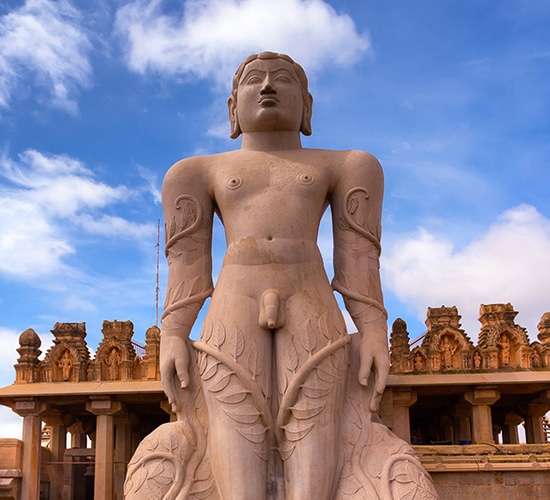
The Gomateshwara Statue, also known as the Bahubali Temple, is one of the 7 Wonders of India and a remarkable testament to India’s ancient artistry and spiritual heritage. Located in the village of Shravanabelagola, this awe-inspiring monolithic statue was carved from a single granite block in 983 AD. Standing 57 feet tall atop Vidhyagiri Hill, it is visible from over 30 kilometers away.
The statue portrays Bahubali, the second son of the first Jain Tirthankara, in the Kayotsarga posture, with arms by his side and eyes looking forward, symbolizing deep meditation and renunciation. Intricate carvings and naturally growing plants around the sculpture enhance its spiritual aura. The depiction of Digambar, the practice of nudity in Jainism, represents the abandonment of all material desires to attain spiritual liberation.
A giant stone base supports the structure, further highlighting its engineering brilliance. This sacred monument remains a vital symbol of Jain devotion and India’s rich cultural legacy. Voted as one of the 7 wonders of India in 2007, the statue symbolizes non-violence.
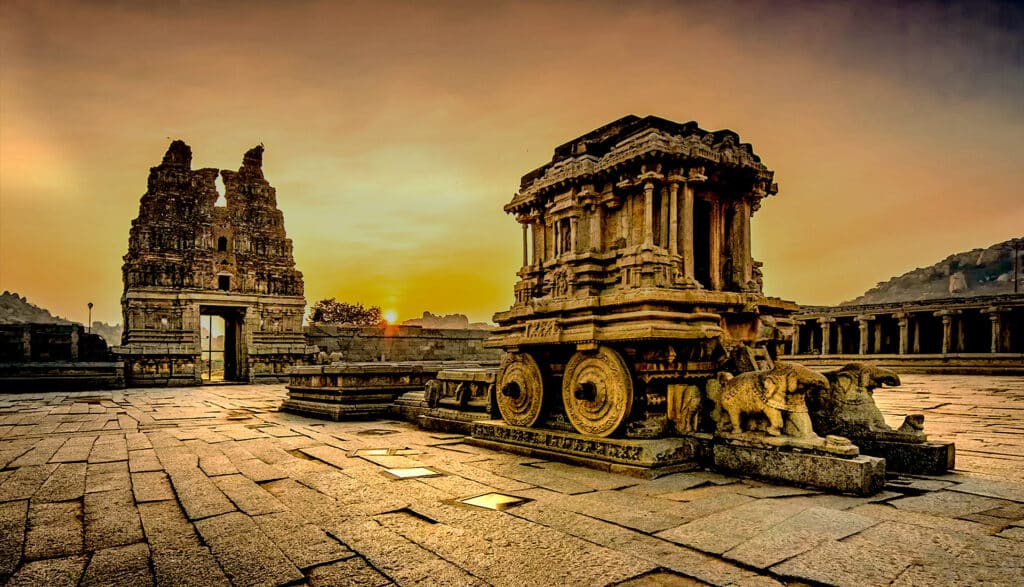
Hampi, one of the 7 Wonders of India, was the glorious capital of the Vijayanagara Empire, the last great Hindu kingdom in Indian history. Located in Karnataka’s Bellary district by the Tungabhadra River, the city once spanned over 4,187 hectares and is now a UNESCO World Heritage Site. Between the 14th and 16th centuries, Hampi flourished as a vibrant metropolis, and today it houses over 1,600 surviving structures, including temples, forts, mandapas, pillared halls, royal complexes, and more.
Notable sites include the Krishna, Achyutaraya, Vitthala, Pattabhirama Temple Complexes, and the Lotus Mehal. Hampi showcases exquisite Dravidian architecture, seen in its towering pillars and grand dimensions, while reflecting a multi-religious and multicultural society through elements of Indo-Islamic architecture, such as the Queen’s Bath and Elephant Stables. Though partially destroyed after the Battle of Talikota, Hampi remains a stunning reminder of India’s rich historical and architectural legacy.
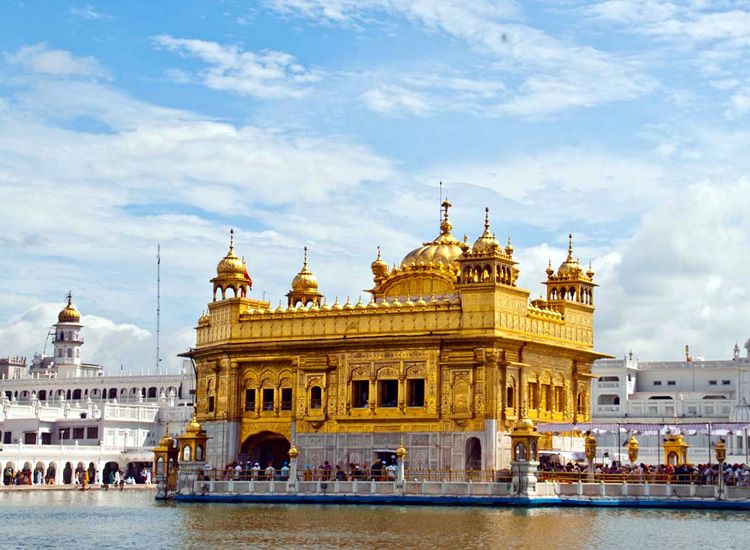
Harmandir Sahib, popularly known as the Golden Temple or Darbar Sahib, is one of the 7 Wonders of India and the holiest shrine in Sikhism. Located in Amritsar, Punjab, it was built in 1604 by Guru Arjan Dev Ji, the fifth Sikh Guru. He designed the temple on a lower level to symbolize humility, ensuring all visitors step down to enter.
The Golden Temple is a beacon of unity and inclusivity, with four entrances welcoming people from all directions, castes, and religions. Though repeatedly destroyed by invaders, the temple was magnificently rebuilt in the early 19th century by Maharaja Ranjit Singh. He adorned it with white marble, copper, and a striking layer of gold foil, giving it the radiant appearance that inspired its popular name. Today, the Golden Temple serves as a place of spiritual devotion and represents the Sikh principles of equality, hospitality, and eternal service.
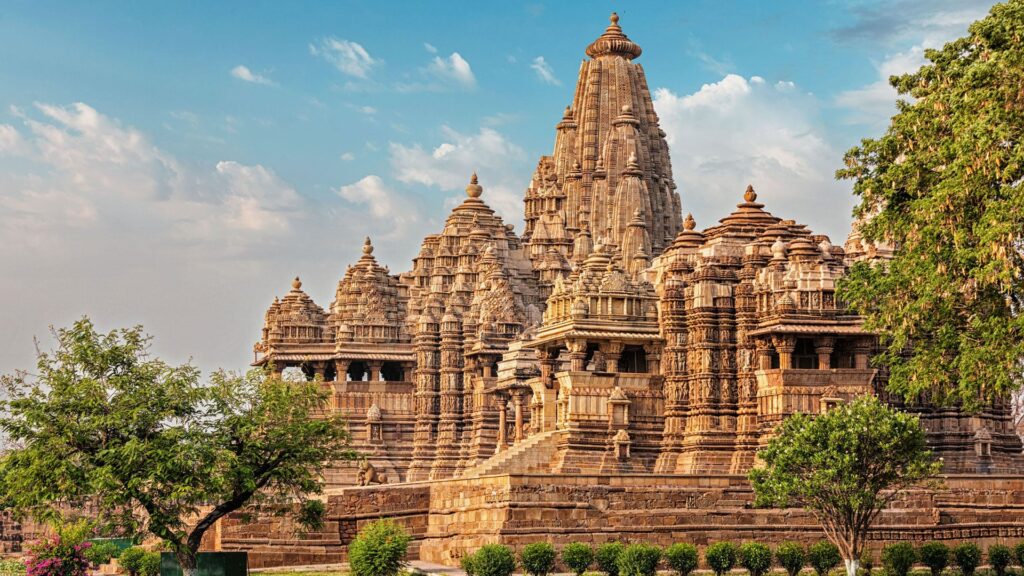
Khajuraho, one of the 7 Wonders of India, is a magnificent temple complex in Madhya Pradesh, renowned for its intricate sculptures and symbolic artistry. Built between the 9th and 10th centuries by the Chandela dynasty, the site originally housed 85 temples, though only 23 have survived. These temples represent the Nagara style of North Indian architecture, including Hindu and Jain shrines, reflecting a spirit of religious tolerance.
Chinese pilgrim Xuanzang mentioned Khajuraho in 641, but the site fell into obscurity following the decline of the Chandela dynasty and repeated invasions. The temples lay hidden within dense forests for centuries until a British engineer rediscovered them in 1838. The temples are best known for their elaborate carvings, including erotic sculptures that symbolize the celebration of life and spirituality.
In 1986, Khajuraho was designated a UNESCO World Heritage Site, preserving its legacy as a remarkable example of ancient Indian architecture and cultural expression.
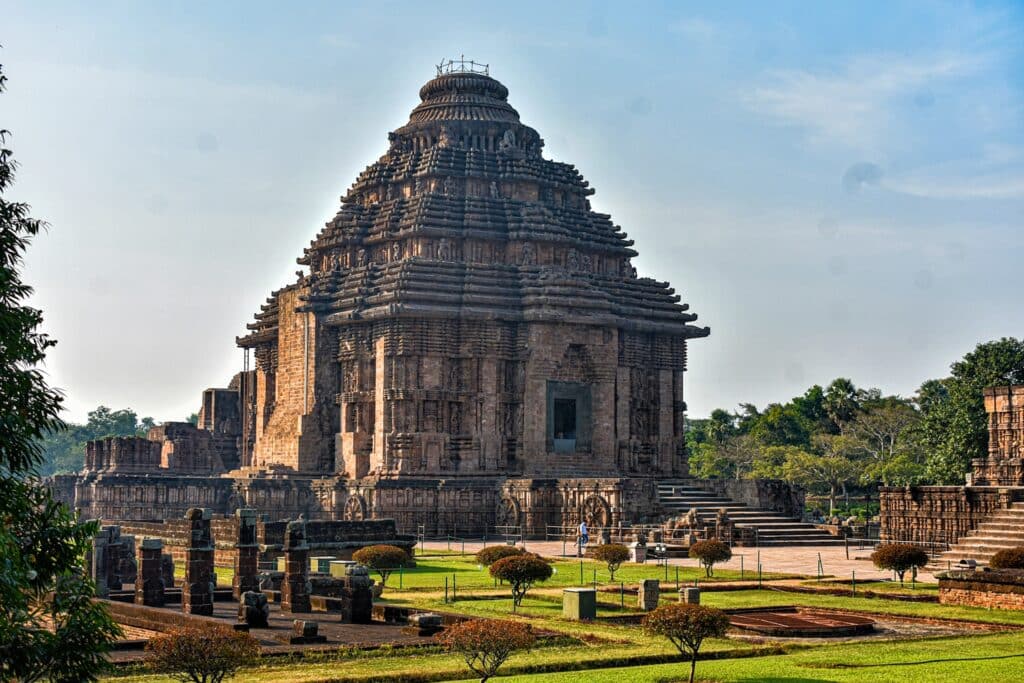
The Konark Sun Temple, one of the 7 Wonders of India and a UNESCO World Heritage Site, is located in Konark, about 35 km from Puri, Odisha. Built in the 13th century by the rulers of the Eastern Ganga dynasty, the temple is a grand tribute to Surya, the Sun God, reflecting a tradition of sun worship that dates back to the 19th century BC.
Designed as a colossal chariot with intricately carved wheels, horses, dancers, animals, and musicians, the temple exemplifies the brilliance of Kalinga architecture. Its key elements include the Shikhara (crown), Natmandir (dance hall), Janmohana (audience hall), and Vimana (tower). The sanctum sanctorum, or Garbhagriha, housed a statue of the Sun God that once received the first rays of the rising sun.
Though the original 200-foot-high Shikhara has been destroyed, the temple remains a powerful symbol of India’s artistic and spiritual heritage.
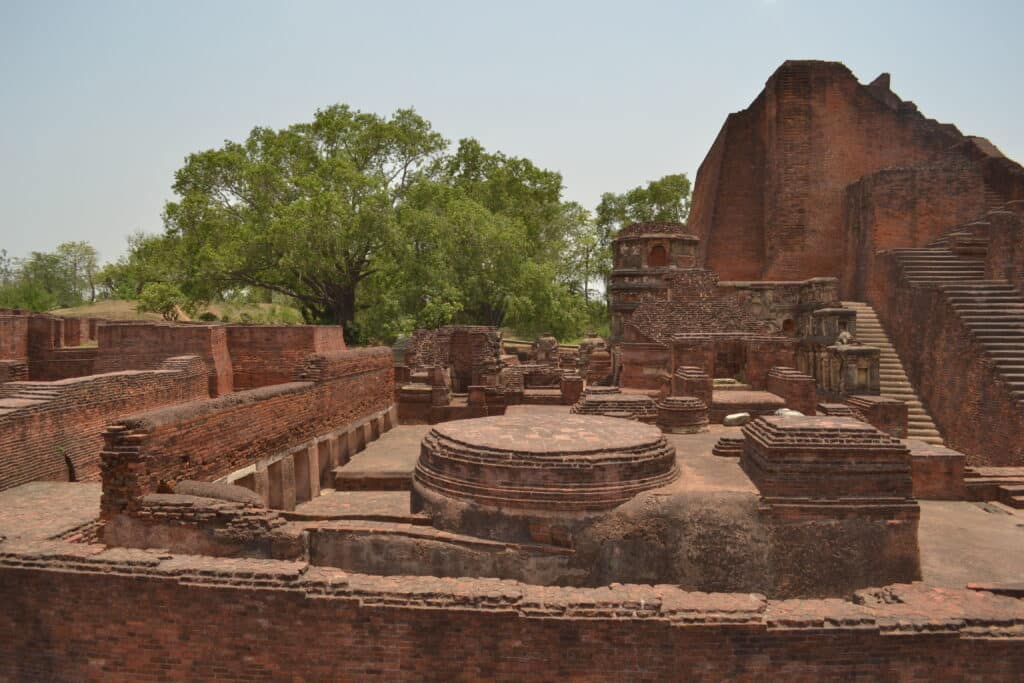
Nalanda Mahavihara, or Nalanda University, located in Rajgir, Bihar, is the oldest of the 7 Wonders of India and a symbol of India’s Golden Age. Established during the Gupta period, it is recognized as the world’s first residential university, flourishing between the 5th and 12th centuries. This renowned learning center attracted scholars across Asia and housed some of the era’s most brilliant minds.
Chinese traveler Xuanzang documented its academic excellence and the spread of sacred Sanskrit texts. The vast university complex included monasteries, temples, stupas, meditation halls, classrooms, and most notably, the grand library Dharma Gunj, a multistoried treasure trove of ancient knowledge. Although partially destroyed during invasions, Nalanda continued to influence learning for centuries and is now a UNESCO World Heritage Site. It is a powerful reminder of the Magadha dynasty’s contribution to education and India’s pivotal role in shaping global intellectual and spiritual traditions.
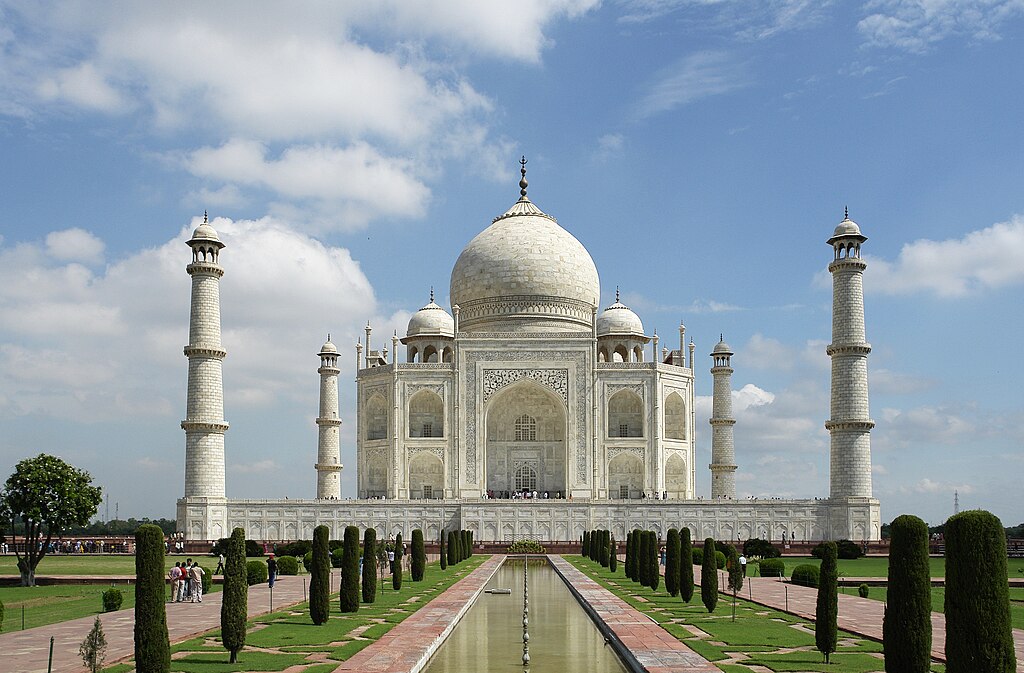
The Taj Mahal, one of the 7 Wonders of India and one of the 7 Wonders of the World, is a timeless symbol of love and architectural brilliance. Built in the 17th century by Shah Jahan, the fifth ruler of the Mughal dynasty, it serves as a mausoleum for his beloved wife, Mumtaz Mahal.
Located on the banks of the Yamuna River in Agra, Uttar Pradesh, the magnificent white marble monument took 16 years and 20,000 artisans to complete. Ustad Ahmad Lohri was the chief architect, supported by expert dome builders, carvers, painters, and stone inlayers.
The Taj Mahal is celebrated for its flawless Indo-Islamic architecture, elegant symmetry, and breathtaking detail. The complex features the grand entrance gateway, a mosque, a reflecting garden, the jawab (a structure mirroring the mosque), four towering minarets, and the central mausoleum. This masterpiece continues to enchant the world as an enduring tribute to eternal love.
India treasures historical sites and buildings that showcase its rich history and culture. From the palaces of Rajasthan to the caves in Maharashtra and the Dravidian temples of Karnataka, India hosts a variety of cultures and architecture. However, these sites and structures are deteriorating because of rising pollution, urbanization, and other harmful human activities. It is essential to conserve these sites so future generations can experience the history and variety of cultures India has birthed and fostered.
The concept of the “Seven Wonders of the World” has captivated travelers and history buffs for millennia. These awe-inspiring structures represent the pinnacle of human ingenuity and artistry from various eras. Explore the ancient and modern 7 Wonders of the World below:
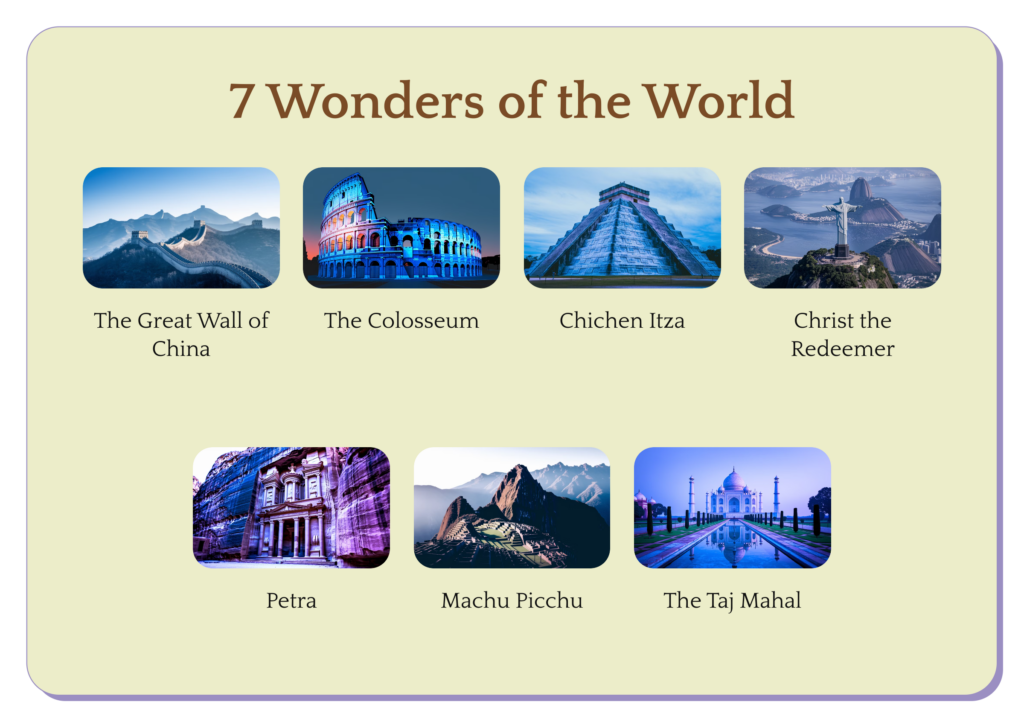
The fascinating Waste to Wonder Park in New Delhi, India, features replicas of the iconic Seven Wonders of the World created from industrial and other waste materials. This innovative theme park combines environmental consciousness with awe-inspiring monuments:
The park showcases replicas of the following iconic monuments 7 Wonders Of The World:
Waste to Wonder Park combines art, environmental consciousness, and global heritage, making it a must-visit attraction for locals and tourists.
From the awe-inspiring Gomateshwara Statue to the majestic Taj Mahal, the 7 Wonders of India represent the nation’s rich history, deep-rooted beliefs, and architectural brilliance. Each monument tells a unique story of devotion, power, creativity, and culture that continues to captivate visitors worldwide. These wonders are tourist attractions and symbols of India’s glorious past and diverse heritage. As we admire their beauty, it’s equally important to preserve them.
Protecting these landmarks ensures that future generations can experience their grandeur and understand their values. Honoring these wonders is a tribute to the timeless legacy of Indian civilization and a step toward safeguarding our cultural identity.
Read More:
Preserving these sites is crucial for maintaining India’s cultural identity, promoting tourism, and enriching education.
The Gomateshwara Statue signifies the Jain practice of Digambar, along with the virtues of peace, non-violence, and simplicity.
Nalanda University faced multiple attacks from neighboring dynasties at the end of the 12th Century.
The Konark Sun Temple is considered one of the seven wonders of India. However, it is not listed among the seven wonders of the world.
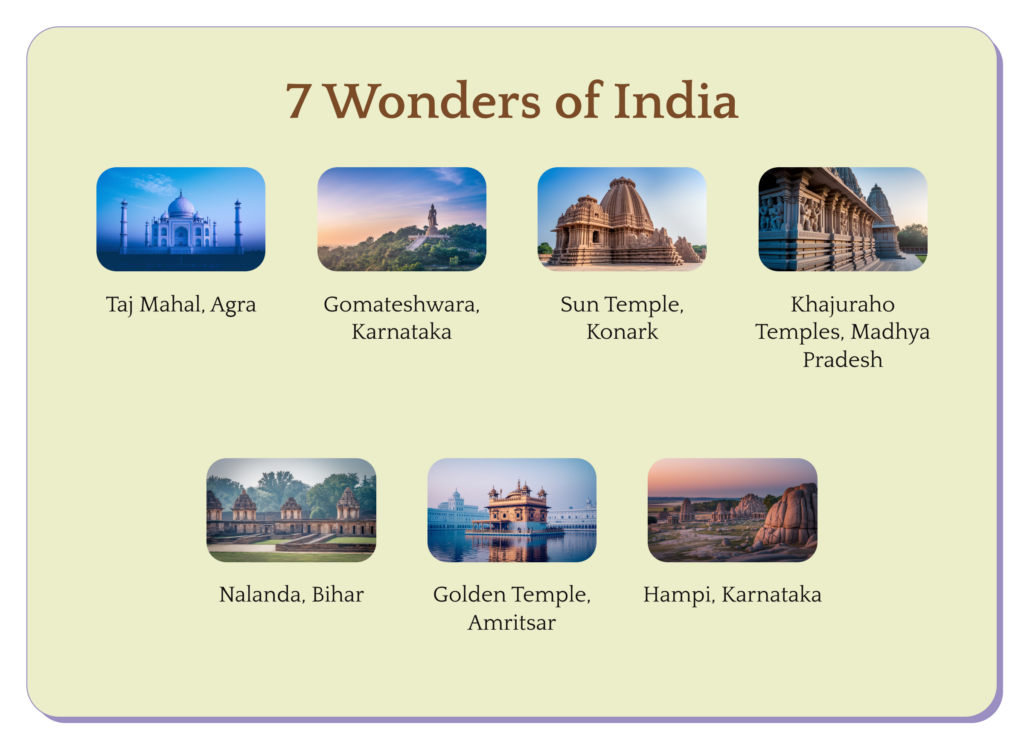
7 wonders of India are:
-Taj Mahal – Agra, Uttar Pradesh.
-Golden Temple – Amritsar, Punjab.
-Hampi – Karnataka.
-Sun Temple – Konark, Odisha.
-Khajuraho Temples – Madhya Pradesh.
-Nalanda University – Bihar.
-Gomateshwara Statue – Karnataka.
The term “7 Wonders of India” is used to highlight 7 of the most impressive and historically significant sites in India. These sites are chosen for their cultural, historical, or architectural significance and reflect the country’s rich heritage.
The Konark Sun Temple in Odisha is renowned as the Wonder Temple of India for its stunning architecture and intricate carvings.
The Swaminarayan Akshardham Temple in Delhi is often regarded as the 8th wonder of India. It was crafted in five months and is one of India’s most stunningly carved temples.