

In 2025, freelance writing jobs from home are booming like never before-opening doors for aspiring writers to earn money online without a fixed 9-to-5. From content writing freelance jobs with global brands to freelance blog jobs that let you share your voice, this industry is shaping the future of flexible careers.
If you’ve ever wondered how to start freelance writing, land your first client, or scale into a full-time income, you’re in the right place. This guide reveals everything beginners need to know-from the best-paying freelance niches and essential writing skills to real-world salary expectations and client acquisition strategies. Whether you want a side hustle or a thriving freelance career, this article will help you unlock the full potential of freelance writing in 2025.
Are you wondering what freelance writing is for beginners? Or what does the freelance writer mean? Writing for a living while working independently and not for a company or organization is known as freelancing.
Whatever written text is required by their clients, freelance writers produce it while working from home or in an office that they have rented. A writer may work for various clients or for one extremely large client who provides a lot of consistent, ongoing work. You can be a specialist knowledgeable about everything, or focus on a single subject. Because they develop a set of skills that enables them to work more quickly and have a track record that editors come to know.

Recommended Read: 7 Smart Steps to Create a Freelance Business Plan
To succeed as a freelance writer, several key skills are necessary. First, excellent writing abilities are essential. This means having a firm grasp of grammar, punctuation, and style. Time management is also crucial, as freelancers often juggle multiple projects simultaneously. Researching thoroughly and quickly is another essential skill, allowing writers to create well-informed content on various topics. Lastly, adaptability is key since freelance writers may need to switch between different writing styles, tones, or industries depending on their clients’ needs.
When it comes to freelancing and writing for pay, you may offer many different types of writing.

You can decide what kind of writing you will undertake depending on what you are comfortable with, what interests you, or what your skills are.
Your financial requirements or situation may occasionally influence your writing style.
Freelance content writing jobs involve writing for the web is referred to as content writing. This can include social media updates, blog posts, personal essays, and magazine articles. If you’re new to the field, it’s probably one of the most popular types of freelance writing and a fantastic place to start.
Content writing might aim to be informative, entertaining, promotional, or instructive. The customer’s aims greatly influence the length and format options.
Understanding your target audience, how content format relates to user intent, and search engine optimization (SEO) will help you generate content more effectively.
The copywriter succeeds when it comes to creating marketing and promotional materials. Understanding that the primary objective of this kind of writing is to sell is crucial if you want to become a copywriter.
Copywriters work on several kinds to sell, promote, or influence the reader to take a certain action.
This is a fantastic field if you enjoy sharing an organization’s or product’s history, like internet shopping, or are skilled at researching and contrasting various products. This kind of writing probably isn’t ideal for you if you dislike making sales.
You might be strong at technical writing if you have experience in a particular discipline like engineering, computer science, or medicine. Manuals, SOPs, and evaluation reports are written in this discipline with other professionals in their field in mind. However, it includes business planning, legal summaries, grant proposal writing, curriculum, and instructional or training materials. It is an excellent fit for people who naturally write more formally and are skilled at organizing content, procedures, information, and data.

Traditional journalism is a unique form of freelance writing focused on creating investigative reports and feature articles. Journalists work under tight deadlines and must present factual, well-researched content backed by interviews, data, and credible sources.
This field demands strong attention to detail and excellent research skills. While journalism can be competitive and tough for beginners, it’s a rewarding path for those who love storytelling, solving mysteries, and uncovering the truth.
Ghostwriting involves writing content for others without public credit—your name won’t appear, and all earnings go to the client. It’s common in blogs, books, and articles, often for people who lack time or writing skills. While you don’t earn royalties, ghostwriting pays well, usually more than regular content writing.
Since you can’t always share ghostwritten work, list the type of project in your portfolio without naming clients. This role suits those who love storytelling, research, and prefer working behind the scenes.
The majority of us are familiar with writing fiction. You, the author, have fictionalized storytelling. Fiction can be ghostwritten so that you wouldn’t be credited as the author. Literary or commercial fiction can be divided into genres, such as romance, mystery, and horror. Sub-genres are used to categorize several genres further.
Consider writing fiction if you have a vivid imagination and can create engaging stories that leave readers wanting more. Fiction writing is one technique to achieve your goal of having your name listed among the bestsellers.
What it sounds like is that this kind of writing is just that. People who need help writing their resumes will frequently hire a freelance resume writer to do it for them. Depending on your degree of expertise and the clientele you work with, resume writing can be a lucrative field for freelance writers.
Consider writing resumes if you know how to turn a housewife into a domestic engineer and if you have a wide range of knowledge about various vocations and careers. Resume writing may be a good fit for you if your friends and family turn to you for advice when they require a resume to apply for a job.
Recommended Read:

Education isn’t a prerequisite for freelance writing, but a bachelor’s or master’s degree in English or communication can increase your chances of getting hired, especially for specialized content such as marketing or technical writing.
Becoming a freelance writer requires a laptop or desktop computer with writing and photo-editing software, professional email, video conferencing, and payment accounts.
Your freelance writing portfolio should demonstrate your skills, strengths, and interests through diverse topics and provide your contact details for prospective clients to reach out to you.
Start your freelance writing profession by writing for your family, friends, or neighbors. Acquire knowledge and skills. Showcase your work on your website, blog, or social media. Additionally, to improve writing skills, read extensively on relevant topics, focus on sentence construction, parallelism, and vocabulary, write constantly, and read aloud to practice.
You must sell your skills to get new jobs as a freelance writer. Promote your job using both online and offline strategies, such as referrals, word-of-mouth advertising, and brochures.
Look for freelance writing employment on online job boards, establish social media connections with possible employers, submit magazine pitches, and tailor applications with examples.
Making time to develop a detailed marketing plan is crucial, regardless of whether you prefer a notepad and pen or a Google Sheets spreadsheet.
Creating a strong freelance portfolio is essential to attract paid work clients want proof of your skills. Use portfolio-building websites to showcase your best work professionally. If you’re just starting out, guest blogging is a great way to build samples quickly, and some platforms even pay for guest posts, helping you earn while you grow your credibility.
Joining active writers’ forums is a great way to network, learn valuable tips, and discover freelance opportunities. Niche-specific boards also help you showcase your expertise to potential clients professionally.
LinkedIn is a great place to find new clients. It is the finest social media site for networking with potential clients. Ensure your LinkedIn profile is tailored to draw in and encourage contact from your potential clients.
Freelancers frequently make the error of concentrating on themselves rather than their clients when pitching. Explain to potential customers how you intend to address their issues in your sales pitch.
Only slightly more established freelancers can use this marketing strategy. Ask for referrals from clients you enjoy working for and for whom you frequently provide services.
Freelance writing can be a rewarding career, but it’s not without its challenges. Writers often face hurdles impacting their work-life balance, income stability, and client relationships. Here are some of the most common challenges and ways to overcome them:
| Challenge | Solution |
|---|---|
| Inconsistent income | Diversify client base and build savings |
| Time management | Use planners and set clear goals |
| Creative block | Take breaks and try new content types |
| Client expectations | Set clear communication and project scopes |
| Work-life balance | Define boundaries and working hours |
A job as a freelance writer requires perseverance, effective time management, and the drive to seek new assignments continuously. Study the freelance writing career advice every author should be familiar with to help you develop a satisfying career in this profession.
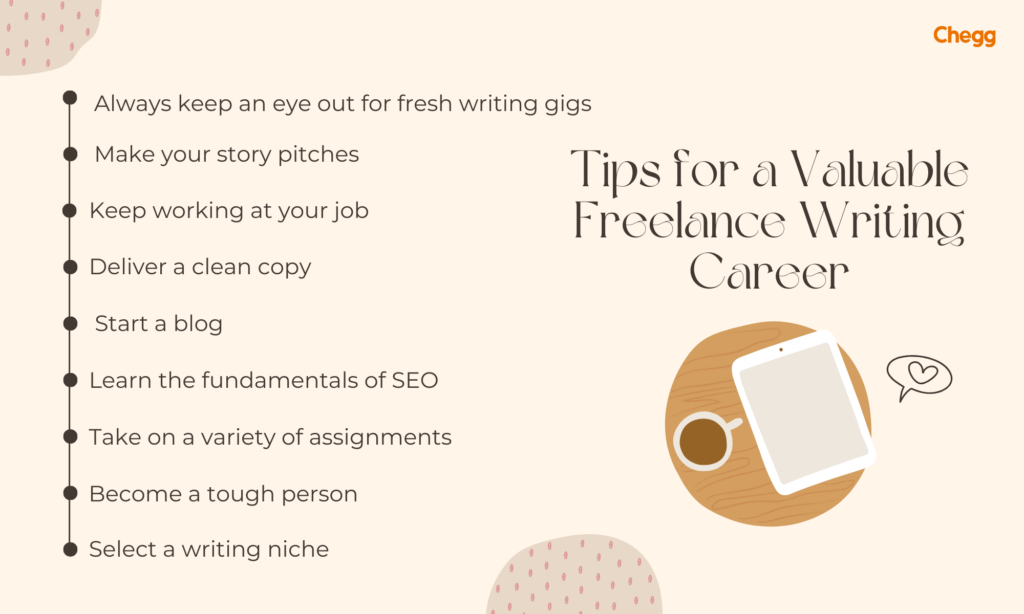
You manage customer acquisition when you run your freelance writing firm. You must constantly search for new freelance writing assignments to maintain earning money and avoid downtime between contracts. Look through job boards online. Connect with other authors so they may refer you to clients when they’re booked up.
If you’re a writer, you probably have your ideas running through your head. Then, come up with pertinent story ideas and pitch them to the publications or newspapers you wish to write for. Once your first story is accepted and you obtain your first byline, you’ll find it simpler to pitch ideas to other magazines.
If you’re a beginning writer, start by working part-time as a freelancer before starting your side hustle. Finding your first client and beginning to earn well as a professional freelance writer may take some time. If you have one, keep working at your day job, even as you start writing freelance.
Make the leap and transition to freelancing as your full-time employment once you’ve established a continuous stream of freelance assignments and writing clients.
You must submit writing assignments with an error-free copy. This entails editing and proofreading your work. Make sure your sentences are succinct, clear, and simple to understand. Review your writing word-by-word and line-by-line to look for grammar, punctuation, and spelling mistakes.
Consider starting a blog on something you are passionate about, such as skiing, parenting, or food. Maintaining a blog is a creative outlet that aids in developing your writing abilities and helps you develop your writing style. For potential customers to locate you, it also gives you an online presence and the capacity to use some search engine optimization (SEO) techniques.
Materials that will direct customers to more businesses are needed. These will require content marketing writers who understand the fundamentals of SEO and how to raise a website’s ranking in search results. As a freelance writer, I know where to strategically place keywords to improve web traffic to the company’s website and understand how search engine optimization works.
Take on several writing tasks when you first start as a freelancer and work with all clients. You’ll write about a lot of subjects that are unfamiliar to you. One customer might give you in-depth white papers, thoroughly researched thought-leadership pieces that demand a lot of research. Another can ask you to provide social media content for their business. You might be hired by someone else to write a copy. Even though the two jobs are very different, you will gain essential writing experience from both.
With some projects, you’ll have to start from scratch and write on a subject you don’t fully understand. Check to discover if there is a certain kind of writing that you excel at and love as you take on additional work. You might discover, for instance, that you enjoy technical or medical writing. You will become a sought-after writer with those companies when you specialize in a particular genre.
Make sure it’s a good fit by taking the time to research the kind of freelance writing jobs beginners want to undertake. Learn more about beginner freelance writing jobs or freelance writer jobs. You can choose a job as a career.
Once you know the type of freelance writing that best suits you, it will be much simpler to consider the following step: selecting your niche. You might be able to make money writing greeting cards if you have a knack for words and can stir up emotions without breaking a sweat. This can be an excellent option to try if you enjoy writing poetry and are willing to take the time to find the perfect word to convey your message.
Read More:- Online Earn Money by Typing: 15 Best Typing Jobs in 2025
Freelance writing is not just about words; it is also about building a personal brand, managing projects, and consistently delivering value. Whether seeking freelance writing jobs for students, part-time gigs, or a full-fledged writing career, this field offers limitless possibilities. With the right mindset, strategy, and persistence, you can turn your writing skills into a sustainable and rewarding career right from the comfort of your home.
Whether you’re a beginner or looking to scale, freelance writing offers the flexibility, freedom, and fulfillment of running your career. The possibilities are endless when you write your path, from freelance writing jobs for students to full-time content writing freelance jobs.

You can become a successful freelance content writer in different niches. The key to success is to develop a strong portfolio, network with potential clients, and consistently deliver high-quality content that meets their expectations. By doing so, you’ll be able to establish your expertise in different niches and build a successful career as a freelance content writer.
6 Types of Freelance Writing are possible:
1. Web content writer
2. Technical writer
3. Business writer
4. Newspaper writer
5. Instructional writer
6. Ghostwriter
List of Different Types of Writing Careers
1. Screenwriter
2. Novelist
3. Speechwriter
4. Technical Writer
5. Book Editor
6. Columnist
7. Public Relations Specialist
8. Marketing Communications Specialist
1. Long-form Blog Posts
2. E-Books
3. White Papers
4. Case Studies
5. Email Writing
6. Sales Pages or Landing Pages
7. Video Script Writing
8. Online or E-Learning Courses
Yes, becoming a freelance content writer without experience is possible. However, investing in your skills and knowledge is important to improve your chances of success. Consider taking writing courses, attending workshops, or reading books on writing and content creation. This will help you develop a strong foundation and gain confidence in your writing abilities.
Yes, there are many ways to get paid to write. Freelance writers can make money writing by pitching blog posts, actual stories, and useful articles related to different topics. Sites like Make a Living Writing share valuable information, writing gigs, and tips to help writers begin writing and earning.
How to become a freelance writer:
1. Research the freelance writing industry.
2. Develop necessary business skills.
3. Ensure you have the tools of the trade.
4. Understand current writing conventions.
5. Work on improving your writing skills.
6. Decide on a writing niche.
7. Create a writing portfolio.
8. Market your writing.
Online jobs offer flexibility and the ability to work from home. Here are some popular online jobs for 14-year-olds: Freelance Writing: Teens with strong writing skills can take up freelance writing gigs. Websites like Fiverr and Upwork often have opportunities for young writers.
Beginners in freelance writing in India generally charge ₹200-₹500 per hour (depending on their niche, portfolio strength, and whether the client is domestic or international). With some experience or for more specialized work, rates may rise to ₹700-₹1,000/hr or more, especially when working with international clients or on technical/professional content.
A computer, reliable internet, writing software (like Google Docs or MS Word), grammar checkers (Grammarly), SEO tools, and payment methods such as PayPal or bank transfer are essential.
1. Beginners: ₹800 – ₹2,000 per 500 words
2. Intermediate writers: ₹2,000 – ₹6,000 per 500 words
3. Experienced/specialists: ₹6,000+ per 500 words (technical, research-heavy, or international clients)
Tip: Rates vary by niche, research depth, and whether you work with Indian or global clients.