Biosphere Reserves are designated areas that aim to promote the conservation of biodiversity, support sustainable development, and facilitate research and education.
India has 18 Biosphere Reserves established by the Government, but only 12 are recognised by UNESCO.
These reserves are crucial for protecting endangered species and ecosystems, preserving genetic diversity, and maintaining ecological processes.
Table of Contents
India is home to some of the richest biodiversity on the planet, and one of the most significant global recognitions of this diversity is the UNESCO Biosphere Reserve in India. Biosphere reserves are protected areas that conserve ecosystems, support sustainable development, and promote scientific research. They are integral to the UNESCO Man and Biosphere (MAB) Programme, connecting conservation with local community welfare.
With its unique geography, varied climate, and ecological wealth, India has developed one of Asia’s largest networks of biosphere reserves. Out of the total biosphere reserves in India, several have earned international recognition from UNESCO, highlighting India’s role in safeguarding the planet’s natural resources.
What is Biosphere Reserve?
A biosphere reserve is a specially designated area that protects plant and animal diversity while allowing sustainable human use. Unlike national parks or wildlife sanctuaries, a biosphere reserve follows a three-zone structure:
Core Zone – strictly protected for wildlife and habitats.
Buffer Zone – limited human activity, such as research and education.
Transition Zone – local communities engage in sustainable development.
This model ensures conservation while meeting human needs. India’s biosphere reserves embody this balance, from the Nilgiri Biosphere Reserve to the Agasthyamalai Biosphere Reserve.
Total Biosphere Reserves in India (2025)
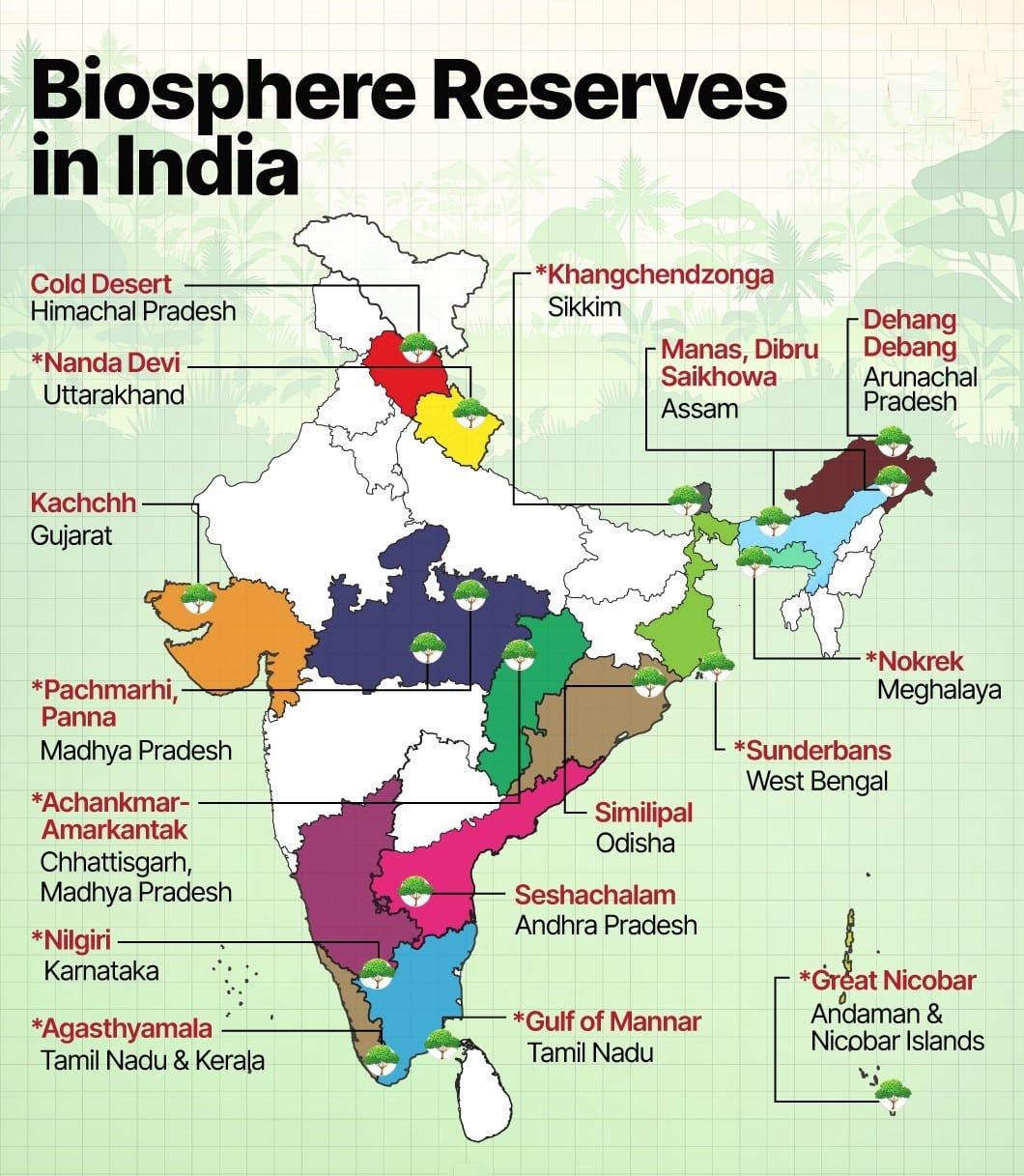
India has 18 biosphere reserves spread across different ecological regions, from the Himalayas to the coastal belts and islands. As of 2025, 12 of these are UNESCO recognized, while the others hold national importance.
Map of UNESCO Biosphere Reserve in India
18 Biosphere Reserves in India (with UNESCO recognition)
Biosphere Reserve
State(s) Covered
Year of Designation
UNESCO Status
Nilgiri Biosphere Reserve
Tamil Nadu, Kerala, Karnataka
1986
Yes
Nanda Devi
Uttarakhand
1988
Yes
Nokrek Biosphere Reserve
Meghalaya
1988
Yes
Great Nicobar
Andaman & Nicobar Islands
1989
Yes
Gulf of Mannar
Tamil Nadu
1989
Yes
Sundarbans
West Bengal
1989
Yes
Manas
Assam
1989
Yes
Similipal
Odisha
1994
Yes
Pachmarhi Biosphere Reserve
Madhya Pradesh
1999
Yes
Achanakmar–Amarkantak
Madhya Pradesh, Chhattisgarh
2005
Yes
Agasthyamalai Biosphere Reserve
Tamil Nadu, Kerala
2001
Yes
Panna Biosphere Reserve
Madhya Pradesh
2011
Yes
Dibru-Saikhowa
Assam
1997
No
Dihang-Dibang
Arunachal Pradesh
1998
No
Khangchendzonga
Sikkim
2000
No
Seshachalam Biosphere Reserve
Andhra Pradesh
2010
No
Cold Desert
Himachal Pradesh
2009
No
Kachchh
Gujarat
2008
No
First Biosphere Reserve in India
The Nilgiri Biosphere Reserve, established in 1986, was India’s first biosphere reserve. It is also one of the most famous and richly diverse, spanning Tamil Nadu, Kerala, and Karnataka. Known for the Nilgiri tahr, lion-tailed macaque, and shola-grassland ecosystems, it remains central to India’s conservation efforts.
Largest Biosphere Reserve in India
The Gulf of Kachchh Biosphere Reserve in Gujarat is often recognized as the largest biosphere reserve in India. Its vast area includes marine ecosystems, mangroves, coral reefs, and endangered species, making it an ecological hotspot of global significance.
Famous UNESCO Biosphere Reserves in India
1. Nilgiri Biosphere Reserve – India’s First Biosphere Reserve
The Nilgiri Biosphere Reserve, established in 1986, is India’s first biosphere reserve and one of the most famous in the world. Spread across Tamil Nadu, Kerala, and Karnataka, it covers parts of the Western Ghats and includes renowned protected areas like Bandipur, Nagarhole, Mudumalai, Silent Valley, and Wayanad.
Importance: As the first biosphere reserve in India, Nilgiri set the foundation for sustainable conservation strategies.
Key Species: Nilgiri tahr, lion-tailed macaque, Asian elephant, and tigers.
Highlights: It is a hotspot of shola-grassland ecosystems and houses over 3,000 flowering plants.
2. Pachmarhi Biosphere Reserve – The Heart of Central India
Located in Madhya Pradesh, the Pachmarhi Biosphere Reserve was designated in 1999 and later recognized by UNESCO. It encompasses the Satpura ranges, including forests rich in teak, sal, and bamboo.
Highlights: Known for its blend of dense forests and plateaus, Pachmarhi is Central India’s biodiversity treasure.
Key Species: Leopards, bison, flying squirrels, and a variety of medicinal plants.
Cultural Significance: Home to tribal communities like the Gond and Bharia, who rely on forest produce.
3. Agasthyamalai Biosphere Reserve – The Southern Sentinel
The Agasthyamalai Biosphere Reserve, recognized by UNESCO in 2016, spans Tamil Nadu and Kerala in the southern Western Ghats. Named after the sage Agastya, it is considered sacred by local communities.
Highlights: High endemism, pristine evergreen forests, and sacred groves make it ecologically unique.
Key Species: Nilgiri langur, lion-tailed macaque, Malabar civet, and several endemic reptiles.
Flora: Known for rich medicinal plant diversity, with over 2,000 species of higher plants.
4. Panna Biosphere Reserve – A Tiger Conservation Success Story
The Panna Biosphere Reserve in Madhya Pradesh was designated a UNESCO site in 2011. Panna is famous for the Ken River and its diamond mines, which symbolize India’s conservation resilience.
Highlights: Rich in plateaus, gorges, and forested landscapes..
Key Species: Tigers, gharials, chinkara, and vultures.
Conservation Story: Once declared tiger-less in 2009, Panna successfully revived its tiger population through relocation programs.
5. Nokrek Biosphere Reserve – The Gem of Meghalaya
UNESCO recognized the Nokrek Biosphere Reserve in Meghalaya in 2009. It is home to the red panda, one of India’s rarest mammals, and serves as a genetic reservoir for wild citrus fruits.
Highlights: Nokrek is both a biodiversity hotspot and a cultural landscape of the Garo tribes.
Key Species: Red panda, Asiatic elephant, clouded leopard.
Flora: Abundant in citrus fruits, especially Citrus indica, which is believed to be the original ancestor of cultivated citrus.
6. Seshachalam Biosphere Reserve – Land of Red Sanders
Declared in 2010, the Seshachalam Biosphere Reserve in Andhra Pradesh is unique for its red sanders trees found only in the Eastern Ghats.
Key Species: Red sanders, slender loris, golden gecko.
Cultural Importance: Close to the Tirumala hills, it holds spiritual importance.
Highlights: One of the few reserves that combines ecological and religious significance.
18 Biosphere Reserves in India: Ecological Spread
India’s natural diversity is remarkable, beautifully represented through its 18 UNESCO recognized biosphere reserves. Spread across different states and ecological zones, these reserves conserve rich biodiversity and safeguard local communities’ cultural traditions.
The ecological spread of biosphere reserves in India reflects the country’s varied geography from snow-capped Himalayan peaks to lush tropical forests, arid deserts, riverine systems, and coastal ecosystems. Each reserve serves as a living laboratory, balancing conservation with sustainable use of resources.
Northern & Himalayan Region
Nanda Devi Biosphere Reserve (Uttarakhand): A UNESCO World Heritage Site known for alpine meadows, glaciers, and unique Himalayan flora and fauna.
Khangchendzonga Biosphere Reserve (Sikkim): Famous for its sacred landscapes and pristine forests, home to red pandas and snow leopards.
Cold Desert Biosphere Reserve (Himachal Pradesh): Covers the arid landscapes of Ladakh and Spiti, preserving high-altitude cold desert ecosystems.
Eastern India & Northeast
Manas Biosphere Reserve (Assam): A UNESCO World Heritage Site, home to the pygmy hog and golden langur.
Dibru-Saikhowa Biosphere Reserve (Assam): Noted for swamp forests and the endangered white-winged wood duck.
Nokrek Biosphere Reserve (Meghalaya): Famous for its population of red pandas and citrus fruit diversity.
Sundarbans Biosphere Reserve (West Bengal): The world’s largest mangrove ecosystem, habitat of the iconic Royal Bengal Tiger.
Central India & Deccan Plateau
Pachmarhi Biosphere Reserve (Madhya Pradesh): A rich forested zone with sal and teak, known for tribal heritage and medicinal plants.
Achanakmar–Amarkantak Biosphere Reserve (Chhattisgarh & MP): Source region of the Narmada, Son, and Johilla rivers.
Panna Biosphere Reserve (Madhya Pradesh): Home to tigers, gharials, and the famous diamond mines of India.
Western India & Desert Region
Kachchh Biosphere Reserve (Gujarat): Spanning the Rann of Kachchh, it supports desert wildlife like the Indian wild ass.
Southern India & Western Ghats
Nilgiri Biosphere Reserve (Tamil Nadu, Kerala, Karnataka): The first biosphere reserve in India (1986), covering Ooty, Wayanad, and Bandipur, home to elephants and rich shola-grassland ecosystems.
Agasthyamalai Biosphere Reserve (Kerala & Tamil Nadu): A biodiversity hotspot with over 2,000 species of medicinal plants.
Gulf of Mannar Biosphere Reserve (Tamil Nadu): A marine paradise with coral reefs, seagrass beds, and endangered dugongs.
Eastern Ghats & Coastal Regions
Seshachalam Biosphere Reserve (Andhra Pradesh): Known for its red sanders trees and rich birdlife.
Simlipal Biosphere Reserve (Odisha): Tiger and elephant reserve with lush sal forests and scenic waterfalls.
Andaman & Nicobar Islands
Great Nicobar Biosphere Reserve (Andaman & Nicobar): The largest biosphere reserve in India, rich in marine biodiversity and tribal communities like the Shompens.
Importance of UNESCO Biosphere Reserve in India
Biosphere reserves serve multiple purposes:
Biodiversity Conservation – Protect rare species like the snow leopard, red panda, and royal Bengal tiger.
Cultural Preservation – Support traditional knowledge and local communities.
Sustainable Development – Encourage eco-tourism, organic farming, and medicinal plant cultivation.
Climate Change Mitigation – Forests, wetlands, and marine areas absorb carbon and regulate the climate.
Thus, biosphere reserves are protected areas and living laboratories for balancing nature and human needs.
Government and UNESCO Initiatives
The National MAB Committee oversees India’s biosphere reserves.
Schemes like the National Food Security Mission and the Rashtriya Krishi Vikas Yojana indirectly support agro-ecosystems within reserves.
UNESCO provides research networks, funding, and global visibility through the World Network of Biosphere Reserves.
Challenges Facing Biosphere Reserves in India
Despite progress, challenges persist:
Deforestation and Encroachment – Expanding agriculture and infrastructure.
Poaching and Illegal Trade – Threat to species like tigers and red sanders.
Community Conflicts – Balancing development and conservation.
Addressing these challenges requires stricter laws, community participation, and global cooperation.
UNESCO Biosphere Reserve of India UPSC
UNESCO Biosphere Reserve in India is a crucial topic for the UPSC exam, particularly in the Environment and Ecology section of the General Studies paper. Here’s a breakdown of key points to understand:
Concept:
Established by UNESCO’s Man and the Biosphere (MAB) Programme, Biosphere Reserves are areas designated for sustainable development.
They reconcile the needs of conservation with socio-cultural values and economic activities.
Three zones are integrated within a biosphere reserve:
Core Zone: Strictly protected for conservation with minimal human intervention.
Buffer Zone: Allows sustainable resource use like research and education.
Transition Zone: Where communities reside and work harmoniously with nature (e.g., eco-tourism).
India’s Biosphere Reserves:
India boasts 18 biosphere reserves, of which UNESCO recognizes 12.
These reserves showcase the nation’s rich biodiversity, encompassing diverse ecosystems from the Himalayas (Nanda Devi) to island forests (Great Nicobar).
UPSC Exam Significance:
The UNESCO Biosphere Reserve of India highlights the country’s commitment to environmental conservation and sustainable development, a key government focus area.
It is crucial to understand their role in biodiversity preservation, community involvement, and research fostering.
Expect questions on specific biospheres, their unique features, and challenges faced (e.g., human-wildlife conflict, resource use).
Additional Resources:
Ministry of Environment, Forestry and Climate Change (MoEFCC) website on biosphere reserves: (MoEFCC)
UNESCO’s Man and the Biosphere Programme website: (UNESCO MAB)
By understanding the significance and functionalities of the UNESCO Biosphere Reserve of India, you can effectively address this topic in the UPSC exam.
Conclusion
The network of UNESCO biosphere reserves in India is a testament to its commitment to preserving its rich natural heritage. From the Nilgiri Biosphere Reserve, India’s first, to newer sites like the Panna Biosphere Reserve, these areas protect wildlife, ecosystems, and local traditions.
The nation plays a pivotal role in global conservation, with total biosphere reserves in India 2025 standing at 18, including 12 UNESCO-recognized sites. Protecting these treasures is not just about nature but about ensuring a sustainable future for generations to come.
How many UNESCO Biosphere Reserves are there in India?
India has 18 Biosphere Reserves that protect biodiversity and ecosystems.
Which is the 11th UNESCO Biosphere Reserve in India?
The UNESCO-designated World Network of Biosphere Reserves (WNBR) included the Khangchendzonga Biosphere Reserve as the 11th biosphere reserve from India.
Which is the 12th UNESCO biosphere reserve in India?
UNESCO designated the Nilgiri Biosphere Reserve as India’s first biosphere reserve.
What are the 11 Biosphere Reserves of UNESCO?
Of the 18 Biosphere Reserves in India, 12 are now officially recognized by UNESCO. The list includes: Nilgiri (2000) Gulf of Mannar (2001) Sundarban (2001) Nanda Devi (2004) Nokrek (2009) Pachmarhi (2009) Simlipal (2009) Great Nicobar (2013) Achanakmar-Amarkantak (2012) Khangchendzonga (2018) Panna (2020) Cold Desert (2009)
Which is the Largest and Smallest Biosphere Reserve in India?
The largest Biosphere reserve in India is the Gulf of Kachchh, Gujarat, and the smallest Biosphere Reserve in India is Dibru-Saikhowa in Assam.
When did UNESCO launch the Biosphere Reserve Program?
Launched in 1971, UNESCO’s Man and the Biosphere Program (MAB) is an Intergovernmental Scientific Program that aims to establish a scientific basis for improving relationships between people and their environments.
How many biosphere reserves are there in India
In India, the Biosphere Reserve is declared by the Union Ministry of Environment, Forest and Climate Change (MoEFCC), based on recommendations from the State Government and the Indian National Man and Biosphere (MAB) Committee.
Which is the smallest Biosphere Reserve in India?
The smallest Biosphere Reserve in India is the Sundarbans Biosphere Reserve in West Bengal.
Authored by, Muskan Gupta Content Curator
Muskan believes learning should feel like an adventure, not a chore. With years of experience in content creation and strategy, she specializes in educational topics, online earning opportunities, and general knowledge. She enjoys sharing her insights through blogs and articles that inform and inspire her readers. When she’s not writing, you’ll likely find her hopping between bookstores and bakeries, always in search of her next favorite read or treat.