The Bharat Ratna is India’s highest civilian award, was established on January 2, 1954, by Dr Rajendra Prasad, the nation’s first President.
The Bharat Ratna is awarded to people for their exceptional contributions to the country. These awards are open to all individuals, regardless of race, profession, status, or gender.
Five People were awarded the Bharat Ratna in 2024, the highest number of awards given in a single year since 1999. The Prime Minister nominates recipients directly to the President of India.
Table of Contents
The Bharat Ratna (Jewel of India) is the highest civilian award in the Republic of India. Instituted on January 2, 1954, it is awarded in recognition of exceptional service or performance of the highest order in any field of human endeavour.
Each year, the Prime Minister nominates three recipients for the award. Winners receive a certificate called a Sanad, signed by the President. The medallion for the Bharat Ratna is shaped like a peepal leaf. Initially, the award focused on arts, literature, science, and public service, but in 2011, the Government expanded its scope to include any field of human endeavour.
It Initially focused on humanities, literature, sciences, and public service.
Expanded in December 2011 to recognize contributions in “any field of human endeavour.”
Recipients must demonstrate significant contributions in areas such as arts, science, literature, public service, and sports.
The Prime Minister nominates deserving candidates. Nominations are submitted to the President, who grants the award to the winners.
As of February 2024, the Bharat Ratna award has been given to 53 People. However, Five People were awarded the Bharat Ratna in 2024, the highest number of awards given in a single year since 1999.
As of now, the Indian government has made no official announcement about Bharat Ratna awardees for 2025.
History of Bharat Ratna
On January 2, 1954, the President of India established it to honor exceptional service or performance of the highest order in any field of human endeavor.
The term “Bharat Ratna” translates to “Jewel of India” in Hindi.
The award underwent various amendments to its eligibility criteria over the years.
Initially, it was only given to Indian citizens, but in 2011, the eligibility was expanded to include non-citizens as well.
Additionally, the criteria were broadened to include contributions in fields such as art, literature, science, and public service.
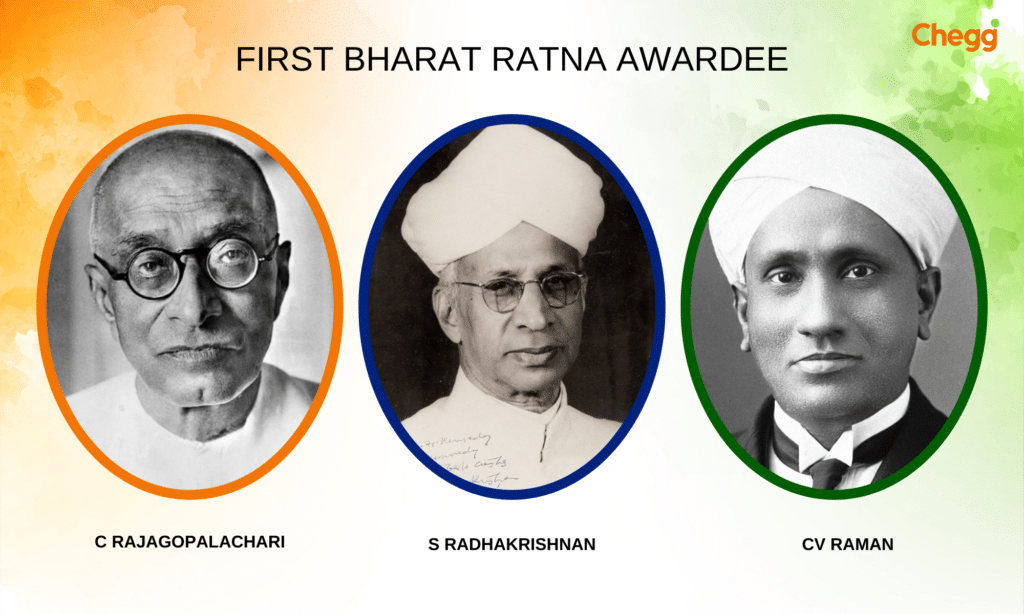
The first recipients of the Bharat Ratna were Dr. Sarvepalli Radhakrishnan, Chakravarti Rajagopalachari, and Dr. C. V. Raman, who were honored in 1954 for their outstanding contributions to their respective fields.
Since then, the Bharat Ratna has been bestowed upon individuals from diverse backgrounds, including politicians, scientists, artists, and social reformers.
The Bharat Ratna is awarded by the President of India and is presented in the form of a medallion, a certificate, and a cash prize.
It is a symbol of the nation’s highest recognition and appreciation for exceptional service and achievement.
Over the years, the Bharat Ratna has come to embody the values of excellence, integrity, and dedication to the nation.
Who is eligible to receive the Bharat Ratna Award?
The Bharat Ratna is India’s highest civilian honor, awarded for exceptional contributions in fields like public service, arts, science, literature, and sports. Here’s an overview of the eligibility and selection criteria:
1. Bharat Ratna eligibility criteria
Indian Citizens: Primarily awarded to Indian citizens who have made extraordinary contributions in their respective fields.
Foreign Nationals: Foreign nationals can also be awarded for significant contributions to India, though this is rare.
2. Fields of Recognition
The Bharat Ratna is awarded for exceptional service in:
Public Service: Contributions in politics, governance, and social service.
Arts: Recognizing achievements in music, dance, cinema, and cultural contributions.
Literature: For notable writers, poets, and intellectuals.
Science: For advancements in scientific and technological research.
Sports: Recognizing athletes for bringing national pride through global achievements.
3. Disqualifications
Sitting Members of Parliament/State Legislatures: Ministers or sitting MPs and state legislators are not eligible during their tenure.
4. Posthumous Awarding
The Bharat Ratna can be awarded posthumously to honor individuals who have passed away but made lasting contributions to the nation.
5. Number of Recipients
There is no fixed number of recipients each year. The decision rests with the President of India, based on the merit of the nominees.
6. Selection Process
No Formal Nominations: The award is not based on a nomination process. The Prime Minister recommends the awardees to the President.
Centralized Decision: The final decision is made by the President, with consultation from the Prime Minister and other officials.
7. One-Time Award
A person can receive the Bharat Ratna Award only once. Re-awarding an individual is not allowed.
8. Special Cases
In rare instances, the Bharat Ratna Award may be given in extraordinary cases of national importance, such as posthumous recognition or in transformative historical contexts.
9. Influence of Politics
While the Bharat Ratna Award is intended to recognize genuine contributions, there have been discussions about the political influence on the selection process.
10. Presentation
Award Ceremony: The award is presented by the President of India in a formal ceremony at Rashtrapati Bhavan, New Delhi.
Medal: The medal features a map of India and the inscription “Bharat Ratna Award.”
11. Recent Changes to Eligibility
Exclusion of Ministers and Legislators: In 2011, the eligibility criteria were amended to exclude sitting members of Parliament, state legislators, and ministers.
Who were the first recipients of the Bharat Ratna Award?
Dr. Sarvepalli Radhakrishnan:
Born on September 5, 1888, in Tamil Nadu.
Distinguished philosopher, statesman, and the first Vice President (1952-1962) and second President (1962-1967) of India.
Renowned for contributions to philosophy and education, advocating holistic learning and moral development.
Chakravarti Rajagopalachari (Rajaji):
Prominent lawyer, politician, and freedom fighter.
Served as the last Governor-General of India (1948-1950).
Dr. C. V. Raman:
Born on November 7, 1888, in Tamil Nadu.
Renowned physicist; Nobel Prize in Physics (1930) for groundbreaking work in light scattering.
In 1954, these exceptional individuals received the Bharat Ratna for their outstanding contributions and service to the nation. Their legacy continues to inspire generations of Indians.
List of Bharat Ratna Awardees Year-Wise
Recipients (State/UT)
Year
About
C. Rajagopalachari/ Rajaji (Tamil Nadu)
1954
Lawyer, statesman, and activist
Sarvapalli Radhakrishnan (Tamil Nadu)
1954
First Vice-President and Second President of India
C. V. Raman (Tamil Nadu)
1954
Mathematicians, scientists, and physicists
Bhagwan Das (Uttar Pradesh)
1955
Educationist, activist, and philosopher
M. Visvesvaraya (Karnataka)
1955
Mysore’s Diwan, statesman, and civil engineer
Jawaharlal Nehru (Uttar Pradesh)
1955
Author and activist who held the position of Indian prime minister
Govind Ballabh Pant (Uttarakhand)
1957
First Chief Minister of Uttar Pradesh and activist
Dhondo Keshav Karve (Maharashtra)
1958
Social activist and Educator
Bidhan Chandra Roy (West Bengal)
1961
Social worker, educator, philanthropist, politician, and physician
Purushottam Das Tandon (Uttar Pradesh)
1961
Speaker of the United Provinces Legislative Assembly and activist
Rajendra Prasad (Bihar)
1962
Activist, lawyer, statesman, and scholar
Zakir Husain (Andhra Pradesh)
1963
Activist, economist, and education philosopher served as a Vice-Chancellor of Aligarh Muslim University and the Governor of Bihar
Pandurang Vaman Kane (Maharashtra)
1963
Indian scholar and Sanskrit expert, renowned for his five-volume literary composition
Lal Bahadur Shastri (Uttar Pradesh)
1966
Activist and served as the second Prime Minister of India
Indira Gandhi (Uttar Pradesh)
1971
India’s first female prime minister
V. V. Giri (Odisha)
1975
Trade Unionist
K. Kamaraj (Tamil Nadu) *
1976
Former Tamil Nadu chief minister and independence fighter
Mother Teresa (West Bengal, born in North Macedonia)
1980
The founder of the Missionaries of Charity and a Catholic nun
Vinoba Bhave (Maharashtra)
1983
Social reformer, activist, and close friend of Mahatma Gandhi
Khan Abdul Ghaffar Khan (Pakistan)
1987
First non-citizen and activist for independence
M. G. Ramachandran (Tamil Nadu)
1988
Actor turned politician and Tamil Nadu chief minister
B.R. Ambedkar (Maharashtra)
1990
Social reformer, Dalit activist, principal drafter of the Indian Constitution, and the nation’s first law minister.
Nelson Mandela(South Africa)
1990
Head of the South African Anti-Apartheid Movement and President of South Africa
Rajiv Gandhi (Uttar Pradesh)
1991
India’s ninth prime minister
Vallabhbhai Patel (Gujarat)
1991
First Deputy Prime Minister of India and activist
Morarji Desai (Gujarat)
1991
Prime Minister of India and activist
Abul Kalam Azad (West Bengal)
1992
First Minister of Education and an activist
J. R. D. Tata (Maharashtra)
1992
Businessman and a philanthropist
Satyajit Ray (West Bengal)
1992
A director, filmmaker, writer, novelist
Gulzarilal Nanda (Punjab)
1997
Activist and the interim Prime Minister of India
Aruna Asaf Ali (West Bengal)
1997
Activist
A.P.J Abdul Kalam (Tamil Nadu)
1997
Aerospace and defense scientist
M. S. Subbulakshmi (Tamil Nadu)
1998
Carnatic classical vocalist
Chidambaram Subramaniam (Tamil Nadu)
1998
Activist and the Agriculture Minister of India
Jayaprakash Narayan (Bihar)
1999
Activist and social reformer
Amartya Sen (West Bengal)
1999
Economist
Gopinath Bordoloi (Assam)
1999
Activist
Ravi Shankar (Uttar Pradesh)
1999
Musician, sitar player
Lata Mangeshkar (Maharashtra)
2001
Singer
Bismillah Khan (Uttar Pradesh)
2001
Hindustani classical shehnai player
Bhimsen Joshi (Karnataka)
2009
Hindustani classical vocalist
C. N. R. Rao (Karnataka)
2014
Chemist and professor, author
Sachin Tendulkar (Maharashtra)
2014
Cricketer
Madan Mohan Malaviya (Uttar Pradesh)
2015
Scholar and educational reformer
Atal Bihari Bajpayee (Madhya Pradesh)
2015
Nine times elected Lok Sabha , and twice Rajya Sabha member, and Former Prime Minister of India for three terms
Pranab Mukherjee (West Bengal)
2019
Former President of India
Nanaji Deshmukh (Maharashtra)
2019
Social activist
Bhupen Hazarika (Assam)
2019
Playback singer, lyricist, musician, singer, poet, and filmmaker from Assam
Karpoori Thakur(Bihar)
2024
Former Chief Minister of Bihar
Lal Krishna Advani
2024
Former Bhartiya Janta Party Leader
MS Swaminathan(Thiruvananthapuram)
2024
Father of Green Revolution
Chaudhary Charan Singh(Uttar Pradesh)
2024
Former Prime minister who championed the farming industry and protected farmers’ rights
PV Narasimha Rao(Andhra Pradesh)
2024
Former Prime Minister
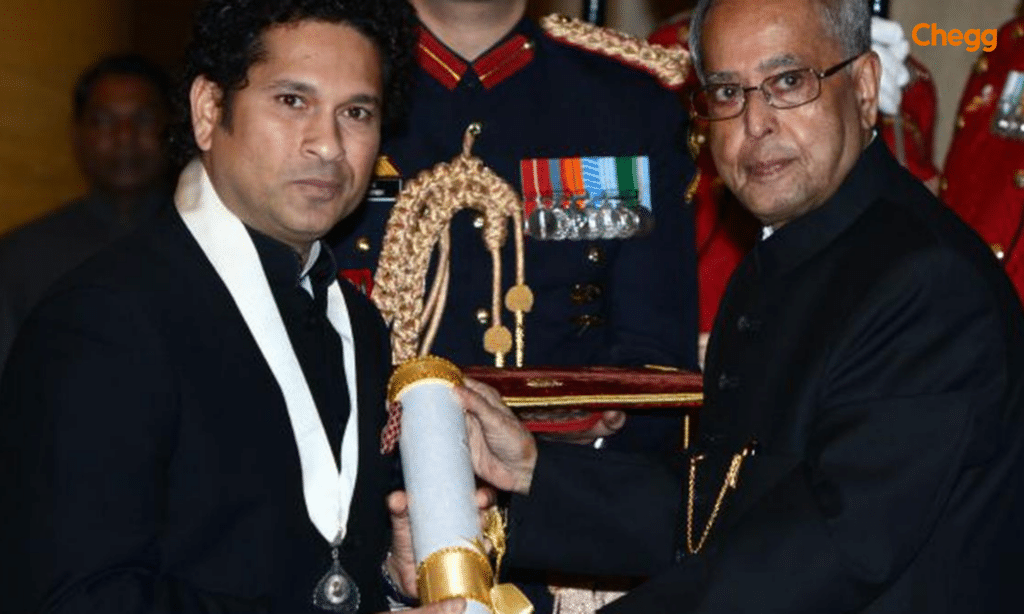
Youngest Bharat Ratna Awardee: Sachin Tendulkar
Sachin Tendulkar is the youngest recipient of the Bharat Ratna award.
Born on April 24, 1973.
Widely regarded as one of the greatest cricketers of all time.
Received the Bharat Ratna on February 4, 2014, at the age of 40.
Honoured for his unparalleled contributions to Indian cricket and outstanding international achievements.
His career is marked by numerous records and accolades.
Tendulkar is an iconic figure in both sports and Indian society.
Who was the Oldest Bharat Ratna Award recipient?
Nanaji Deshmukh is the oldest recipient of the Bharat Ratna award.
Awarded the Bharat Ratna posthumously on August 8, 2019, at the age of 102.
Recognized for his lifelong dedication to social service, rural development, and nation-building.
His efforts focused on uplifting marginalized communities and promoting grassroots democracy.
Left a significant impact on Indian society, remaining an important figure throughout his life.
Award Design
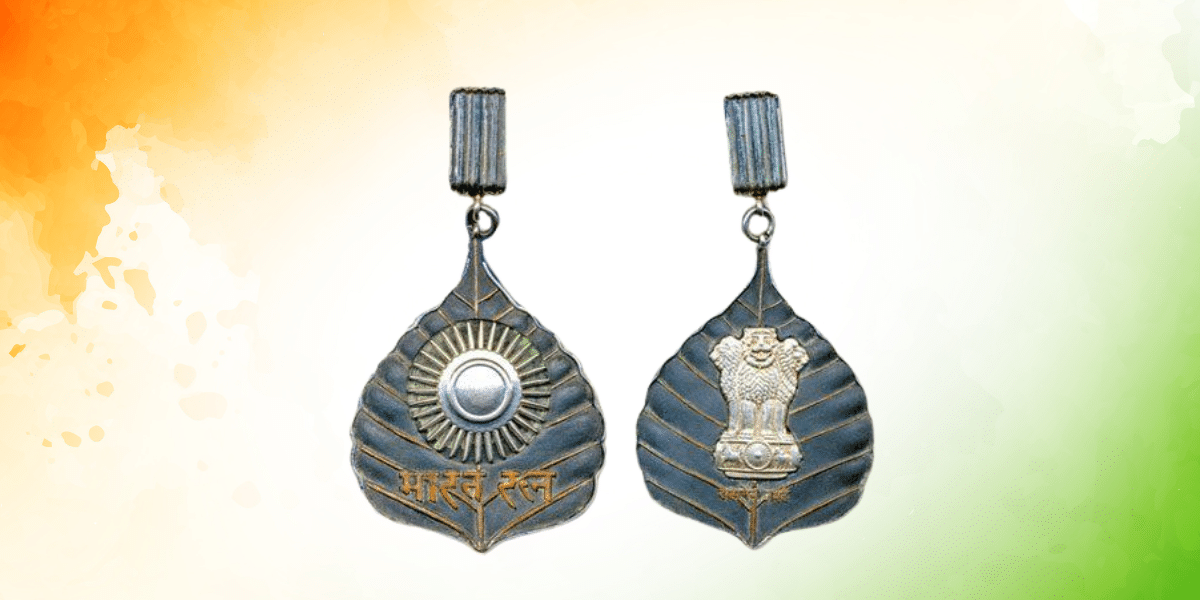
The Bharat Ratna medallion is a unique and symbolic object of prestige.
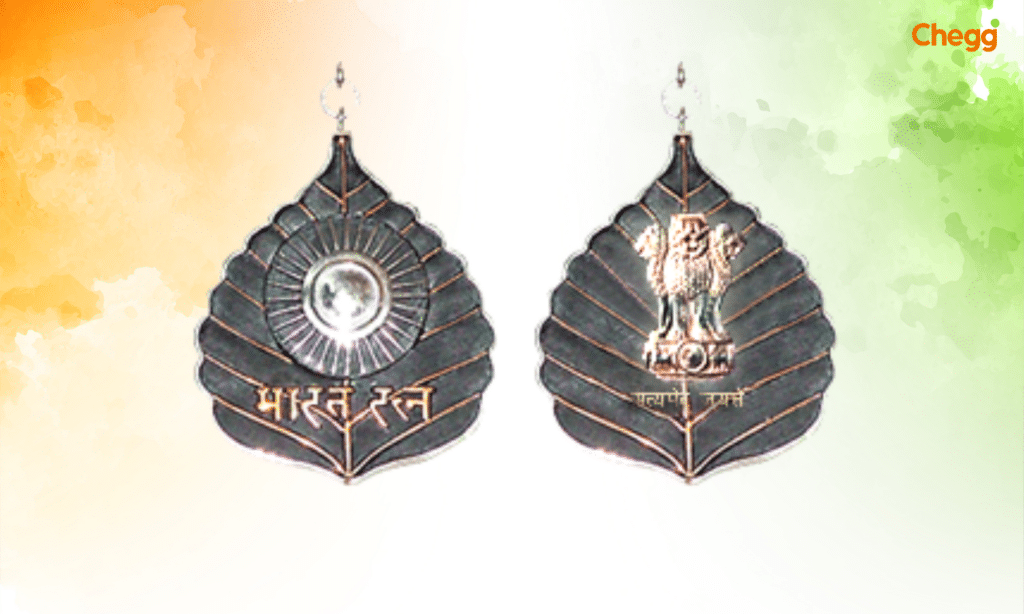
The Medallion: It is crafted in the shape of a peepal leaf, approximately 5.8 cm long, 4.7 cm wide, and 3.1 mm thick. It is made of platinum instead of gold. The front side features a sunburst emblem superimposed on a map of India, with the words “Bharat Ratna” inscribed in Devanagari script below. The reverse side bears the Indian national emblem (the Lion Capital of Ashoka) and the national motto, “Satyameva Jayate” (Truth Alone Triumphs).
The Sanad (Certificate): Along with the medallion, the recipient receives a Sanad (a certificate of award) signed by the President of India.
Presentation Ceremony: The award is presented by the President in a formal ceremony at the Rashtrapati Bhavan (the Presidential Palace) in New Delhi. The ceremony is a significant state event, honoring the recipient’s contributions to the nation.
Controversies and Debates
Suspensions:
The award was suspended twice in its history. The first time was in 1977 when Morarji Desai became the Prime Minister. His government withdrew all personal civil honours, including the Bharat Ratna, on July 13, 1977.
The second suspension happened in the mid-1990s when the Kerala High Court and the Madhya Pradesh High Court filed legal cases challenging the “constitutional validity” of the award.
Posthumous Awards: It can be awarded after death. Notable posthumous recipients include Sardar Vallabhbhai Patel and Madan Mohan Malaviya.
Age Records: The youngest recipient is cricketer Sachin Tendulkar (awarded at 40), and the oldest is social activist Nanaji Deshmukh (awarded posthumously at 102).
List of Posthumous Recipients of the Bharat Ratna Award
A few people have received posthumous Bharat Ratna Awards. That is to say, they received their honor after passing away. The list of Bharat Ratna awardees who received posthumous honors is provided here.
Lal Bahadur Shastri (Passed away on 11 January 1966)
Kamaraj (Passed away on 2 October 1975)
Vinoba Bhave (Passed away on 15 November 1982)
M. G. Ramachandran (Passed away on 24 December 1987)
B. R. Ambedkar (Passed away on 6 December 1956)
Rajiv Gandhi (Passed away on 21 May 1991)
Vallabhbhai Patel (Passed away on 15 December 1950)
Abdul Kalam Azad (Passed away on 22 February 1958)
Aruna Asaf Ali (Passed away on 29 July 1996)
Jayaprakash Narayan (Passed away on 8 October 1979)
Gopinath Bordoloi (Passed away on 5 August 1950)
Madan Mohan Malaviya (Passed away on 12 November 1946)
Bhupen Hazarika (Passed away on 5 November 2011)
Nanaji Deshmukh (Passed away on 27 February 2010)
List Bharat Ratna Award winners in 2024
Karpoori Thakur: Renowned socialist leader and former Chief Minister of Bihar, posthumously awarded the Bharat Ratna on the eve of his 100th birth anniversary.
Lal Krishna Advani: Veteran Bharatiya Janata Party (BJP) leader, conferred with the prestigious Bharat Ratna award for his contributions to Indian politics and public life.
PV Narasimha Rao: Former Prime Minister of India, recognized for his leadership during critical phases of economic reform and liberalization.
Chaudhary Charan Singh: Former Prime Minister of India, honored for his advocacy for farmers’ rights and agricultural reforms.
MS Swaminathan: Renowned agricultural scientist, acknowledged for his pioneering work in agricultural research and development, particularly in the Green Revolution.
List of Former President Bharat Ratna Awardees
Over the period spanning from 1954 to 2024, several Presidents of India have been recipients of the prestigious Bharat Ratna Award. Among the 48 esteemed awardees, six Indian Presidents received the Bharat Ratna Award. The table below shows their names and the respective years when they were conferred with this honor:
Presidents of India
Year of Award
Sarvapalli Radhakrishnan
1954
Rajendra Prasad
1962
Zakir Hussain
1963
A. P. J. Abdul Kalam
1997
Dr. V V Giri
1975
Pranab Mukherjee
2019
Bharat Ratna Benefits and Privileges
The Bharat Ratna, India’s highest civilian award, is a mark of great honor and recognition. However, it does not come with monetary rewards or special legal privileges. Here are the key benefits and privileges that recipients of the Bharat Ratna enjoy:
1. National Recognition and Prestige
Bharat Ratna awardees gain immense respect and admiration across the country.
Their contributions are officially recognized by the Indian government.
2. Lifetime Status and Honor
The title “Bharat Ratna Awardee” stays with them for life.
Their name is recorded in history as one of India’s greatest contributors.
3. Special Treatment in Government Functions
Recipients are given a place of honor at official events and ceremonies.
They may be invited as chief guests for national celebrations.
4. Diplomatic and State-Level Recognition
They are treated as state guests when traveling for government functions.
Their presence is highly respected at international events.
5. No Monetary Benefits or Pension
Unlike some other civilian or military honors, Bharat Ratna does not provide a cash prize.
There is no pension or financial reward attached to the award.
6. Exemption from Protocol Restrictions
Bharat Ratna awardees often receive special treatment in public and private institutions.
They may be given priority seating in important public events.
7. Higher Status in Government Precedence List
The awardees hold a high position in the Order of Precedence, ranking just after members of Parliament and Governors.
Conclusion
The Bharat Ratna, India’s top civilian award, was started in 1954. Anyone with the Bharat Ratna Award has contributed to improving humanity in any field, like science, literature, arts, public service, and sports, regardless of their job, gender, or racism. The Bharat Ratna Award can be given to three people annually. The winners receive the award from the Indian President.
The Bharat Ratna Award has been given to 16 persons posthumously. It means the person who has died can also receive the Bharat Ratna Award for their great contributions. As you have studied above, the list of Awardees all played an important role in the betterment of our country. We must take inspiration from them and always do hard work.
53 people have received the prize since 1954, including 18 who received it posthumously. In January 1966, an amendment to the original rules enabled the posthumous recognition of former prime minister Lal Bahadur Shastri. He became the first person to receive such an honor.
Who Is the first Bharat Ratna awardee?
In 1954, the Bharat Ratna provision was instituted. Famous scientists Dr. Chandrasekhara Venkata Raman, lawyer and independence campaigner C. Rajagopalachari, and Sarvepalli Radhakrishnan, India’s first vice president, were the first to receive the esteemed honor.
Who has been awarded the Bharat Ratna in 2025?
As of now, the Indian government has made no official announcement about Bharat Ratna awardees for 2025. While there is speculation about potential recipients, no names have been confirmed. The Bharat Ratna, India’s highest civilian award, is usually announced in January or February and conferred by the President of India.
Who is the first woman to get the Bharat Ratna award?
Shrimati Indira Gandhi became the first female recipient of the Bharat Ratna award. She is referred to as India’s “Iron Lady.” She is India’s first female prime minister and its third overall.
Who is the youngest Bharat Ratna winner?
Sachin Tendulkar became the youngest recipient of the Bharat Ratna in 2014 at the age of 40. He received India’s highest civilian award for his exceptional contribution to cricket and sports, making history as the first sportsperson and the youngest ever to be honored.
Who refused the Bharat Ratna?
Renowned freedom fighter and political leader Jayaprakash Narayan is believed to have declined the Bharat Ratna. Additionally, Netaji Subhas Chandra Bose was posthumously awarded the Bharat Ratna in 1992, but the award was later withdrawn due to controversy over his death.
How many females have received the Bharat Ratna?
Since its inception in 1954, the Bharat Ratna has been awarded to five women . They are: Indira Gandhi (1971): Former Prime Minister of India . Mother Teresa (1980): Catholic nun and founder of the Missionaries of Charity . Aruna Asaf Ali (1997, Posthumous): Independence activist . M. S. Subbulakshmi (1998): Carnatic classical vocalist . Lata Mangeshkar (2001): Playback singer
Who is eligible to receive the Bharat Ratna Award?
The Bharat Ratna is India’s highest civilian award, given to individuals for exceptional service in any field, including arts, literature, science, public service, and sports. Both Indian citizens and foreigners are eligible. The award recognizes outstanding contributions that benefit the nation or humanity at large.
Authored by, Muskan Gupta Content Curator
Muskan believes learning should feel like an adventure, not a chore. With years of experience in content creation and strategy, she specializes in educational topics, online earning opportunities, and general knowledge. She enjoys sharing her insights through blogs and articles that inform and inspire her readers. When she’s not writing, you’ll likely find her hopping between bookstores and bakeries, always in search of her next favorite read or treat.