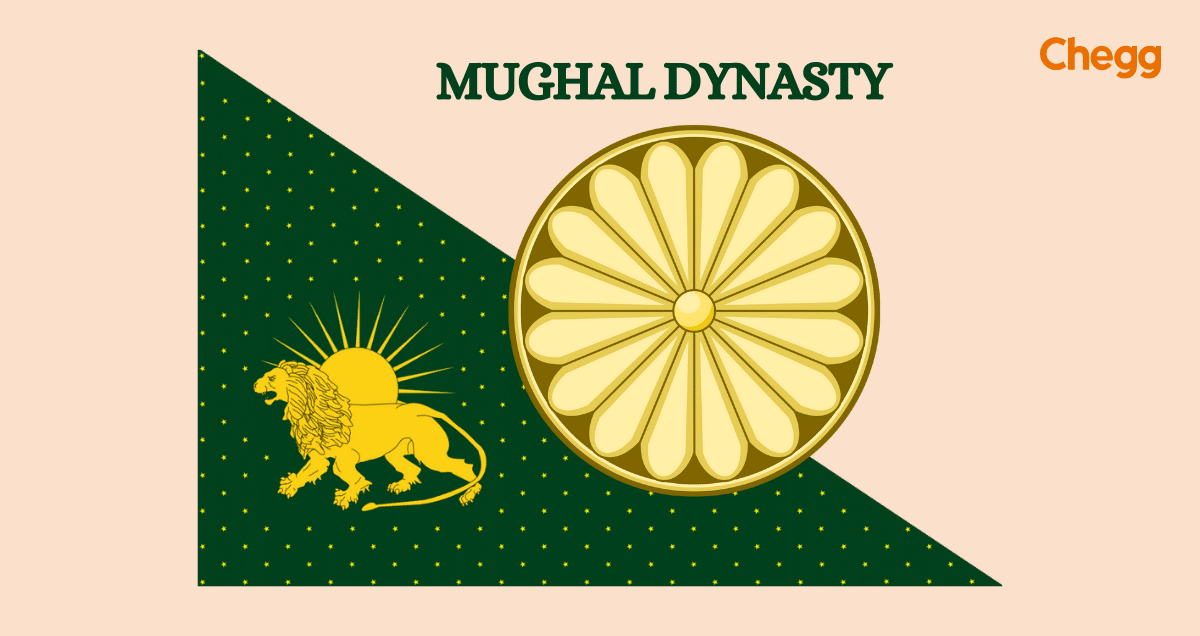
The Mughal Dynasty, one of the most influential empires in Indian history, was established by Babur in 1526 and ruled large parts of the subcontinent until 1857. Descended from Turkic-Mongol origins and often called Timurids after their ancestor Timur, the Mughals are renowned for their magnificent architecture, including the Taj Mahal, and for shaping a rich cultural and political legacy that united much of India. Their empire began to decline in the 18th century, eventually falling under British control.
Founded by Babur, a Central Asian prince and the Mughal dynasty founder, this Islamic empire blended Persian, Turkic, and Indian traditions, leaving an enduring legacy on the region’s socio-political fabric. Under the Mughal rule in India, the country experienced unparalleled prosperity, religious syncretism, and monumental architectural achievements.
From towering forts to intricately designed tombs, the dynasty left behind a vast architectural and cultural heritage. To understand this remarkable empire, it’s essential to explore the contributions of various Mughal dynasty rulers, their lineage as shown in the family tree, and their policies that reshaped the subcontinent.
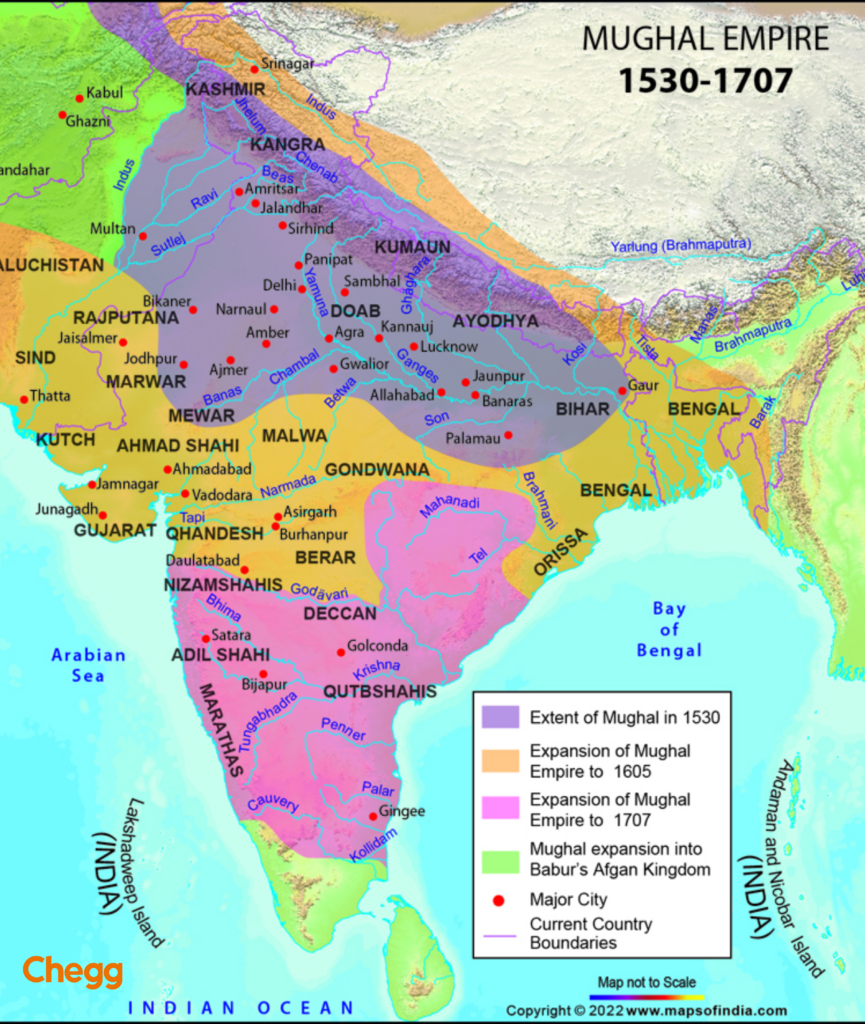
At its height, the Mughal Empire stretched from the Indus Valley in the west to Assam in the east, and from Kashmir in the north to parts of the Deccan Plateau in the south. This expansive territory underlines the military strength and administrative efficiency of the empire’s leadership.
The dynasty formally began with Babur’s decisive victory at the First Battle of Panipat in 1526, a milestone that launched a line of rulers- Humayun, Akbar, Jahangir, Shah Jahan, and Aurangzeb, each of whom contributed uniquely to the growth and character of the empire. However, the decline began under Aurangzeb, whose rigid policies, though expansionist, strained the empire’s administrative and economic systems. As internal dissent grew and external forces, particularly the British East India Company, began to interfere, the empire weakened. Understanding how the company planned to bring an end to the Mughal dynasty reveals how colonial powers capitalized on internal strife and succession conflicts.
The final chapter unfolded during the Revolt of 1857, after which Bahadur Shah II, the last ruler in the Mughal family tree, was deposed. This event marked the end of the Mughal rule time period and officially concluded more than 300 years of Mughal rule in India, leaving behind a complex but rich historical legacy.
The Mughal Dynasty, a prominent empire in Indian history, spanned generations of rulers. Here’s a simplified Empire tree or Babur family tree to illustrate their lineage:
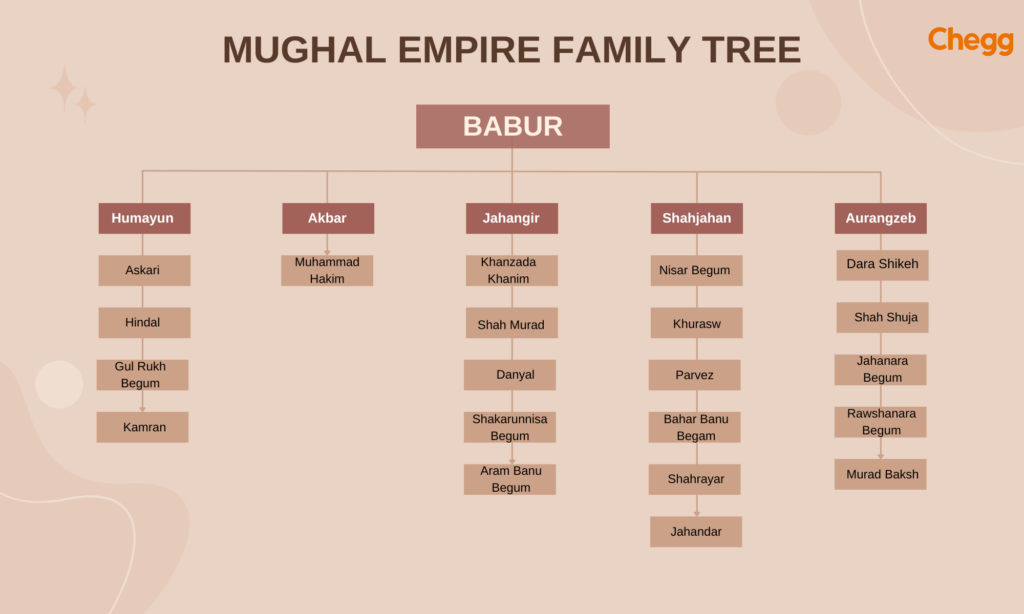
Babur, the Mughal founder, is the root node of the extensive Mughal family tree. His son, Humayun, had two children: Akbar and Muhammad Hakim. Dara Shikoh, a key figure in the Mughal family tree, claimed the throne after Shah Jahan but failed. Aurangzeb, the last powerful ruler among the Mughal dynasty rulers, had no clear successor, leading to the dynasty’s eventual decline.
The Empire timeline narrates the empire’s ascent through power, cultural synthesis, and architectural achievements. It began with Babur, who answered the question of who was the founder of Mughal dynasty, by establishing the empire in 1526. His descendants, like Akbar and Shah Jahan, shaped the Mughal rule with their contributions. Akbar’s reforms and Shah Jahan’s monuments became milestones of the Mughal rule in India. The long time period, which spanned over three centuries, helps us understand how many years Mughals ruled India and how the empire evolved through the generations of the Mughal family tree.
Among the most influential Mughal dynasty rulers were Babur, Akbar, Shah Jahan, and Aurangzeb. Their reigns reflect the grand arc of the Mughal rule period. Akbar’s establishment of Subahs and Shah Jahan’s Taj Mahal construction are key achievements during the Mughal rule.
| Emperor | Reign Period | Notable Achievements |
| Babur | 1526–1530 | Founder of the Mughal Empire; victories at the Battle of Panipat and Battle of Khanwa. |
| Humayun | 1530–1540, 1555–1556 | Restored rule after Suri Dynasty interruption; unified empire for his son, Akbar. |
| Akbar | 1556–1605 | Defeated Hemu; abolished Jizyah tax; promoted religious tolerance and cultural synthesis. |
| Jahangir | 1605–1627 | Opened relations with the British East India Company. |
| Shah Jahan | 1628–1658 | Founder of the Mughal Empire; victories at the Battle of Panipat and the Battle of Khanwa. |
| Aurangzeb | 1658–1707 | Expanded empire, reinterpreted Islamic law, and captured Golconda’s diamond mines. |
| Bahadur Shah I | 1707–1712 | Decline of the empire; lack of leadership among successors. |

The Mughals ruled India for over three centuries, and here’s a list of their emperors in chronological order:
| Emperor | Reign |
|---|---|
| Babur | 1526 – 1530 |
| Humayun | 1st Term: 1530 – 1540; (Suri Dynasty: 1540 – 1555) 2nd Term: 1555 – 1556 |
| Akbar | 1556 – 1605 |
| Jahangir | 1605 – 1627 |
| Shah Jahan | 1627 – 1658 |
| Aurangzeb | 1658 – 1707 |
| Bahadur Shah I | 1707 – 1712 |
| Jahandar Shah | 1712 – 1713 |
| Furrukhsiyar | 1713 – 1719 |
| Rafi Ul-Darjat | 1719 |
| Rafi Ud-Daulat | 1719 |
| Muhammad Ibrahim | 1720 |
| Muhammad Shah | 1719 – 1748 |
| Ahmad Shah Bahadur | 1748 – 1754 |
| Alamgir II | 1754 – 1759 |
| Shah Jahan III | 1759 – 1760 |
| Shah Alam II | 1760 – 1806 |
| Akbar Shah II | 1806 – 1837 |
| Bahadur Shah II | 1837 – 1857 |
Despite being a minority, the ruling elite promoted social stability and economic prosperity. India thrived as a hub of trade under their rule. The empire capitalized on textile, cotton, and spice production, integrating itself deeply into the Indian Ocean trade network. Traders from China, Persia, and Europe flocked to India’s markets for its handloom textiles, silk, and exotic spices.
The Mughal dynasty fostered a robust economic network. Though a Muslim minority ruled over a Hindu majority, the empire achieved social stability and economic prosperity through trade. The Mughals in India capitalized on India’s textile, cotton, and spice production, making it a central node in the Indian Ocean trade. Traders from China, Persia, and Europe were drawn to India’s handloom textiles, silk, and spices like nutmeg and cardamom. The flourishing trade under Mughal rule in India reinforced their influence on global markets.
At its zenith, the Mughal dynasty in India commanded vast territories. The empire stretched:
Founded by Babur, the Mughal dynasty founder, the empire developed an efficient bureaucracy. Officers, known as mansabdars, were appointed irrespective of religion. They collected taxes, maintained cavalry, and held land-based status, not inherited, but based on merit. This system enabled the Mughal dynasty to govern a large and diverse population.
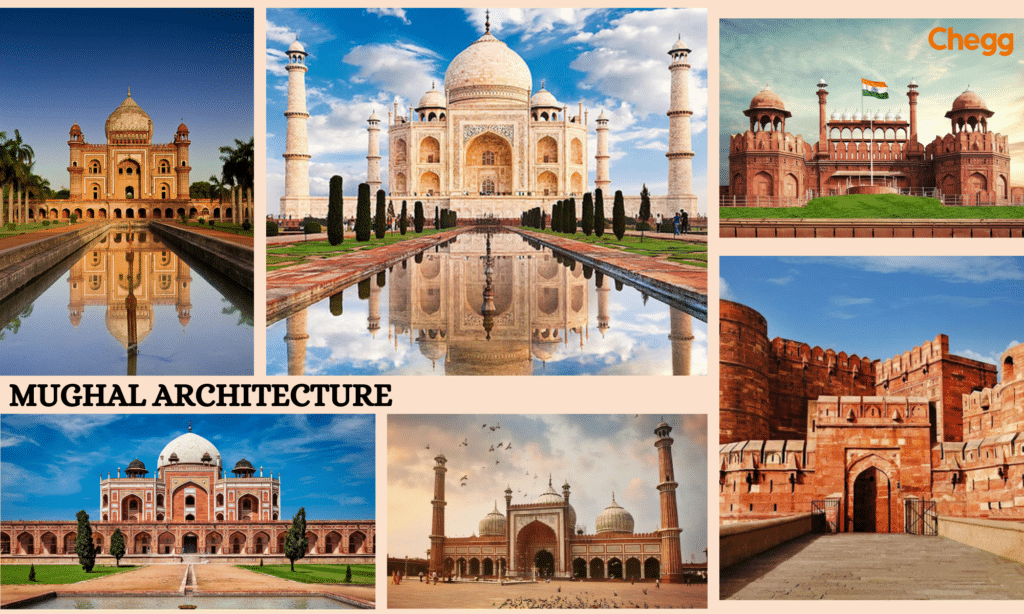
The Mughals ruled India from the early 16th to the mid-19th century and left an indelible mark on Indian architecture. Mughal emperors were passionate patrons of art and culture, actively promoting architectural innovation.
The synthesis of these diverse influences resulted in a unique architectural style.
Mughal architecture influenced subsequent Indian styles, including Rajput, Deccani, and Indo-Saracenic, leaving an enduring legacy that shaped the architectural landscape of India.
The Mughal dynasty in India is remembered for both grandeur and internal decline. Scholars debate the cultural and administrative achievements versus the religious orthodoxy and missteps in the later Mughal empire timeline. The historical map of the Mughal Empire illustrates its vast reach from Kabul to the Deccan, reinforcing the enduring imprint of the Mughal dynasty time period.
Click here to read – Bibi Ka Maqbara in Aurangabad: Everything You Need to Know
The Mughal dynasty played a pivotal role in shaping Indian civilization. From Babur’s founding battles to the 1857 British conquest, the Mughals in India contributed enduring legacies in art, governance, and architecture. Understanding the Mughal dynasty tree, their rule, and how the company plans to bring an end to the Mughal dynasty unveils the arc of one of India’s most transformative eras. The 331-year-long Mughal dynasty time period remains a cornerstone of Indian heritage, vividly remembered through monuments, literature, and historical reflection.

Read the related articles along with the Mughal Dynasty by visiting the above links.
Recommended Read:-
Babur, whose original name was Zahiruddin Muhammad, founded the Mughal Empire in India.
The Mughal dynasty ruled India for approximately 331 years, from 1526 to 1857.
Yaqoob Ziauddin Tucy is recognized as the most recent descendant of the Mughal lineage. He traces his ancestry back six generations to Bahadur Shah Zafar, the final Mughal Emperor. It is noteworthy, though, that the Mughal empire formally concluded when Bahadur Shah II was dethroned in 1857.
The first Indian emperor is regarded as Chandragupta Maurya. Born in 340 BC, he succeeded to the throne in 321 BC following the demise of his father, Bindusara.
The Mughal dynasty began with Babur and continued with Humayun
1. Akbar
2. Jahangir
3. Shah Jahan
4. Aurangzeb
5. Bahadur Shah I
6. Jahandar Shah
7. Farrukhsiyar
8. Rafi ud-Darajat
9. Shah Jahan II
10. Muhammad Shah
11. Ahmad Shah Bahadur
12. Alamgir II
13. Shah Jahan III
14. Shah Alam II
15. Akbar Shah II
16. Bahadur Shah II
The 7th Mughal emperor was Shah Jahan (reigned 1628–1658), renowned for commissioning the Taj Mahal in memory of his wife Mumtaz Mahal. His reign marked the peak of Mughal architecture, culture, and wealth, though it also saw increased court intrigues and succession conflicts.
The Mughal dynasty was founded by Babur in 1526 after defeating Ibrahim Lodi at the First Battle of Panipat. Babur, a descendant of Timur and Genghis Khan, established Mughal rule in India, laying the foundation for one of the subcontinent’s most influential empires.
The decline of the Mughal Empire began during Aurangzeb’s late reign (1658–1707) and accelerated in the 18th century due to internal rebellions, regional fragmentation, and colonial interventions. The empire officially ended in 1857 after the Indian Rebellion, when the last emperor, Bahadur Shah II, was exiled by the British.