

Preparing for a job interview can be stressful, especially when you encounter behavioral interview questions that aim to explore your past experiences. Unlike traditional questions that focus on your qualifications or technical skills, behavioral interview questions require you to give real-life examples of how you have handled specific situations at work. These questions help employers see your problem-solving skills, teamwork, leadership, and how you react to challenges.
Behavioral interview questions usually begin with phrases like “Tell me about a time when…” or “Give an example of…” They focus on areas such as problem-solving, teamwork, dealing with pressure, and leadership. Common questions ask about handling a tough situation, resolving conflict with a coworker, making a mistake, or adjusting to changing demands. To answer these questions, use the STAR method: Situation, Task, Action, and Result.

Behavioural interview questions are a crucial tool used by recruiters to evaluate a candidate’s ability to handle real-world workplace situations. Unlike traditional interview questions that focus on hypothetical scenarios, behavioural interview questions require candidates to provide concrete examples from their past experiences. These questions assess a wide range of soft skills, including communication, teamwork, leadership, and problem-solving abilities.
A well-prepared response to behavioural questions for interview can help candidates stand out from the competition. Employers often use the STAR method (Situation, Task, Action, Result) to structure their evaluation, ensuring that answers are clear, concise, and relevant. For instance, a question like, “Tell me about a time you handled a conflict with a coworker,” allows the candidate to showcase their conflict resolution and interpersonal skills. Strong answers highlight problem-solving approaches, emotional intelligence, and professional growth. Mastering behavioural interview questions is essential for job seekers looking to make a lasting impression and demonstrate their potential for success in a given role.
Example: During my college fest, I encountered a conflict with my co-organizer. To handle the situation effectively, I applied behavioural interview questions principles, staying calm, actively listening, and presenting my ideas logically. Through open discussions, we reached a mutual decision, strengthening my teamwork and conflict-resolution skills.
Points to keep in mind:
Example: I was asked to give a presentation to a new client. I made sure that before we began working, the views of each team member were put on the table and discussed thoroughly. I then gave specific roles to different people keeping in mind their expertise. Finally, I compiled all the work for the final presentation.
Points to keep in mind
Example: I am experienced with working in C++ but I was once assigned an important project in python. I believe challenges are inevitable and hence before starting the project I spent a week learning python and its basic. As a result, I was able to timely submit the project to my senior.
Points to keep in mind:

Example: In my previous role at the bank, I frequently handled upset customers. One instance involved a client frustrated with failed online transactions. Using my problem-solving skills and applying behavioural interview questions techniques, I reassured him, coordinated with my team, and resolved the issue within hours, ensuring customer satisfaction.
Points to keep in mind:
Example: On the occasion of our company event the PR team was unable to fetch media partners. I got together some people from the team and contacted our media partners from previous years, negotiated a few terms and conditions and within 3 days it was all done.
Points to keep in mind:
Example: Being the HR at my previous workplace, I once had to resolve a conflict between two co-workers. Each of them had their version of the situation. It was necessary to uphold the truth and it took me some digging into the matter and consultation with other office members to reach a fair conclusion.
Points to keep in mind:
Example: In school, we convinced our principal to establish a basketball team and let us compete in the zonal matches. A few months later, we returned victorious, with a trophy for the team and a Player of the Tournament medal around my neck. This experience reflects teamwork, persistence, and leadership, key qualities often assessed in behavioural basic interview questions.
Points to keep in mind:
Example: At my previous job, days before an important meeting my co-worker met with an accident and the responsibility of guiding his team fell upon me. I divided the time slots in the day between the two teams working under me and took turns working with each one of them.
Points to keep in mind:
Example: In the days when I worked in an MBA institute, a professor was unable to attend college on the day of assessment. Being an MBA graduate myself, I discussed with the professor and made the students a question paper then and there which they solved and submitted.
Points to keep in mind:
Example: I noticed my team was not fully engaged in the new project, often skipping meetings. I addressed this concern with my team leader and collaborated on a plan to re-engage the members. By the weekend, we held a productive team meeting that successfully refocused everyone’s attention, an experience that highlights problem-solving and leadership, essential for tackling behavioural interview questions.
Points to keep in mind:
Example: At my previous office, we were supposed to submit weekly work reports. I always made sure they were detailed, well maintained and easy to read and further work with.
Points to keep in mind:
Example: During my design internship, I collaborated with a teammate who favored international designs, while I had a strong inclination toward Indian styles. Despite our differences, we combined our perspectives and successfully created an Indo-Western fusion design. This experience highlights my adaptability and teamwork, key aspects often explored in behavioural interview questions.
Points to keep in mind:
Example: I had my appointment at the passport office on the same day as an important presentation. I wrapped up the work a day prior and went for the appointment the next morning. I was continuously in touch with my team and managed the presentation via an online meeting with the client.
Points to keep in mind:
Example: As the assistant director of my college dramatics society, I once forgot to book the venue while managing multiple responsibilities. On the day of the play, I quickly approached the auditorium management, explained the situation, and secured special permission for our performance. This experience reflects my problem-solving skills and ability to stay composed under pressure, key traits often assessed in behavioural interview questions.
Points to keep in mind:
Example: I worked as a class 12 mathematics teacher. One day I was asked to be the substitute teacher for class 5 until a new teacher was found. This was an exciting chance yet challenging as it required more effort to make those little ones understand mathematics. I borrowed help from videos and activities to teach them over those 6 months. This was the time when I worked outside of my comfort zone.
Points to keep in mind:
Example: In college, as the president of the dance society, I led a collaboration with the dramatics society for an international event. We created a unique fusion performance that showcased our teamwork and creativity, ultimately winning third prize. This experience highlights my leadership and adaptability, key aspects often evaluated in behavioural interview questions.
Points to keep in mind:
Example: During my research project, I had to convey all the details I learned in a seminar to my co-workers. I did so by simplifying the information using mind maps and flowcharts and had multiple group discussions on the same.
Points to keep in mind:
Example: At my previous workplace, I realized there was no Internal Complaint Committee. Understanding its importance, I engaged in multiple discussions with HR over two months. My persistence paid off when we successfully established the company’s first ICC. This experience demonstrates my initiative and problem-solving skills, key qualities often assessed in behavioural interview questions.
Points to keep in mind:
Example: I once had to convince my team leader of the idea of giving the team a small gap while working with different clients. I explained to her in a very detailed manner how switching between clients is confusing and hinders productivity.
Points to keep in mind:
Example: In college, as the president of the cultural society, I led my team in convincing our convenor to allow a performance on a sensitive social issue. We persistently wrote applications to the principal and engaged in daily discussions with the convenor. Our dedication paid off, and we were granted permission. This experience showcases my leadership, perseverance, and teamwork, qualities often evaluated in behavioural interview questions.
Points to keep in mind:
When answering behavioural interview questions, provide specific details about the situation, your role, and the actions you took to resolve the issue or accomplish the task. This shows your interviewer that you have experience in handling real-world situations.
While it’s important to showcase your strengths, it’s also important to be truthful about your experiences. Behavioural interview questions, Do not try to exaggerate or make up experiences as this can backfire during the interview process.
Even if the situation you describe was challenging, behavioural interview questions try to focus on the positive outcomes of the situation and the skills you developed. This demonstrates your ability to learn from experiences and improve your skills.
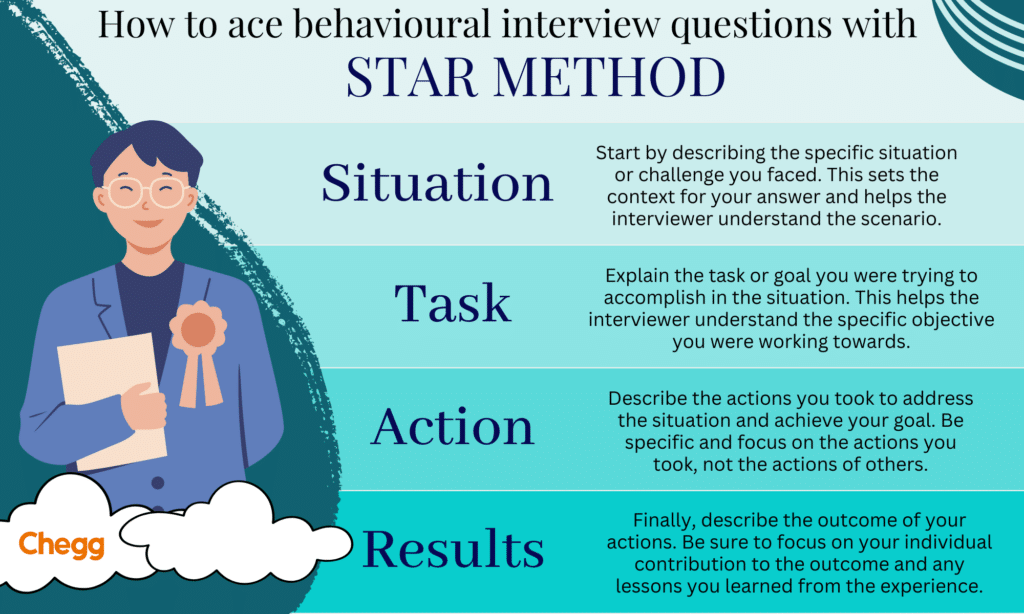
The STAR method is a structured approach to behavioral interview questions and answers. The acronym stands for Situation, Task, Action, and Result.
Situation: Begin by describing the situation that you faced. Be specific and provide details about the context, including the time frame, people involved, and any challenges.
Task: Next, describe the task that you needed to accomplish in the situation. This should include your role and responsibilities.
Action: Describe the actions that you took to address the situation and accomplish the task. Be specific about the steps you took and why you took them.
Result: Finally, describe the results of your actions. Include any positive outcomes, what you learned from the experience, and how it helped you grow professionally.
Read more:
Behavioural interview questions play a crucial role in showcasing your skills, experience, and ability to handle workplace challenges. As a job seeker, preparing thoughtful responses to behavioural interview questions is essential for demonstrating your qualifications and increasing your chances of securing your dream job.
By practicing and structuring your answers using the STAR method (Situation, Task, Action, Result), you can provide clear and compelling examples that highlight your problem-solving abilities, teamwork, leadership, and adaptability. Employers use behavioural interview questions to assess how you have handled past situations, making it critical to respond with confidence, honesty, and positivity.
To stand out from the competition, ensure your responses align with the job role and company values. Preparing well for behavioural interview questions allows you to present yourself as a strong and capable candidate, leaving a lasting impression on hiring managers. By refining your answers and delivering them effectively, you can boost your confidence, impress interviewers, and take a significant step toward achieving your career goals.
Ace your job interviews with tailored tips for a great first impression! Explore more Interview Tips with us.
Mastering behavioral interview questions can help you stand out in any job interview. By preparing clear, organized answers and sharing real experiences, you can show your skills, flexibility, and potential value to employers.
Keep in mind that every behavioral question gives you a chance to share your unique story. You can showcase how you deal with challenges, collaborate with others, and achieve results. With practice and preparation, you will enter your next interview with confidence and leave a lasting impression.
Evaluate numerous career choices to choose the right career path for yourself. Dive into our guide on Career Advice.

“Tell me about a time you faced a challenge at work and how you dealt with it.”
“Describe a situation where you worked in a team.”
“Give an example of a time you took on a leadership role.”
“Tell me about a mistake you made and what you learned from it.”
“Describe a time you had to meet a tight deadline.”
Tip: Use the STAR method (Situation, Task, Action, Result) to organize your answers clearly and confidently.
The STAR method helps you answer behavioral interview questions with clear, organized stories.
S – Situation: Describe the background or challenge.
T – Task: Explain your role or responsibility.
A – Action: Share what steps you took.
R – Result: End with the outcome or what you learned.
Example: “When our project was falling behind (Situation), I reorganized the team’s schedule (Task), held quick daily check-ins (Action), and we finished two days early (Result).”
Tip: Keep your story short and focused on what you did, not just the team.
A behavioral interview is when interviewers ask about your past experiences to see how you handled real situations.
They want to know how you react to challenges, work with others, solve problems, and make decisions. Past behavior predicts future performance.
Tip: Prepare stories from your experience that demonstrate your skills and attitude using the STAR method.
In a 30-minute interview, expect about 3 to 5 behavioral interview questions. This depends on how detailed your answers are and if other types of questions are also asked.
Tip: Prepare 4-5 strong stories using the STAR method. This way, you’ll be ready for any behavioral questions that come up!
Employers ask behavioral interview questions because they want to understand how you handled real situations in the past. They believe your past actions are the best way to predict how you will perform in future challenges at work.
Tip: Share specific examples that demonstrate your skills and problem-solving abilities!