
A personal interview is an important part of the hiring process. It allows you to show your skills, experience, and personality to someone who is an employer (or has a direct relationship to the potential employer). Knowing what to expect and how to prepare for a personal interview is critical, notably when competition for a position increased in 2025. It is just as crucial to understand how to position yourself for the interview, regardless of whether you are a new college graduate or an applicant with years of professional experience.
This will cover everything you need to know about personal interviews, including what to expect, what kinds of personal interview questions to expect, and tips to make a positive impression. You will understand how an interviewer will likely gauge your skills and experience, receive guidance about personal interviews to highlight your accomplishments and strengths, and obtain more suggestions about potentially challenging situations. Now we will discuss how to prepare and present yourself confidently and clearly for your next personal interview.
A personal interview is a meeting organized by a recruiter in which the recruiter evaluates a potential employee for prospective employment. However, this meeting should be considered a two-way process between the candidate and the interviewer. The interviewer looks to find out how well the candidate could do the job and fit in with their organization and team, and the candidate aims to show that they are the best person for the job and the organization.
A personal interviewer is expected to know more about your work background and personal experiences. An interviewer will also judge you by looking at your work history and success and failure stories. That’s why it’s essential to talk about all the points that cover your past success in your job, which has greatly molded you for the job you’re applying for. This provides a clear understanding of what a personal interview is. In a personal interview, you and the interviewer are introduced.
The interview is a good way to understand each other and determine whether both benefit equally. A personal interview for freshers is an opportunity for recruiters to assess your potential and suitability for the role, focusing on your skills, qualifications, and enthusiasm for the position.
Personal interviews are essential for several reasons, especially in job recruitment, academic admissions, journalism, research, and therapy. Here’s a breakdown of why they matter:
Personal interviews provide a firsthand understanding of a person’s thoughts, personality, and motivations-something resumes, forms, or written responses can’t fully capture.
Interviews allow for immediate two-way communication. This makes it easier to:
In fields like HR, counseling, or research, personal interviews help build rapport and trust, making people more likely to open up and give honest, detailed answers.
Personal interviews are often the deciding factor for employers or admissions committees-they help compare candidates who may appear similar on paper.
It’s a way to verify claims made in resumes, applications, or portfolios. Interviewers can ask for examples, challenge inconsistencies, or dive deeper into experiences.
Interviews also test how well a person communicates under pressure, a key skill in most careers or professional settings.
Rather than applying the same standardized test to everyone, personal interviews let evaluators adapt questions to each individual, leading to more meaningful evaluations.
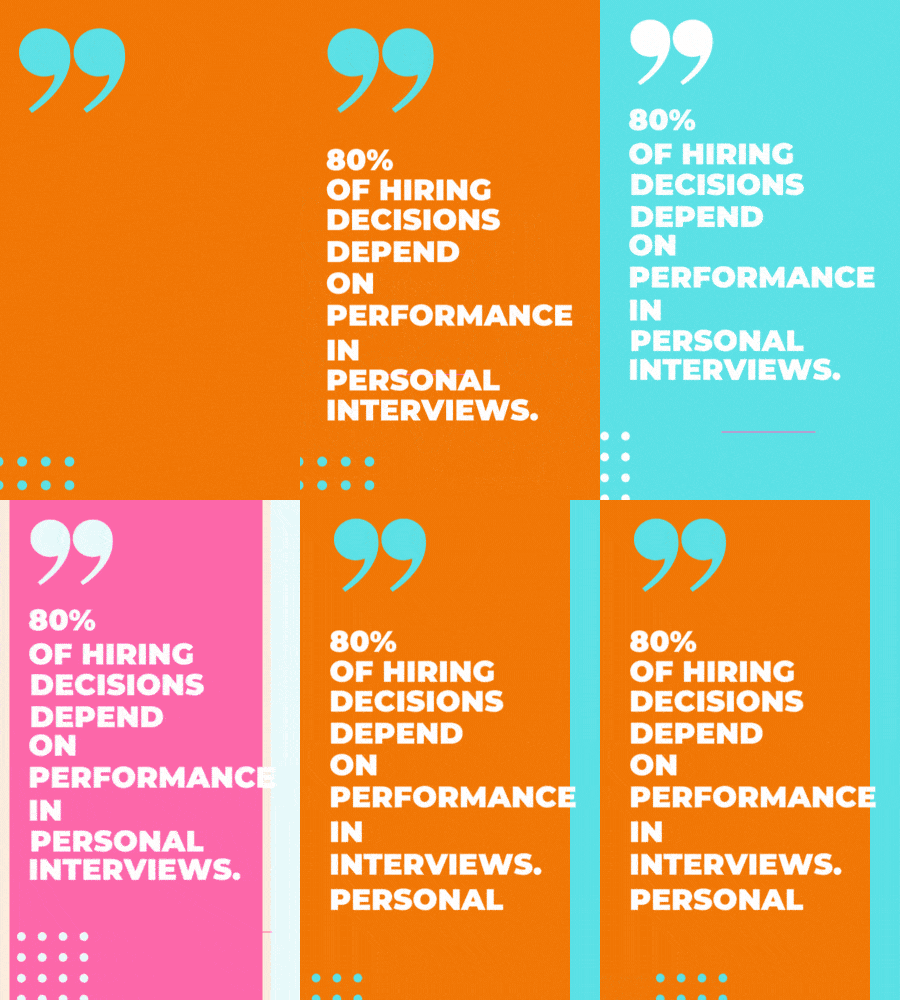
Start your interview preparation by learning about the organization. Visit the company’s website to understand its mission, values, products, and services. Dig into their social media handles and LinkedIn page to get a feel for the company culture and how they communicate. Reading up on recent news articles or blog updates will also help you understand their latest projects, market reputation, and industry standing.
Once you’ve explored the company, focus on thoroughly understanding the role you’re applying for. Study the job description carefully and highlight the key skills, qualifications, and responsibilities mentioned. Think about how your experience- academic, internship-based, or professional, aligns with these requirements.
Practicing potential interview questions helps you articulate your thoughts confidently. Start with common ones like “Tell me about yourself,” “Why do you want this job?” or “What are your strengths and weaknesses?” Use the STAR method-Situation, Task, Action, and Result, to structure your answers when discussing past experiences. This keeps your responses organized and impactful.
Your attire speaks volumes before you say a word, so it’s essential to dress appropriately. Choose formal wear for corporate interviews and smart casuals for more relaxed settings like startups. Make sure your clothes are clean, well-ironed, and properly fitted. Grooming is just as important-neatly combed hair, clean nails, and polished shoes complete the look.
Keeping your documents organized adds to your overall preparedness. Carry multiple copies of your updated resume, even if you’ve shared it digitally. Include academic certificates, work samples, reference letters, and other supporting material relevant to the job. Place them neatly in a folder so they’re easily accessible when asked.
Punctuality reflects discipline, so plan your travel ahead of time. Look up the interview location and map your route, keeping traffic or transit delays in mind. Aim to reach the venue at least 10 to 15 minutes early. If it’s a virtual interview, check your tech setup in advance-ensure a stable internet connection, test your microphone and camera, and find a quiet, well-lit space.
An interview isn’t just about answering questions-it’s also your chance to ask insightful questions. Prepare questions that reflect your interest in the company and the role, such as “What does a typical day in this role look like?” or “What are the growth opportunities in this position?” Avoid questions with answers that are readily available online.
Non-verbal cues play a big part in interviews, often influencing the interviewer’s impression of you. Maintain eye contact to show confidence, smile naturally to create a positive vibe, and sit up straight to show attentiveness. Avoid slouching, fidgeting, or crossing your arms, as these may come off as disinterest or nervousness.
This question is an opportunity to briefly overview who you are, often called your “elevator pitch.” Focus on summarizing your most important achievements, such as education, relevant work experience, and accomplishments. Conclude by explaining how these experiences make you an excellent fit for the role.
Example: “I recently graduated with a degree in advertising, where I completed three internships and consistently made the Dean’s List. Alongside my internships, I worked as a waitress to support myself.”
For this question, try to emphasize strengths that align with the job requirements while providing a weakness that won’t hinder your performance. Offering a blend of three strengths and two weaknesses can be helpful. To lighten the conversation, humorously mention something non-job-related as a weakness.
Example: “My strengths are communication, attention to detail, and strong work ethic. As for weaknesses, I have a hard time saying no to chocolate. But I do find myself becoming too empathetic, often taking on others’ emotional burdens.”
Choose words that align with the job and show your awareness of areas for growth. Offering a word that reflects a minor flaw can demonstrate self-awareness.
Example: “I would describe myself as loyal, passionate, cautious, and humorous.”
Answer this question positively and professionally, avoiding negative remarks about your previous employer. Frame your departure as seeking better opportunities or professional growth.
Example: “I’m seeking opportunities to expand my skills and take on new challenges. I believe this role is a perfect match for that.”
This can be a tricky question. Before the interview, it’s essential to research typical salaries for the position. Offer a range based on your experience, skills, and industry standards, but indicate that you’re open to negotiation.
Example: “Considering my qualifications, I expect a salary between $45,000 and $55,000 annually. I’m flexible and open to discussing this further.”
It’s often beneficial to highlight your ability to work well in both scenarios, emphasizing your flexibility and collaboration skills.
Example: “I enjoy working with a team and brainstorming ideas together, but I also value moments when I can step back and work independently to focus on tasks.”
Use this opportunity to show your ambition and career goals. Demonstrate your desire for growth and increased responsibility while aligning your goals with the company’s vision.
Example: “In five years, I see myself in a leadership position, such as an art director at a creative agency, where I can continue developing my skills and leading impactful projects.”
This lighthearted question tests your creativity and ability to think quickly. Choose an animal that aligns with your strengths and personality traits.
Example: “If I were an animal, I would be a deer-loyal, kind, and cautious, but occasionally surprised by new things.”
Explain your coping mechanisms and describe an experience where you successfully handled stress. Employers value candidates who can remain calm under pressure.
Example: “When I’m stressed, I take a moment to breathe deeply, then prioritize tasks based on urgency. I recently handled a stressful deadline by breaking the work into manageable steps, which helped me stay focused.”
Asking questions at the end of the interview can leave a positive impression and help you determine if the job is a good fit for you. Be prepared with thoughtful questions about the role, team culture, or company goals.
Example: “Can you tell me about the team dynamics and how this role contributes to the company’s overall mission?”
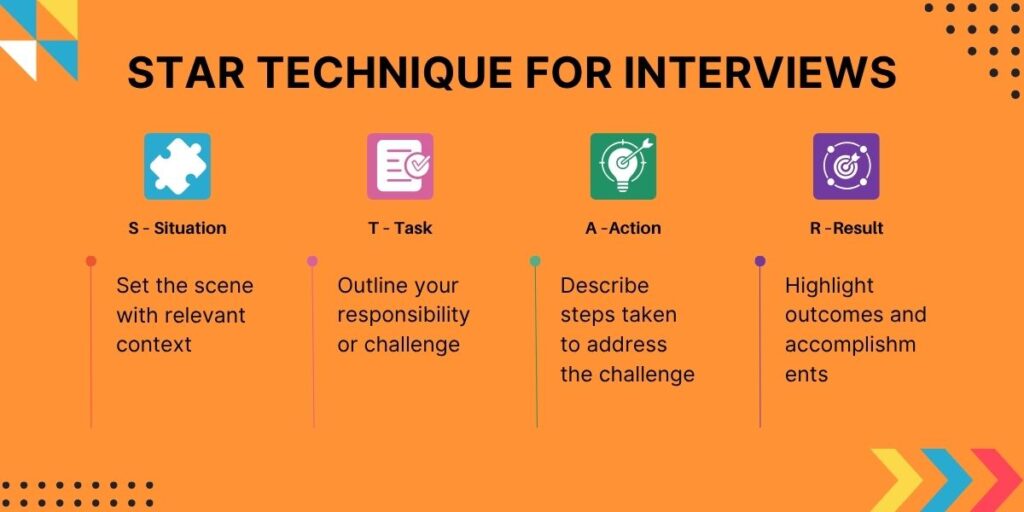
The STAR method is structured to answer behavioral interview questions clearly and effectively. It helps you tell a story by breaking it into four parts:
This method keeps your answer focused and ensures you highlight your problem-solving and decision-making skills.
Your body language can say just as much, if not more, than your words during an interview. Non-verbal cues like posture, eye contact, facial expressions, and hand gestures help shape the impression you leave. Here’s how to use them to your advantage:
| Do’s | Don’ts |
|---|---|
| Dress professionally and neatly | Don’t arrive late or unprepared |
| Make eye contact and smile | Don’t interrupt the interviewer |
| Greet with a confident handshake | Don’t use slang or informal language |
| Listen actively and nod to show engagement | Don’t fidget or show nervous habits |
| Answer clearly and stay on topic | Don’t go off on unrelated tangents |
| Use the STAR method to explain experiences | Don’t badmouth previous employers or colleagues |
| Ask thoughtful questions about the role/company | Don’t say “I don’t know” without trying to respond |
| Bring extra copies of your resume and documents | Don’t check your phone during the interview |
| Follow up with a thank-you note/email | Don’t forget to express interest in the role |
There are different types of personal interviews for other purposes. Let’s take a quick look at them all. There are two types of personal interviews:
A personal interview for a job focuses on your skill set, whether you are the right candidate for the organization, whether or not you have clear communication skills, and how well you fit in with the team.
An admission interview focuses on shortlisting the right student for the limited seats in the selected stream. The admission panel observes the student’s body language, communication skills, and learning ability.
Read More:- What is a walk-in interview? Tips to Ace it
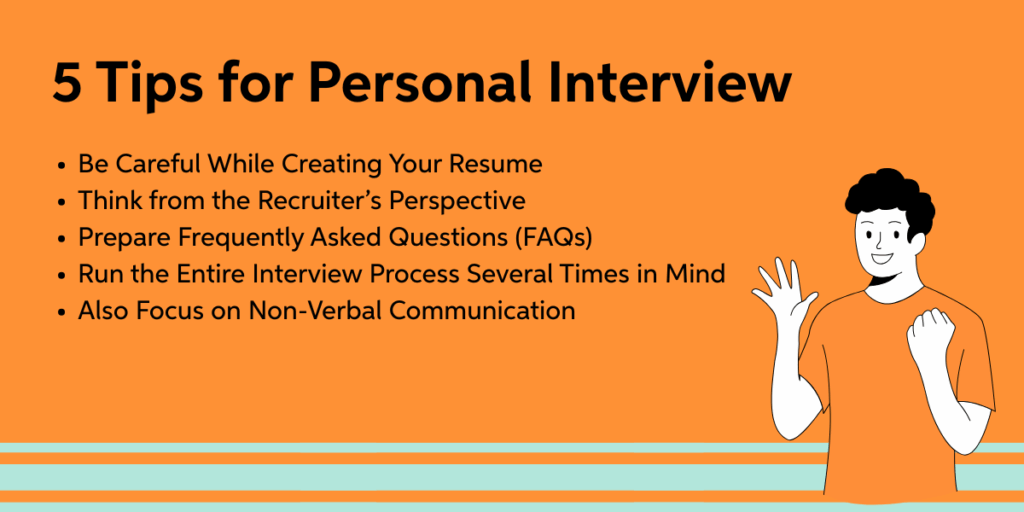
The purpose of your resume is to show your interviewer why you are the best person for this job. Your resume is the first impression on the interviewer, representing your candidature. This is the first impression for you to get the job. And remember – a resume is different than a CV. Writing a resume well is essential because it reflects you as a potential company employee.
Make sure to include these pointers while drafting your resume –
The second step for cracking interviews is considering what you would have looked for in an ideal candidate if you were an interviewer. This is one of the most useful personal interview tips. Try to understand the specific needs of the job. Carefully review the Job Description, and you can showcase the qualities needed to fulfill the qualifications.
For example, if you are going for a marketing job, you can highlight your travel hobby, but if you are going for operations, you should not. Depending on the job requirements, you can change your CV and make it even more effective by emphasizing the pointers relevant to the employee during the PI round.
Some questions are prevalent in job interviews, which are asked in almost every personal interview. Including these questions in your interview preparation can help you excel during the interview. Some of the commonly asked questions during a personal interview round are:
The fourth way to crack an interview is to run the entire interview process several times in mind before you present yourself. By doing this, the mind becomes clear about many things. The most important part is to visualize you interacting with the interviewer. By doing this, such questions often come to mind whose answers you might not have prepared. Sit and prepare yourself more patiently.
Practicing beforehand will make you comfortable and calm, which will help you in the final interview. Walking through the interview process will give you an idea of the personal interview questions, and you will be able to tackle them easily.
There are two ways to communicate: verbally and nonverbally. Verbal communication refers to what you speak or write, whereas nonverbal communication includes your tone, sitting, eye contact, and even your dressing sense. Remember, at least 70% of our communication is nonverbal. Hence, while interacting with the interviewer, you have to pay attention to a few things:
Interviews aren’t something to fear but rather an opportunity for mutual understanding. Both you and the interviewer share a common goal: finding a perfect fit for the role. The process is about showcasing how well you align with the job and how you will thrive within the company culture.
Interviewing is a skill that can be developed with practice. Building confidence is difficult without preparation and might result in missed opportunities. Before your final interview, thoroughly prepare for the company and your qualifications. Being well-prepared gives you the edge and shows the interviewers you’re a strong contender for the position.
Remember, not knowing an answer is okay. The attitude and willingness to learn will make you stand out and help you grow professionally and personally.
An interview is an opportunity to show your qualifications, characteristics, and compatibility for the position. You are guaranteed to impress your potential employer once you prepare, practice your responses, and approach the conversation optimistically. Don’t forget to research the organization beforehand and know the job description. The interviewer will want to hear your stories in an honest and foundational way.
Overall, you will be ahead of the game with good preparation and the correct mindset. You will be able to handle any question the interviewer poses, which will become a learning experience and a means for professional development. Always approach an interview as an opportunity to practice and one step closer to your career aspirations!
Read More-
In a personal interview, be confident and honest about your skills and goals.
Example: “I’m a quick learner who enjoys teamwork and problem-solving. I’m excited to grow in this role.”
Tip: Practice speaking naturally, let your personality show!
Structured Interview – Fixed set of questions
Unstructured Interview – Casual, open-ended discussion
Panel Interview – Multiple interviewers together
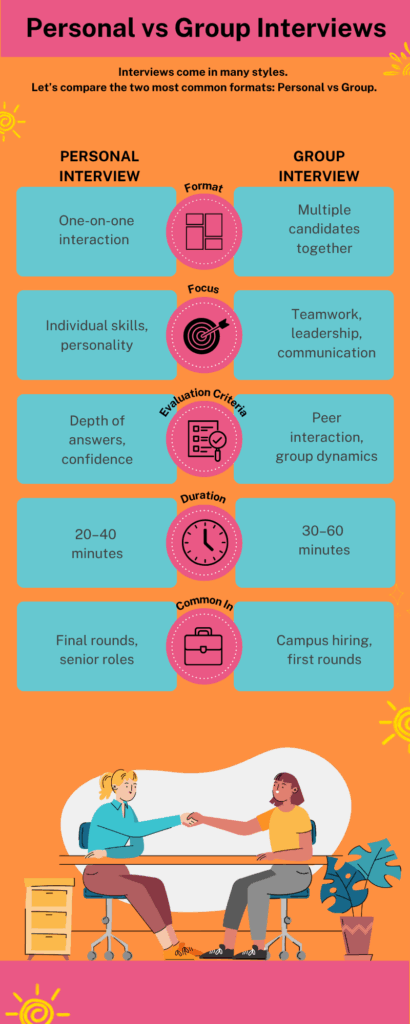
Group Interview – Multiple candidates at once
Behavioral Interview – Based on past actions (e.g., STAR method)
Case Interview – Solve real-life or hypothetical problems
Telephonic/Video Interview – Remote interview over phone or video
Example: In a panel interview, three managers may ask you questions one after another.
Tip: Know the format in advance so you can prepare accordingly!
A personal interview is a one-on-one conversation between you and the interviewer to assess your skills, personality, and suitability for a role.
Example: An HR manager asks about your strengths, goals, and experience.
Tip: Be honest, stay confident, and keep your answers clear and relevant.
I handle stress by staying calm, breaking tasks down, and focusing on one thing at a time.
Example: During a tough exam week, I made a simple plan and stuck to it.
Tip: Stay steady and don’t overthink!
You should hire me because I’m eager to learn, reliable, and always give my best. I’m ready to contribute and grow with the team.
Example: I once helped my team finish a project early by staying focused and organized.
Tip: Be honest and show your enthusiasm!
The biggest interview mistakes are being late, not preparing, giving unclear answers, or sounding negative.
Example: Forgetting the company’s name can hurt your chances.
Tip: Be on time, prepare well, and stay positive!