

Understanding your gross salary is the first step to making informed financial decisions in your career. Many employees see a figure on their offer letter but aren’t always sure what it really means. Gross salary isn’t just your basic pay; it includes allowances, bonuses, and other benefits before any deductions are made.
In today’s competitive job market, knowing what gross salary means can help you compare job offers, negotiate better pay, and plan your finances more effectively. This guide will explain what gross salary is, what’s included, and why it matters for your financial health both professionally and personally.
When you join an organization, the employer has to pay you a certain amount in exchange for your services. This salary includes deductions and benefits that you will get from the company. If you are an employee in an Indian company, you might be looking to know the gross salary meaning. This is important as it will help you understand the major difference between gross salary and what you get in-hand.
It is the full amount that the employees get from the organization in exchange for their services. It is the total amount inclusive of the deductions and additional benefits. This has income from all sources. It does not limit itself to any one source of income.
It is important to ensure accurate calculation of the same. It includes taxes and other expenses. The calculation is based on several factors. It may include job role, experience, industry, and company policies.
The factors affecting gross income calculation are as follows:
Let’s consider an example to understand the method of calculation. Suppose an employee’s basic salary is Rs. 50,000 per month, and they receive a house rent allowance of Rs. 10,000 per month and a transport allowance of Rs. 5,000 per month. The employee also receives a bonus of Rs. 25,000 and a health insurance benefit of Rs. 5,000 per month.
The formula for calculation for this employee would be as follows:
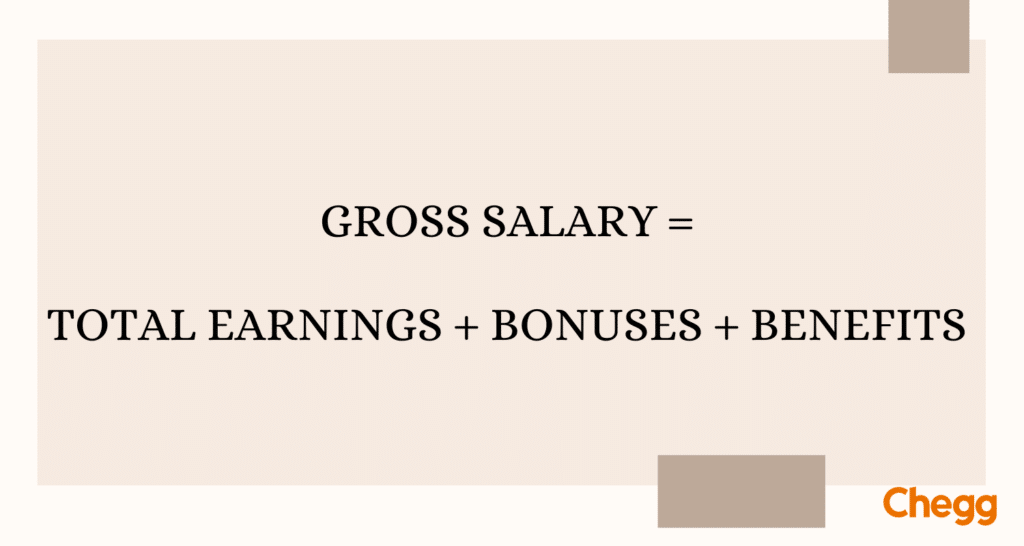
Gross Salary = Basic Salary + House Rent Allowance + Transport Allowance + Bonus + Health Insurance Benefit
Gross Salary = ₹50,000 + ₹10,000 + ₹5,000 + ₹25,000 + ₹5,000 = ₹95,000 per month

Employees need to know the process of calculation. This helps them avoid any unnecessary problems in their salary calculation. The process will help you understand what is your actual salary and what will be your take-home salary.
Employees and employers need to perform appropriate calculations. This makes it easier for them to manage their finances. Therefore, they will be able to plan their savings, budget, and expenses.
While calculating, it is important to comply with the latest regulations. If you are not calculating as per the law, it can hamper your taxes. Moreover, you might as well be in legal trouble for it. When you calculate properly, you will avoid making any rash decisions in terms of your finances. Therefore, you will be able to avoid any legal and financial consequences for their taxable income.
Cost to Company (CTC) represents the total amount an employer spends on an employee in a year. It includes gross salary, benefits, and additional perks such as bonuses, provident fund (PF), gratuity, health insurance, and other allowances. While CTC may appear high, the take-home salary is often lower due to deductions like taxes, PF contributions, and other statutory deductions. Understanding the difference between CTC, gross salary, and net salary is essential for salary negotiations and financial planning. Employees should analyze their CTC structure carefully to ensure they maximize benefits and optimize their earnings effectively.
CTC (Cost to Company) is the total amount an employer spends on an employee. However, CTC is different from gross salary.
Example:
If an employee’s CTC is ₹7 LPA:
Then, Gross Salary = ₹7,00,000 – (₹50,000 + ₹25,000) = ₹6,25,000 per year
Many people often use the terms gross salary and net salary interchangeably. However, it is important to know that these are different concepts.
| Gross Salary | Basic Salary |
| It is the total amount an employee receives without any deductions. | It is the main salary or core salary that an employee receives. |
| It includes overtime pay, allowances, and bonuses. | It includes overtime pay, allowances, and bonus. |
| Gross Salary | Net Salary |
| The employee will receive the complete amount. The salary does not hold deductions. | Net salary is the final amount that an employee receives. It is the amount after all the deductions. The net salary is therefore the amount an employee gets from the employer. |
| The formula for calculation: Gross Salary= Basic Salary + House Rent Allowance + Extra Allowances | The formula for net salary calculation: Net Salary= Gross Salary – Income Tax – Provident Fund – Professional Fund |
It is important to keep these concepts from the initial stages of applying for the job.
Read more: Salary Breakup, Structure, and How it Affects In-hand Salary
Consider an example to know how taxes and salary deductions can impact the net salary. Suppose an employee’s gross salary is Rs. 60,000 per month. After taxes, contributions, and deductions, the net salary could be Rs. 45,000 per month. This means that Rs. 15,000 is deducted from the employee’s gross salary, leaving them with a net salary of Rs. 45,000. These deductions may include:
In India, income tax is a progressive tax. It’s more an employee earns, the higher the percentage of income tax they will have to pay.
Every employee must pay a percentage of their salary fund to Social Security Contributions. These contributions can reduce an employee’s net salary.
Some companies offer health insurance benefits to their employees. The premium for this insurance is deducted from the employee’s gross salary.
Employees can reduce their taxable income through various deductions:
The Union Budget 2025, presented by Finance Minister Nirmala Sitharaman, has introduced notable revisions to income tax slabs under the new tax regime. Effective from April 1, 2025, for the financial year 2025-26, these changes aim to streamline taxation and provide relief to taxpayers across various income groups. The updated tax slabs under the revised regime are as follows:
| Taxable Income (Rs.) | Tax Rate (%) |
|---|---|
| 0 – 12,00,000 | Nil |
| 12,00,001 – 16,00,000 | 15% |
| 16,00,001 – 20,00,000 | 20% |
| 20,00,001 – 24,00,000 | 25% |
| Above 24,00,000 | 30% |
Gross salary plays a crucial role in financial planning as it serves as the foundation for budgeting, savings, and investment decisions. It includes all earnings before deductions like taxes, provident fund contributions, and other deductions. Understanding gross salary helps individuals assess their actual earnings, plan monthly expenses, and set long-term financial goals.
A clear grasp of gross salary components also enables better tax planning, ensuring maximum savings under applicable exemptions. Whether planning for a home, education, or retirement, knowing your gross salary helps in making informed financial choices that align with your aspirations.
You must also learn the calculation process on your own. Once you receive the offer letter, you can apply the formulas and calculate them by yourself. You must see what additional benefits the company is offering you. Since it is important to comply with the law, in case of any discrepancies, you can reach out to HR.
Understanding the full meaning of gross salary helps you make better career and financial choices. By recognizing what it includes, such as allowances, bonuses, and other benefits, you can evaluate job offers more effectively and ensure you are paid fairly.
Keep in mind that gross salary is only the starting point. Knowing how it differs from your net take-home pay helps you plan your budget, savings, and long-term financial goals. With this knowledge, you’ll be ready to make decisions that support your professional growth and personal financial security.
Evaluate numerous career choices to choose the right career path for yourself. Dive into our guide on Career Advice.

Gross salary is the total amount an employee earns before any deductions like taxes, provident fund, or insurance. It includes basic pay, allowances, bonuses, and other benefits provided by the employer in the compensation package.
Your gross salary is the total money you earn before any deductions such as taxes, provident fund, or insurance. It includes your basic pay, allowances, bonuses, and other benefits offered by your employer as part of your pay.
A gross salary of ₹15,000 means you earn ₹15,000 each month before any deductions, such as taxes, provident fund, or insurance. This amount includes your basic pay plus any allowances, bonuses, or other benefits you receive.
Gross Salary = Basic Salary + Allowances + Bonuses + Other Benefits
Basic pay is the standard part of your salary that makes up the basis of your earnings. It does not include allowances, bonuses, or benefits. Basic pay is used to figure out other components like allowances and deductions. Typically, it stays the same.
Basic pay is often about 40 to 50% of the CTC, but this is not a strict rule. The percentage can change based on company policy, industry standards, and compensation structure. Employers create salary components differently for each role.