When people search for what is GST Council is, they are essentially looking for the body that manages India’s most transformative tax reform, the Goods and Services Tax (GST). Introduced in 2017, GST replaced multiple indirect taxes levied by the Centre and States, bringing uniformity and efficiency to the tax system. At the heart of this framework lies the GST Council, the decision-making authority that recommends tax rates, exemptions, rules, and regulations to ensure the smooth implementation of GST across the country.
The Council promotes cooperative federalism by uniting the Union and State governments on a common platform for tax-related deliberations. It simplifies compliance, prevents tax overlapping, and ensures fair revenue distribution between the Centre and States.
Constitutionally, the GST Council was established under Article 279A through the 101st Constitutional Amendment Act of 2016. By harmonizing taxation policies nationwide, the GST Council has become an indispensable institution in India’s economic and fiscal governance.

The GST Council is India’s apex body responsible for overseeing the implementation and smooth functioning of the Goods and Services Tax (GST). It was established under Article 279A of the Constitution in 2016 under the 101st Constitutional Amendment Act. The Council consists of the Union Finance Minister as Chairperson and the Finance Ministers of all States and Union Territories as members.
Its primary role is to make recommendations on GST-related matters, including tax rates, exemptions, threshold limits, and dispute resolution between the Centre and States. By harmonizing tax policies, the Council ensures a uniform and efficient tax system across the country, avoiding double taxation and promoting cooperative federalism. It also focuses on simplicity, transparency, and fairness, benefiting businesses, consumers, and governments. Since its inception, the GST Council has played a vital role in shaping India’s indirect tax regime, making it one of the most critical institutions in the nation’s economic governance.
India had a complex indirect tax system before introducing the Goods and Services Tax (GST). The Center and States levied multiple taxes like excise duty, service tax, VAT, octroi, and entry tax separately. This caused cascading taxes, higher costs, and administrative challenges for businesses and consumers.
To address these issues, a unified tax system, “one nation, one tax,” was proposed, subsuming most indirect taxes under GST. Since taxation involves the Union and the States, a common decision-making body was needed. The GST Council, established under Article 279A of the Constitution through the 101st Constitutional Amendment Act, 2016, was created on September 15, 2016. It ensures cooperative federalism, uniform policies, fair revenue distribution, and a transparent, efficient, and business-friendly tax system.
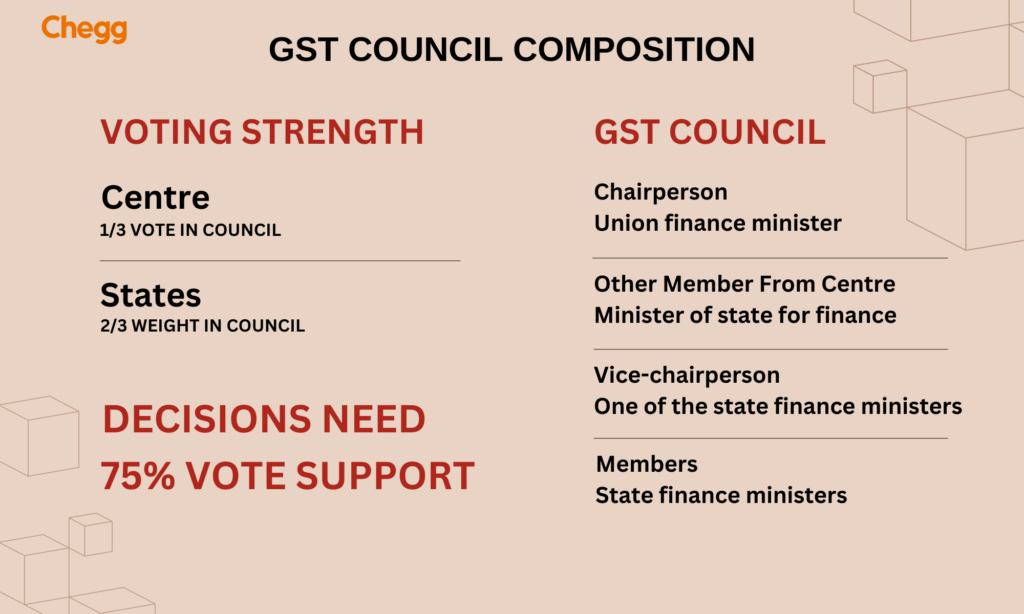
The GST Council has a carefully designed structure that balances the interests of the Union and the States. Its composition reflects the principle of cooperative federalism, ensuring that both levels of government participate in key tax-related decisions.
The Union Finance Minister acts as the Chairperson of the GST Council, and the Union Minister of State for Finance/Revenue serves as a member, representing the Central Government’s role in indirect taxation. This ensures that the Centre plays a guiding role in policy formulation.
Every State Finance Minister (or any minister nominated by the State Government) is a member of the Council. Similarly, Union Territories with legislatures such as Delhi, Jammu & Kashmir, and Puducherry are represented by their respective Finance or Taxation Ministers. This inclusive composition ensures that all States and UTs with legislative powers have a direct say in GST-related decisions.
The administrative backbone of the Council is its Secretariat, located in New Delhi. The Secretary (Revenue) from the Ministry of Finance is the Ex officio Secretary. They are assisted by an Additional Secretary and four Commissioners who manage coordination, documentation, and execution of the Council’s decisions.
A unique feature of the GST Council is its voting pattern. The Centre has one-third of the voting power, while all the States together hold two-thirds. No decision can be passed without consensus between the two sides. This arrangement prevents unilateral decision-making and promotes collaborative governance, making the Council a true reflection of India’s federal spirit.
The GST Council plays a central role in ensuring the smooth functioning of the Goods and Services Tax system in India. Its responsibilities cover many areas, from framing laws to maintaining federal balance. Understanding these functions is essential for anyone studying or researching GST.
One of the Council’s primary functions is to frame and recommend GST laws, rules, and regulations. It decides tax rates for goods and services, exemptions, thresholds, and compliance procedures. By creating uniform policies across all States and Union Territories, the Council ensures that businesses and consumers face a consistent and transparent tax environment.
The GST Council also acts as a dispute resolution authority. In cases where disagreements arise between the Centre and States regarding tax issues or revenue-sharing, the Council provides a platform for discussion and consensus. This function helps maintain harmony among States and prevents legal or administrative conflicts that could disrupt the tax system.
Another crucial role is revenue distribution. The Council recommends sharing GST revenue between the Centre and the States to ensure fairness and financial stability. It also proposes structural reforms in the GST framework to simplify procedures, reduce compliance burdens, and make the system more efficient.
The decisions of the GST Council directly impact both businesses and consumers. Clear tax rules and standardized rates reduce compliance complexities and lower operational costs for businesses. For consumers, a well-regulated GST system ensures transparency in pricing, avoids multiple taxation, and often leads to lower prices of goods and services.
The GST Council derives its authority from Article 279A of the Constitution, which grants it extensive powers to regulate the Goods and Services Tax in India. Its constitutional powers include recommending tax rates, exemptions, threshold limits, and dispute resolution. The Council can also suggest amendments to GST laws and rules to ensure uniformity and efficiency across all States and Union Territories.
Apart from its regular powers, the GST Council has special powers to address exceptional situations. For example, it can recommend a cess on particular goods in case of natural calamities or extraordinary financial needs. Additionally, the Council is critical in resolving disputes between the Centre and the States, preventing conflicts that could disrupt the tax system. These powers make the Council highly flexible and responsive in India’s fiscal governance.
Unlike ordinary tax authorities, the GST Council is a constitutional body with legislative-like powers. While entities such as the Central Board of Indirect Taxes and Customs (CBIC) implement tax laws, the GST Council frames the rules, decides rates, and manages revenue-sharing policies. This makes it unique compared to other tax bodies in India, as it functions both as a policy-making and dispute-resolution institution, balancing the interests of the Centre and the States.

| Feature | GST Council | CBIC (Central Board of Indirect Taxes & Customs) | State Tax Authorities |
|---|---|---|---|
| Nature | Constitutional body (Article 279A) | Administrative & regulatory authority | Administrative & regulatory authority |
| Primary Role | Frames GST laws, recommends tax rates, revenue-sharing, dispute resolution | Implements GST laws, collects taxes, enforces compliance | Implements GST laws within the state, collects SGST, ensures compliance |
| Decision-Making Power | Legislative-like powers; requires consensus of Centre & States | Executes policies; limited policy-making | Executes policies; limited policy-making |
| Special Powers | Recommend cess for calamities, resolve inter-state disputes | None; operational only | None; operational only |
| Federal Balance | Voting power: Centre (1/3), States (2/3) ensures cooperative federalism | Does not represent States; under Union Ministry | Represents only the State; no decision on Centre policies |
| Scope | Nationwide policy framework and reforms | Tax administration & enforcement | Tax administration & enforcement within the state |
The GST Council follows a structured decision-making process to ensure fairness and cooperative federalism. For any meeting to be valid, a quorum of at least one-third of the total members must be present, including representatives of the Centre and at least half of the States or Union Territories with legislatures. This ensures broad participation before key decisions are made.
Decisions in the Council are taken through voting, with a unique weightage system. The Central Government holds one-third of the total voting power, while all the States together hold two-thirds. This arrangement ensures that no decision can be imposed unilaterally by the Centre, preserving the federal structure and protecting State interests.
Although voting is the formal mechanism, the Council generally strives for consensus. Meetings involve detailed discussions on rates, exemptions, and rules, allowing members to negotiate and align their positions. Only when consensus is not possible does the formal voting procedure come into play. This approach promotes cooperation, transparency, and stability in India’s GST framework, making the decision-making process democratic and efficient.
The GST Council meets regularly to review and decide on matters related to the Goods and Services Tax, ensuring smooth implementation across India. While the Constitution does not prescribe a fixed schedule, the Council typically meets four to six times yearly, depending on emerging issues, amendments, or policy requirements.
The Union Finance Minister and representatives from all States and Union Territories with legislatures attend each meeting. The meetings provide a platform to discuss tax rates, exemptions, compliance procedures, and dispute resolutions. Decisions are made through consensus whenever possible, with formal voting used if required.
Over the years, the Council has made several important decisions, such as rationalizing tax rates, exempting certain essential goods, and introducing sector-specific reforms. These meetings are crucial for maintaining uniformity, fairness, and transparency in India’s GST system, benefiting both businesses and consumers.
The 56th GST Council meeting in September 2025 introduced significant reforms to simplify India’s Goods and Services Tax structure. The Council consolidated the previous four-tier tax system into a streamlined three-tier structure: 5%, 18%, and 40%, abolishing the 12% and 28% slabs. Most items have transitioned to the 5% or 18% categories, while a new 40% tax rate was introduced for “demerit” or “sin” goods, including tobacco products, pan masala, and online real-money gaming.
These decisions reflect the government’s broader strategy to simplify the GST system, enhance compliance, and provide relief to households and businesses. The GST Council aims to make the taxation framework more transparent, fair, and efficient by rationalizing tax rates, exempting essentials, and addressing sector-specific concerns. Regular meetings and updates ensure that emerging economic challenges and industry concerns are addressed promptly and cooperatively.

The GST Council is a key institution in India’s tax system, ensuring that the Goods and Services Tax functions smoothly and efficiently. Its decisions impact every State and Union Territory, businesses of all sizes, and millions of consumers. By harmonizing policies and promoting cooperation between the Centre and States, the Council strengthens India’s economy and supports transparent taxation.
The GST Council ensures a uniform taxation system across all States and Union Territories. Harmonizing tax rates and policies eliminates multiple layers of taxation, reduces the cascading effect, and promotes efficiency in trade and commerce.
A key feature of the Council is its emphasis on cooperative federalism. Representatives from the Centre and all States participate in decision-making, ensuring that tax policies respect regional interests while maintaining national priorities.
The Council contributes significantly to the ease of doing business. Standardized rules, clear tax slabs, and uniform compliance procedures simplify businesses’ operations, reducing administrative burdens and costs.
The GST Council plays a vital role in curbing tax evasion by recommending monitoring mechanisms, standardizing invoicing, and ensuring compliance. These measures strengthen revenue collection and create a fair, transparent taxation environment.
Through these functions, the GST Council supports economic growth and promotes transparency, efficiency, and cooperation in India’s indirect tax system.
Despite its cooperative federalism framework, the GST Council sometimes faces disagreements between the Centre and States. Conflicts can arise over tax rates, exemptions, or revenue-sharing, especially when States feel their financial interests are not adequately addressed. Resolving these disputes requires careful negotiation and consensus-building.
Another significant challenge is the timely compensation to States for revenue losses due to GST implementation. Although the Constitution mandates a compensation fund for five years, delays in disbursal or differences over calculation methods have occasionally led to tensions between the Centre and certain States.
The GST system is dynamic, with frequent updates to tax rates, rules, and compliance procedures. While these changes aim to simplify taxation, they often create confusion for businesses and require continuous adaptation, increasing compliance burdens and administrative workload.
Although the Council is designed to ensure federal balance, there is occasional criticism of perceived Central dominance. With the Centre holding one-third of voting power and setting the agenda, some States argue that their concerns may not always receive equal attention.
These challenges highlight the need for continuous dialogue, transparency, and effective coordination to maintain the efficiency and fairness of India’s GST system.
The GST Council is a key institution in India’s indirect taxation system, serving as the apex decision-making body for the Goods and Services Tax. Established under Article 279A of the Constitution, it brings together representatives from the Centre and all States to ensure uniform tax policies, rational rates, and fair revenue distribution. Its main functions include framing laws, resolving disputes, recommending reforms, and promoting cooperative federalism, making it crucial for economic stability and growth.
The Council has been instrumental in simplifying the tax structure, enhancing transparency, easing business compliance, and curbing tax evasion. Consensus-driven decision-making balances the interests of the Centre and the states, creating a fair and efficient taxation environment.
Looking ahead, the GST Council’s role remains vital. It will continue to adapt tax policies to emerging sectors and economic challenges, ensuring harmonized taxation and fiscal cooperation and supporting sustainable growth, business efficiency, and financial stability across India.
Read More:-
The GST Council is India’s top decision-making body for GST. It comprises the Centre and State representatives and is responsible for recommending tax rates, exemptions, and rules and ensuring uniform and fair taxation across the country.
In India, there is only one GST Council, the apex body responsible for GST policy-making. It includes representatives from the Centre and all States/Union Territories with legislatures.
The Union Finance Minister of India heads the GST Council. According to the latest information, Smt. Nirmala Sitharaman holds the position.
Article 279A of the Indian Constitution establishes the GST Council as a constitutional body. The Constitution’s One Hundred and First Amendment introduced the Goods and Services Tax (GST).
India implements four types of GST: IGST, SGST, CGST, and UTGST. This classification clearly distinguishes between interstate and intrastate transactions, simplifying tax administration and ensuring transparency in the collection and distribution of goods and services taxes.