
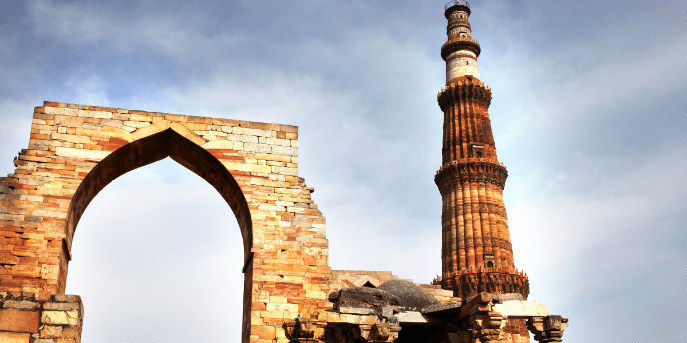
The Qutub Minar is an ancient and towering monument located in Delhi, India, standing as a symbol of the country’s rich history, architectural brilliance, and cultural heritage. It was built by Qutb-ud-din Aibak, the first ruler of the Delhi Sultanate, in 1193. This historic site offers a glimpse into the fascinating past, inviting visitors and history enthusiasts to explore its significance. Beyond its height, the surrounding Qutub complex serves as a treasure trove of stories from medieval India, helping us stay connected to the way things were centuries ago.
If you’re looking for Qutub Minar reviews & information for a school project, it’s an ideal subject that offers insights into India’s past and the craftsmanship involved in its construction. Visiting this iconic monument allows one to admire its intricate designs, appreciate the efforts that went into building it, and understand why it remains a cornerstone of Indian culture today.
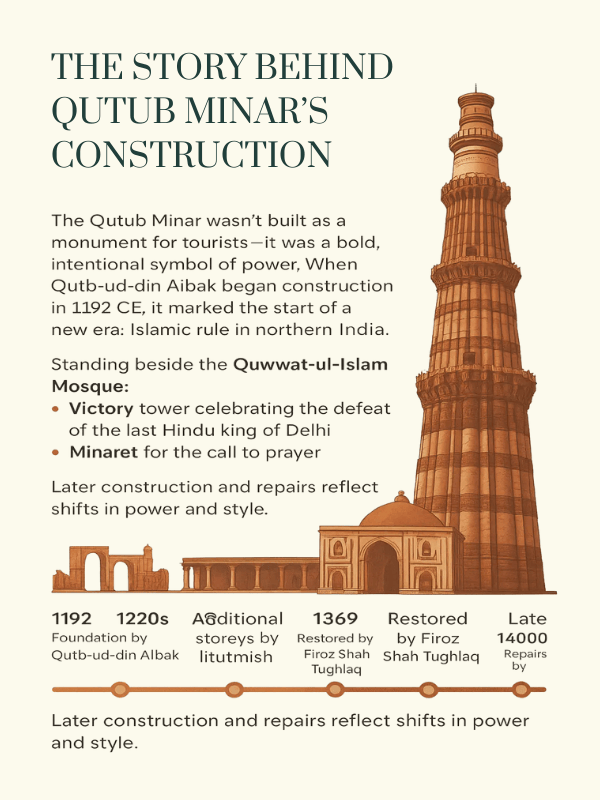
The Qutub Minar is one of India’s most famous historical monuments, located in Delhi. It is renowned for its impressive height and intricate architectural details. Here’s a brief history inside Qutub Minar:
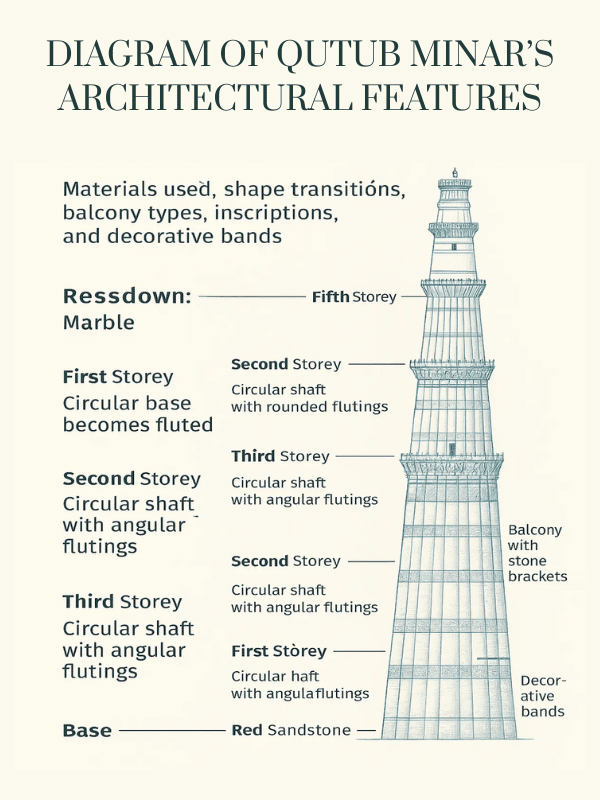
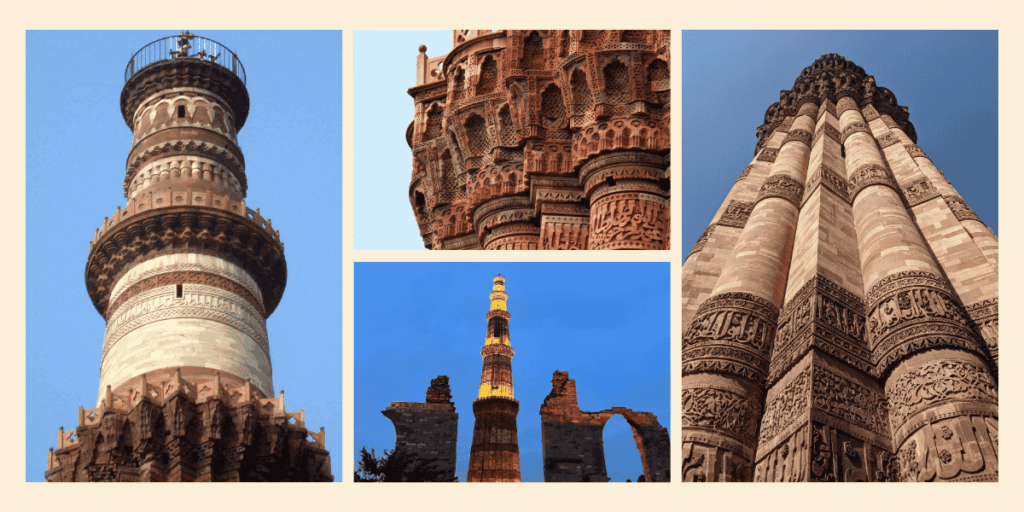
The architecture of the Qutub Minar is a remarkable example of Indo-Islamic architecture, showcasing a blend of Islamic and Indian styles. Here are some key features and elements of its architectural design:
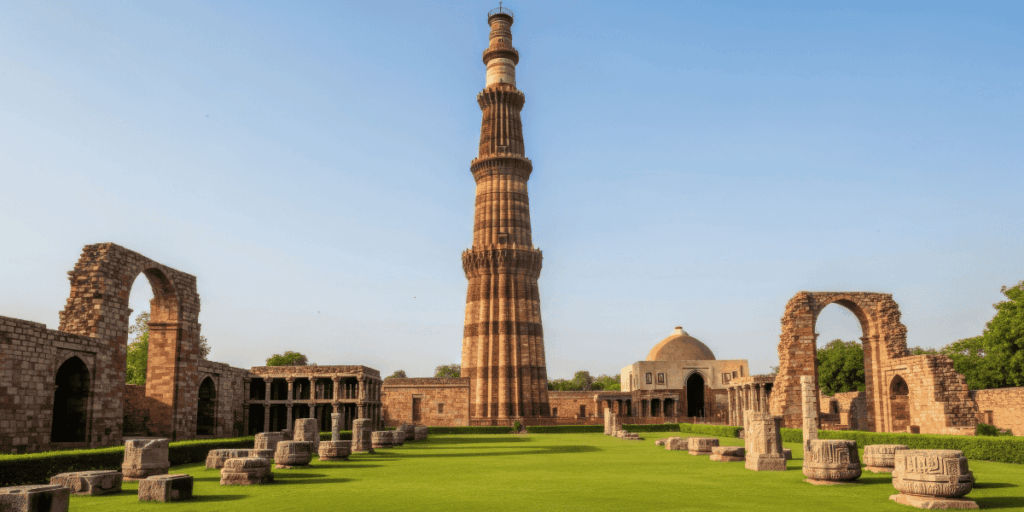
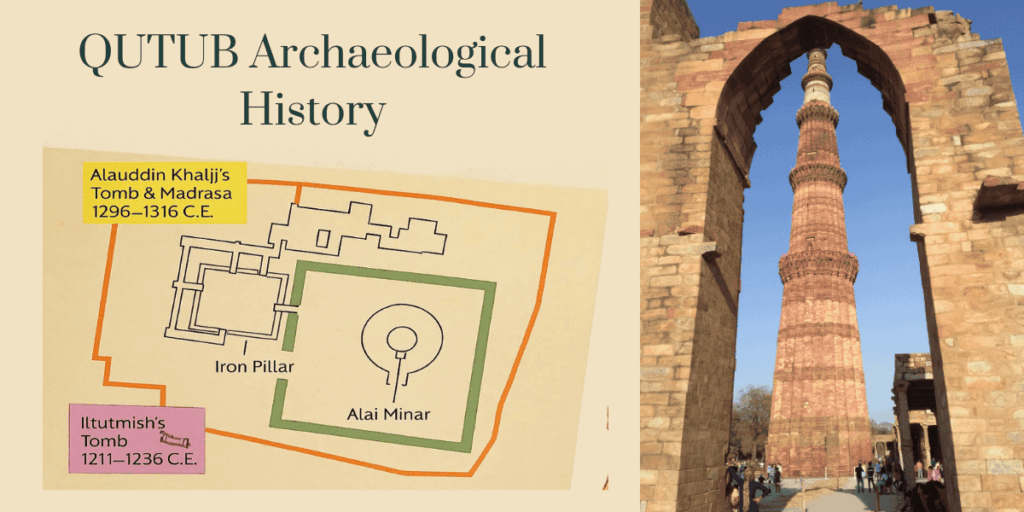
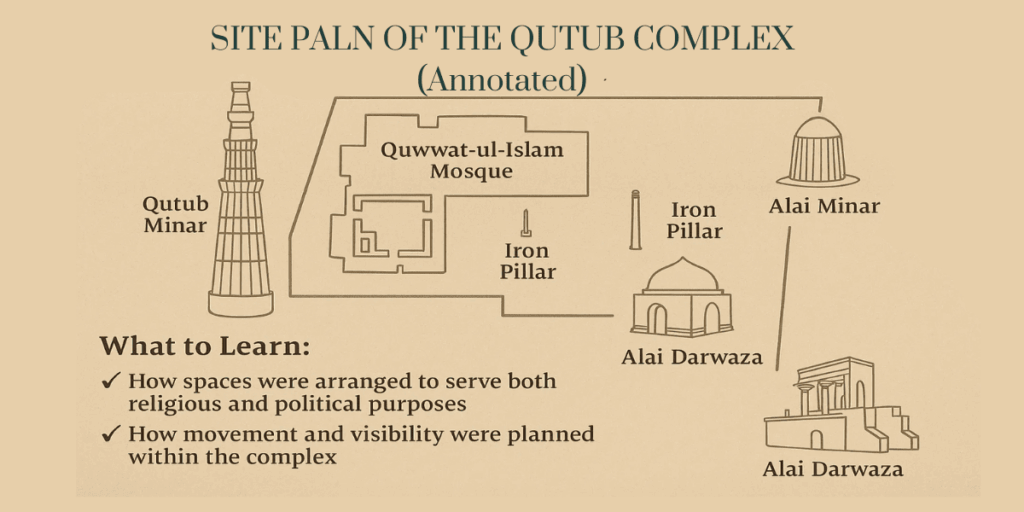
The Qutub Complex has many important historical buildings, with the Qutub Minar being the most famous. In the middle of the complex is the Qutub Mosque, a 13th-century mosque that helps us learn about the early Delhi Sultanate. The layout of the complex was built in stages by different rulers. The main structures in the complex are:
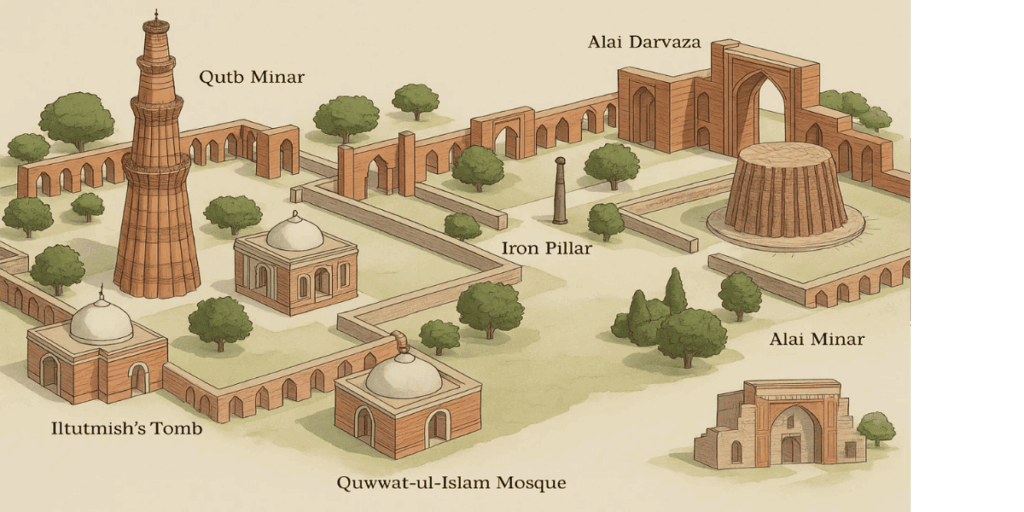
Alai Darwaza, commissioned by Alauddin Khilji circa 1311, served as the entrance to the Qutub Minar and Quwwat-ul-Islam mosque, standing at over 14 meters tall with meticulously proportioned arches. Notably, it boasts one of the earliest scientifically precise domes in Indian architecture, marking a significant advancement for the period.
Khilji initially intended to erect a tower surpassing the Qutub Minar in height but redirected efforts toward constructing this grand entrance instead. Crafted by skilled Turkic artisans, the gateway features pointed arches and ornate lotus motifs, showcasing the fusion of red sandstone and white marble characteristic of Khilji’s era.
Inscriptions in Arabic adorn its walls, reflecting the influence of Islamic architectural principles. Alai Darwaza, with its arcade-style construction and innovative use of technology, stands as a testament to the artistic and engineering prowess of medieval Indian craftsmanship.
Qutb-ud-din Aibak built the Quwwat-ul-Islam Mosque, Delhi’s first mosque after the Islamic conquest, in 1193 CE to commemorate his triumph over the Rajputs. He intentionally selected the conquered Rajput fortress of Qila Rai Pithora for the mosque’s site to assert Islam’s supremacy over the newly conquered land.
The mosque’s architectural design is similar to Aibak’s Adhai-din-ka Jhonpra at Ajmer, Rajasthan. The mosque is notable for its smaller side arches and its floral and religious motif-adorned wall. The mosque, which was constructed in the Corbel style, has different arch patterns. Temple mandap domes are on display in the entry courtyard, and under the reign of Iltutmish, Muslim craftsmen took over the role of Hindu masons, giving the sanctuary’s arches a more Islamic appearance.
A masterpiece of metalwork, the iron pillar was first built at Udayagiri by Chandragupta II Vikramaditya in 402 AD. Anangpal moved it to its present location in the tenth century CE. At its current site, Anangpal aimed to incorporate it into a Vishnu temple. Standing on Vishnupada hill, the pillar bears an inscription in Sanskrit written in Brahmi script from the 4th century AD, explaining its original function as a Vishnudhvaja.
The Minar has experienced significant damage over the years, primarily due to natural events such as lightning strikes and earthquakes. One of the most notable incidents occurred in 1803 when an earthquake caused substantial harm to the structure. In response to these challenges, several rulers undertook restoration efforts to preserve this iconic monument.
Firoz Shah Tughlaq, during his reign in the 14th century, is known to have made significant repairs to the minar, reinforcing its stability. Later, Sikander Lodi also contributed to its restoration, ensuring that the tower remained an enduring symbol of India’s architectural heritage.
Today, the Qutub Minar is a well-maintained historical site that attracts thousands of visitors from around the globe. Its preservation allows people to appreciate not only its grandeur and intricate design but also its historical significance as a testament to India’s rich past. Visitors can explore the surrounding Qutub Minar reviews & complex, which includes other historical structures, making it a popular destination for tourists and history enthusiasts alike.
In 1993, UNESCO honored the Qutub Minar complex with World Heritage Site status, recognizing its global cultural significance. This accolade underscores its historical importance and cements its status as a custodian of India’s shared heritage. The Qutub Festival annually injects modern energy into the monument’s enduring cultural significance, showcasing India’s rich diversity through performances at this venue. In 1993, UNESCO honored the Qutub Minar complex with World Heritage Site status, recognizing its global cultural significance.
This accolade underscores its historical importance and cements its status as a custodian of India’s shared heritage. The Qutub Festival annually injects modern energy into the monument’s enduring cultural significance, showcasing India’s rich diversity through performances at this venerable site. This festival highlights that the Qutub Minar remains an active symbol of inspiration, education, and unity. This festival highlights that the Qutub Minar remains an active symbol of inspiration, education, and unity.
The Qutub Minar is an architectural marvel and the tallest brick minaret in the world. Here are its key height and dimension details:
A court petition alleged that 27 temples were demolished to construct the Quwwat-ul-Islam mosque within the Qutub Minar complex. Later, the petition was dismissed under the Places of Worship (Special Provisions) Act, 1991. However, the petitioner contested this decision, arguing that the dismissal based on the 1991 Act was incorrect as the Qutub Minar complex falls under the Ancient Monuments and Archaeological Sites and Remains (AMASR) Act of 1958.
The Archaeological Survey of India (ASI) countered, stating that when initially designated as a protected monument in 1914, the Qutub Minar complex was not classified as a place of worship. ASI clarified that a monument’s classification is determined at the time of its protection and that the petitioner cannot now attempt to alter the monument’s classification.
Qutub Minar is accessible to the public every day, offering a window into history from 7 am to 5 pm. Early mornings or evenings are optimal to make the most of your visit, with cooler temperatures, enhancing the exploration and strolls. The entrance fees are ₹35 for Indian visitors, while children below 15 enter for free. Foreign tourists are charged ₹550 per person. Additionally, there’s a nominal fee of ₹25 for both still and video cameras for non-commercial use.
Qutub Minar online tickets can be purchased through the official online ticketing portal of the Archaeological Survey of India (ASI). Simply select the preferred date, time, and ticket type to complete the booking.
| Aspect | Details |
| Location | Mehrauli, Delhi |
| Status | UNESCO World Heritage Site |
| Timings | 7:00 am to 5:00 pm; every day |
| Aspect | Details |
| Entry Fee | ₹35 for Indians; ₹550 for foreigners; free for children below 15 years |
| Still Camera | ₹25 (non-commercial use) |
| Video Camera | ₹25 (non-commercial use) |
| Nearest Metro Station | Qutab Minar |
A trip to the Qutub Minar in Delhi is a captivating journey through time. Here’s a glimpse of the architectural gems that await you:
The Qutub Minar Complex is more than just a collection of monuments; it’s a portal to a bygone era. Each structure whispers stories of empires, faith, and artistic mastery. So, on your next visit to Delhi, don’t miss this opportunity to step back in time.
When answering “where is Qutub Minar,” the answer can be different based on the choice of transportation. Yet, some of the easiest ways to reach Qutub Minar, you take the Delhi Metro to the Qutub Minar Metro Station on the Yellow Line, which is about 2.2 km away from the monument. Alternatively, you can use buses or taxis from various parts of Delhi, with Anand Vihar ISBT and Nizamuddin Railway Station being nearby transport hubs.
| Place | Distance from Qutub Minar |
|---|---|
| Tomb of Adham Khan | 850 m |
| Dargah of Hazrat Khwaja Qutbuddin Bakhtiar Kaki | 1.4 km |
| Zafar Mahal | 1.5 km |
| Jahaz Mahal | 2 km |
| Hauz-i-Shamsi | 2.1 km |
| Jamali Kamali Mosque and Tomb | 3.3 km |
| Tomb of Balban | 3.3 km |
Qutub Minar stands as a monumental bridge connecting India’s past with its present. Its towering presence, intricate designs, and rich history make it a must-visit destination for history enthusiasts and travelers alike. A visit to this UNESCO World Heritage Site offers a glimpse into the country’s diverse cultural tapestry and architectural excellence.
Read More:
Qutub Minar was initiated by Qutb-ud-din Aibak in 1199 but only the first story was completed. His successor, Iltutmish, completed it around 1220.
On December 4, 1981, a devastating stampede took place inside the Qutub Minar, claiming the lives of 45 people and leaving 21 others injured. The tragedy unfolded due to a sudden power failure that left the spiral staircase in complete darkness, triggering panic among the visitors amid an already overcrowded environment.
Qutub Minar does not have a day in the week when it is closed. It only has visiting hours of 7 AM to 5 PM during the day; there are opportunities like nighttime exploration, where it is open from 8 PM to 10 PM.
Yes, one can visit the Qutub Minar at night during specific occasions or days when it is allowed. Generally, a time slot of 7 PM to 10 PM is the time when such experiences may be allowed.
Qutub Minar, a UNESCO World Heritage Site in Delhi, is primarily constructed using red sandstone and marble. The intricate carvings and alternating materials showcase the craftsmanship of its era, blending robust structure with aesthetic elegance.
No one is buried inside the Qutub Minar itself; however, within the Qutub Minar complex, the tomb of the Delhi Sultanate ruler Iltutmish is located, as is the tomb of Alauddin Khalji. The Qutub Minar itself is a minaret or victory tower, and not a tomb.