The human historical era unfolds across a vast timeline, from prehistory to the modern world. It has witnessed innovation, conflict, exploration, and societal transformations that have continuously shaped our identity. The periods of history each carry unique characteristics and developments that have left lasting impacts on civilization. Understanding the historical period enables us to grasp key events and transitions that influenced our present-day societies.
In this blog, we’ll explore the major ages in history, delve into the different time periods, and understand the evolution from the earliest Paleolithic Age time period to the complexities of the modern era.
When discussing major divisions in the human timeline, historians often refer to the following four periods of history:
These four periods of history help us classify human development and understand the evolution of society, governance, and thought.

Prehistory refers to the time before written documentation, stretching back around 3.4 million years to the emergence of written language. It marks the evolutionary journey from early hominids to modern humans and is divided into the Stone Age, which includes the Paleolithic, Mesolithic, and Neolithic periods.
The Paleolithic Age time period was defined by the use of rudimentary stone tools, mastery over fire, and early artistic expression through cave paintings. These early acts of creativity served as the first sources of history, offering a glimpse into early human beliefs and their deep connection to nature.
This time period saw humans adapting to new environments and innovating tools for hunting and gathering. Communities began developing semi-permanent shelters and diversifying their diets, showing early signs of social progress.
The Neolithic Revolution marked a critical shift in human history. Communities transitioned from nomadic lifestyles to settled agrarian societies, resulting in the domestication of plants and animals, permanent settlements, and the eventual rise of cities and civilizations.
Ancient history, one of the first well-documented historical period, spans from around 3000 BCE to 500 CE. This time period includes the Bronze Age, Iron Age, and the Classical Era, where human societies advanced in governance, language, philosophy, and infrastructure.
Medieval history, also known as the Middle Ages or Post-Classical Era, spans from the 5th to the 15th century CE. This historical era followed the fall of the Western Roman Empire and preceded the Early Modern Ages.
Intellectual Flourishing: Despite the term “Dark Ages,” the Middle Ages witnessed major progress in medicine, philosophy, and architecture in both the Islamic world and Europe.
Feudal Systems & Religious Influence: The medieval period was defined by feudalism, chivalry, and the dominance of religious institutions like the Catholic Church and Islamic Caliphates.
Rise of Kingdoms & Empires: New kingdoms emerged, establishing the political landscapes of modern Europe and Asia.
The Early Modern Era emerged post-15th century, bridging the medieval period and the modern age. It was an age of discovery, innovation, and ideological change.
Understanding this history time period is essential to track the evolution of human thought, from religious dogma to reason and logic.
Also read:-
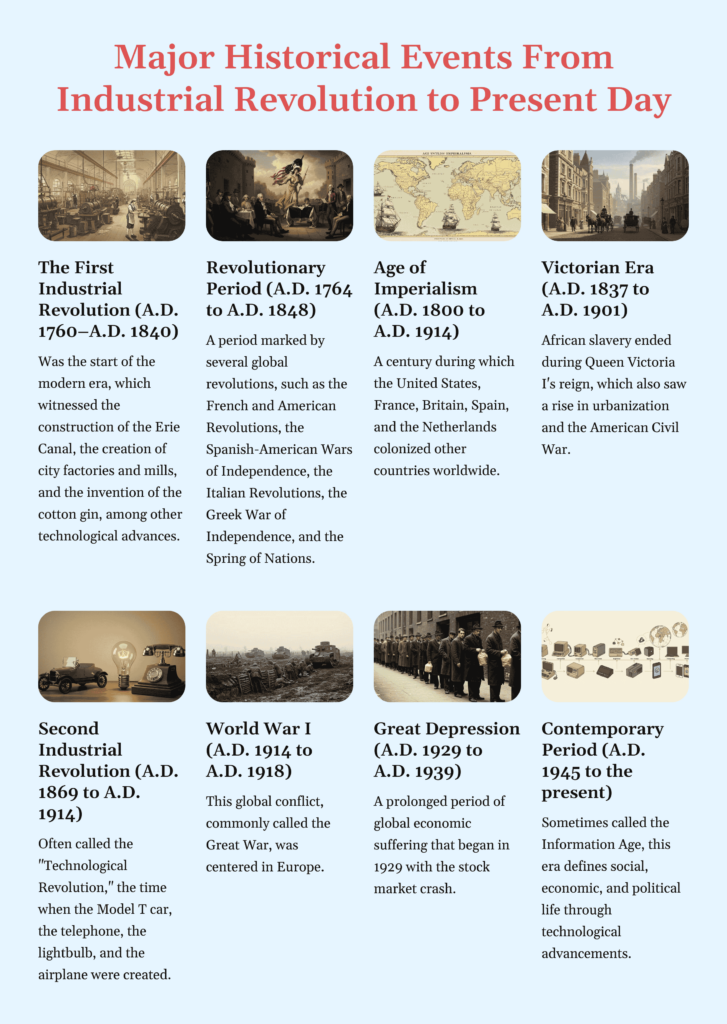
Among all the historical periods, modern history stands out for its pace of change. From the 18th century onward, the world saw the rise of industrialization, revolutions, and globalization.
Each time period within the modern age, from the Enlightenment to the digital age, builds on earlier historical legacies while introducing unprecedented innovations..
Think of the different historical periods not as isolated segments but as a continuous narrative where one historical era flows into the next. From the Paleolithic Age time period to the modern era, each time periods hold invaluable lessons, achievements, and turning points that shape our world today.
Understanding the sources of history, the 4 periods of history, and their global contexts fosters deeper insight into who we are and where we’re heading. By studying each historical period, we not only preserve our past but also illuminate our path forward.
I. Ancient Times (marked by early civilizations like Egypt, Greece, and Rome),
II. Middle Ages (feudalism, knights, and influence of the Catholic Church),
III. Early Modern Era (scientific revolution, exploration), and
IV. Modern Era (industrial revolution, world wars, globalization).
The correct order of ages in history is as follows:
Stone Age
Bronze Age
Iron Age
Middle Ages
Modern Age
The Middle Ages witnessed feudalism, the influence of the Catholic Church, and social divisions. It eventually led to the Early Modern Era, characterized by scientific progress, exploration, and a shift in societal perspectives.
Scientific advancements and explorations during these periods of history led to global connections and changed conventional beliefs, triggering a transition from medieval to modern ideas.
The various periods in Prehistory marked milestones in tool-making, the transition from nomadic to settled communities, and the emergence of agriculture, crucial for human evolution.