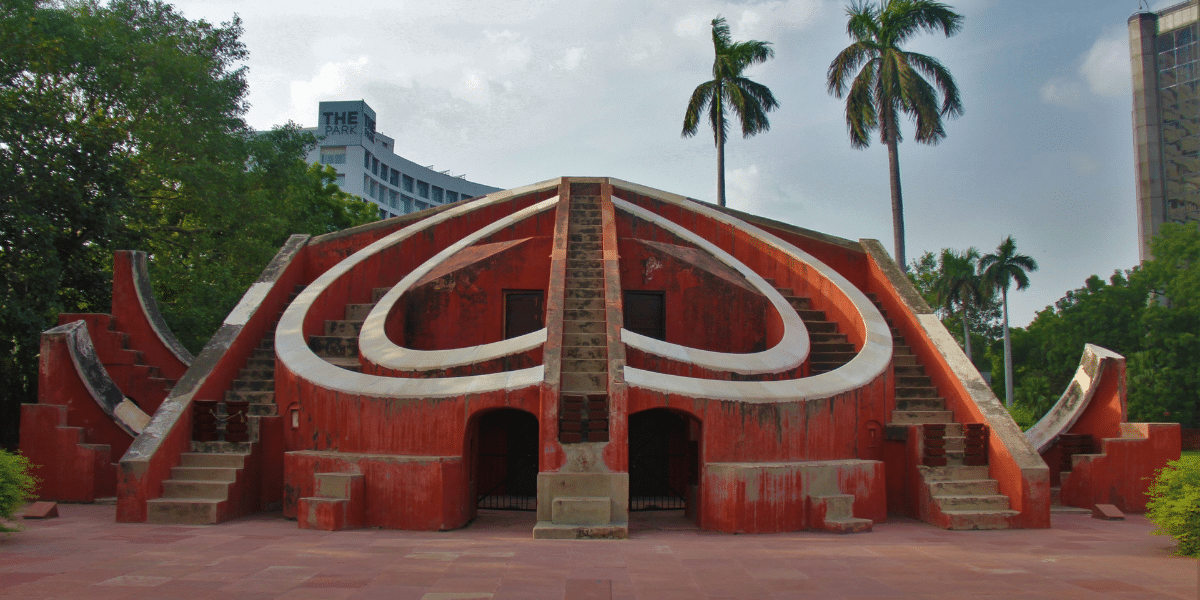
Jai Singh’s observatories are unique architectural and scientific marvels, each differing in size, design, and construction while serving the same purpose studying celestial movements. The first observatory was built in Delhi in 1724, followed by the most elaborate one in Jaipur in 1728. Smaller observatories were later established in Benares, Ujjain, and Mathura, though the Mathura site was demolished before 1857. Among them, the Delhi and Jaipur observatories are the most famous, attracting tourists and astronomy enthusiasts alike. These Jantar Mantars feature massive instruments designed to measure time, track stars, and predict celestial events. The Jaipur Jantar Mantar, a UNESCO World Heritage Site, houses the world’s largest stone sundial, showcasing the brilliance of ancient Indian astronomy and engineering.
Jantar Mantar(JM), a term drawn from the Sanskrit words yantra (instrument) and mantra (system), encapsulates the essence of this unique arrival. It isn’t always just a cluster of building wonders but a perfect mixture of scientific instruments and artistic ingenuity. These instruments were carefully made to measure time, expect celestial events, and interpret cosmic symphony.

Maharaja Sawai Jai Singh II, built Jantar Mantar. The creation of Jantar Mantar changed into a joint effort that worried skilled workers, architects, and astronomers under the direction of Maharaja Jai Singh II. Knowledge combined to create India’s silent astronomical history instruments.
The well-known historical site known as the Jantra Mantra houses some tools that were once used to study the motions of spacecraft in the heart of Jaipur, Rajasthan. It is an extension of the first astronomy class in Delhi. But the one in Rajasthan is bigger and more significant. This place has a well-known and lengthy past.
Sawai Jai Singh II, the Rajput monarch credited with founding the city of Jaipur, started constructing Yantra Mantra Jaipur, primarily focusing on the observatory, without a set date. Conversely, he built Delhi’s first stone astronomical observatory in 1724. Jai Singh built five more such observatories in various places, but the Jaipur one remains the best and possibly the most ideal of the lot.
By 1728, they had completed nearly all of the instrumentation in the Jaipur area, and construction continued until 1738. About twenty-three astronomers set up the apparatus in Jaipur; however, in 1735, Jai Singh replaced the Delhi location as the principal astronomer, a post he retained until he died in 1743 due to the kingdom’s shifting political landscape.
Here are a few lines and Interesting Facts about Jantar-Mantar:
| Aspect | Details |
|---|---|
| What is it? | Astronomical observatory complex |
| Founded by | Maharaja Sawai Jai Singh II |
| First built | 1724 in Jaipur |
| Locations | Jaipur, Delhi, Ujjain, Varanasi, Mathura |
| Purpose | To observe astronomical positions and time |
| Key Instruments | Samrat Yantra (sundial), Jayaprakash Yantra |
| Architectural Style | Indian architecture with astronomical precision |
| Cultural Significance | Blend of science, art, and heritage |
Scattered across the numerous landscapes of India, there are 5 Jantar Mantar in India. However, the primary focus is on Jaipur and Delhi, where these cosmic wonders most effectively represent the spirit.
| Jantar Mantar Location | Year Established | Key Feature |
|---|---|---|
| Jaipur | 1724 | Largest stone sundial |
| Delhi | 1724 | Instruments for time |
| Ujjain | 1725 | Star observation tools |
| Varanasi | 1737 | Astronomical structures |
| Mathura | 1728 | Smaller observatory |
Jaipur has the most famous Jantar Mantar. Maharaja Jai Singh II invented this artistic and scientific observatory. Visitors can explore astronomical measuring with massive tools like the Samrat Yantra and Jai Prakash Yantra.

Delhi holds one of the lesser-known Jantar-Mantars, yet its historical importance is obvious. Maharaja Jai Singh II built the Yantra Mantra for science. It quietly recalls India’s astronomical history in the city.

Nestled in the city of Ujjain, the Yantra Mantra here holds a unique focus on timekeeping and eclipse forecasts. Maharaja Jai Singh II’s gift to Ujjain’s observatories promotes science.

Mathura’s Jantar Mantar, while less known, serves as a tribute to old Indian astronomy knowledge. Astronomy thrives through generations, as Maharaja Sawai Madho Singh II’s telescope shows.
Varanasi, on the banks of the holy Ganges, this Jantar-Mantar was built by Maharaja Jai Singh II. Varanasi’s ancient observatory reflects its spirituality and cosmic views.
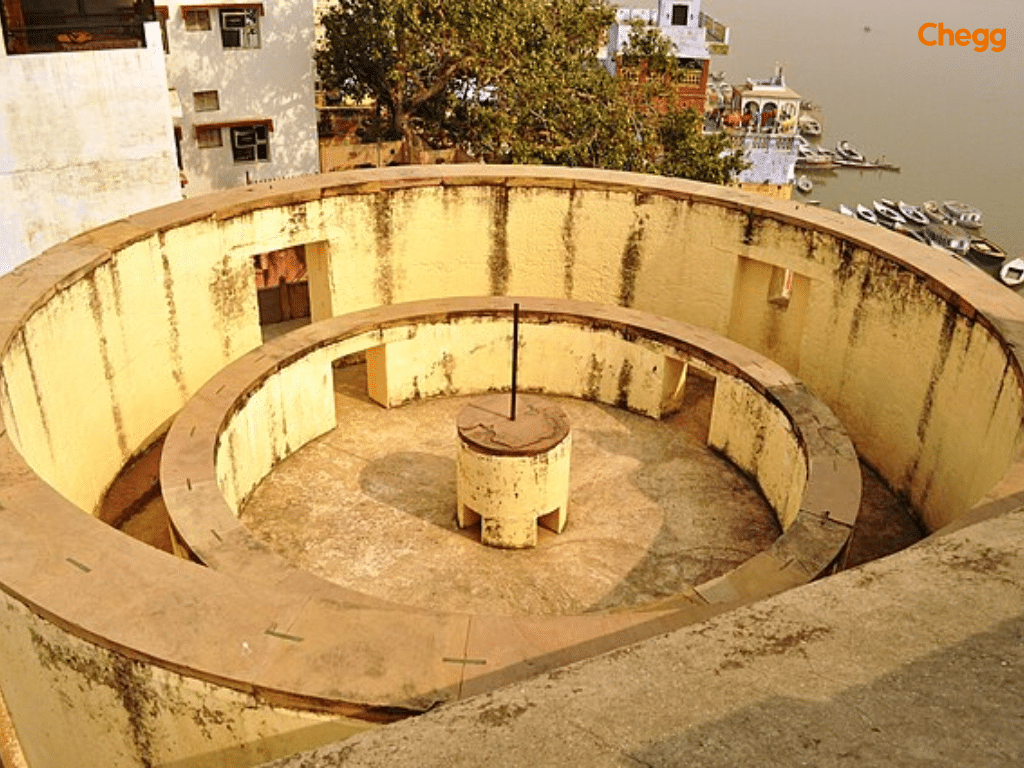
The Jantar Mantar in Mathura, one of the five astronomical observatories built by Maharaja Jai Singh II in the 18th century, stands as a lost marvel of India’s scientific heritage. Unlike its counterparts in Delhi, Jaipur, Ujjain, and Varanasi, the Mathura observatory succumbed to time and neglect, leaving only fragments of its architectural brilliance.
Stepping into the heart of Jantar Mantar is akin to getting into a world in which the past and present meet. Inside Jantar Mantar, an exciting set of instruments lay asleep, ready to show the secrets of the cosmos.
The Jantar-Mantar buildings are living reminders of scientific curiosity and architectural genius. Architecture, astronomy, and our insatiable quest for cosmic knowledge inspire human inquiry.
Jantar Mantar Jaipur’s observatories are architectural marvels made of stones that tell stories of human creativity. These buildings combine technology and art with finesse. Maharaja Sawai Jai Singh II built this Yantra Mantra in the 18th century. Yantra Mantra Jaipur’s entry fee is not too costly; it depends on the tourism authorities of Jaipur. Jantar Mantar’s timings also depend on Jaipur’s tourism authority.
Jantar Mantar instruments are superbly precise and creative. The makers of these equinox and solstice prediction instruments are scientific.
Jai Singh aimed to create astronomical instruments that were more accurate and permanent than traditional brass tools. His solution was to build massive stone and masonry structures, leading to the creation of observatories that remain unparalleled today.
One of the most remarkable instruments is the Samrat Yantra, a giant sundial that:
The Chakra Yantra, a large circle clock-like instrument, shows how heavenly measurements affect time. The instrument’s flexibility is shown by radial marks and circular rings measuring axial and horizon coordinates.
Jantar Mantar’s instruments become more complicated with the Rama Yantra. The device’s shadows helped astronomers determine the sun’s ecliptic plane role, making the observatory more systematic.
Jantar-Mantar influenced art, literature, and film. Its celestial drawings and history influence many art forms.
Jantar Mantar Delhi’s grandeur inspires artists and writers. Writing represents travel and human interest. Painting its complex machines shows their beauty and technical complexity.
The silver screen has accepted Jantar Mantar’s mystery. Movies honor their history and intellectual surprise. Cinema transports viewers to JM’s sunny gardens and wind instruments.
Jantar Mantar’s memory must be preserved for generations. The conservation and maintenance of the instruments are still in question.
Balancing restoration and preservation is hard. Keep instruments clean and useful with knowledge and dedication.
Keeping JM’s influence goes beyond physical restoration. Digital replicas, instructional programs, and interactive experiences are being created to preserve its wisdom for future generations.
Jantar Mantar is located in the heart of Delhi, making it easily accessible by public transport or taxi. Visitors can choose from different travel options depending on their arrival point.
| Arrival Point | Travel Mode | Details |
|---|---|---|
| Indira Gandhi International Airport | Taxi | Take the Airport Express Line to New Delhi Metro Station, then a rickshaw or walk 1.5 km |
| Metro + Rickshaw/Walk | Take Airport Express Line to New Delhi Metro Station, then a rickshaw or walk 1.5 km | |
| New Delhi Railway Station | Metro (Yellow Line) | Travel to Rajiv Chowk Station, then walk to Jantar Mantar |
To visit Jantar-Mantara in Delhi, you’ll need to purchase a ticket. Here’s a breakdown of the ticket prices:
These are just a few of the many tourist spots near Jantar-Mantar, Delhi. With so much to see and do, you will surely have a memorable visit to this historic city.
Nestled in the heart of India’s capital, Jantar Mantar has evolved from an ancient astronomical site into the nation’s most prominent stage for democratic expression. This historic ground consistently generates headlines, becoming a vital pulse point for societal issues. Its strategic location ensures that every peaceful gathering, whether for farmers’ rights or social justice, is amplified into major news stories, capturing the nation’s attention.
The space thrives as the definitive venue for disciplined, non-violent demonstrations, embodying the very spirit of civil discourse. The constant stream of coverage from this location does more than just report events; it transforms local grievances into subjects of national debate, holding a mirror to the government and society alike. This synergy between physical protest and digital news cycles secures Jantar Mantar’s enduring role as a fundamental pillar of Indian democracy, where peaceful assembly consistently shapes public conversation and policy.
The Jantar Mantar, with its 19 remarkable instruments, was built by Sawai Jai Singh II, the Rajput king and founder of Jaipur, and completed in 1734. It is home to the world’s largest stone sundial and is recognized as a UNESCO World Heritage Site. Located close to Jaipur’s famous landmarks like Hawa Mahal and City Palace, this Ptolemaic positional observatory allows astronomical observations with a single instrument. Its unique structures represent the equatorial, ecliptic, and horizon-zenith systems, showcasing advanced scientific knowledge of the time.
The highlight is the Kamala Yantraprakara, the largest sundial in the world, designed to directly convert coordinates between two systems, although it was damaged during the 1800s. Initial restoration efforts were overseen by amateur astronomer Major Arthur Garrett, who served as Assistant State Engineer for Jaipur District, ensuring that this architectural and astronomical marvel continues to stand as a testament to India’s scientific and cultural heritage.
Read More:-
The world’s largest stone sundial, the Samrat Yantra, is located at Jantar-Mantar in Jaipur. It offers precise time measurements, with its shadow moving about 1 millimeter per second.
Jai Singh II of Jaipur built five Jantar-Mantar in the early 18th century: New Delhi, Jaipur, Ujjain, Mathura, and Varanasi.
Maharaja Jai Singh II, the ruler of Jaipur, built the Jantar Mantar observatories in the early 18th century to study astronomy and celestial movements.
It is in Jaipur, Rajasthan. The work ended in 1723. It has 19 architectural astronomical devices.
At Jantar-Mantar, time is measured using large sundials like the Samrat Yantra. The shadow cast by the gnomon (the triangular part of the sundial) moves along marked lines, indicating the local time with remarkable precision.
The Ram Yantra, designed in pairs like the Jai Prakash, primarily measures the altitude and azimuth of celestial objects, including the sun.
The Jantar-Mantar in Mathura was destroyed. It was one of the five original observatories built by Maharaja Jai Singh II, but it no longer exists due to neglect and urban development over time.
Jantar Mantar is famous for its collection of 19 architectural astronomical instruments built by Maharaja Sawai Jai Singh II in the 18th century. It houses the world’s largest stone sundial and is a UNESCO World Heritage Site. Known for precise astronomical observations, it was used to study time, celestial bodies, and planetary movements, making it one of India’s most significant scientific and cultural landmarks.
Jantar Mantar is located in five cities of India Jaipur, Delhi, Ujjain, Mathura, and Varanasi. Maharaja Sawai Jai Singh II built these astronomical observatories between 1724 and 1735 to study celestial movements, measure time, and improve astronomical calculations. Among them, the Jantar Mantar in Jaipur is the largest and is recognized as a UNESCO World Heritage Site.
The Samrat Yantra, the world’s largest sundial, is located at the Jantar Mantar observatory in Jaipur, Rajasthan, India.