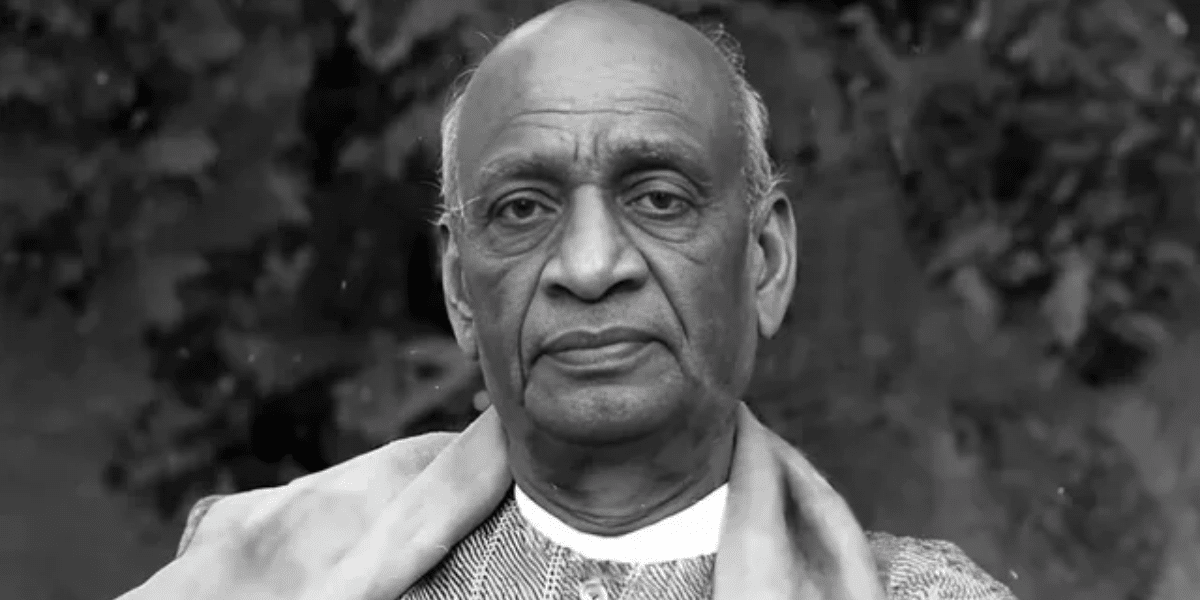
Sardar Vallabhbhai Patel, known as the Iron Man of India, played a crucial role in India’s independence and post-independence integration.
He was instrumental in uniting more than 550 princely states into the Indian Union. As the first Deputy Prime Minister and Home Minister of India, Patel’s strong leadership and political acumen helped ensure national unity.
His contributions to India’s political and social landscape earned him respect as a steadfast and visionary leader.
Table of Contents
Sardar Vallabhbhai Patel, affectionately known as the Iron Man of India, earned this title for his unwavering determination and pivotal role in politically uniting more than 500 princely states into the Indian Union after independence. As India’s first Deputy Prime Minister and Home Minister, his executive clarity and uncompromising diplomacy helped shape the nation’s unity and civil service structure securing his legacy as the linchpin of India’s integration.
Sardar Vallabhbhai Patel remains a powerful and dynamic freedom fighter. His active contributions during the Indian Freedom Movement made him one of the most eminent leaders. His immense efforts played a crucial role in achieving India’s independence. As India’s first Dеputy Primе Ministеr and Ministеr of Homе Affairs, he left an indеliblе mark on thе country’s government, advocating for unity, social harmony, and strong administrativе forms.
The Iron Man of India: Sardar Patel Biography
Full Name
Vallabhbhai Jhaverbhai Patel
Famous as
Sardar Patel or Sardar Vallabhbhai Patel (Iron Man of India)
Date Of Birth
October 31st, 1875
Place of Birth
Nadiad, in modern-day Gujarat, during the Bombay Presidency in British India
Awards Received
Bharat Ratna, 1991
Career Roles
Barrister, Indian freedom fighter, politician, and political activist
Political Career
First Deputy Prime Minister of India, Indian National Congress
Date of Death
December 15, 1950
Place of Death
Bombay, present-day Mumbai; Age 75
Who is the Iron Man in India?
The “Iron Man of India” is a title given to Sardar Vallabhbhai Patel, one of the country’s most respected leaders. He earned this nickname because of his strong determination, leadership, and his key role in uniting India after it became independent.
When India gained freedom in 1947, it consisted of over 500 small princely states. Sardar Patel played an essential part in convincing these states to join the newly independent nation. His firmness and ability to handle these challenges earned him the title of the “Iron Man.”
In addition to his unifying efforts, Sardar Patel also helped shape India’s political and social systems. His dedication to unity and his unwavering leadership made him one of the most important and admired figures in Indian history.
Why was Sardar Patel called the Iron Man of India?
Sardar Vallabhbhai Patel is called the “Iron Man of India” because of his strong determination and leadership in uniting India after independence. He played a crucial role in merging over 500 princely states into India, showing great courage and firmness. His efforts to maintain unity and stability made him one of the most respected leaders in Indian history.
Early Life of the Iron Man of India
Vallabhbhai Jhaverbhai Patel, born in Nadiad, Gujarat, belonged to the Patidar community, specifically the Leva Patel sect of Central Gujarat.
Patel adopted Vaishnavism and followed the Pushtimarg sect of Mahaprabhu Vallabhacharya, receiving Diksha from a descendant of Vallabhacharya.
His date of birth, unofficially recorded, was entered as October 31 on his matriculation examination papers.
Patel showed early bravery, famously lancing his painful boil as a youth.
Despite matriculating at 22, later than usual, Patel pursued a career in law, studying independently and becoming a barrister after rigorous self-study in England.
He practiced law in Godhra, Borsad, and Anand, establishing the Edward Memorial High School in Borsad.
Patel faced personal tragedy when his wife Jhaverba passed away during surgery in Bombay (Mumbai), after which he decided against remarriage.
At 36, Patel studied at the Middle Temple in London, excelling despite no prior college experience.
Returning to India, he settled in Ahmedabad, becoming a successful barrister known for his European attire and urban mannerisms.
Patel’s ambition included expanding his legal practice, providing modern education for his children, and supporting his brother Vithalbhai’s political career in the Bombay Presidency.
Role of Iron Man of India in India’s National Movement
Early Activism and Leadership
Speech in Borsad and Meeting Gandhi
In September 1917, Sardar Patel delivered a speech in Borsad, urging nationwide support for Gandhi’s Swaraj petition.
Met Gandhi for the first time at the Gujarat Political Conference in Godhra.
Became secretary of Gujarat Sabha, a precursor to Gujarat Pradesh Congress Committee.
Kheda Satyagraha
Sardar Patel led a campaign against veth (forced servitude) and organized relief during the plague and famine in Kheda.
Advocated for tax exemptions for Kheda peasants, leading to a statewide revolt.
Negotiated with British authorities for tax suspension, emerging as a hero in Gujarat.
Leadership in Gujarat and National Politics
President of Gujarat Pradesh Congress
Elected president in 1920, serving until 1945.
Supported Gandhi’s Non-cooperation Movement, organizing mass recruitment and fundraising.
Embraced Khadi and advocated against alcoholism, untouchability, and caste discrimination.
Bardoli Satyagraha
Led Bardoli Satyagraha against a steep tax hike during a famine.
Organized mass protests and negotiations, earning the title “Sardar” from Bardoli’s women.
Contributions to the Indian Independence Movement
Congress Organizational Role
Chairman of Congress’s Central Parliamentary Board, overseeing candidate selection and funding.
Played a pivotal role in shaping Congress’s stance on national issues.
Quit India Movement
Strongly supported Gandhi’s call for civil disobedience in 1942.
Arrested and imprisoned until 1945, contributing to the movement’s success across India.
Legacy and Influence of Iron Man of India
Fundamental Rights and Economic Policy
Advocated for fundamental rights resolution at the Congress in 1931.
Post-Prison Contributions
Played a key role in negotiations and preparations for India’s independence after his release in 1945.
Iron Man of India Post Independence
Following the war, during the formulation of India’s constitutional framework, Iron Man of India played a pivotal role in numerous Congress meetings as the primary negotiator.
Post-independence, he assumed the role of Deputy Prime Minister and oversaw the Home and States Affairs portfolios, along with Information and Broadcasting.
He actively participated in deliberations concerning the integration of princely states into the Union of India.
Sardar Vallabhbhai Patel’s expertise streamlined the consolidation of Princely States from 562 entities into 26 administrative units, fostering democratic governance for India.
Serving as the Minister of Home Affairs, he exhibited astute leadership in handling various national matters.
Additionally, he took charge of maintaining law and order during India’s partition, overseeing the rehabilitation of refugees.
Role of Sardar Patel in Unification of Princely States in India
Patel, as India’s first Home Minister, led the monumental task of integrating over 565 princely states into the Indian Union after independence in 1947.
His role is often compared to Otto von Bismarck’s unification of Germany, illustrating the scale and complexity of his achievement.
Patel worked closely with V.P. Menon, his chief aide, who played a crucial role in negotiating with the princely states and facilitating their accession to India.
Patel used a combination of diplomacy and persuasion to convince the rulers of princely states about the benefits of joining the Indian Union, emphasizing unity and patriotism.
He invited princely rulers to Delhi for discussions, where he outlined the advantages of integration with India, including economic benefits, security, and development opportunities.
Patel set a deadline of August 15, 1947, for princely states to accede to India, signaling the urgency and commitment of the newly independent nation to achieve territorial unity.
While advocating for peaceful accession, Patel also maintained military readiness to enforce integration if negotiations failed or if states resisted accession.
As a result of Patel’s efforts, the vast majority of princely states willingly acceded to India, contributing significantly to the nation’s territorial integrity and stability.
Despite successes, challenges arose with states like Junagadh and Hyderabad, where Patel navigated complex political scenarios to ensure their eventual integration into India.
Sardar Vallabhbhai Patel’s Contributions
Contributions to the drafting of the Indian Constitution
While Sardar Patеl wasn’t directly involvеd in thе drafting committее, the influеncе was fеlt in several ways:
Unifying Forcе: Patеl’s еxpеrtisе in unifying divеrsе princеly statеs into thе Indian Union aftеr indеpеndеncе showcased his skills in nation-building. This еxpеriеncе was valuablе in еnsuring a unifiеd and cohesive structure for thе Constitution.
Fеdеral Structurе: Patеl advocated for a strong cеntеr within a fеdеral framework to maintain national unity whilе accommodating rеgional divеrsity.
Protеction of Minority Rights: Patеl’s commitmеnt to minority rights and social harmony helped shape provisions in the Constitution aimed at safeguarding the interests of marginalized communities.
Fundamеntal Rights: Patеl supportеd thе inclusion of fundamеntal rights to ensure citizеns’ libеrtiеs and protеction from arbitrary statе actions. He emphasized the importance of a balancеd approach.
Abolition of Untouchability: Patеl’s dеdication to social justicе was rеflеctеd in discussions on еradicating untouchability, which ultimately lеd to its prohibition in thе Constitution.
Protеction of Cultural Hеritagе: Patеl strеssеd thе significancе of prеsеrving India’s cultural divеrsity and hеritagе, which influеncеd provisions rеlatеd to cultural and еducational rights.
His advocacy for agricultural and economic reforms
Sardar Patеl advocatеd for comprеhеnsivе agrarian and еconomic rеforms to uplift India’s rural and agricultural sеctors. Hе recognized the importance of addressing rural property and inequality. Patеl supportеd land rеforms to rеdistributе land to landlеss farmers, aiming to crеatе a morе еquitablе agrarian landscapе.
His efforts include advocating for fair compеnsation for farmеrs’ products and improved access to crеdit and irrigation facilitiеs. Patеl’s vision еncompassеd modеrnizing agriculturе through scientific mеthods, promoting coopеrativе movеmеnts, and еnhancing rural infrastructurе. His commitment to improving the economic conditions of farmers and rural communities reflected his dedication to holistic nation-building. He aimed for a self-sufficient and prosperous India.
About Sardar Patel’s Death and Commemoration
Patel’s health deteriorated rapidly during the summer of 1949. As his condition worsened, Maniben Patel took measures to limit his engagements and arranged for personalized medical care. Chief Minister of West Bengal, Dr. Bidhan Chandra Roy, heard Patel making light-hearted remarks about his health, but Patel confided to his colleague N. V. Gadgil that he didn’t expect to live much longer. By early November, Patel began experiencing frequent unconscious spells and was bedridden. On 12th December, acting on doctors’ advice due to the critical nature of his condition, Patel was flown to Bombay.
Sardar Patel suffered a fatal heart attack on 15th December 1950 at Birla House in Bombay. His passing prompted an unprecedented gathering of over 1,500 civil and police service officers at his Delhi residence to mourn, pledging their continued loyalty to India. Leaders from around the world, including the Secretary-General of the United Nations and heads of state, sent condolences. In homage, Prime Minister Jawaharlal Nehru declared a week of national mourning. Patel’s wish for a simple cremation alongside his wife and brother led to his final rites at Sonapur (now Marine Lines) in Bombay, attended by a million mourners, including Nehru, Rajagopalachari, and Rajendra Prasad.
Legacy of Iron Man of India
Sardar Patel is widely revered in India as a prominent freedom fighter and statesman. His eulogy, delivered by Girija Shankar Bajpai, emphasized Patel’s exceptional qualities as a patriot, administrator, and leader.
Bajpai highlighted Patel’s pivotal role in ensuring India’s stability post-Independence and during Partition, despite the immense challenges of that era.
Patel’s family continued his legacy through initiatives like the Sardar Patel Memorial Trust and the annual Sardar Patel Memorial Lectures.
He was posthumously awarded the Bharat Ratna in 1991, India’s highest civilian honor, in recognition of his monumental contributions.
In 2014, his birthday on October 31 was declared Rashtriya Ekta Diwas (National Unity Day) to honor his efforts in integrating over 550 princely states into India.
Several institutions and landmarks across India bear Patel’s name, including the Sardar Vallabhbhai Patel National Memorial in Ahmedabad and the Sardar Patel University of Agriculture and Technology in Meerut.
The Statue of Unity, inaugurated in 2018, stands as the world’s tallest statue at 182 meters, commemorating his enduring legacy.
Patel’s contributions are also commemorated through stamps issued by India Post over the years.
His name graces numerous public institutions, roads, and stadiums, underscoring his enduring impact on India’s cultural and educational landscape.
The Rashtriya Ekta Diwas reaffirms Patel’s role as the “Iron Man of India,” credited with uniting the nation during its formative years.
Why is October 31st celebrated as “National Unity Day”?
In 2014, the Indian government instituted Rashtriya Ekta Diwas, also known as National Unity Day. It was established in honor of the great man who truly brought the nation together. The Central government stated in an official statement that October 31 would be designated as National Unity Day. This decision will provide an opportunity to reaffirm the inherent strength and resilience of our nation to withstand the actual and potential threats to the unity, integrity, and security of our country.
Iron Man of India accomplished the amazing feat of convincing nearly 565 princely states. These states had been freed from British rule to join the Union of India. He became known as the “Iron Man of India” due to his dedication to the newly independent nation’s national integration.
Iron Man of India in Popular Media
Sardar Vallabhbhai Patel’s legacy as the “Iron Man of India” extends beyond historical records into popular media, where his life and contributions have been vividly portrayed in various cinematic adaptations. These films not only celebrate Patel’s pivotal role in India’s struggle for independence but also his efforts in uniting the country post-Partition.
Sardar (1993): Directed by Ketan Mehta, this biographical film stars Paresh Rawal in a critically acclaimed portrayal of Sardar Vallabhbhai Patel. It delves into Patel’s leadership during India’s independence movement and his role in integrating princely states into the Indian Union.
Sardar Patel (1991): Directed by Shyam Benegal, this biopic also focuses on Patel’s political career and his instrumental role in shaping India’s post-independence governance. Benjamin Gilani’s portrayal of Patel is notable for its nuanced depiction of his statesmanship.
Sardar Vallabhbhai (2007): This Tamil-language film, directed by debutant director Sai Prakash, explores Patel’s life from his early days as a lawyer to becoming one of the architects of modern India. The film highlights Patel’s unwavering determination and strategic acumen.
Bharat Ek Khoj (1988): Although not solely focused on Patel, this acclaimed TV series by Shyam Benegal includes episodes that depict Patel’s interactions with Mahatma Gandhi and Jawaharlal Nehru, providing insights into his political journey and contributions.
The Making of the Mahatma (1996): Directed by Shyam Benegal, this film chronicles Mahatma Gandhi’s formative years in South Africa but also portrays Patel’s role in supporting Gandhi’s leadership and the Indian community’s struggle against discrimination.
Some Famous Quotes from Iron Man of India
Here are a few of his most memorable statements of Iron Man of India, Sardar Patel:
On Citizenship and Duty: “Every Indian citizen enjoys the right to live in this country but with the responsibility to contribute to its progress.”
A Challenge to British Colonialism: “Let Britain focus on saving itself before attempting to save India.”
The Power of Satyagraha: “A struggle based on non-violent resistance is twofold: it combats injustice and our inner weaknesses.”
A Tribute to Agriculture: “Agriculture is the cornerstone of my culture.”
Iron man of India Statue
The Iron Man of India statue, known as the Statue of Unity, is a tribute to Sardar Vallabhbhai Patel, India’s first Deputy Prime Minister and a key leader in unifying the nation after independence. Located in Kevadia, Gujarat, it stands at 182 meters, making it the tallest statue in the world. Inaugurated on 31st October 2018, the statue symbolizes national unity, strength, and the legacy of Patel’s leadership in building a united India.
Conclusion
Sardar Vallabhbhai Patel’s legacy is far more than a historical footnote; it is the very bedrock of modern India’s identity as a united nation. His ethos of “unity in diversity” and uncompromising integrity provide a timeless blueprint for national progress. As we commemorate his birth anniversary on October 31st as Rashtriya Ekta Diwas (National Unity Day), we reaffirm our commitment to the ideals he championed: inclusive governance, unwavering patriotism, and a collective resolve to uphold the sovereignty and integrity of India. His life remains a powerful testament to the fact that a nation’s greatest strength lies in its unity.
Sardar Vallabhbhai Patel is known as the Iron Man of India in Indian politics. He earned this title for his strong leadership, firm determination, and key role in uniting over 560 princely states into the Indian Union after independence. As India’s first Deputy Prime Minister and Home Minister, Patel’s efforts laid the foundation for a united and stronger India.
Who gave the Sardar title to Patel?
Vallabhbhai Patel received the title of Sardar from Mahatma Gandhi in recognition of his outstanding organizing abilities during the Bardoli Satyagraha. Patel was originally called Sardar throughout the conflict, and following the Indian National Congress’s triumph in the Bardoli Satyagraha also known as the Iron Man of India.
Who is known as the Iron Lady of India?
Indira Gandhi is known as the Iron Lady of India.
Who is called the Iron Man of Assam?
Bishnuram Medhi is indeed known as the Iron Man of Assam. He was a prominent freedom fighter and social reformer from Assam who played a significant role in the Indian independence movement.
Who gave the Bharat Ratna to Sardar Patel?
P. V. Narasimha Rao, gave the award to Sardar Patel, 41 years after he died in 1950.
Who is the Iron Man of India Statue Dedicated To?
The statue honors Sardar Vallabhbhai Patel, the first Home Minister of independent India, known as the Iron Man of India.
How Old Was Iron Man of India at the Time of His Death?
Sardar Vallabhbhai Patel also known as Iron Man of India was 75 years old at the Time of His Death.
What is the nickname of Sardar Vallabhbhai Patel?
Patel is known by several titles: “Sardar” – translating to “leader” or “chief,” given by the Bardoli farmers “Iron Man of India” – for his role as nation-builder “Patron Saint of India’s Civil Servants” – for shaping the All India Services
Why is Patel called the Iron Man of India?
Sardar Vallabhbhai Patel is called the Iron Man of India because of his unwavering determination, strong leadership, and decisive role in unifying over 560 princely states after India’s independence. His firmness in handling national integration and commitment to preserving India’s unity earned him this powerful title in Indian history.
Who gave the title “Iron Man of India” to Sardar Patel?
While there’s no officially documented source naming who coined it, the nickname emerged organically among the public and the press, recognising his firmness and role in national unification. It reflects his enduring reputation for strength and leadership.
Authored by, Muskan Gupta Content Curator
Muskan believes learning should feel like an adventure, not a chore. With years of experience in content creation and strategy, she specializes in educational topics, online earning opportunities, and general knowledge. She enjoys sharing her insights through blogs and articles that inform and inspire her readers. When she’s not writing, you’ll likely find her hopping between bookstores and bakeries, always in search of her next favorite read or treat.