In 2024, the Indian sex ratio 2024 stood at 100 women per 106.506 men, marking significant progress over the years. However, there remains a notable disparity across Indian states. In India, gender imbalance has been a considerable concern for a long time, affecting social stability and gender equity. Recent 2025 data reveal trends that point to progress and persistent issues in achieving gender balance.

The Indian sex ratio has gradually improved, with the estimated 2025 ratio at 100 women per 106.443 men, compared to 100 women per 106.5 men in 2024. This shift reflects positive outcomes from national efforts like Beti Bachao Beti Padhao and the PCPNDT Act, but deep-seated gender biases still challenge long-term balance. This blog explores national and state-level trends, rural-urban disparities, and projections shaping India’s demographic future.
The sex ratio refers to the number of females per 1,000 males in a given population. It is an important demographic indicator that reflects gender balance in society; for instance, a sex ratio of 1005 means 1,005 women for every 1,000 men.
India has been documenting population trends through the Census since 1881, making it one of the longest-running exercises of its kind. While the Census is conducted every ten years, the most recent comprehensive figures on sex ratio come from the National Family Health Survey (NFHS-5, 2019–21), since the official Census due in 2021 was delayed.
The sex ratio is generally calculated using the following formula:
Sex Ratio = (Number of Males / Number of Females) × 1000
Sex ratio refers to the proportion of males to females in a population. It can be categorized into four distinct types, each representing a different stage of human development:
| State / Union Territory | Indian Sex Ratio 2025 (Females per 1000 Males) | Notes / Interpretation |
|---|---|---|
| Kerala | 1,084–1,121 | Leads the nation with the best balance, reflecting strong literacy and social equality. |
| Rajasthan | 1,099 | Significant rise compared to past surveys, showing steady progress. |
| Bihar | 1,090 | Continues to improve, with noticeable gains over recent years. |
| Tamil Nadu | 1,088 | Maintains a stable and high ratio, especially in non-urban areas. |
| Manipur | 1,066 | Above India’s national average, showing a consistent trend. |
| Odisha | 1,060 | Improvements linked to better education and state initiatives. |
| Jharkhand | 1,053 | Positive results, particularly in communities with larger tribal populations. |
| Telangana | 1,045–988 | Largely stable; however, child sex ratio is lower at 933. |
| West Bengal | 1,045 | Nearly a 10% increase since the early 2000s; reflects steady progress. |
| Andhra Pradesh | 1,045 | Strong performance overall, with rural areas showing especially good ratios. |
| Chhattisgarh | 961–964 (Child Ratio) | Higher numbers among children, though overall ratio remains comparatively lower. |
| Mizoram | 971 (Child Ratio) | Child sex ratio is robust, while overall figures remain steady. |
| Meghalaya | 970 (Child Ratio) | Encouraging child ratio; comprehensive overall data still limited. |
| Arunachal Pradesh | 972 (Child Ratio) | Records the highest child sex ratio among all Indian states. |
| Assam | 950 (Approx.) | Shows more than 10% improvement over the 2001–2011 period. |
| Uttar Pradesh | 943 (Approx.) | Close to the national level, but pace of progress is slower. |
| Delhi (UT) | 866–956 | Among the weaker performers, though progress has been visible since the last decade. |
| Punjab | 846–879 (Child Ratio: 846) | Continues to face challenges of gender bias despite some improvements. |
| Haryana | 877–926 | Lowest among states; recent data shows a drop in sex ratio at birth to 910. |
| Puducherry (UT) | 1,037 | Stands as the best among Union Territories. |
| Andaman & Nicobar Islands (UT) | 968 (Child Ratio) | Child ratio remains strong; overall figure consistently above 900. |
| Lakshadweep (UT) | 900+ | Performs better than several other UTs, maintaining above-average levels. |
| Daman and Diu (UT) | 618 | Lowest in the country, showing deep-seated demographic imbalance. |
In 2025, the estimated Indian sex ratio stands at 100 women per 106.443 men, reflecting a slight improvement over previous years. This trend suggests progress in gender equity, influenced by government policies, improved access to healthcare, and shifting cultural attitudes. While challenges like sex-selective practices persist, data indicate India is moving gradually toward a more balanced population structure.
This improvement reflects ongoing efforts through government programs like Beti Bachao Beti Padhao, increased access to women’s healthcare, and greater female education. High-performing states like Kerala, Andhra Pradesh, and Chhattisgarh are expected to maintain strong sex ratios above 1,000.
However, challenges such as urban-rural disparity and gender-biased sex selection still affect the overall balance. These projections, while optimistic, reinforce the importance of policy consistency and community action to achieve India’s goal of a balanced sex ratio by 2030.
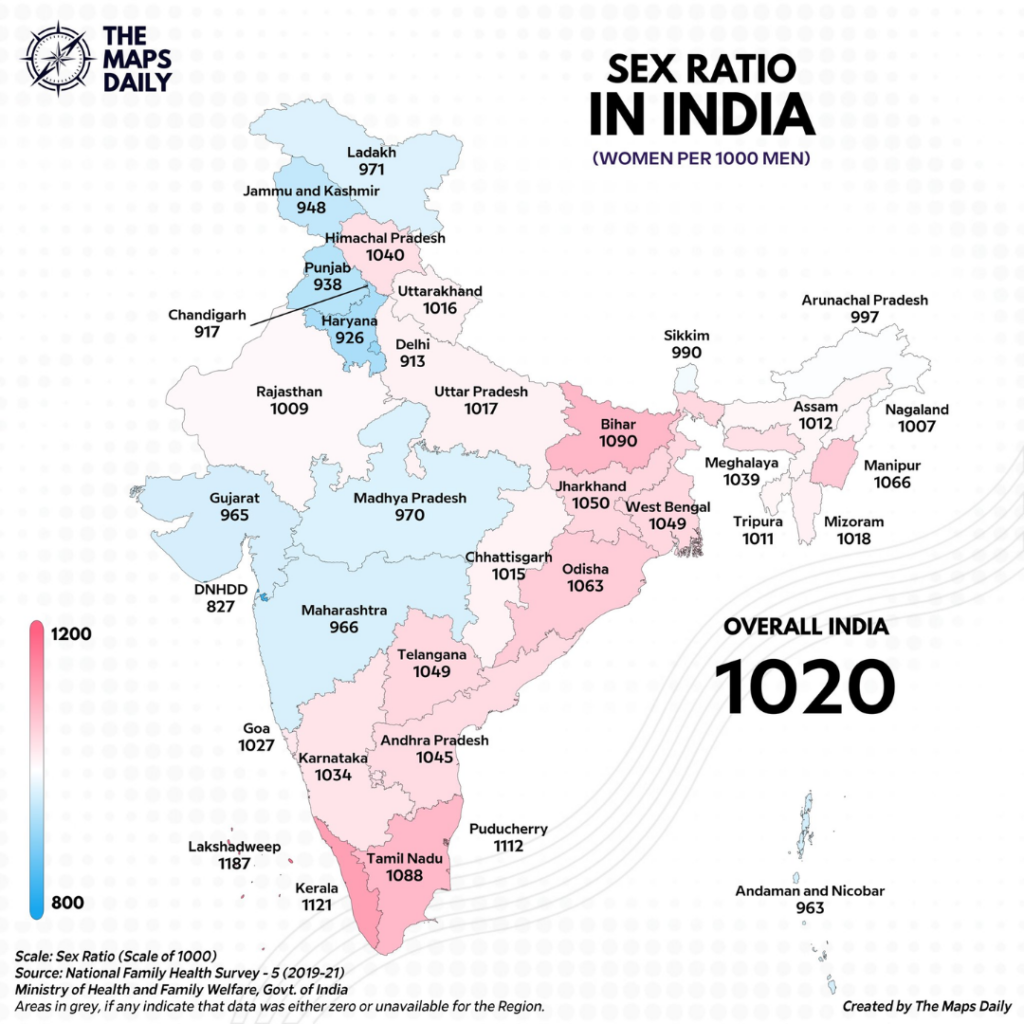
This table presents key metrics on India’s sex ratio based on the latest available official data from the National Family Health Survey-5 (NFHS-5, 2019-21). The decennial Census for 2021 was postponed, making NFHS-5 the most recent comprehensive source.
| Metric | Detail | Data Source |
|---|---|---|
| National Sex Ratio | 1,020 females per 1,000 males | NFHS-5 (2019-21) |
| Sex Ratio at Birth (SRB) | 929 females per 1,000 males | NFHS-5 (2019-21) |
| Child Sex Ratio (0-6 years) | 929 females per 1,000 males | NFHS-5 (2019-21) |
| Rural vs. Urban | Rural: 1,037 females per 1,000 males Urban: 985 females per 1,000 males | NFHS-5 (2019-21) |
| State with Highest Ratio | Kerala: 1,121 females per 1,000 males | NFHS-5 (2019-21) |
| State with Lowest Ratio | Haryana: 926 females per 1,000 males | NFHS-5 (2019-21) |
| UT with Highest Ratio | Puducherry: 1,037 females per 1,000 males | Census 2011* |
| UT with Lowest Ratio | Dadra and Nagar Haveli and Daman and Diu: 774 females per 1,000 males | Census 2011* |
Note on Data: The figures for Union Territories (UTs) are from the 2011 Census, as the NFHS-5 report typically highlights state-level data. The former UT of Daman and Diu (2011 ratio: 618) was merged with Dadra and Nagar Haveli in 2020; their combined 2011 ratio was 774.
The Indian sex ratio 2024 is calculated as the number of women per 1,000 men, highlighting existing social and gender disparities. Current data reveals that there are 943 women for every 1,000 men.
The Indian population in 2024 was approximately 1.44 billion, with 698.29 million females and 743.39 million males. Women account for 48.42% of the population, resulting in a male surplus of 45.71 million.
Despite this imbalance, the gender ratio has shown significant improvement over time. In 2011, there were 943 women for every 1,000 men; in 2001, this figure was 933 women per 1,000 men. Looking ahead, projections for 2036 suggest a ratio of 952 women per 1,000 men, indicating steady progress.
Rural and urban areas display contrasting trends in the sex ratio. According to the 2020-2021 NFHS-5 data, the rural Indian sex ratio was 1,037 females per 1,000 males compared to urban areas, which reported 985 females per 1,000 males.
Sex ratios vary significantly across states. Kerala currently has the highest ratio, while Haryana ranks at the bottom. These disparities underscore the need for targeted state-level interventions. The table below illustrates these differences clearly.
The FMCG sector is constantly evolving, driven by changes in consumer preferences and market demands. Various factors, such as technology, social behaviours, and economic shifts, play a major role in shaping these trends. There are some important trends in the Indian sex ratio that you must be aware of:
| State/ Union Territory | NHFS-5 | 2011 Census | 2001 Census | Change (2001 to 2011) | ||||
| Rank (Sex ratio at birth) | Sex ratio at birth | Sex ratio | Child sex ratio | Sex ratio | Child sex ratio | Sex ratio | Child sex ratio | |
| Lakshadweep | UT1 | 1051 | 947 | 911 | 948 | 959 | (−1) | (−48) |
| Tripura | S1 | 1028 | 960 | 957 | 948 | 966 | (12) | (−9) |
| Meghalaya | S2 | 989 | 989 | 970 | 972 | 973 | (17) | (−3) |
| Uttarakhand | S3 | 984 | 963 | 890 | 962 | 908 | (1) | (−18) |
| Arunachal Pradesh | S4 | 979 | 938 | 972 | 893 | 964 | (45) | (8) |
| Karnataka | S5 | 978 | 973 | 948 | 965 | 946 | (8) | (2) |
| Jammu and Kashmir | UT2 | 976 | 889 | 862 | 892 | 941 | (−3) | (−79) |
| West Bengal | S6 | 973 | 950 | 956 | 934 | 960 | (16) | (−4) |
| Mizoram | S7 | 969 | 976 | 970 | 935 | 964 | (41) | (6) |
| Sikkim | S8 | 969 | 890 | 957 | 875 | 963 | (15) | (−6) |
| Manipur | S9 | 967 | 992 | 930 | 978 | 957 | (14) | (−27) |
| Assam | S10 | 964 | 958 | 962 | 935 | 965 | (23) | (−3) |
| Chhattisgarh | S11 | 960 | 991 | 969 | 989 | 975 | (2) | (−6) |
| Puducherry | UT3 | 959 | 1037 | 967 | 1001 | 967 | (36) | |
| Madhya Pradesh | S12 | 956 | 931 | 918 | 919 | 932 | (12) | (−14) |
| Gujarat | S13 | 955 | 919 | 890 | 920 | 883 | (−1) | (7) |
| Kerala | S14 | 951 | 1084 | 964 | 1058 | 960 | (26) | (4) |
| Nagaland | S15 | 945 | 931 | 943 | 900 | 964 | (31) | (−21) |
| Uttar Pradesh | S16 | 941 | 912 | 902 | 898 | 916 | (14) | (−14) |
| Andhra Pradesh | S17 | 934 | 993 | 939 | 978 | 961 | (15) | (−22) |
| India | 929 | 943 | 919 | 933 | 927 | (10) | (−8) | |
| Delhi | UT4 | 923 | 868 | 871 | 821 | 868 | (47) | (3) |
| Andaman and Nicobar Islands | UT5 | 914 | 876 | 968 | 846 | 957 | (30) | (11) |
| Maharashtra | S18 | 913 | 929 | 894 | 922 | 913 | (7) | (−19) |
| Bihar | S19 | 908 | 918 | 935 | 919 | 942 | (−1) | (−7) |
| Punjab | S20 | 904 | 895 | 846 | 876 | 798 | (19) | (48) |
| Jharkhand | S21 | 899 | 948 | 948 | 941 | 965 | (7) | (−17) |
| Telangana | S22 | 894 | 988 | – | – | – | – | – |
| Odisha | S23 | 894 | 979 | 941 | 972 | 953 | (7) | (−12) |
| Haryana | S24 | 893 | 879 | 834 | 861 | 819 | (18) | (15) |
| Rajasthan | S25 | 891 | 928 | 888 | 921 | 909 | (7) | (−21) |
| Tamil Nadu | S26 | 878 | 996 | 943 | 987 | 942 | (9) | (1) |
| Himachal Pradesh | S27 | 875 | 972 | 909 | 968 | 896 | (4) | (13) |
| Goa | S28 | 838 | 973 | 942 | 961 | 938 | (12) | (4) |
| Chandigarh | UT6 | 838 | 818 | 880 | 777 | 845 | (41) | (35) |
| Dadra and Nagar Haveli | UT7 | 817 | 774 | 926 | 812 | 979 | (−38) | (−53) |
| Daman and Diu | UT8 | 817 | 618 | 904 | 710 | 926 | (−92) | (−22) |
The Indian sex ratio 2024 remains a significant concern for many, shaped by government efforts, access to healthcare, and cultural norms. Below are some of the primary factors influencing it:
In India, social and cultural standards shape gender preferences, rooted deeply in historical beliefs and methods. The family’s sons are pictured as heirs and caregivers and are expected to support their parents during their old age. This leads to a strong son preference, especially in patriarchal communities.
The daughters are expected to marry and then move into their husbands’ residences, restricting their value within the natal family. Many societal expectations have shown that men are considered breadwinners and women manage the domestic duties.
These beliefs have compounded due to various economic facets. Although many initiatives have been taken to improve the status of female children, changing all these deep-rooted cultural standards is still challenging to attain gender equality in the nation.
Healthcare plays a massive part in lessening all the gender-based disparities in the nation. Access to all healthcare services, specifically prenatal care, is crucial for enhancing child and maternal health outcomes. However, in many rural sections, limited awareness, deficient infrastructure, and even a lack of trained specialists have increased the mortality rate among females.
So, by educating all families about effective pregnancy care and promoting the value of female health, all such distinctions can be managed instantly. Several approaches, such as the “Ayushman Bharat” policy, can increase women’s healthcare access.
The Indian government has launched numerous programs, such as “Beti Bachao Beti Padhao,” to protect girls and promote their education. While these policies have positive outcomes, their implementation remains inconsistent, especially in rural areas.
Awareness campaigns encourage people to reject harmful practices like gender-based abortions and foster a culture of valuing daughters. For sustained change, such efforts need to be persistent and widespread. Addressing these issues is essential for India to achieve a fairer and more balanced society.
The Indian sex ratio 2024 has far-reaching effects, influencing various aspects of society, from family dynamics to economic development. Below are the key consequences of an imbalanced ratio:
A balanced population is vital in driving economic growth, and the Telugu sex ratio 2024 highlights both progress and challenges. States like Andhra Pradesh and Telangana, key Telugu-speaking regions, have shown improved overall figures, with sex ratios of 1,045 and 1,049 females per 1,000 males, respectively.
These gains in the Telugu sex ratio 2024 indicate a positive shift, yet disparities persist, particularly in child and urban demographics, due to ongoing gender bias. Comparatively, states with more balanced ratios, such as Kerala (1,084 females per 1,000 males), often experience higher female workforce participation, which boosts productivity. To strengthen the gains reflected in the Telugu sex ratio 2024, focused initiatives in awareness, legal enforcement, and inclusive development are crucial. Sustained efforts will be key to improving the Telugu sex ratio in 2024 across all ages and social groups.
Fewer females within a region cause issues in the marriage market. Men might face difficulty finding marriage partners, leading to changes within the family dynamics and marriage delays. In some areas, this imbalance has led to harmful practices like “bride trafficking,” which disrupts social harmony and violates human rights.
The Indian sex ratio in 2024 also impacts education. In areas with fewer females, families are less likely to invest in their daughters’ education, which significantly worsens gender inequality. Healthcare systems face challenges as imbalances impact women’s and men’s well-being. Moreover, communities with fewer women may experience reduced female representation in leadership roles, increased social unrest, and higher corruption rates.
The primary objective of society and the government is to enhance the Indian sex ratio 2024. Many upcoming approaches and policies seek to ensure long-lasting progress through various measures and technology.
The Indian Government has introduced countless initiatives, such as the Kasturba Gandhi Balika Vidyalaya and Sabla Scheme, which aim to increase the education and health of girls and reduce gender inequality. Legislation and education also play vital parts in enhancing gender proportions. Improving academic access for girls has significantly increased workforce participation.
Female labour force participation increased from 23.3% to 41.7% between 2023 and 2024. One well-known campaign that targeted “gender equity” is the “LahuKaLagaan,” which has nullified the tax on all sanitary napkins. Such initiatives raised awareness, displaying the optimistic effects of collective measures to attain gender equality.
Technology plays a significant role in addressing gender-related problems. Tools are available to track sex and birth ratio data, which helps identify areas that require intervention. Various social media campaigns use online workshops, infographics, and videos to spread awareness about gender equality. Success stories from states like Rajasthan and Haryana show how local community efforts combined with digital tools can yield positive results. In addition, the PCPNDT Act has led to many technological improvements, such as online monitoring of all ultrasound clinics, which reduces all sex-selective abortions.
India aims to achieve a balanced sex ratio by 2030. Projections indicate gradual improvements if current actions are effectively extended and maintained. Some of the upcoming approaches include:
Community measures are also essential for improving the balance of the Indian sex ratio 2024. Grassroots initiatives can challenge harmful cultural norms and help create a brighter future for all.
In 2025, India’s estimated sex ratio stands at 100 women per 106.443 men, showing marginal improvement from 2024 yet still reflecting a notable gender imbalance. While initiatives like the PCPNDT Act, Beti Bachao Beti Padhao, and improved female education have driven progress, deep-rooted challenges such as sex-selective practices and cultural son preference persist. Achieving true gender balance will require continued vigilance, stronger enforcement, and grassroots-level change across both rural and urban India.
Read more:
In 2024, the Indian sex ratio stood at approximately 943 females per 1,000 males. Out of a total population of 1.44 billion, India has around 698.29 million females and 743.39 million males, with women comprising 48.42% of the population.
A crooked sex ratio diminishes female participation in the workforce, leading to a decline in economic productivity. Indian states with excellent gender balance witness higher involvement of women in economic movements.
Lakshadweep has 1,051 females for every 1,000 males, and Kerala has 1,084 females. Haryana has 893, and Goa and Chandigarh have 838 females for every 1,000 males, making these states have the worst Indian sex ratio 2024.
Some primary initiatives here are Beti Bachao Beti Padhao, the PCPNDT Act, and awareness movements to show that daughters should be cherished and deter all-gender bigotry.
The country’s gender proportion is 943 women for every 1,000 men, which is much lower than the international standard of 984 women for every 1,000 men. India’s neighbouring nations, such as Bangladesh, Sri Lanka, and Nepal, have much higher proportions.
As per the 2011 Census, Kerala holds the highest sex ratio among Indian states, with 1,084 females per 1,000 males, reflecting a progressive gender balance.
Haryana has the lowest Indian sex ratio, with only 879 females per 1,000 males, as recorded in the 2011 Census, highlighting a need for stronger efforts toward gender equality.