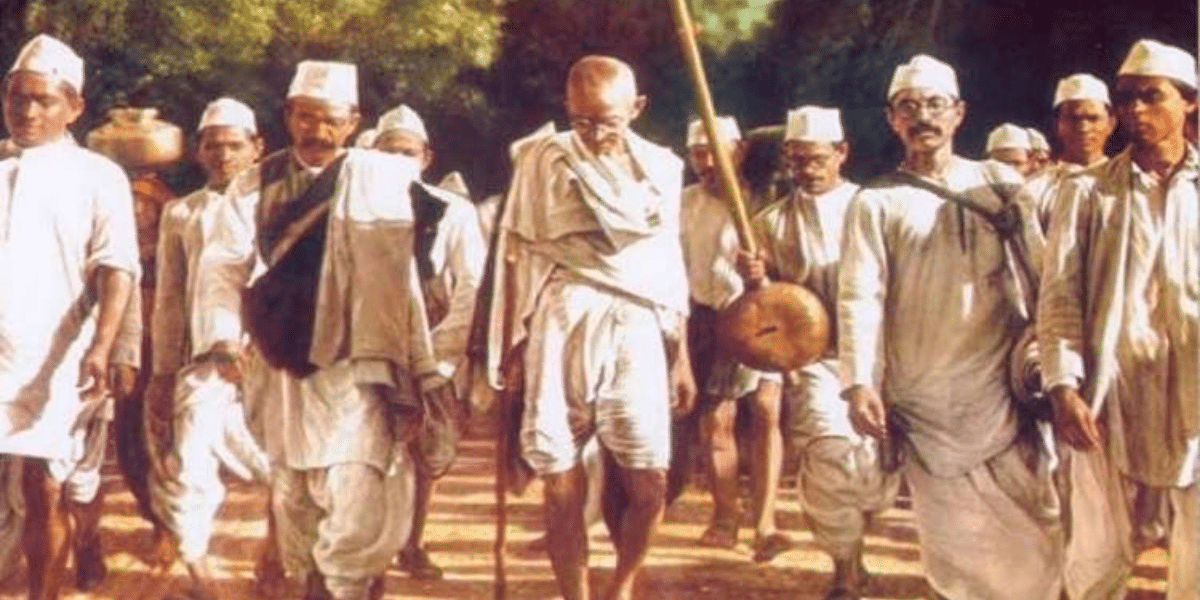
The Indian National Movement began with the founding of the Indian National Congress in 1885, led by Allan Octavian Hume alongside prominent Indian leaders like Dadabhai Naoroji and Surendranath Banerjee. Initially, it served as a platform for educated elites to engage with political discourse under British rule. Over time, it evolved into a comprehensive fight for sovereignty, spearheaded by voices like Gandhi, Nehru, and Bose, uniting India’s diverse communities in the quest for freedom. From petitions and Swadeshi protests to mass civil disobedience, this movement laid the foundation for India’s eventual independence in 1947. Let’s discuss the national movements of India in this blog.
The Indian National Movement (INM) started in the 19th century and included people from different regions, religions, linguistic backgrounds, and cultures. They demanded self-governance and sought freedom from the oppressive British Raj. The unity, devotion, and limitless hard work of these freedom fighters finally led to the Independence of India on August 15, 1947.
The INM helped India break free from British rule and become an independent country. This vital fight brought people together, created heroes, and showed the world how peaceful protest and unwavering resolve can change the course of history.
In this blog, we will deeply understand what the Indian National Movement is. We will learn about the history of India and the Indian National Movement’s relevance in leading to the birth of Modern India.
| Year | National Movement |
|---|---|
| 1857 | Revolt of 1857; Sepoy Mutiny |
| 1885 | Foundation of Indian National Congress |
| 1905 | Swadeshi Movement |
| 1906 | Muslim League Founded |
| 1914 | Gadar Party Movement |
| 1916-1918 | Home Rule Movement |
| 1917 | Champaran Satyagraha |
| 1917 | Kheda Satyagraha |
| 1918 | Ahmedabad Mill Strike |
| 1919 | Rowlatt Satyagraha |
| 1920 | Khilafat and Non-Cooperation Movement |
| 1930 | Civil Disobedience Movement |
| 1940 | Individual Satyagraha |
| 1942 | Quit India Movement |
The Indian National Movement was a mass movement where the people of India began to develop a strong sense of nationalism. This unity and pride in their country inspired Indians to stand up and speak out against British rule. As a result, they started revolting for their rights and freedom.
Established in 1906, the Muslim League was a prominent political party in British India that led to the partition and creation of Pakistan. This League aimed to safeguard the interests and represent the Muslim minority in British India.
Implementation of the Morley-Minto Reforms 1909(Indian Council Act 1909) took place before the outbreak of World War I. These reforms introduced limited elective representation for Indians in legislative councils. The Muslim League supported this reform. These reforms became significant during World War I when political awareness grew, and Indians dreamt of freedom from the British and self-governance.

Leaders like Bal Gangadhar Tilak and Annie Besant led the Home Rule Movement, advocating for self-governance within the British Empire.
The 1907 Surat split within the Indian National Congress was later healed through the Lucknow Pact. This pact showed that the Indian National Congress and the Muslim League were united in their efforts against the British.
The official reason for the controversial Partition of Bengal in 1905 was improved administrative practices. But Indians suspected that this reason was just a tactic under the British policy of Divide and Rule.
The Swadeshi Movement was initiated in response to the partition of Bengal. Under this movement, Indians boycotted foreign goods and promoted indigenously produced materials. This movement arose as a symbol of unity and nationalism.
In 1914, the Komagata Maru, a ship carrying 376 Indian immigrants, primarily Punjabis, arrived in Canada, where many passengers faced Canada’s discriminatory immigration laws. The people onboard faced further hardships due to police action after returning to Calcutta, which symbolized the racial discrimination and prejudice faced by Indians in British colonies.
The Ghadar Movement was initiated in 1913 by Indian immigrants in the United States and Canada, aiming to end the oppressive British rule. The Ghadar Party published revolutionary literature, including the Ghadar newspaper, to raise awareness about the cause.
The Movement took place in 3 phases over the years from 1885 to 1947:
The first phase of the Indian national movement aimed to attain a dominion status within the British Empire. The leaders then demanded political, social, and economic reforms rather than complete independence. This movement led to the initial idea of political awareness and reforms. These initial efforts paved the way for future radical movements.
This phase aimed at achieving swaraj or self-government, independent from the British Raj. The leaders assertively demanded political freedom. They followed militant forms of protest and collective action by uniting Indians nationwide. They laid the foundation for the idea of seeking complete Independence. Famous leaders like Bal Gangadhar Tilak, Bipin Chandra Pal, and Lala Lajpat Rai were prominent in this phase. They used non-cooperation, boycotts, and civil disobedience to resist British policies and repression. This period witnessed movements like the Swadeshi Movement and the Non-Cooperation Movement.
During this period, Mahatma Gandhi emerged as a prominent figure in India. His idea of non-violence and Satyagraha aimed to secure complete freedom from the British government. The Non-Cooperation Movement, Civil Disobedience Movement, and Quit India Movement were prominent campaigns during this phase. Mass mobilization and peaceful protests played a key role. This phase ultimately brought success to the Indian Freedom struggle.
The early Indian National Congress (INC) was led by moderates who advocated for gradual political reforms within the British Raj. Here are some key figures:
These moderates and others like Dinshaw Wacha and Mahadev Govind Ranade used petitions and negotiations to push for greater Indian participation in government.
The Indian National Congress (INC), established in 1885, began organized political resistance against British rule in India. Early leaders, known as Moderates, advocated for constitutional methods, including petitions and negotiations, to achieve political reforms. Their goal was to work within the British system to increase Indian representation in government and civil services.
The movement also aimed to address economic issues, social reforms, and educational advancement. Dadabhai Naoroji’s “Drain Theory” highlighted how British exploitation was economically draining India, stressing the importance of economic self-sufficiency.
Moderates presented their demands for political reforms through memoranda and petitions to the British authorities. A significant example is the protest against the “Ilbert Bill” in 1883, which opposed racial discrimination in the judiciary.
Efforts were made to foster understanding and cooperation with the British, persuading them to implement reforms voluntarily. The early sessions of the INC focused on civil rights, local self-government, and economic policies.
Moderates also emphasized the value of Western education and the English language as vital tools for social and political progress.
During the early 20th century, the Indian National Movement underwent a radical shift known as the Extremist Phase (1905-1916). This pivotal period was marked by significant events, leaving a great impact on Indian history:
In 1905, the British authorities partitioned Bengal into East Bengal, Assam, and West Bengal, creating discontent. People felt that this was an evil attempt to create a divide between the united population. Partition led to extreme outrage, protests, and united action against colonial rule.
In response to Partition, Extremists launched the Swadeshi Movement, promoting Indigenous products and boycotting British goods. This movement aimed to promote the feeling of self-sufficiency. People across India actively boycotted British-manufactured goods, weakening the colonial economic base.
The Surat Split in 1907 caused a significant internal conflict within the Indian National Congress. Extremists, led by figures like Bal Gangadhar Tilak, Lala Lajpat Rai, and Bipin Chandra Pal, advocated a more radical approach involving direct action and non-cooperation with the British. This was in contrast to the Moderates, who preferred a cautious, constitutional approach.
The Extremist Phase saw a shift of ideology from diplomatic to more radical and assertive. Mass mobilization took place to make an apparent demand for Swaraj. This did not directly lead to the independence of India, but it played a pivotal role in shaping the journey of the Indian freedom struggle.
The history of India has always seen decisive actions against several factors that caused discontent among the general public:
Looking at India’s records, economic and social inequalities have always caused discontent in the public. The country’s agricultural economy saw a difficult-to-bridge gap between poor farmers and wealthy landowners. British colonial rule worsened these problems, leading to even more economic exploitation.
As the 1800s went on, political protests became stronger. People adopted a highly radical ideology and demanded a say in running the country. Leaders like Dadabhai Naoroji and Bal Gangadhar Tilak spoke up for Indians to have a role in decision-making.
Indian leaders looked to other nations for inspiration. They saw how countries like Russia, the United States, and Ireland fought for their liberty. These international movements encouraged Indians to desire freedom, equality, and the right to self-determination.
The Indian National Movement from 1857 to 1947 was a struggle ignited due to various factors that collectively influenced people to take repressive measures:
India possessed vast and diverse resources, including rich mineral deposits, fertile land, valuable ores, abundant water sources, and diverse landscapes that attracted foreigners to take advantage of these. British colonial rulers robbed these resources to enrich the British Empire. The suffering of ordinary Indians, exploited for the benefit of a foreign power, sowed the seeds of revolt.
The British Empire sought to suppress the very essence of Indian identity. Languages, traditions, cultures, and values were used to divide the unified Indian Population. The national movement, in part, was a reclamation of these suppressed cultural treasures. Indians experienced the need to restore the original sense of pride they always had in their varied cultures.
The colonial domination ignited a feeling of oppressive subjugation in the hearts of Indians. They urgently needed to overpower these colonial masters and regain political autonomy and self-governance. The late 19th and 20th centuries witnessed a rise of nationalism and democratic values.
These elements built the foundation and cornerstone of India’s struggle for Independence.
The idea of the Indian National Movement originated from the rise of consciousness, the intellectual awakening, and the influence of remarkable leaders. This movement changed the identity of India from a colony to an independent nation on August 15, 1947.
This movement was fueled by the atrocities of colonial rule, the impact of British policies on Indian society and the economy, and simultaneously, Indians’ exposure to the ideals of liberty and self-determination through Western education. It is said that Indian leaders like Bal Gangadhar Tilak and Bipin Chandra Pal began to sow the seeds of nationalistic fervor through their writings and speeches.
One of the most peculiar features of the Indian National Movement was the intellectual awakening that took place. Visionaries like Dadabhai Naoroji and Gopal Krishna Gokhale played a pivotal role in articulating the concerns of the Indian population. They used a combination of Western political thought and traditional Indian values to put down British rule.
Moreover, the Indian press, through publications like ‘The Kesari’ and ‘The Indian Mirror,’ became powerful media for spreading the message of dissent and advocating for self-governance.
The Indian National Movement achieved monumental success because many influential figures rose to prominence. Leaders like Jawaharlal Nehru, Mahatma Gandhi, and Subhas Chandra Bose, with their dedication and vision for a free India, inspired millions of people to join movements like Civil Disobedience, Quit India, etc., that forced the British to agree to the demands of the Indian Masses and liberate them from colonial rule.
Let’s discuss some of the key events of the Indian Freedom struggle and the important centers of the Indian National Movement from 1857 to 1947 associated with them:
The First War of Independence in India started in Meerut initially when the Indian military men disagreed with using the controversial cartridges and mutinied. The revolt spread to various northern and central Indian regions, with significant centers of resistance in Delhi, Lucknow, Kanpur, and Jhansi. Prominent figures included Rani Lakshmibai of Jhansi, Bahadur Shah II, Kunwar Singh, and Begum Hazrat Mahal.
The Swadeshi Movement aimed to boycott British goods and accept the idea of complete self-reliance, was particularly active in Calcutta, the eastern region, and West Bengal.
The Ghadar movement was held in the United States and Canada by the Punjabi immigrants from India to warn foreigners about how oppressive British rule was in India.
The Home Rule Movement was a pan-Indian movement led by leaders like Annie Besant and Bal Gangadhar Tilak during the Extremist phase.
The Champaran Satyagraha, led by Mahatma Gandhi, was an act of civil resistance against the oppressive Indigo plantation practices in Bihar.
The Peasant Satyagraha, led by Mahatma Gandhi, took place in Kheda, Gujarat. Farmers protested against oppressive taxation and revenue policies.
The Rowlatt Satyagraha, a protest against the repressive Rowlatt Act that granted the colonial government powers to arrest and detain individuals without trial and to suppress political activities that were considered to be threatening to British rule, was particularly active in the northern region near Amritsar.
The Khilafat and Non-cooperation Movement was a nationwide campaign, especially in Chauri Chaura, Uttar Pradesh.
The Civil Disobedience Movement, initiated by Gandhi, was marked by the famous Dandi March against the High Salt Tax, which began in Dandi, Gujarat, and had a nationwide impact.
The Quit India Movement was a call for immediate independence and was a pan-India campaign.

These questions are designed to help applicants get a feel for the topics covered in government exams. To fully prepare, reviewing the previous year’s question papers and solutions is advised.
Q.1. Which of these acts was infamously known as the ‘Black Bill’ during the Indian freedom struggle?
Q.2. The provision for separate electorates for Hindus and Muslims was introduced in which act?
Q.3. Who played a key role in the formation of the Indian National Congress (INC) as an English officer?
Q.4. The enactment of the Rowlatt Act immediately led to which major event?
Q.5. Who said, “Nehru is a patriot while Jinnah is a politician”?
Q.6. In which session of the Indian National Congress was Poorna Swaraj (Complete Independence) declared as the goal?
Q.7. Who started the Khilafat Movement in India?
Q.8. The Hunter Commission was set up by the British to investigate which incident?
Answer: B) Jallianwala Bagh Traged
The Indian National Movement from 1857 to 1947 is relevant to competitive exams like UPSC. The background of the Indian national movement is a core component of the UPSC syllabus, spanning every little detail about it. To learn about the background of the Indian National Movement and freedom struggle, refer to Chegg and the Indian National Movement notes given above as they provide an easy understanding of the toughest concepts. If you have expert knowledge on related topics, share it with others on Chegg and help them in their exam preparation.
Having in-depth knowledge about the Indian National Movement and the constitution of India is important for aspirants to crack these competitive exams and excel with top-notch ranks. The information given by this movement equips aspirants with historical, political, and social insights, enabling a deeper understanding of India’s evolution and governance.
The Indian National Movement was a pivotal, organized struggle that united diverse populations to end colonial rule and achieve India’s independence. This historic movement, defined by non-violent resistance and civil disobedience, successfully established India as a sovereign, democratic republic. For competitive exam aspirants and students, a thorough understanding of its key phases—from the early Congress moderates to the Gandhian era and the final push for Partition is crucial. Analyzing this movement provides essential insights into the core values of civic duty, inclusive governance, and participatory citizenship that continue to shape modern India.
Read More:-

The Indian National Movement effectively began in 1885, with the founding of the Indian National Congress, which marked the first organized political effort toward independence. Earlier expressions of resistance, such as the 1857 Sepoy Mutiny, were important precursors but not part of the formal national political campaign.
Various factors, including economic exploitation, cultural suppression, and political subjugation fueled the Indian National Movement. The colonial rule escalated these issues, leading to a strong desire for self-governance.
International movements like the Russian and American Revolutions served as a source of inspiration for Indians to fight for their liberty as well. These movements highlighted the ideals of freedom, justice, and self-determination.
The Indian National Movement was formally launched with the formation of the Indian National Congress (INC) in 1885 by Allan Octavian Hume, a retired British civil servant. However, the movement gained real momentum under leaders like Bal Gangadhar Tilak, Mahatma Gandhi, and Dadabhai Naoroji, who transformed it into a mass struggle for India’s independence from British rule.
The Rowlatt Satyagraha was a non-violent protest against the Rowlatt Act, aimed at opposing British rule through peaceful means. It marked a significant moment in India’s quest for freedom.
The father of the Indian National Movement is Mahatma Gandhi for his leadership in the struggle for independence.
There are 14 major Indian national movements between 1885 and 1947, starting from the Revolt of 1857 to the Quit India Movement, each marking a significant step toward India’s independence.The Indian independence struggle is often divided into three main phases: Moderate Phase (1885–1905) Focused on reforms through petitions and negotiations. Extremist Phase (1905–1919) Marked by assertive demands and radical methods.Gandhian Phase (1919–1947) Characterized by mass non-violent movements like the Non-Cooperation, Civil Disobedience, and Quit India campaigns.
The independence movement is typically viewed in these three phases:
Moderate Phase (1885–1905): Advocated reforms through dialogue and petitions.
Extremist Phase (1905–1919): Urged self-rule using assertive, sometimes radical approaches like the Swadeshi Movement. Gandhian Phase (1919–1947): Emphasized non-violent mass mobilization under Gandhi, culminating in freedom.