

Gallantry Awards in India are the nation’s highest honors given to recognize courage, valor, and exemplary acts of bravery in the face of danger, both on the battlefield and in civilian life. Instituted by the Government of India post-Independence, these awards are conferred biannually on Republic Day (26th January) and Independence Day (15th August) to honor members of the armed forces, police, paramilitary, and civilians.
India classifies gallantry awards into two main categories:
Each award tells a story of selflessness and national pride. These honors serve not only to recognize bravery but also to inspire future generations.
Here, you will find the Gallantry Award’s meaning and some key information about this award. There are primarily three awards: the Param Vir Chakra, the Maha Vir Chakra, and the Vir Chakra. Each has its own criteria, with the Param Vir Chakra being the highest military honor in India.
Instituted on January 26, 1950, these awards recognize acts of bravery and sacrifice by the personnel of the Armed Forces, other forces, and civilians.
There are 6 major Gallantry Awards in India 3 for wartime and 3 for peacetime bravery:
These awards demonstrate the country’s appreciation for bravery. Winners earn a certification of bravery and embed their names in the hearts of Indian citizens. These awards empower people in the future by instilling a feeling of obligation, honor, and nationalism.
The history of these awards in India dates back to the British era. However, post-independence, there was a need to have our system. The government then instituted these awards to honor acts of bravery and sacrifice. On January 26, 1950, the Indian Government introduced the first three awards, the Param Vir Chakra, Maha Vir Chakra, and Vir Chakra, which were believed to be in force as of August 15, 1947.
On January 4, 1952, the government established the three gallantry medals: Ashoka Chakra Class-I, Class-II, and Class-III. In January 1967, they were renamed Ashoka Chakra, Kirti Chakra, and Shaurya Chakra, respectively.
The Param Vir Chakra (PVC) is the highest gallantry award in India. It was instituted on January 26, 1950. The bronze medal carries the national emblem on the obverse and “Param Vir Chakra” inscribed in Hindi and English on the reverse.
India has honored countless brave soldiers with the Param Vir Chakra. Each recipient’s journey is a story of courage, sacrifice, and dedication to the nation.
These stories of award winners testify to the courage and sacrifice of India’s armed forces, inspiring new generations to honor and remember these heroes.
These awards are categorized based on the nature of the act and the circumstances. The three primary wartime awards are:
For peacetime acts of bravery, the awards are:
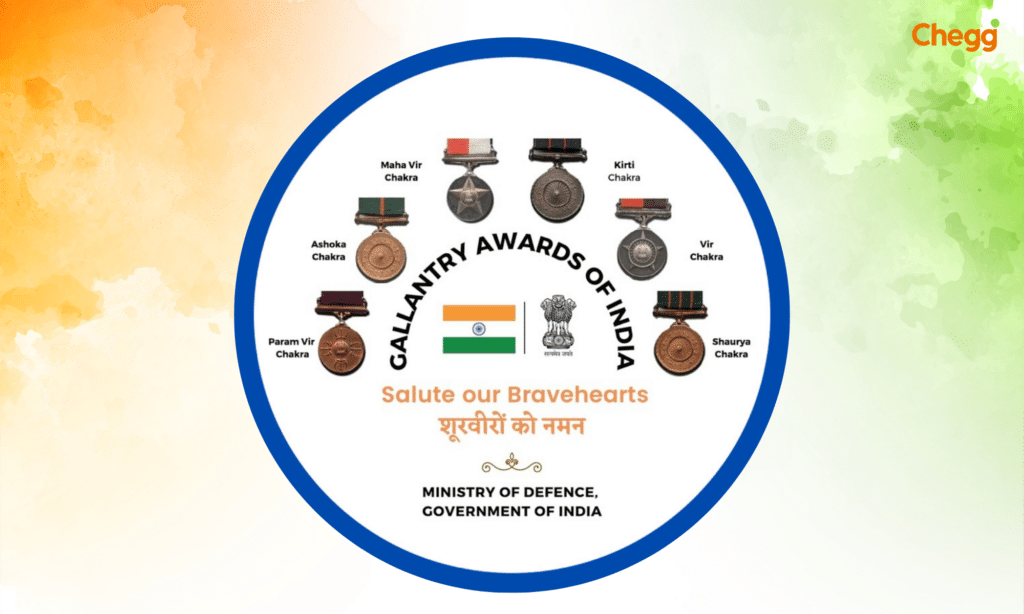
Ashoka Chakra (AC): The medal’s center features a gold wheel, the Ashoka Chakra. Surrounding it is a lotus wreath with a two-line Ashoka Chakra inscription in Hindi on a silver gilt.
Kirti Chakra (KC): The silver medal displays a five-pointed star in the center, bearing an Ashoka Chakra. The reverse side of the medal carries the national emblem and the inscription in Hindi.
Shaurya Chakra (SC): This bronze medal showcases a five-pointed star with the Ashoka Chakra in the center. The reverse has the national emblem and a two-line Shaurya Chakra inscription in Hindi.
Apart from the primary awards, there are other lesser-known awards like the Sena Medal, Nao Sena Medal, and Vayu Sena Medal. Acts of gallantry in non-operational areas and warlike situations earn these awards. Their significance lies in recognizing the resilience of armed forces personnel in situations other than direct combat.
While the primary purpose of these awards is to honor and recognize the bravery and sacrifice of armed forces personnel, certain benefits and privileges are associated with receiving such awards. These benefits can vary depending on the specific award and the policies of the respective armed forces.
However, some common benefits and privileges may include:
It’s important to note that the specific benefits and privileges may vary depending on the country and the particular award received. For detailed information, it’s best to consult the relevant military authorities or government regulations.
These Awards are the highest military honors bestowed upon individuals for acts of extraordinary courage and sacrifice. Here’s a breakdown of who’s eligible and for what:
For Acts Against Enemies:
Eligibility:
For Acts Beyond Enemy Conflict:
Eligibility:
While these awards are open to all ranks, the distinction often lies in the act. The higher awards (Paramveer Chakra, Mahaveer Chakra, Veer Chakra) are typically for acts beyond the call of duty. While still significant, the lesser-known awards might be for acts of bravery within the expected line of duty. Rank does not play a direct role in the awarding process; the act of courage is paramount.
India has seen numerous heroes who’ve been recognized with these awards. Some notable award winners include:
These heroes have made a lasting impact on India’s military history. We won’t forget their bravery; we share it in schools and training centers, motivating young minds. Many monuments, roads, and institutions bear their names so their memory never fades. Their stories continue to touch our hearts and remind us of their sacrifices for India’s freedom and security.
These awards serve as a reminder that heroes exist among us. They inspire future generations to be brave and selfless. They show us that some individuals rise above fear to protect and serve even in the most challenging times. This tradition of celebrating heroes and their brave actions has been a part of our culture for a long time.
These Awards are a testament to extraordinary courage and sacrifice. But how are these heroes chosen? Here’s a glimpse into the selection process:
Twice a Year Nominations:
Military Nominations:
Civilian Nominations:
A Rigorous Process:
This multi-layered selection process ensures that only the most deserving acts of bravery are recognized with India’s highest gallantry honors.
Once recommended, the nomination undergoes scrutiny. A military committee reviews the details, ensuring the act meets the award’s criteria. After this, higher committees, including top military officials and sometimes civilian representatives, further evaluate the nominations. The final list is then sent to the President of India for approval, as the awards are conferred in the name of the President.
The presentation is a solemn and grand affair. Awardees or their next of kin receive the medal during the Republic Day or Independence Day ceremonies. The President of India presents the awards amidst military and civilian dignitaries. The ceremony is a blend of military tradition and national pride broadcasted nationwide, ensuring the entire country joins in honoring the brave.

Public awareness of these awards is critical to saluting the bravery of our beloved heroes.
Many initiatives can be adopted, such as:
Gallantry Award winners in India are celebrated as national heroes. Their stories of bravery, sacrifice, and dedication inspire countless individuals. They serve as role models, especially for the youth, instilling values of courage, patriotism, and selflessness. Moreover, schools and colleges often invite these heroes to share their experiences, providing firsthand accounts of their bravery.
Their stories inspire many. They show selflessness in tough times, and people admire these awardees. Their bravery becomes a societal benchmark. Media, books, and films are crucial in spreading the word about these brave souls. They take these stories to a broader audience, ensuring more people learn about these heroes and their incredible deeds. This exposure helps us all appreciate and celebrate bravery even more.
For example, Captain Vikram Batra received the Param Vir Chakra. His bravery during the Kargil War remains unparalleled. Similarly, Flight Lieutenant Nirmal Jit Singh Sekhon posthumously earned the award. These stories remind us that courage is not just a word; it’s a force that can change the world.

India’s 77th Independence Day (2025) was marked by a profound display of gratitude and recognition for the armed forces, paramilitary, and police personnel who demonstrated exceptional courage. In the Defence Investiture Ceremony, the President of India conferred 103 gallantry medals, celebrating acts of valor in the line of duty.
These awards reflect extraordinary bravery and devotion to the nation:
A total of 1,037 police medals were distributed across categories to honor bravery, service, and dedication:
These individuals stood out for their heroic service:
In addition to the Defence Investiture Ceremony, India’s 77th Independence Day witnessed further recognition of the courage and sacrifice displayed by the armed forces and police personnel. The President of India conferred a total of 103 prestigious honors across various categories.
A total of 1,037 police medals were awarded, including:
Among the prominent awardees were Colonel Manpreet Singh (posthumously), Rifleman Ravi Kumar (posthumously), Major Malla Rama Gopal Naidu, and Deputy Superintendent Himayun Muzzammil Bhat (posthumously), all of whom were recipients of the prestigious Kirti Chakra.
Gallantry Awards are a profound tribute to the bravery, courage, and sacrifice of India’s Armed Forces, security personnel, and police officers. These national honors celebrate acts of extraordinary heroism and selflessness, often performed at great personal risk. Prestigious awards like the Kirti Chakra, Shaurya Chakra, and Param Vir Chakra recognize not only individual acts of valor but also the unwavering spirit of duty and patriotism. They serve as a constant reminder of the sacrifices made to protect our freedom and security, inspiring every citizen to uphold courage, resilience, and service to the nation. By honoring these heroes, India ensures that their legacy continues to motivate future generations and strengthen the values that define our country.
Read More:-

The President of India presents these Awards during special ceremonies, usually on Republic Day or Independence Day.
Subedar Major Yadav became the youngest soldier to receive the Param Vir Chakra at 19. He was awarded this highest honor for his bravery during the Kargil War, where he sustained 15 bullet wounds in combat.
Major Mithali Madhumita is the first female officer to receive this Award in India, honored with the Sena Medal in 2011 for her bravery during a terrorist attack on the Indian embassy in Kabul.
Wartime awards, like the Param Vir Chakra, are given for bravery during battle. Peacetime awards, such as the Ashoka Chakra, recognize acts of courage outside of war situations.
The six Gallantry Awards of India are Param Vir Chakra, Maha Vir Chakra, Vir Chakra, Ashoka Chakra, Kirti Chakra, and Shaurya Chakra.
The Gallantry Medal Award is an honor given by the Government of India to recognize acts of exceptional bravery, courage, and sacrifice. These awards are classified into wartime and peacetime categories, including Param Vir Chakra, Maha Vir Chakra, Vir Chakra, Ashoka Chakra, Kirti Chakra, and Shaurya Chakra. They are awarded to members of the Armed Forces, paramilitary forces, and even civilians who display heroic acts beyond the call of duty.
As of the latest Republic Day 2025 honours, the Ministry of Defence announced the following:
3 Shaurya Chakras
5 Kirti Chakras
10 Sena Medals (Gallantry)
No Param Vir or Ashoka Chakra awards announced this cycle
Note: These numbers are dynamic and vary based on the year’s operations, bravery incidents, and nominations.
The highest Gallantry Award in India is the Param Vir Chakra (PVC). It is awarded for displaying the most conspicuous bravery, self-sacrifice, or extraordinary courage in the presence of the enemy during wartime. Instituted on 26 January 1950, the PVC is equivalent to the Medal of Honor in the USA and is the most prestigious military decoration in India.