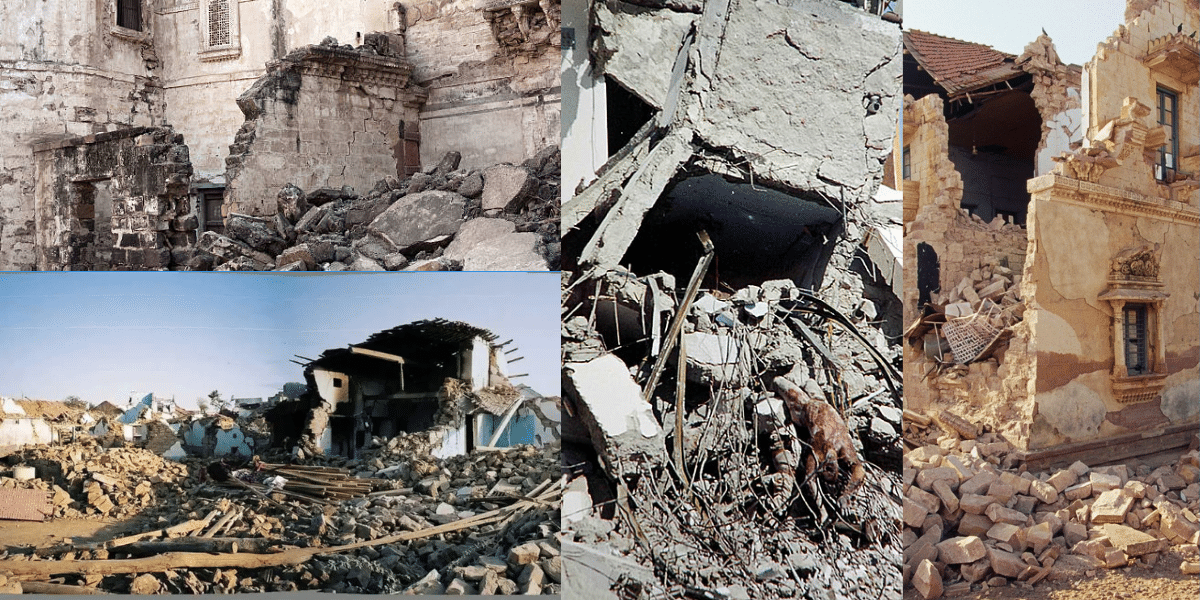
The Bhuj Earthquake of 2001, one of India’s deadliest quakes, struck Gujarat on 26 January at 8:46 AM IST with a magnitude of 7.7. Lasting just 90 seconds, it claimed over 13,800 lives, injured 167,000, and destroyed 340,000 buildings, causing $1.3 billion in damage.
The epicentre was near Chobari village in Kutch, about 20 km from Bhuj. In its aftermath, India strengthened disaster management laws, enforced earthquake-resistant construction, introduced early warning systems, and formed the National Disaster Management Authority (NDMA).
This tragedy became a turning point in India’s resilience planning.
The Indian subcontinent is prone to earthquakes due to the movement of the Indian plate into Asia. As per reports, nearly 58% of India’s land is vulnerable to earthquakes.
India’s seismic zoning map categorizes the country into zones 2, 3, 4, and 5. Zone 2 is the Low-Damage-Risk Zone with the least seismic activity. Zone 5, including Bhuj, Kashmir, the Western and Central Himalayas, and the Andaman and Nicobar islands, experiences the highest seismic activity and is classified as a High-Damage-Risk Zone. Areas with trap or basaltic rock formations are particularly vulnerable to earthquakes.
Gujarat is about 300-400 km from the plate boundary between the Indian and Eurasian plates. Despite this distance, the region’s tectonic activity is still influenced by the ongoing continental collision along this boundary.

The Bhuj earthquake 2001 was one of the most devastating earthquakes in India’s history. This case study aims to provide an in-depth analysis of the event, its causes, and its impact on the region.
On January 26, 2001, the Indian state of Gujarat was struck by a catastrophic earthquake with a moment magnitude of 7.7. The epicenter was near Bhuj, hence the name Bhuj earthquake. The earthquake resulted in the death of more than 20,000 people, injured another 167,000, and caused extensive property damage.
The 2001 Bhuj earthquake wasn’t just a tremor but a catastrophe that left a lasting scar on the region. Beyond the immediate collapse of buildings, the earthquake triggered a devastating chain reaction impacting lives, infrastructure, and the very spirit of the affected communities.

The 2001 Bhuj earthquake magnitude was 7.7, claiming over 13,805 lives and damaging nearly 340,000 buildings.

The 2001 Bhuj earthquake, a devastating event that claimed thousands of lives and caused widespread destruction, left a lasting impact on the survivors. Akshat Chaturvedi, a witness to this tragedy, has dedicated his life to documenting and sharing the stories of resilience that emerged from the ashes.
Akshat Chaturvedi, then a 22-year-old theatre enthusiast, experienced the earthquake firsthand. The devastation he witnessed profoundly affected him, leading him to work with the World Bank’s Disaster Risk Management Program and volunteer with the United Nations.
Akshat’s book, “Resilience in Kutch,” showcases the inspiring stories of earthquake survivors. Here are a few examples:
These stories highlight the extraordinary resilience of the people of Bhuj. They faced unimaginable hardships yet found ways to persevere, rebuild their lives, and inspire others. Akshat Chaturvedi’s work in documenting these stories is a powerful reminder of the human spirit’s ability to overcome adversity.
| Magnitude | Description | Effects | May cause severe damage in populated areas. |
| < 3.0 | Micro | Not felt, but recorded. | Thousands (estimated at 100,000+ annually) |
| 3.0 – 3.9 | Minor | Often felt, but rarely causes damage. | 10,000 – 15,000 |
| 4.0 – 4.9 | Light | Noticeable, but usually causes minimal damage. | 1,000 – 1,500 |
| 5.0 – 5.9 | Moderate | Can cause damage to poorly built structures. | 100 – 200 |
| 6.0 – 6.9 | Strong | May cause serious damage in populated areas. | 10 – 20 |
| 7.0 – 7.9 | Major | Can cause severe damage to buildings, roads, etc. | 1 – 2 |
| 8.0 – 8.9 | Great | Can cause widespread destruction in large areas. | 0 – 1 |
| ≥ 9.0 | Mega | Can cause massive destruction and loss of life over a vast area. | < 1 (extremely rare, typically less than one per decade) |
The 2001 Gujarat earthquake, measuring 7.9 on the Richter scale, was a devastating event that left an indelible mark on the state. However, the people’s resilience and the government’s effective response have ensured that Gujarat has not only recovered but has also become a model for disaster resilience.
The Gujarat government swiftly implemented emergency relief measures to address the immediate needs of the affected population. Healthcare facilities were established, infrastructure was repaired, and essential services were restored.
Under the leadership of then-Chief Minister Narendra Modi, the government adopted a “build back better” approach, focusing on sustainable and disaster-resistant reconstruction. This involved implementing innovative strategies and modern technologies to ensure that the rebuilt infrastructure was resilient to future earthquakes.
Gujarat became a pioneer in disaster management by enacting the Gujarat State Disaster Management Act 2003. This act provided a legal and regulatory framework for effective disaster response, risk mitigation, and reconstruction efforts and served as a blueprint for India’s national Disaster Management Act, 2005.
The Gujarat government rebuilt hospitals in the Kutch district, using the Base Isolation Technique to make them earthquake-resistant. This investment in healthcare infrastructure ensured that the state was better prepared to respond to future disasters.
Twenty years after the earthquake, Gujarat has made significant strides in becoming more disaster-resilient. Adopting international frameworks like the WHO Safe Hospital Initiative, the Sendai Framework for Disaster Risk Reduction, and revising national building codes demonstrates the state’s commitment to preparedness and resilience.
The duration of the earthquake was 90 seconds, but the tremendous shocks for 90 seconds were enough to claim thousands of lives and cause property loss of around $1.3 billion.
The Bhuj earthquake of January 26, 2001, remains one of India’s most devastating natural disasters, causing massive destruction and loss of life in the Kutch region of Gujarat. In memory of the victims and to honor the resilience of the survivors, several memorial sites have been established. These sites serve as symbols of remembrance, healing, and strength. Notable among them are the Earthquake Memorial in Bhuj, Smritivan in Anjar, the Museum of Memories in Gandhidham, and the Resilience Park in Ahmedabad. Each site tells a story of tragedy, survival, and the enduring spirit of the people of Gujarat.
| Memorial Site | Location | Description |
| Earthquake Memorial | Bhuj, Gujarat | A monument built to honour the victims, featuring names of those who perished |
| Smritivan | Anjar, Kutch | A forest planted in memory of the lives lost, each tree symbolizing a life. |
| Museum of Memories | Gandhidham, Kutch | Showcases artefacts, photographs, and personal stories from the earthquake |
| Resilience Park | Ahmedabad, Gujarat | A park dedicated to the spirit of resilience shown by survivors |
There have been no reports of major earthquakes in Bhuj, Gujarat, India. Fortunately, reliable sources like the Government of India’s Institute of Seismological Research (ISR) and the United States Geological Survey (USGS) have not indicated any significant seismic activity in the region.
The Bhuj earthquake serves as a sad and solemn reminder of the devastating power of natural disasters. Architects design earthquake-resistant structures to minimize damage during seismic events. While no building can be fully earthquake-proof, modern engineering aims to enhance resilience. Today, engineers employ advanced techniques such as base isolation and structural vibration control to reduce earthquake-induced forces and deformations while strengthening structures. Such innovations ensure that buildings not only withstand quakes but also sustain minimal damage.
The 2001 Bhuj earthquake magnitude was 7.7, claiming over 13,805 lives and damaging nearly 340,000 buildings. The Kutch earthquake 2001 remains a stark reminder of the importance of disaster preparedness and resilient infrastructure.
To learn more about the geological causes of the earthquake, refer to the Bhuj earthquake pdf. Additionally, a news video from 26 January 2001, the Bhuj earthquake video, showcases the earthquake’s aftermath.
Bhuj is a city in the Kutch district of Gujarat, India. The devastating earthquake that occurred there on January 26, 2001, measured 7.7 on the Richter scale.
According to government estimates, the Bhuj earthquake resulted in 13,572 deaths and 21,456 injuries. However, other sources suggest significantly higher figures for both fatalities and injuries.
The Bhuj earthquake had a moment magnitude of 7.7, equivalent to 6.9 on the Richter scale.
The Bhuj earthquake was a natural disaster caused by tectonic activity. It occurred at the convergent plate boundary between the Indian and Eurasian plates.
The Gujarat earthquake of 2001 lasted for over two minutes. However, some sources mention the earthquake lasted for around 90 seconds or 110 seconds.
The Bhuj earthquake, often called the 2001 Gujarat earthquake, struck on 26 January 2001. Its magnitude was 7.7, and it affected parts of Gujarat, especially Bhuj. The quake resulted in approximately 20,000 deaths and left over 167,000 injured.
The world’s strongest earthquake, with a magnitude of 9.5 (Mw), occurred in Chile on May 22, 1960.
Although the 2001 Bhuj earthquake in India is often compared to intraplate quakes like those in the New Madrid seismic zone of the central U.S., it occurred along the diffuse western boundary of the Indian plate with the Eurasian plate.